Vana (VANA) is an EVM-compatible Layer 1 blockchain focused on personal data monetization through Data DAOs and Data Liquidity Pools, currently trading at $2.418 with a market cap of $74.47 million. This comprehensive analysis evaluates VANA's investment potential by examining its historical price performance, which declined 80.64% from an all-time high of $35.703, and provides price forecasts ranging from $2.10-$2.90 for 2026 to potentially $5.80+ by 2031 under optimistic scenarios. The article addresses critical investment factors including tokenomics with 25.67% circulation rate, institutional adoption across 17 exchanges, and macroeconomic implications for AI-related blockchain projects. Key sections detail investment strategies suitable for different investor profiles—from dollar-cost averaging for beginners to swing trading for experienced traders—while emphasizing risk management through asset allocation and secure storage solutions. Significant risks including extreme volatility, regulatory uncertaint
Introduction: Vana (VANA) Investment Position and Market Outlook
Vana (VANA) is an EVM-compatible Layer 1 blockchain that has emerged as a notable asset in the cryptocurrency sector. Launched in December 2024, VANA has established its presence in the data monetization and AI economy space. As of January 18, 2026, VANA holds a market capitalization of approximately $74.47 million, with a circulating supply of 30.8 million tokens out of a maximum supply of 120 million tokens. The current trading price stands at $2.418, reflecting a 24-hour price increase of 2.5%. With its positioning in transforming personal data into tradable financial assets through Data DAOs and innovative proof mechanisms, VANA has attracted attention in discussions surrounding data ownership and AI-driven blockchain applications. The token ranks 430th in market capitalization, representing approximately 0.0085% of the total crypto market. This article provides a comprehensive analysis of VANA's investment characteristics, historical price movements, future price projections, and associated investment risks to serve as a reference for market participants.
I. Vana (VANA) Historical Price Review and Current Investment Value
- 2024: Token Generation Event (TGE) in December → Following the TGE, VANA experienced significant price volatility, with the fully diluted valuation (FDV) showing brief expansion before entering a correction phase
- 2024-2025: Post-launch market adjustment → VANA price underwent substantial fluctuations, declining from its initial trading levels as the market adjusted to token distribution and liquidity dynamics
- 2025: Market stabilization phase → The token entered a consolidation period following its initial volatility, with price movements reflecting broader market conditions and platform development progress
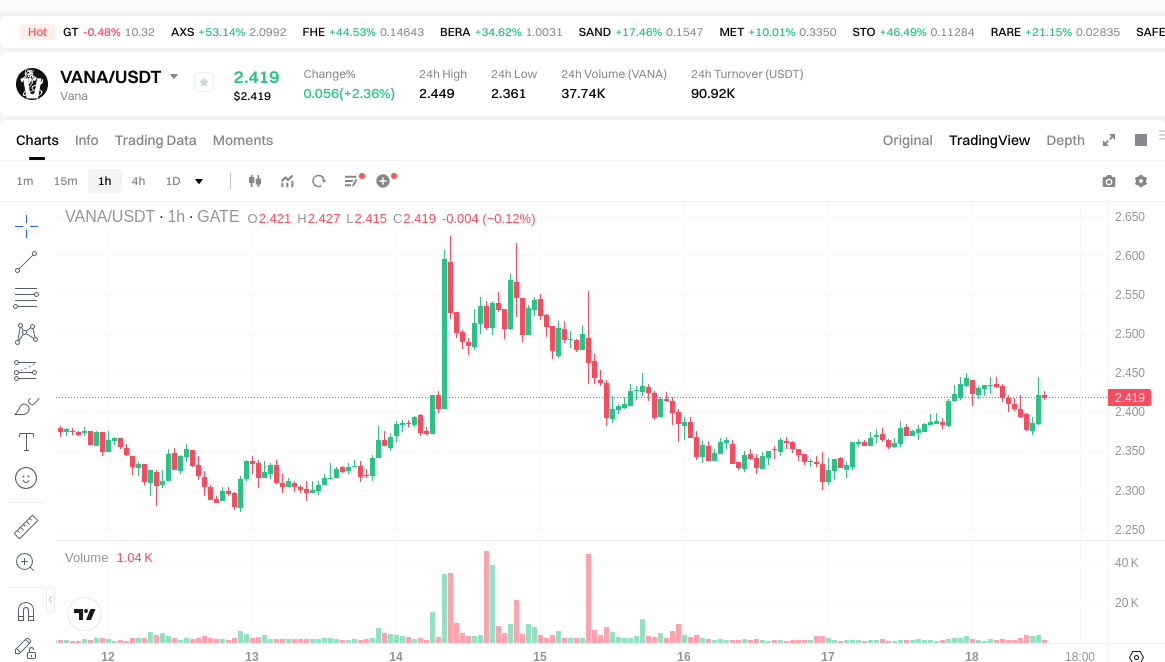
Current VANA Investment Market Status (January 2026)
- VANA current price: $2.418 USD
- Market capitalization: $74.47 million USD
- 24-hour trading volume: $90,369.85 USD
- Circulating supply: 30.8 million VANA (representing 25.67% of maximum supply)
- Market ranking: #430 among digital assets
Click to view real-time VANA market price
II. Core Factors Influencing Whether VANA is a Good Investment (Is Vana(VANA) a Good Investment)
Supply Mechanism and Scarcity (VANA investment scarcity)
- Supply structure: Vana has a maximum supply of 120,000,000 tokens, with a current circulating supply of 30,800,000 tokens, representing a circulation ratio of approximately 25.67%
- Tokenomics design: The defined maximum supply cap may contribute to potential scarcity dynamics as adoption increases
- Investment significance: The predetermined supply ceiling could serve as a fundamental factor for evaluating long-term investment value, though market performance depends on multiple variables
Institutional Investment and Mainstream Adoption (Institutional investment in VANA)
- Exchange presence: VANA is currently listed on 17 exchanges, indicating a certain level of market accessibility
- Data ownership model: The project's focus on transforming personal data into tradable financial assets through Data DAOs represents an approach to bridging Web2 and Web3 ecosystems
- Policy considerations: The regulatory landscape surrounding data ownership and AI-related blockchain projects may influence investment dynamics
Macroeconomic Environment Impact on VANA Investment
- Market positioning: As an EVM-compatible Layer 1 blockchain focused on data monetization, VANA's performance may be influenced by broader trends in blockchain adoption and data economy development
- Economic conditions: General cryptocurrency market sentiment, monetary policy shifts, and risk appetite in digital assets could affect investment appeal
- Innovation sector exposure: The project's intersection with AI economy and data privacy themes may respond to technological and regulatory developments in these domains
Technology and Ecosystem Development (Technology & Ecosystem for VANA investment)
- Technical infrastructure: Vana operates as an EVM-compatible Layer 1 blockchain, utilizing Data Liquidity Pools (DLPs) for data aggregation and validation
- Proof mechanisms: The implementation of Proof-of-Contribution and Data DAOs represents the project's technical approach to data monetization
- Ecosystem positioning: The focus on creating a data token asset class and enabling AI model training while maintaining data privacy represents the project's value proposition
- Application scope: The platform's approach to connecting personal data ownership with blockchain infrastructure may influence long-term utility and adoption potential
III. VANA Future Investment Forecast and Price Outlook (Is Vana(VANA) worth investing in 2026-2031)
Short-term Investment Forecast (2026, short-term VANA investment outlook)
- Conservative forecast: $2.10 - $2.42
- Neutral forecast: $2.42 - $2.65
- Optimistic forecast: $2.65 - $2.90
Mid-term Investment Outlook (2027-2029, mid-term Vana(VANA) investment forecast)
-
Market stage expectation: Based on available data, VANA may experience gradual growth through the mid-term period, with projected average prices ranging from approximately $2.66 in 2027 to $3.48 in 2029. This period may reflect ecosystem maturation and increased adoption of Data Liquidity Pools.
-
Investment return forecast:
- 2027: $1.57 - $3.53
- 2028: $1.83 - $3.87
- 2029: $3.27 - $3.86
-
Key catalysts: Adoption rate and partnerships, technical development of blockchain infrastructure, and the ability to attract data contributors and validators through Data DAOs and Proof-of-Contribution mechanisms.
Long-term Investment Outlook (Is VANA a good long-term investment?)
- Base scenario: $2.72 - $4.11 (corresponding to steady progress and gradual mainstream application enhancement)
- Optimistic scenario: $4.11 - $5.80 (corresponding to large-scale adoption and favorable market conditions)
- Transformative scenario: Above $5.80 (corresponding to breakthrough progress in ecosystem development and mainstream popularization)
Click to view VANA long-term investment and price forecast: Price Prediction
2026-01-18 to 2031 Long-term Outlook
- Base scenario: $2.72 - $4.11 (corresponding to steady progress and gradual mainstream application enhancement)
- Optimistic scenario: $4.11 - $5.80 (corresponding to large-scale adoption and favorable market conditions)
- Transformative scenario: Above $5.80 (if the ecosystem achieves breakthrough progress and mainstream popularization)
- 2031-12-31 projected high: $5.80 (based on optimistic development assumptions)
Disclaimer: The forecasts provided are based on statistical models and historical data analysis. Actual results may vary significantly due to broader market conditions, regulatory changes, technological developments, and various other factors. These projections should not be construed as investment advice, and potential investors should conduct their own research and consult with financial advisors before making investment decisions.
| Year |
Predicted High Price |
Predicted Average Price |
Predicted Low Price |
Price Change |
| 2026 |
2.898 |
2.415 |
2.10105 |
0 |
| 2027 |
3.533145 |
2.6565 |
1.567335 |
9 |
| 2028 |
3.868528125 |
3.0948225 |
1.825945275 |
27 |
| 2029 |
3.864659596875 |
3.4816753125 |
3.27277479375 |
43 |
| 2030 |
4.5547276438125 |
3.6731674546875 |
3.30585070921875 |
51 |
| 2031 |
5.8006660444425 |
4.11394754925 |
2.715205382505 |
69 |
IV. Vana Investment Strategy and Risk Management (How to invest in Cryptocurrency)
Investment Methodology (Vana investment strategy)
Long-term Holding (HODL Vana)
For conservative investors seeking stable exposure to data ownership and AI economy sectors, a long-term holding strategy may be considered. This approach involves acquiring VANA tokens and maintaining positions through market cycles, with the expectation that the project's fundamental development in data monetization and blockchain infrastructure could potentially drive value over extended periods. Investors following this methodology typically focus on the project's technological milestones, ecosystem growth, and adoption rates rather than short-term price movements.
Active Trading
Active trading strategies rely on technical analysis and momentum-based operations. Given VANA's 24-hour price change of 2.5% and 7-day change of 2.23%, traders may identify short-term opportunities through chart patterns, volume analysis, and market sentiment indicators. This approach requires continuous market monitoring and understanding of technical indicators such as support levels around $2.359 and resistance near $2.449 based on recent 24-hour ranges.
Risk Management (Risk management for Vana investment)
Asset Allocation Ratios
- Conservative Investors: May consider allocating 1-3% of their cryptocurrency portfolio to VANA, maintaining majority holdings in established assets
- Aggressive Investors: Could allocate 5-10% to VANA as part of a diversified altcoin strategy, balancing potential growth with established cryptocurrencies
- Professional Investors: May implement dynamic allocation strategies ranging from 3-15% based on market conditions, technical indicators, and fundamental developments
Risk Hedging Solutions
Implementing a multi-asset portfolio approach can help mitigate concentration risk. This may include:
- Diversification across different blockchain sectors (Layer 1, DeFi, AI-focused projects)
- Maintaining stablecoin reserves for opportunistic purchasing during market corrections
- Considering correlation analysis with broader cryptocurrency market movements
Secure Storage
- Cold Wallet Storage: Hardware wallets such as Ledger or Trezor are recommended for long-term holdings, providing offline security against online threats
- Hot Wallet Management: For active trading, reputable exchange wallets or software wallets with multi-signature features can be utilized, though only amounts needed for immediate trading should be kept in hot storage
- Custody Solutions: Institutional investors may consider qualified custodial services that provide insurance and regulatory compliance
V. Vana Investment Risks and Challenges (Risks of investing in Cryptocurrency)
Market Risks
High Volatility: VANA has demonstrated significant price fluctuations, with a 1-year change of -80.64% from its historical high of $35.703 to the current price of $2.418. The token reached an all-time low of $1.174 on October 10, 2025. This volatility pattern indicates substantial downside risk and the potential for rapid price movements in either direction.
Price Manipulation Concerns: With a 24-hour trading volume of $90,369.85 and market capitalization of $74.47 million, the token's relatively limited liquidity compared to major cryptocurrencies may present susceptibility to significant price movements from large trades.
Regulatory Risks
Policy Uncertainty: The regulatory landscape for data tokenization and AI-related blockchain projects remains unclear across different jurisdictions. As Vana operates at the intersection of personal data monetization and blockchain technology, evolving data privacy regulations and cryptocurrency policies could impact the project's operational framework.
Compliance Requirements: Different countries maintain varying approaches to cryptocurrency regulation, which could affect VANA's accessibility, trading venues, and legal status in specific markets. Investors should remain aware of their local regulatory requirements regarding cryptocurrency holdings and transactions.
Technical Risks
Network Security: As an EVM-compatible Layer 1 blockchain, Vana faces potential security challenges including smart contract vulnerabilities, consensus mechanism attacks, and network infrastructure weaknesses. Any security breach could negatively impact token value and user confidence.
Upgrade Failures: Blockchain upgrades and protocol modifications carry inherent technical risks. Failed implementations or unforeseen bugs during network upgrades could temporarily or permanently affect network functionality, potentially leading to service disruptions or security vulnerabilities.
Data Privacy Mechanisms: Given Vana's focus on personal data monetization through Data Liquidity Pools (DLPs) and Data DAOs, the effectiveness and security of its privacy-preserving mechanisms are critical. Technical challenges in maintaining data privacy while enabling AI model training could pose operational risks.
VI. Conclusion: Is Cryptocurrency a Good Investment?
Investment Value Summary
Vana presents a distinctive value proposition in the data ownership and AI economy sector, with its EVM-compatible Layer 1 infrastructure and innovative approach to personal data monetization. However, the token has experienced significant price volatility, declining 80.64% over the past year from its all-time high. The project's long-term potential may be influenced by factors including adoption of Data DAOs, development of the Data Liquidity Pool ecosystem, and broader market acceptance of data tokenization concepts. Short-term price movements have shown considerable fluctuation, as evidenced by the 24-hour range between $2.359 and $2.449.
Investor Recommendations
✅ Beginners: Consider implementing a dollar-cost averaging strategy to mitigate timing risk, combined with secure storage in hardware wallets. Focus on understanding the project's fundamentals and data ownership concepts before committing significant capital.
✅ Experienced Investors: May explore swing trading opportunities based on technical analysis while maintaining a core position for medium-term holds. Portfolio allocation should account for VANA's volatility profile and correlation with broader cryptocurrency markets.
✅ Institutional Investors: Could evaluate strategic long-term allocation as part of a diversified blockchain infrastructure portfolio, with particular attention to the project's development roadmap in data tokenization and AI economy sectors.
⚠️ Disclaimer: Cryptocurrency investment carries substantial risk, including the possibility of complete loss of invested capital. This content is provided for informational purposes only and does not constitute investment advice, financial advice, trading advice, or any other type of advice. Readers should conduct their own research and consult with qualified financial advisors before making investment decisions.
VII. FAQ
Q1: What is Vana (VANA) and what makes it different from other blockchain projects?
Vana is an EVM-compatible Layer 1 blockchain launched in December 2024 that focuses on transforming personal data into tradable financial assets. What distinguishes VANA from other blockchain projects is its specialized infrastructure for data monetization through Data DAOs (Decentralized Autonomous Organizations) and Data Liquidity Pools (DLPs). The platform implements innovative mechanisms including Proof-of-Contribution, enabling users to maintain ownership and privacy of their personal data while allowing it to be used for AI model training. Unlike traditional blockchains that primarily focus on financial transactions or smart contracts, Vana positions itself at the intersection of data ownership, privacy preservation, and the AI economy, creating a unique value proposition in the Web3 ecosystem.
Q2: How has VANA's price performed since its launch?
Since its Token Generation Event (TGE) in December 2024, VANA has experienced significant price volatility. The token reached an all-time high of $35.703 but has since declined 80.64% to its current price of $2.418 as of January 18, 2026. The token hit an all-time low of $1.174 on October 10, 2025. Currently, VANA shows modest short-term gains with a 24-hour increase of 2.5% and a 7-day change of 2.23%. This substantial price correction from its peak reflects the post-launch market adjustment phase common to new token launches, as well as broader market conditions affecting the cryptocurrency sector. The token's trading volume of $90,369.85 over 24 hours and market capitalization of $74.47 million indicate relatively limited liquidity compared to established cryptocurrencies.
Q3: What are the key investment risks associated with VANA?
VANA carries several significant investment risks that potential investors should carefully consider. Market risks include extreme price volatility, as evidenced by the 80.64% decline from its all-time high, and potential manipulation concerns due to relatively limited trading volume of $90,369.85 daily. Regulatory risks stem from policy uncertainty surrounding data tokenization and evolving data privacy laws across different jurisdictions, which could impact the project's operational framework. Technical risks include potential smart contract vulnerabilities, network security challenges inherent to Layer 1 blockchains, and the critical need to maintain effective privacy-preserving mechanisms while enabling data utilization for AI training. Additionally, with only 25.67% of tokens currently in circulation (30.8 million out of 120 million maximum supply), future token unlocks could create selling pressure that affects price stability.
Q4: What is the price forecast for VANA in the short and long term?
Short-term forecasts for 2026 suggest VANA may trade within a range of $2.10 to $2.90, depending on market conditions and adoption rates. The conservative estimate places the price between $2.10-$2.42, while optimistic scenarios project up to $2.90. For the mid-term period (2027-2029), projections indicate gradual growth with average prices potentially ranging from approximately $2.66 in 2027 to $3.48 in 2029, reflecting possible ecosystem maturation and increased adoption of Data Liquidity Pools. Long-term projections through 2031 present three scenarios: a base case of $2.72-$4.11 assuming steady progress, an optimistic scenario of $4.11-$5.80 with large-scale adoption, and a transformative scenario above $5.80 if breakthrough ecosystem development occurs. However, these forecasts are based on statistical models and historical data analysis, and actual results may vary significantly due to market conditions, regulatory changes, technological developments, and numerous other factors.
Q5: What investment strategy is most suitable for VANA?
The appropriate investment strategy for VANA depends on individual risk tolerance, investment goals, and experience level. For long-term holders (HODL strategy), conservative investors might consider allocating 1-3% of their cryptocurrency portfolio to VANA, focusing on the project's technological milestones and ecosystem growth rather than short-term price movements. This approach suits those seeking stable exposure to the data ownership and AI economy sectors. Active traders may pursue momentum-based strategies leveraging technical analysis, given VANA's recent price movements showing support around $2.359 and resistance near $2.449. For this approach, aggressive investors could allocate 5-10% as part of a diversified altcoin strategy. Beginners should consider dollar-cost averaging to mitigate timing risk, while experienced investors might explore swing trading opportunities alongside core position holdings. Regardless of strategy, proper risk management including secure storage in hardware wallets for long-term holdings and diversification across different blockchain sectors is essential.
Q6: How does VANA's tokenomics affect its investment potential?
VANA's tokenomics structure presents both opportunities and considerations for investors. The project has a maximum supply cap of 120 million tokens, with only 30.8 million tokens currently in circulation, representing a circulation ratio of 25.67%. This defined supply ceiling could contribute to potential scarcity dynamics as adoption increases, serving as a fundamental factor for long-term value evaluation. However, the low circulation percentage also means that approximately 74.33% of tokens (89.2 million VANA) remain to be released, which could create significant selling pressure in the future depending on the unlock schedule. The predetermined maximum supply distinguishes VANA from inflationary token models, potentially supporting long-term value preservation. With a current market capitalization of $74.47 million and ranking #430 among digital assets, VANA's fully diluted valuation would be approximately $290 million at current prices, indicating substantial room for either growth or dilution depending on how future token releases are managed and absorbed by market demand.
Q7: Is VANA suitable for institutional investors?
For institutional investors, VANA presents both opportunities and challenges that require careful evaluation. The project's focus on data monetization and AI economy positions it in a growing sector with potential long-term relevance, particularly as data ownership and privacy concerns gain prominence. VANA's presence on 17 exchanges provides a certain level of market accessibility, though the 24-hour trading volume of $90,369.85 suggests limited liquidity that may pose challenges for larger institutional positions. Institutional investors might consider VANA as part of a diversified blockchain infrastructure portfolio, with strategic long-term allocation focusing on the project's development roadmap in data tokenization. However, several factors warrant caution: the significant price volatility (80.64% decline from all-time high), regulatory uncertainty surrounding data tokenization projects, and the relatively early stage of the project's development. Institutional investors should implement proper custody solutions, conduct thorough due diligence on the project's technical architecture and governance model, and maintain position sizes appropriate to the token's liquidity profile and risk characteristics. Professional investors may consider dynamic allocation strategies ranging from 3-15% based on ongoing assessment of market conditions and fundamental developments.
Q8: What factors could drive VANA's price growth in the future?
Several key factors could potentially influence VANA's price trajectory moving forward. Ecosystem adoption represents a primary catalyst, particularly the successful implementation and user adoption of Data DAOs and Data Liquidity Pools (DLPs), which form the core of VANA's value proposition. Increased participation from data contributors and validators through Proof-of-Contribution mechanisms could drive organic demand for the token. Technological developments, including successful network upgrades, enhanced privacy-preserving mechanisms, and seamless integration with AI model training applications, may strengthen the project's competitive position. Strategic partnerships with data providers, AI companies, or major Web2 platforms could accelerate mainstream adoption and expand the ecosystem. Broader market trends favoring data ownership solutions and AI-related blockchain projects may create favorable sentiment. Additionally, the project's ability to navigate regulatory landscapes successfully and demonstrate effective data monetization use cases could build confidence among investors and users. However, these potential catalysts must be balanced against execution risks, competitive pressures from other data-focused blockchain projects, and the overall cryptocurrency market conditions that influence investor risk appetite.
* The information is not intended to be and does not constitute financial advice or any other recommendation of any sort offered or endorsed by Gate.