This comprehensive analysis examines whether VaraNetwork (VARA) represents a viable investment opportunity in 2026 and beyond. VARA, launched in September 2023, is a Layer-1 blockchain platform utilizing Actor Model and Persistent Memory architecture for decentralized application development. Currently trading at $0.0012131 with a market cap of $5.89 million, VARA has experienced significant price volatility and an approximate 92.83% year-over-year decline. The article evaluates VARA's investment potential through multiple dimensions: technological differentiation, market position ranking 1451, supply dynamics with 48.58% circulating tokens, and price projections ranging from $0.000716 to $0.002541 through 2031. Key investment strategies include long-term holding for conservative investors and active trading for experienced traders. Critical risks encompass extreme price volatility, limited liquidity across only 2 exchanges, regulatory uncertainties, and technical execution risks. The analysis provides tailor
Introduction: VaraNetwork (VARA) Investment Position and Market Outlook
VARA is a notable asset in the cryptocurrency sector, launched in September 2023 with a focus on Web3 decentralized application development. As of January 28, 2026, VaraNetwork holds a market capitalization of approximately $5.89 million, with a circulating supply of around 4.86 billion tokens, and the current price is maintained at approximately $0.0012131. Positioned as a platform leveraging the Actor Model and Persistent Memory architecture for building next-generation dApps, VARA has gradually become a focal point when investors discuss "Is VaraNetwork (VARA) a good investment?" This article will comprehensively analyze VARA's investment value, historical trends, future price forecasts, and investment risks to provide reference for investors.
VaraNetwork operates at the forefront of Web3 evolution, providing developers with an environment to craft decentralized applications. The platform's architecture integrates the Actor Model, which facilitates secure asynchronous communication through isolated actors, and Persistent Memory technology, allowing each program's complete state to reside in dedicated memory spaces. This combination aims to enhance network efficiency and security while simplifying the development process.
The token has experienced notable price volatility since its launch. Data shows a 24-hour price change of 1.96%, a 7-day decline of 7.9%, and a 30-day increase of 30.36%. Over the past year, however, VARA has declined by 92.83% from its initial valuation. The token is currently available on 2 exchanges, with a 24-hour trading volume of approximately $23,313. With a total supply capped at 10 billion tokens and approximately 48.58% currently in circulation, VARA's fully diluted market cap stands at $12.13 million, representing 0.00038% of the total cryptocurrency market dominance.
I. VaraNetwork (VARA) Price History Review and Current Investment Value
- 2023: VARA launched in September with an initial offering price of $0.25, entering the market during a period of moderate Web3 infrastructure development.
- 2024: On January 17, the token reached a notable price level of $0.2, reflecting early-stage market interest in decentralized application platforms. Throughout the year, price fluctuations occurred as the broader cryptocurrency market experienced volatility.
- 2025: The token underwent significant market adjustment, with prices declining substantially from previous levels. By late December, the price moved toward lower trading ranges, reflecting broader market correction trends affecting Layer-1 blockchain projects.
Current VARA Investment Market Status (January 2026)
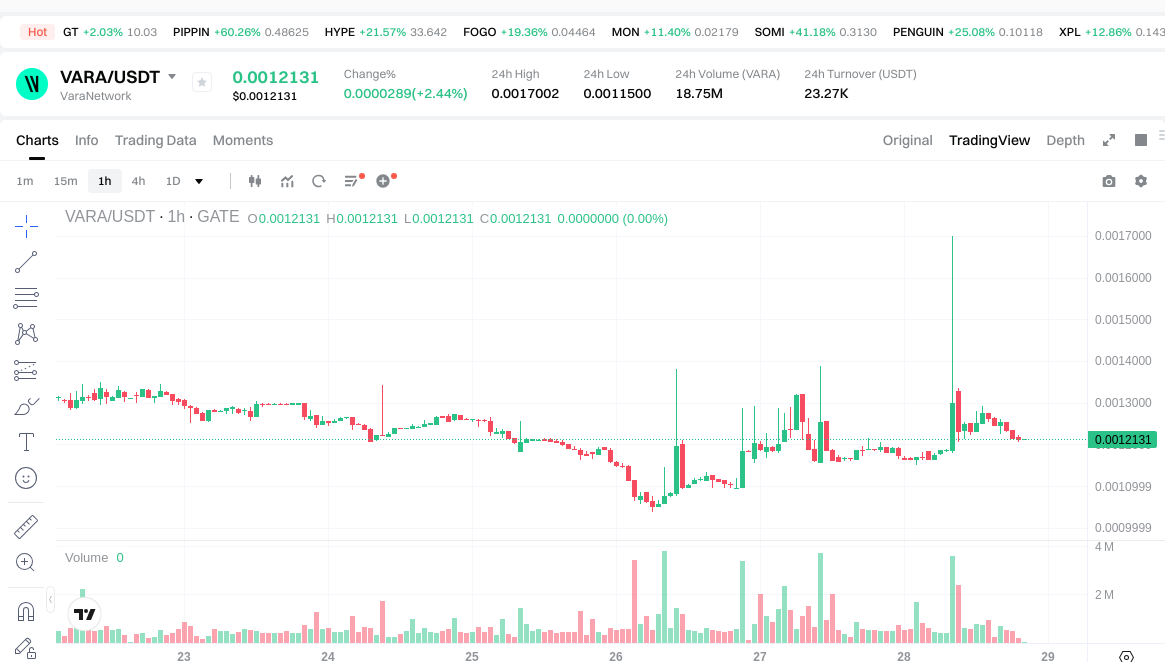
- VARA current price: $0.0012131
- 24-hour trading volume: $23,313.21
- Market capitalization: approximately $5.89 million
- Circulating supply: 4.86 billion VARA (48.58% of maximum supply)
- Available trading venues: 2 exchanges
Click to view real-time VARA market price
II. Core Factors Influencing Whether VARA Is a Good Investment
Supply Mechanism and Scarcity (VARA Investment Scarcity)
- Supply Structure Impact on Value: Vara Network has a maximum supply of 10,000,000,000 VARA tokens, with approximately 4,857,620,577 tokens currently in circulation (48.58% of total supply). This circulating supply ratio indicates that a significant portion of tokens remains locked or unvested, which may influence future price dynamics as additional tokens enter circulation.
- Market Capitalization Considerations: With a current market cap of approximately $5.89 million and a fully diluted market cap of $12.13 million, VARA represents a relatively small-cap cryptocurrency investment. The gap between current and fully diluted valuation suggests potential dilution risk as more tokens are released into circulation.
- Investment Implications: The token's scarcity relative to demand will be a key determinant of investment value. The significant supply overhang may create downward pressure on price as vesting schedules unlock additional tokens, which investors should consider when evaluating long-term holding strategies.
Macroeconomic Environment Impact on VARA Investment
- Market Position and Volatility: VARA currently ranks 1451 in market capitalization with a dominance of 0.00038%, indicating limited market influence. The token has experienced significant volatility, with 24-hour price fluctuations ranging between $0.00115 and $0.0017002, representing approximately a 47.8% intraday range.
- Historical Performance Context: VARA has demonstrated considerable price variability since its launch in September 2023 at $0.25. The token reached a notable price level of $0.2 in January 2024, but subsequently experienced substantial downward movement, with recent trading occurring near $0.001213 as of January 28, 2026.
- Market Sentiment Indicators: Technical analysis suggests VARA entered overbought conditions in January 2026, with RSI14 reaching 79.37. Following a 29.7% price movement, some analytical sources indicate a "Strong Sell" signal based on moving averages and technical indicators, suggesting caution for near-term investment decisions.
Technology and Ecosystem Development (Technology & Ecosystem for VARA Investment)
- Actor Model Architecture: Vara Network employs an Actor Model that facilitates asynchronous communication through isolated "actors," which enhances security by ensuring state isolation and asynchronous messaging. This architectural approach aims to improve network security and efficiency for decentralized application development.
- Persistent Memory Innovation: The platform utilizes Persistent Memory technology, allowing each program's complete state to reside in dedicated memory spaces. This design simplifies the development process and approximates real-world operating system functionality, potentially reducing complexity for developers building on the network.
- Web3 Infrastructure Positioning: Vara Network positions itself as a platform for next-generation decentralized applications (dApps), combining Actor Model and Persistent Memory capabilities. The project's focus on providing a development environment for Web3 applications may contribute to long-term ecosystem value, though adoption metrics and application activity were not detailed in available materials.
- Development Activity: The project maintains active repositories on GitHub under the gear-tech organization, indicating ongoing technical development. However, specific metrics regarding developer engagement, application deployment, or ecosystem growth were not provided in the reference materials.
III. VARA Future Investment Prediction and Price Outlook (Is VaraNetwork(VARA) worth investing in 2026-2031)
Short-term Investment Prediction (2026, short-term VARA investment outlook)
- Conservative prediction: $0.000716 - $0.001194
- Neutral prediction: $0.001213 - $0.001492
- Optimistic prediction: $0.001492 - $0.001771
Mid-term Investment Outlook (2027-2029, mid-term VaraNetwork(VARA) investment forecast)
- Market stage expectation: The token may experience gradual growth as the Actor Model and Persistent Memory architecture continues to evolve within the Web3 ecosystem, potentially attracting developer interest in decentralized application development
- Investment return prediction:
- 2027: $0.001194 - $0.001791
- 2028: $0.001444 - $0.001740
- 2029: $0.001166 - $0.002096
- Key catalysts: Platform adoption by dApp developers, network efficiency improvements, and broader Web3 market sentiment
Long-term Investment Outlook (Is VARA a good long-term investment?)
- Base scenario: $0.001442 - $0.002140 (assuming steady platform development and moderate developer adoption through 2030)
- Optimistic scenario: $0.001815 - $0.002541 (assuming enhanced ecosystem growth and increased mainstream dApp deployment by 2031)
- Risk scenario: $0.000716 - $0.001194 (under conditions of limited adoption or adverse market developments)
Click to view VARA long-term investment and price prediction: Price Prediction
2026-01-28 - 2031 Long-term Outlook
- Base scenario: $0.001442 - $0.002140 (corresponding to steady progress and gradual mainstream application adoption)
- Optimistic scenario: $0.001815 - $0.002541 (corresponding to large-scale adoption and favorable market conditions)
- Transformative scenario: Above $0.002541 (if ecosystem achieves breakthrough progress and mainstream popularization)
- 2031-12-31 predicted high: $0.002541 (based on optimistic development assumptions)
Disclaimer: The above predictions are based on historical data analysis and market trend modeling. Cryptocurrency markets are highly volatile and subject to various unpredictable factors. These predictions should not be considered as investment advice. Investors should conduct thorough research and consider their risk tolerance before making any investment decisions.
| Year |
Predicted High Price |
Predicted Average Price |
Predicted Low Price |
Price Change |
| 2026 |
0.001771126 |
0.0012131 |
0.000715729 |
0 |
| 2027 |
0.0017905356 |
0.001492113 |
0.0011936904 |
23 |
| 2028 |
0.001739803758 |
0.0016413243 |
0.001444365384 |
35 |
| 2029 |
0.00209629939596 |
0.001690564029 |
0.00116648918001 |
39 |
| 2030 |
0.002139577835102 |
0.00189343171248 |
0.001741957175481 |
56 |
| 2031 |
0.002540796014976 |
0.002016504773791 |
0.001814854296412 |
66 |
IV. VARA Investment Strategy and Risk Management (How to invest in Layer-1 blockchain tokens)
Investment Methodology (VARA investment strategy)
Long-term Holding (HODL VARA): Suitable for conservative investors
This approach involves acquiring VARA tokens and holding them for an extended period, betting on the long-term development potential of the Vara Network ecosystem. Investors following this strategy typically focus on the project's technological fundamentals, team background, and ecosystem expansion trajectory. Given VARA's current market cap ranking around 1451 and circulating supply of approximately 4.86 billion tokens (48.58% of total supply), long-term holders should consider the gradual token release schedule and its potential impact on market dynamics.
Active Trading: Relying on technical analysis and swing trading
For traders with higher risk tolerance, active trading strategies can leverage VARA's price volatility. Based on recent data, VARA has demonstrated significant price movements, with 24-hour price changes around 1.96% and 30-day fluctuations reaching 30.36%. Technical traders can utilize support and resistance levels derived from the 24-hour range ($0.00115-$0.0017002) to identify entry and exit points. However, the relatively modest 24-hour trading volume of approximately $23,313 suggests limited liquidity, which may impact execution during volatile periods.
Risk Management (Risk management for VARA investment)
Asset Allocation Ratios: Conservative / Aggressive / Professional investors
- Conservative approach: Allocate 1-3% of crypto portfolio to VARA, prioritizing established assets like Bitcoin and Ethereum for the majority
- Aggressive approach: Position VARA as 5-10% of a diversified altcoin portfolio, balancing with other Layer-1 platforms
- Professional approach: May consider larger positions (10-15%) with active hedging strategies and rigorous monitoring protocols
Risk Hedging Solutions: Multi-asset portfolio + hedging instruments
Investors can mitigate VARA-specific risks through portfolio diversification across different blockchain ecosystems and asset classes. Given VARA's year-over-year decline of approximately 92.83% from previous levels, hedging strategies such as stablecoin reserves, systematic profit-taking at predetermined levels, and position sizing based on volatility metrics become essential risk management tools.
Secure Storage: Hot/cold wallets + hardware wallet recommendations
VARA tokens should be stored using industry-standard security practices:
- Hardware wallets (Ledger, Trezor) for long-term holdings and significant amounts
- Cold storage solutions for maximum security isolation from online threats
- Hot wallets only for active trading amounts, with routine security audits
- Multi-signature setups for institutional holdings requiring enhanced security protocols
V. VARA Investment Risks and Challenges (Risks of investing in Layer-1 blockchain tokens)
Market Risk: High volatility and potential price manipulation
VARA exhibits substantial price volatility, as evidenced by its 7-day decline of approximately 7.9% and 30-day increase of around 30.36%. The token's market dominance of approximately 0.00038% indicates limited market depth, which can amplify price swings during periods of concentrated buying or selling pressure. The relatively low exchange listing count (2 exchanges) and modest daily trading volume suggest potential vulnerability to large order impacts and reduced liquidity during market stress.
Regulatory Risk: Policy uncertainty across different jurisdictions
As a Layer-1 blockchain project, Vara Network faces evolving regulatory frameworks governing decentralized networks, token classifications, and cross-border transactions. Different jurisdictions may implement varying approaches to blockchain regulation, potentially affecting VARA's trading availability, compliance requirements, and operational constraints. Investors should monitor regulatory developments in key markets and assess their potential impact on VARA's accessibility and utility.
Technical Risk: Network security vulnerabilities and upgrade failures
Vara Network's architecture incorporates the Actor Model and Persistent Memory technologies, which while innovative, require ongoing development and maintenance. Potential technical risks include:
- Smart contract vulnerabilities that could compromise network security
- Network upgrade failures during protocol transitions
- Consensus mechanism challenges that may affect transaction finality
- Competition risks from established Layer-1 platforms with larger ecosystems
- Development execution risks related to roadmap delivery and ecosystem growth
VI. Conclusion: Is Layer-1 blockchain token a Good Investment?
Investment Value Summary: VARA presents potential long-term opportunities tied to the Vara Network's technological approach and ecosystem development, but faces significant short-term price volatility and market challenges.
The project's integration of Actor Model and Persistent Memory represents a differentiated technical approach in the competitive Layer-1 landscape. However, investors should carefully consider the substantial drawdown from previous price levels, limited exchange presence, modest trading volumes, and early-stage ecosystem development when evaluating investment potential.
Investor Recommendations:
✅ Beginners: Dollar-cost averaging (DCA) approach + secure wallet storage
- Start with minimal position sizes
- Implement systematic purchasing schedules
- Prioritize security education and wallet setup
- Avoid leveraged positions
✅ Experienced Investors: Swing trading + portfolio allocation
- Utilize technical analysis for entry/exit timing
- Maintain VARA as part of diversified altcoin exposure
- Implement stop-loss disciplines
- Monitor ecosystem developments and network metrics
✅ Institutional Investors: Strategic long-term allocation
- Conduct comprehensive due diligence on technology and team
- Assess competitive positioning within Layer-1 landscape
- Implement institutional-grade custody solutions
- Establish clear risk parameters and rebalancing protocols
⚠️ Disclaimer: Cryptocurrency investments carry substantial risks including potential complete loss of capital. This content is provided for informational purposes only and does not constitute investment advice, financial guidance, or trading recommendations. Investors should conduct independent research and consult qualified financial advisors before making investment decisions.
VII. FAQ
Q1: Is VaraNetwork (VARA) a good investment for beginners in 2026?
For beginners, VARA represents a high-risk, speculative investment that requires careful consideration. The token has experienced a 92.83% decline from its initial valuation and currently maintains a modest market capitalization of approximately $5.89 million with limited exchange presence (only 2 exchanges). Beginners should approach VARA with extreme caution, allocating no more than 1-3% of their cryptocurrency portfolio, and implementing a dollar-cost averaging (DCA) strategy to mitigate timing risks. The platform's Actor Model and Persistent Memory architecture offer technological innovation, but the early-stage ecosystem development and significant price volatility make it unsuitable as a primary holding for inexperienced investors.
Q2: What is the predicted price range for VARA by the end of 2026?
Based on current market analysis, VARA price predictions for 2026 vary across three scenarios: conservative predictions range from $0.000716 to $0.001194, neutral predictions suggest $0.001213 to $0.001492, and optimistic predictions extend from $0.001492 to $0.001771. The predicted high for 2026 is approximately $0.001771, representing potential growth from current levels. These predictions assume continued platform development, gradual developer adoption, and stable broader cryptocurrency market conditions. However, investors should note that cryptocurrency markets are highly volatile, and actual prices may deviate significantly from these projections based on market sentiment, regulatory developments, and ecosystem adoption rates.
Q3: What are the main risks of investing in VARA tokens?
VARA investment carries three primary risk categories: Market Risk includes extreme price volatility (92.83% year-over-year decline), limited liquidity with only $23,313 in 24-hour trading volume, and potential price manipulation due to low market dominance (0.00038%). Regulatory Risk encompasses evolving blockchain regulations across jurisdictions, potential trading restrictions, and compliance uncertainties affecting token accessibility. Technical Risk involves network security vulnerabilities inherent in the Actor Model architecture, potential smart contract exploits, upgrade failure possibilities, and intense competition from established Layer-1 platforms with larger ecosystems. Additionally, the significant supply overhang (only 48.58% of tokens currently circulating) creates potential dilution risk as vesting schedules unlock additional tokens.
Q4: How does VARA's technology differentiate it from other Layer-1 blockchain platforms?
VARA distinguishes itself through two core technological innovations: the Actor Model architecture and Persistent Memory technology. The Actor Model facilitates asynchronous communication through isolated "actors," enhancing security by ensuring state isolation and asynchronous messaging between components. This approach differs from traditional blockchain architectures by preventing direct state interference between processes. Persistent Memory technology allows each program's complete state to reside in dedicated memory spaces, simplifying the development process and approximating real-world operating system functionality. This combination aims to reduce development complexity for Web3 decentralized applications while improving network efficiency and security. However, these technological advantages must be balanced against the platform's early-stage ecosystem development and competition from established Layer-1 networks.
Q5: What investment strategy is most suitable for VARA tokens?
The optimal VARA investment strategy depends on investor risk tolerance and experience level. Long-term holding (HODL) suits conservative investors willing to bet on the project's technological fundamentals and ecosystem expansion, allocating 1-3% of their crypto portfolio with secure cold storage solutions. Active trading appeals to experienced traders with higher risk tolerance who can leverage technical analysis to capitalize on VARA's significant price volatility (30-day fluctuations around 30.36%), utilizing support and resistance levels within the $0.00115-$0.0017002 range. Professional investors may consider strategic long-term allocation (10-15%) with active hedging strategies, institutional-grade custody, and comprehensive due diligence on technology positioning. Regardless of strategy, investors should implement rigorous risk management including portfolio diversification, systematic profit-taking protocols, and position sizing based on volatility metrics.
Q6: What factors could drive VARA's price growth in the next 3-5 years?
Several key catalysts could potentially drive VARA price appreciation through 2031: Ecosystem Development includes increased developer adoption of the Actor Model and Persistent Memory architecture, successful deployment of decentralized applications on the network, and expansion of use cases demonstrating platform utility. Technical Milestones encompass successful network upgrades, enhanced security implementations, and scalability improvements that attract larger projects. Market Factors include broader Web3 market growth, increased institutional interest in alternative Layer-1 platforms, and potential additional exchange listings improving liquidity. According to projections, under optimistic scenarios, VARA could reach $0.002541 by 2031, representing approximately 66% growth from current levels. However, these catalysts remain dependent on successful execution, competitive positioning, and favorable macroeconomic conditions.
Q7: Should investors be concerned about VARA's low trading volume and limited exchange listings?
Yes, VARA's limited liquidity presents significant concerns for investors. The current 24-hour trading volume of approximately $23,313 and presence on only 2 exchanges create several challenges: reduced price discovery efficiency, increased slippage on larger orders, heightened vulnerability to market manipulation, and potential difficulties executing exit strategies during volatile periods. This limited market depth means that even moderately sized buy or sell orders can significantly impact prices, creating unfavorable execution conditions. For institutional investors or those planning larger position sizes, these liquidity constraints represent a material risk factor. Investors should closely monitor potential exchange listing announcements and trading volume trends as key indicators of improving market accessibility and reduced execution risks before committing substantial capital.
Q8: How does VARA's token supply structure affect its investment potential?
VARA's supply mechanics present both opportunities and risks for investors. With a maximum supply of 10 billion tokens and approximately 4.86 billion currently circulating (48.58%), a significant supply overhang exists that could create downward price pressure as vesting schedules unlock additional tokens. The gap between current market capitalization ($5.89 million) and fully diluted market cap ($12.13 million) indicates potential dilution risk of approximately 106%. This supply structure suggests that token scarcity relative to demand will be a critical determinant of investment value. Investors should request detailed information about vesting schedules, token unlock timelines, and team/investor allocation to assess potential dilution impact. The gradual token release may support price stability if accompanied by corresponding ecosystem growth and demand, but could exert bearish pressure if unlocks occur without sufficient adoption momentum.
* The information is not intended to be and does not constitute financial advice or any other recommendation of any sort offered or endorsed by Gate.