This comprehensive analysis examines whether Vaulta (A), a Web3 banking network currently trading at $0.1774 with a market cap of $277.2 million, represents a viable investment opportunity. The article evaluates Vaulta's price history, institutional adoption potential, and technical infrastructure while addressing core investment considerations across multiple timeframes. Short-term forecasts for 2026 range from $0.163 to $0.253, with mid-to-long-term projections reaching $0.427 by 2031, contingent on ecosystem development and market adoption. The analysis provides risk assessment frameworks, portfolio allocation strategies, and investor recommendations spanning beginners to institutional participants. Key risks including market volatility, regulatory uncertainty, and technical vulnerabilities are thoroughly examined. Accessible through 40 exchanges including Gate, Vaulta presents both growth potential and substantial volatility requiring careful due diligence before investment decisions.
Introduction: Vaulta (A)'s Investment Position and Market Prospects
Vaulta (A) represents a notable digital asset within the cryptocurrency landscape, positioning itself as a Web3 banking network designed to power next-generation financial infrastructure. As of January 15, 2026, Vaulta maintains a market capitalization of approximately $277.2 million, with a circulating supply of 1.56 billion tokens and a current trading price around $0.1774. The asset holds a market ranking of #200 and accounts for 0.010% of the total cryptocurrency market share.
With its emphasis on vault-grade security, instant transaction capabilities, and real-world integration, Vaulta presents itself as a platform facilitating global asset transfers, yield generation, and financial solution development. The token's fully diluted valuation stands at $372.54 million, with approximately 74.41% of the maximum supply of 2.1 billion tokens currently in circulation across 40 exchanges.
Recent price performance shows mixed dynamics: while the asset experienced a decline of 2.2% over the past 24 hours and 77.66% over the annual period, it demonstrated positive momentum with gains of 2.71% over seven days and 7.84% over thirty days. The token reached its price peak at $0.7787 on May 28, 2025, and recorded its low point at $0.1431 on December 19, 2025.
As investors evaluate "Is Vaulta (A) a good investment?", this analysis examines the asset's fundamental characteristics, historical price movements, future price projections, and associated investment considerations. The following sections provide a comprehensive assessment of Vaulta's position within the evolving digital banking and Web3 financial services sector.
I. Vaulta (A) Price History Review and Current Investment Value
Historical Price Trends and Investment Returns
Vaulta (A) began trading in May 2025 and has experienced significant volatility in its short trading history. The token reached a notable price level of $0.778734 in late May 2025, representing the upper boundary of its observed price range during the initial months of trading. However, by December 2025, market conditions shifted substantially, with the price declining to approximately $0.143078, marking a substantial correction from earlier levels.
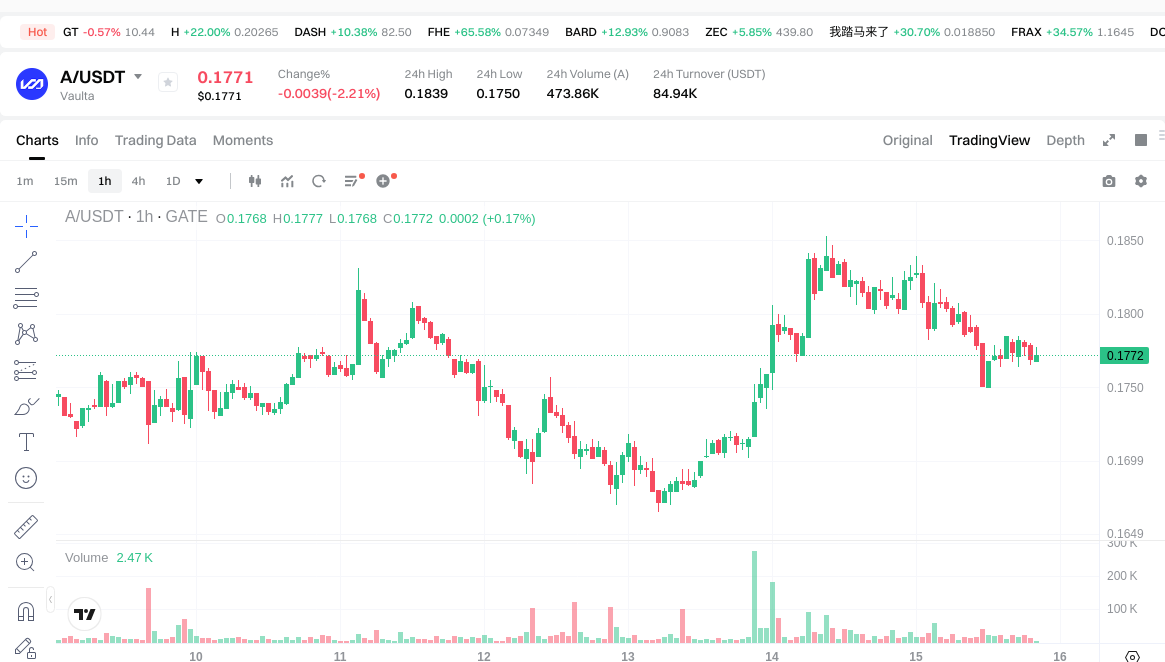
As of January 15, 2026, Vaulta (A) is trading at $0.1774, reflecting a partial recovery from the December 2025 lows but still considerably below the May 2025 peaks. Over the past 24 hours, the token has experienced a modest decline of 2.2%, while the 7-day performance shows a gain of 2.71%. The 30-day trajectory indicates an increase of 7.84%, suggesting some stabilization after the earlier volatility. However, the annual performance remains challenging, with the token down 77.66% from its initial trading levels.
The market has demonstrated considerable fluctuation patterns, with investors experiencing varied outcomes depending on their entry and exit timing. Those who participated during the initial trading period in May 2025 and maintained positions through January 2026 would have faced substantial portfolio value reductions.
Current Investment Market Status (January 2026)
- Current Vaulta (A) Price: $0.1774
- 24-Hour Trading Volume: $86,474.13, indicating moderate liquidity levels
- Circulating Supply: 1,562,570,047 A tokens (74.41% of maximum supply)
- Market Capitalization: $277,199,926.34
- Fully Diluted Valuation: $372,540,000.00
- Market Dominance: 0.010%
- Trading Activity: Listed on 40 exchanges globally
- Recent Price Range: 24-hour high of $0.1839 and low of $0.1750
Click to view real-time Vaulta (A) market price
The current market environment for Vaulta reflects a period of consolidation following earlier volatility. The token's performance across multiple timeframes shows mixed signals, with short-term gains offset by longer-term declines. The relatively modest 24-hour trading volume suggests that market participation remains selective, while the presence on 40 exchanges indicates reasonable accessibility for investors. Market participants should note that the token's circulating supply represents approximately three-quarters of the maximum supply, with the remaining tokens potentially influencing future price dynamics upon release.
II. Core Factors Influencing Whether A is a Good Investment (Is Vaulta(A) a Good Investment)
Supply Mechanism and Scarcity (A Investment Scarcity)
- Supply Structure: Vaulta has a maximum supply of 2.1 billion tokens, with approximately 1.56 billion tokens currently in circulation, representing a circulating ratio of 74.41%. The fixed maximum supply cap may contribute to potential scarcity dynamics over time.
- Supply Impact on Value: Fixed supply mechanisms can support price appreciation if demand increases, though market adoption and utility remain critical determining factors.
- Investment Relevance: The predetermined supply ceiling provides transparency for investors evaluating long-term scarcity potential, though this alone does not guarantee investment returns.
Institutional Investment and Mainstream Adoption (Institutional Investment in Vaulta)
- Partnership Development: Vaulta's rebrand focuses on Web3 banking infrastructure, including partnerships aimed at institutional DeFi adoption. The project emphasizes built-in compliance features such as KYC/AML protocols and enterprise-grade payment tools designed to bridge traditional finance with decentralized systems.
- Bitcoin Integration: Through the exSat platform, Vaulta enables Bitcoin-related yield services, leveraging Bitcoin's liquidity for staking mechanisms. This integration represents an effort to connect with established cryptocurrency infrastructure.
- Adoption Factors: The project's positioning at the intersection of institutional finance and blockchain technology reflects an attempt to address traditional financial requirements while maintaining decentralized architecture.
Macroeconomic Environment Impact on Vaulta Investment
- Market Correlation: General cryptocurrency market conditions directly affect Vaulta's price behavior. The token experienced a 77.66% decline over a one-year period, indicating sensitivity to broader market trends.
- Volatility Context: Short-term price predictions for Vaulta are characterized by volatility dependent on market sentiment, trading volume, and external factors beyond the project's control.
Technology and Ecosystem Development (Technology & Ecosystem for Vaulta Investment)
- Technical Infrastructure: Vaulta retains high-throughput capabilities and low transaction fees while adding Ethereum compatibility, positioning itself as a hybrid platform for compliant decentralized finance applications.
- Banking Network Focus: The project emphasizes vault-level security, instant transaction capabilities, and real-world integration, targeting use cases in global asset transfers, yield generation, and financial solution development.
- Ecosystem Applications: The platform provides tools designed for Web3 banking services, though the practical adoption and utilization of these features remain dependent on market acceptance and regulatory developments.
III. Vaulta (A) Future Investment Forecast and Price Outlook (Is Vaulta (A) worth investing in 2026-2031)
Short-term Investment Forecast (2026, short-term A investment outlook)
Based on current market positioning and technical indicators, Vaulta (A) exhibits moderate volatility characteristics for 2026:
- Conservative forecast: $0.163 - $0.177 (aligned with historical support levels)
- Neutral forecast: $0.177 - $0.220 (reflecting current trading range consolidation)
- Optimistic forecast: $0.220 - $0.253 (contingent on sustained volume expansion and positive sentiment)
The token's current price of $0.1774 positions it within the neutral band, with 24-hour volatility at -2.2% suggesting consolidation rather than directional bias. Key resistance levels emerge near $0.184, while support anchors around $0.175 based on recent trading patterns.
Mid-term Investment Outlook (2027-2029, mid-term Vaulta (A) investment forecast)
Market stage expectations: Transition from early adoption to broader ecosystem maturity phase, contingent on platform development and user acquisition metrics.
Investment return projections:
- 2027: $0.140 - $0.258 (representing 21% average year-over-year growth from 2026 baseline)
- 2028: $0.223 - $0.336 (33% projected growth, subject to macro liquidity conditions)
- 2029: $0.221 - $0.427 (61% potential upside, dependent on sustained adoption trajectories)
Key catalysts: Platform feature rollouts, partnership announcements, regulatory clarity in digital banking sector, and competitive positioning against traditional fintech solutions. Volume expansion and mainnet transaction velocity serve as critical confirmation factors.
Long-term Investment Outlook (Is Vaulta a good long-term investment?)
Benchmark scenario: $0.222 - $0.357 by 2030 (assumes steady ecosystem growth and maintained market share)
Optimistic scenario: $0.357 - $0.428 by 2031 (presumes accelerated adoption, strategic integrations, and favorable regulatory frameworks)
Risk scenario: Below $0.163 (contingent on adverse market conditions, competitive displacement, or systemic crypto market downturns)
For extended price forecasting and analysis: Price Prediction
2026-2031 Extended Outlook
- Base scenario: $0.163 - $0.253 (reflecting steady progress and incremental mainstream adoption)
- Optimistic scenario: $0.286 - $0.428 (aligned with large-scale adoption and favorable market environments)
- Transformative scenario: Above $0.43 (contingent on breakthrough ecosystem developments and mainstream proliferation)
- 2031-12-31 projected high: $0.428 (based on optimistic development assumptions)
Disclaimer: Historical performance does not guarantee future results. Cryptocurrency markets remain highly volatile, with price movements influenced by numerous unpredictable factors including but not limited to technological developments, regulatory changes, macroeconomic conditions, and market sentiment shifts. These projections represent analytical scenarios rather than certainties and should not constitute financial advice. Investors should conduct independent research and consider risk tolerance before making investment decisions.
| Year |
Predicted High Price |
Predicted Average Price |
Predicted Low Price |
Price Change |
| 2026 |
0.253396 |
0.1772 |
0.163024 |
0 |
| 2027 |
0.2583576 |
0.215298 |
0.1399437 |
21 |
| 2028 |
0.336295476 |
0.2368278 |
0.222618132 |
33 |
| 2029 |
0.42697684062 |
0.286561638 |
0.22065246126 |
61 |
| 2030 |
0.3746077012755 |
0.35676923931 |
0.2211969283722 |
101 |
| 2031 |
0.427855510242517 |
0.36568847029275 |
0.259638813907852 |
106 |
IV. Vaulta (A) Investment Strategy and Risk Management (How to invest in cryptocurrency)
Investment Methodology (Vaulta investment strategy)
Long-term Holding (HODL Vaulta)
For conservative investors seeking stability, long-term holding may be an appropriate approach. This strategy involves acquiring Vaulta tokens and maintaining positions through market cycles, potentially benefiting from the project's development trajectory and broader Web3 banking adoption trends.
Active Trading
Active trading strategies rely on technical analysis and swing trading tactics. Traders may monitor price movements within the recent range and utilize chart patterns to identify entry and exit points. Given Vaulta's market characteristics, this approach requires continuous market monitoring and risk assessment.
Risk Management (Risk management for Vaulta investment)
Asset Allocation Ratios
- Conservative investors: Consider allocating 1-3% of total portfolio to Vaulta, maintaining predominant positions in established assets
- Aggressive investors: May allocate 5-10% depending on risk tolerance and market outlook
- Professional investors: Typically employ dynamic allocation models based on technical indicators and market conditions
Risk Hedging Solutions
Implementing multi-asset portfolio strategies can help mitigate concentration risk. Investors may consider:
- Diversification across different cryptocurrency categories
- Combination with stablecoin holdings
- Periodic rebalancing based on market conditions
Secure Storage
- Cold wallets: Hardware wallets such as Ledger or Trezor provide enhanced security for long-term holdings
- Hot wallets: Suitable for active trading amounts, while maintaining majority holdings in cold storage
- Multi-signature solutions: For institutional investors managing significant positions
V. Vaulta (A) Investment Risks and Challenges (Risks of investing in cryptocurrency)
Market Risk
Vaulta exhibits notable price volatility, with the token experiencing significant fluctuations since its launch. The 24-hour trading volume of approximately $86,474 indicates relatively limited liquidity compared to major cryptocurrencies, which may contribute to price volatility and potential slippage during larger transactions.
Regulatory Risk
As a Web3 banking network integrating with real-world financial systems, Vaulta operates in an evolving regulatory landscape. Different jurisdictions maintain varying approaches to cryptocurrency regulation, and potential policy changes could impact the project's operations and token valuation. Investors should monitor regulatory developments in their respective regions.
Technical Risk
While Vaulta emphasizes vault-like security features, all blockchain projects face inherent technical risks including:
- Smart contract vulnerabilities that could be exploited
- Network consensus mechanism challenges
- Integration risks with traditional financial systems
- Potential technical upgrade complications
The project operates on the EOS infrastructure, and any underlying network issues could affect Vaulta's functionality.
VI. Conclusion: Is Cryptocurrency a Good Investment?
Investment Value Summary
Vaulta presents itself as a Web3 banking network aiming to bridge digital and traditional finance. The project's focus on security, instant transactions, and real-world integration addresses specific pain points in the digital banking sector. However, with a market capitalization of approximately $277 million and current circulation of 74.41% of maximum supply, the token demonstrates characteristics of an emerging project with associated opportunities and risks.
The price performance shows substantial volatility, with significant fluctuations over various timeframes. This volatility pattern is common in mid-cap cryptocurrency projects and requires careful consideration.
Investor Recommendations
✅ Beginners: Consider dollar-cost averaging (DCA) strategy with secure wallet storage. Start with small allocations to understand market dynamics before increasing exposure.
✅ Experienced Investors: May employ swing trading strategies combined with portfolio allocation principles. Monitor technical indicators and project development milestones for timing decisions.
✅ Institutional Investors: Conduct comprehensive due diligence on technical infrastructure, team credentials, and regulatory compliance before considering strategic allocation.
⚠️ Important Notice: Cryptocurrency investments carry substantial risk including potential loss of principal. Market volatility, regulatory uncertainty, and technical challenges are inherent to this asset class. This analysis is provided for informational purposes only and does not constitute investment advice. Investors should conduct independent research and consult with qualified financial advisors before making investment decisions.
VII. FAQ
Q1: What is Vaulta (A) and what makes it different from other cryptocurrencies?
Vaulta (A) is a Web3 banking network designed to power next-generation financial infrastructure with vault-grade security and instant transaction capabilities. What distinguishes Vaulta from other cryptocurrencies is its specific focus on bridging traditional finance with decentralized systems through built-in compliance features such as KYC/AML protocols and enterprise-grade payment tools. The platform combines high-throughput capabilities, low transaction fees, and Ethereum compatibility while positioning itself at the intersection of institutional finance and blockchain technology, specifically targeting use cases in global asset transfers, yield generation, and compliant DeFi applications.
Q2: Is Vaulta (A) a good short-term investment for 2026?
Vaulta (A) presents a moderate-volatility opportunity for 2026 with mixed short-term indicators. The token currently trades at $0.1774 with forecasts ranging from a conservative $0.163-$0.177 to an optimistic $0.220-$0.253, contingent on sustained volume expansion and market sentiment. However, short-term investment carries notable risks: the token experienced a 77.66% decline over the past year and maintains relatively limited 24-hour trading volume of approximately $86,474, which may contribute to price volatility. Short-term investors should carefully monitor technical resistance levels near $0.184 and support around $0.175, while being prepared for continued volatility characteristic of mid-cap cryptocurrency projects.
Q3: What are the long-term price predictions for Vaulta (A) through 2031?
Long-term projections for Vaulta (A) through 2031 vary across different scenarios. The base scenario forecasts a range of $0.163-$0.253 reflecting steady ecosystem progress, while optimistic projections suggest $0.286-$0.428 assuming accelerated adoption and favorable market conditions. Specifically, by 2031, the predicted high reaches $0.428 with an average price around $0.366. However, these projections depend on numerous unpredictable factors including technological developments, regulatory changes, competitive positioning, and overall market conditions. A risk scenario suggests prices could fall below $0.163 if adverse conditions emerge. Investors should understand that historical performance does not guarantee future results, and cryptocurrency markets remain highly volatile.
Q4: What are the main risks associated with investing in Vaulta (A)?
Investing in Vaulta (A) carries several significant risks. Market risk is substantial, evidenced by notable price volatility and a 77.66% annual decline, while the relatively limited 24-hour trading volume of $86,474 indicates lower liquidity that may cause price slippage during larger transactions. Regulatory risk exists as Vaulta operates in an evolving legal landscape, with varying jurisdictional approaches potentially impacting operations and token valuation. Technical risks include potential smart contract vulnerabilities, network consensus challenges, integration complications with traditional financial systems, and dependencies on the underlying EOS infrastructure. Additionally, the token's market dominance of only 0.010% suggests competitive pressures from established projects in the Web3 banking and DeFi sectors.
Q5: How should beginners approach investing in Vaulta (A)?
Beginners should approach Vaulta (A) investment with a conservative, methodical strategy. Start with dollar-cost averaging (DCA) to spread entry points across different price levels and reduce timing risk. Allocate only 1-3% of total portfolio to Vaulta, maintaining predominant positions in more established assets to limit exposure. Utilize secure cold wallet storage solutions such as Ledger or Trezor for long-term holdings rather than keeping significant amounts on exchanges. Begin with small allocations to understand market dynamics and the token's volatility patterns before considering increased exposure. Most importantly, conduct independent research, understand that cryptocurrency investments carry substantial risk including potential loss of principal, and never invest more than you can afford to lose.
Q6: What factors could drive Vaulta (A) price appreciation in the future?
Several factors could potentially drive Vaulta (A) price appreciation. Platform development milestones including new feature rollouts and enhanced banking network capabilities could attract user adoption. Strategic partnership announcements, particularly with institutional entities, may increase credibility and usage. Integration with Bitcoin liquidity through the exSat platform for yield services could expand utility. Regulatory clarity in the digital banking and Web3 sectors would reduce uncertainty and potentially attract institutional investment. Sustained growth in mainnet transaction velocity and trading volume expansion across its 40 listed exchanges would indicate increasing adoption. Additionally, successful competitive positioning against traditional fintech solutions and other DeFi platforms, combined with favorable macroeconomic conditions for cryptocurrency markets, could contribute to positive price momentum.
Q7: How does Vaulta's token supply structure impact its investment potential?
Vaulta's token supply structure features a fixed maximum supply of 2.1 billion tokens, with approximately 1.56 billion (74.41%) currently in circulation. This predetermined supply ceiling provides transparency and potential scarcity dynamics that could support price appreciation if demand increases over time. The relatively high circulating ratio of 74.41% means that a significant portion of total supply is already in the market, reducing the immediate impact of future token releases compared to projects with lower circulation percentages. However, the remaining 25.59% of tokens (approximately 537 million) could influence future price dynamics upon release depending on distribution timing and market conditions. While fixed supply mechanisms can theoretically support value appreciation, market adoption, utility development, and demand generation remain the critical determining factors for actual price performance.
Q8: What investment strategy is most appropriate for Vaulta (A) based on current market conditions?
The most appropriate strategy depends on individual risk tolerance and investment objectives. For long-term holders (HODL strategy), maintaining positions through market cycles while focusing on the project's development trajectory and Web3 banking adoption trends may be suitable for conservative investors seeking stability. This approach works best with 1-3% portfolio allocation and secure cold storage. For experienced active traders, swing trading strategies utilizing technical analysis within Vaulta's recent trading range of $0.175-$0.184 may be appropriate, though this requires continuous market monitoring. Given the current market conditions—moderate volatility, limited liquidity, and recent stabilization after significant declines—a hybrid approach combining dollar-cost averaging for accumulation with periodic rebalancing based on technical levels may offer balanced risk-reward exposure while maintaining flexibility to adjust positions as market dynamics evolve.
* The information is not intended to be and does not constitute financial advice or any other recommendation of any sort offered or endorsed by Gate.