Vechain (VET) is an enterprise-grade Layer-1 blockchain platform established in 2015, specializing in supply chain transparency and anti-counterfeiting solutions with partnerships including Walmart, DNV, and Boston Consulting Group. As of January 2026, VET trades at $0.012219 with a market capitalization of $1.05 billion and 85.99 billion tokens in circulation. This comprehensive analysis examines VET's investment viability through multiple dimensions: historical price performance reveals significant volatility from $0.02 (2018) to a peak of $0.281 (2021), currently trading 95.65% below its all-time high. Core investment factors include supply scarcity dynamics, institutional adoption momentum, Renaissance roadmap upgrades enabling Ethereum compatibility and delegated Proof-of-Stake consensus, and regulatory MiCA compliance positioning. Price projections indicate potential appreciation from $0.0123 (2026 average) to $0.026 (2031 average) under baseline conditions, contingent on enterprise adoption acceleratio
Introduction: Vechain (VET)'s Investment Position and Market Outlook
VET represents a notable asset in the cryptocurrency sector. Since its launch in 2017, it has demonstrated meaningful progress in supply chain transparency and anti-counterfeiting applications. As of January 14, 2026, Vechain holds a market capitalization of approximately $1.05 billion, with a circulating supply around 85.99 billion tokens and a current price near $0.012219. With its positioning in enterprise-grade blockchain solutions, VET has become a focal point when investors consider "Is Vechain (VET) a good investment?" This article provides a comprehensive analysis of VET's investment characteristics, historical price movements, future price outlook, and associated risks to serve as a reference for investors.
Founded by Sunny Lu in 2015, VeChain initially focused on blockchain solutions for supply chain management and product authentication. Early enterprise adoption, strategic backing from Fenbushi Capital, and the 2017 token offering established the foundation for the VeChainThor blockchain—an enterprise-focused Layer-1 network. Collaborations with organizations such as DNV, Walmart, and BCG have contributed to validating VeChain's practical applications and expanding its global presence.
As part of its Renaissance strategic upgrade, VeChain is implementing Ethereum-compatible infrastructure, delegated proof-of-stake consensus mechanisms, dynamic VTHO tokenomics, and StarGate NFT staking systems. Combined with MiCA-compliant token architecture and enhanced cross-chain interoperability, VeChain is developing as a blockchain platform where real-world adoption, network utility, and sustainability considerations intersect. The project currently ranks 87th by market capitalization with a dominance of 0.030% and is listed on 41 exchanges, serving over 14.49 million holders.
I. VET Price History Review and Current Investment Value Status
-
2018: VET was initially listed on exchanges at $0.02, marking the beginning of its public trading history. Early investors who participated at this stage experienced significant volatility as the token sought to establish market presence.
-
2021: During the cryptocurrency market bull run, VET experienced substantial upward momentum, with prices moving significantly higher than launch levels. The token benefited from broader market enthusiasm and increased adoption interest, though specific peak performance varied throughout the year.
-
2020-2024: VET underwent considerable price fluctuations reflecting typical cryptocurrency market cycles. The token experienced periods of both expansion and contraction, with notable price variations between different market phases.
Current VET Investment Market Status (January 2026)
- VET Current Price: $0.012219
- 24-Hour Trading Volume: $483.68 million
- Market Capitalization: $1.05 billion
- Circulating Supply: 85.99 billion VET (approximately 99.16% of maximum supply)
- 24-Hour Price Change: +8.02%
- Exchange Listings: Available on 41 cryptocurrency exchanges
Click to view real-time VET market price
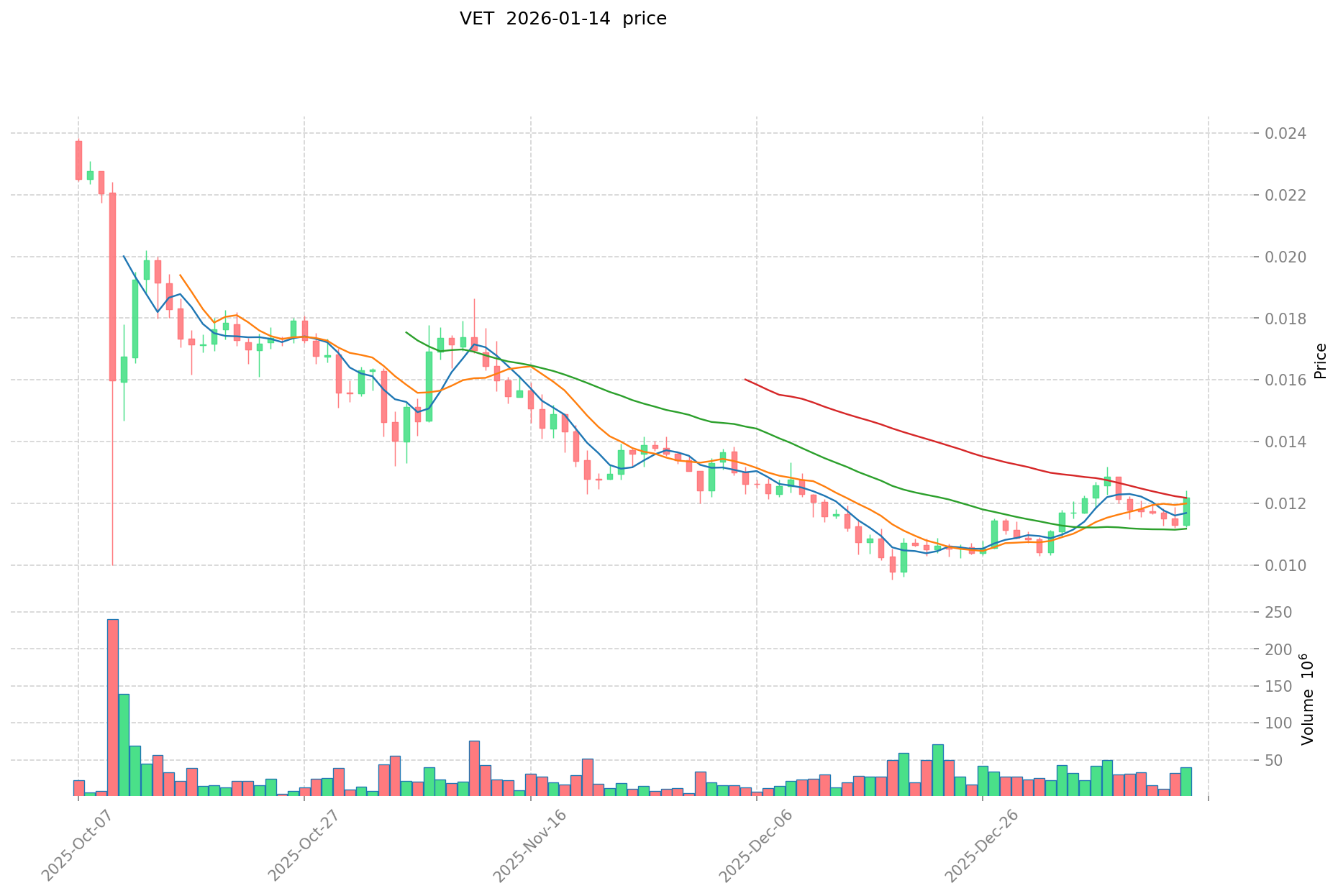
II. Core Factors Influencing Whether VET is a Good Investment
Supply Mechanism and Scarcity (VET Investment Scarcity)
- VET operates with a circulating supply of approximately 85.99 billion tokens and a maximum supply of 86.71 billion tokens, resulting in a circulation ratio of approximately 99.16%
- The limited supply differential between circulating and maximum supply suggests minimal future dilution pressure, which may support price stability
- Investment significance: The near-complete circulation of VET tokens indicates that scarcity-driven price dynamics are largely dependent on demand factors rather than supply expansion
Institutional Investment and Mainstream Adoption (Institutional Investment in VET)
- VeChain has established partnerships with international organizations including DNV, Walmart, and Boston Consulting Group, demonstrating enterprise-level adoption
- Strategic investment from Fenbushi Capital during VeChain's early development provided foundational support for the project's growth
- The project's focus on supply chain transparency and anti-counterfeiting applications positions it for continued enterprise adoption, particularly as businesses seek blockchain-based verification solutions
- Compliance with EU MiCA regulatory standards may enhance institutional confidence and facilitate broader adoption within regulated markets
Macroeconomic Environment's Impact on VET Investment
- As of January 2026, the broader cryptocurrency market has experienced a pullback of approximately 15% from record highs, with VET reflecting similar market-wide volatility
- Interest rate policies and monetary conditions continue to influence risk-on asset classes, including alternative cryptocurrencies like VET
- Market analysts have noted that short-term cryptocurrency performance remains sensitive to liquidity conditions and broader financial market sentiment
- Geopolitical and economic uncertainties may drive periodic fluctuations in alternative cryptocurrency demand, affecting VET's investment profile
Technology and Ecosystem Development (Technology & Ecosystem for VET Investment)
- VeChainThor blockchain operates as an enterprise-grade Layer-1 network designed for efficiency and scalability
- Renaissance roadmap initiatives include Ethereum-compatible infrastructure, delegated Proof-of-Stake (dPoS) consensus mechanism, and dynamic VTHO tokenomics
- StarGate NFT staking system represents an expansion of network utility beyond supply chain applications
- Enhanced cross-chain interoperability capabilities aim to strengthen VeChain's connectivity within the broader blockchain ecosystem
- The project's focus on real-world business applications and regulatory compliance positions it as a platform emphasizing practical utility alongside technological development
III. VET Future Investment Prediction and Price Outlook (Is Vechain(VET) worth investing in 2026-2030)
Short-term Investment Prediction (2026, short-term VET investment outlook)
Based on multiple analytical models, VET's short-term price trajectory in 2026 appears to show a moderate potential range:
- Conservative prediction: 0.0091 - 0.0123 USD
- Neutral prediction: 0.0123 - 0.0148 USD
- Optimistic prediction: 0.0148 - 0.0169 USD
These projections reflect VET's expected average trading price of approximately 0.0123 USD in 2026, representing relatively stable price action in the near term. The range accounts for market volatility and potential fluctuations in enterprise blockchain adoption rates.
Mid-term Investment Outlook (2027-2029, mid-term Vechain(VET) investment forecast)
The mid-term outlook for VET suggests a gradual appreciation trajectory as the VeChainThor ecosystem continues to develop:
- Market stage expectation: Consolidation and selective expansion phase, with increasing enterprise integration driving utility value.
- Investment return prediction:
- 2027: 0.013 - 0.021 USD (estimated average 0.0146 USD)
- 2028: 0.015 - 0.023 USD (estimated average 0.0177 USD)
- 2029: 0.013 - 0.025 USD (estimated average 0.0204 USD)
- Key catalysts: Enhanced Ethereum compatibility infrastructure, expanded dPoS consensus implementation, dynamic VTHO tokenomics evolution, and continued enterprise partnerships in supply chain management sectors.
The mid-term forecast reflects a compound annual growth expectation of approximately 19-66% from 2026 baseline levels, subject to broader market conditions and adoption metrics.
Long-term Investment Outlook (Is VET a good long-term investment?)
Long-term projections for VET through 2030-2031 suggest multiple potential scenarios:
- Baseline scenario: 0.016 - 0.023 USD (assuming steady enterprise adoption and stable market conditions)
- Optimistic scenario: 0.023 - 0.030 USD (assuming accelerated blockchain adoption in supply chain and sustainability sectors)
- Risk scenario: Below 0.016 USD (under conditions of prolonged market downturn or significant competitive pressures)
By 2030, analytical models project VET could reach a high of approximately 0.030 USD under favorable conditions, representing an 87% increase from 2026 baseline predictions. The 2031 forecast suggests a potential average price of 0.026 USD, with a range between 0.016 - 0.029 USD.
Click to view VET long-term investment and price prediction: Price Prediction
2026-2031 Long-term Outlook
- Base scenario: 0.016 - 0.023 USD (corresponding to steady progress and stable mainstream application growth)
- Optimistic scenario: 0.023 - 0.030 USD (corresponding to large-scale adoption and favorable market environment)
- Transformative scenario: Above 0.030 USD (contingent on breakthrough ecosystem developments and mainstream integration)
- 2031-12-31 predicted high: 0.029 USD (based on optimistic development assumptions)
Disclaimer
These price predictions are based on historical data analysis, technical indicators, and market trend assessments. Cryptocurrency markets are highly volatile and subject to numerous unpredictable factors including regulatory changes, technological developments, macroeconomic conditions, and market sentiment shifts. Past performance does not guarantee future results. These projections should not be construed as financial advice or investment recommendations. Investors should conduct their own research and consider their risk tolerance before making any investment decisions.
| Year |
Predicted High Price |
Predicted Average Price |
Predicted Low Price |
Price Change |
| 2026 |
0.01690638 |
0.012251 |
0.00906574 |
0 |
| 2027 |
0.0208475267 |
0.01457869 |
0.0129750341 |
19 |
| 2028 |
0.023027040855 |
0.01771310835 |
0.0147018799305 |
44 |
| 2029 |
0.025462593253125 |
0.0203700746025 |
0.01344424923765 |
66 |
| 2030 |
0.029562070766878 |
0.022916333927812 |
0.020166373856475 |
87 |
| 2031 |
0.029125514605553 |
0.026239202347345 |
0.015743521408407 |
114 |
IV. VET Investment Strategy and Risk Management (How to invest in VET)
Investment Methodology (VET investment strategy)
-
Long-term Holding (HODL VET): This approach may be suitable for investors seeking a more measured approach to digital asset exposure. Given VeChain's enterprise partnerships with organizations such as DNV, Walmart, and Boston Consulting Group, as well as its ongoing Renaissance roadmap development—including Ethereum-compatible infrastructure, delegated Proof-of-Stake consensus, and MiCA-compliant token architecture—some investors view VET as a potential candidate for extended holding periods. However, past partnerships and technical upgrades do not guarantee future performance.
-
Active Trading: Traders who rely on technical analysis and market timing may seek to capitalize on VET's price movements. The token has experienced notable volatility, with a 24-hour change of 8.02% and a 1-year change of -71.72% as of 14 January 2026. Active trading requires continuous monitoring of market conditions, technical indicators, and ecosystem developments.
Risk Management (Risk management for VET investment)
-
Asset Allocation Ratios: Investment exposure to VET should be calibrated according to individual risk tolerance and portfolio objectives. Conservative investors may limit digital asset allocation to a small percentage of their overall portfolio, while those with higher risk tolerance might increase exposure. Professional investors often employ sophisticated portfolio construction techniques, including correlation analysis and rebalancing strategies.
-
Risk Hedging Solutions: Diversification across multiple asset classes and digital assets may help mitigate concentration risk. Some investors consider hedging strategies, though such tools may not be universally available or suitable for all market participants. Portfolio construction should account for the correlation characteristics of different digital assets.
-
Secure Storage: VET can be stored in various wallet solutions. Hot wallets provide convenient access for frequent transactions but maintain constant internet connectivity. Cold storage solutions, including hardware wallets, offer enhanced security by keeping private keys offline. Investors should evaluate the trade-offs between accessibility and security based on their usage patterns and holdings size.
V. VET Investment Risks and Challenges (Risks of investing in VET)
-
Market Risk: VET exhibits considerable price volatility. The token's price of $0.012219 as of 14 January 2026 represents a substantial decline from its historical high of $0.280991 recorded on 19 April 2021. The 24-hour trading volume of approximately $483.68 million indicates active market participation, though liquidity conditions can vary across different market environments. Price movements may be influenced by numerous factors including broader cryptocurrency market trends, trading patterns, and sentiment shifts.
-
Regulatory Risk: The evolving regulatory landscape presents ongoing considerations for VET holders. VeChain's efforts to align with EU MiCA compliance standards represent one approach to navigating regulatory frameworks. However, regulatory approaches vary significantly across jurisdictions, and future policy changes could affect token utility, trading access, or ecosystem development. Investors should monitor regulatory developments in their respective regions.
-
Technical Risk: Blockchain networks face various technical considerations. While VeChain is implementing upgrades through its Renaissance roadmap—including Ethereum compatibility, dPoS consensus mechanisms, and enhanced interoperability—technology implementations carry inherent execution risks. Network security, smart contract vulnerabilities, consensus mechanism stability, and upgrade coordination represent ongoing technical considerations. The project's GitHub repositories show development activity, though code audits and security measures require continuous attention.
VI. Conclusion: Is VET a Good Investment?
-
Investment Value Summary: VET represents an established blockchain project with enterprise partnerships and ongoing technical development through its Renaissance roadmap. The project's focus on supply chain transparency, anti-counterfeiting solutions, and real-world business applications distinguishes its positioning within the digital asset landscape. However, significant price volatility is evident, with a current market capitalization of approximately $1.05 billion and a circulating supply of 85,985,041,177 VET (representing 99.16% of maximum supply). The token's performance has been mixed across different timeframes, with recent gains offset by longer-term declines.
-
Investor Considerations:
✅ Newer Participants: Consider gradual accumulation strategies and prioritize secure storage solutions. Understand the technology, partnerships, and roadmap developments before committing capital.
✅ Experienced Investors: May explore various strategies including portfolio allocation decisions and market timing approaches, while maintaining awareness of the token's historical volatility patterns and ecosystem developments.
✅ Institutional Participants: Conduct comprehensive due diligence including technical audits, regulatory compliance review, liquidity analysis, and ecosystem viability assessment before considering any allocation.
⚠️ Disclaimer: Cryptocurrency investment involves substantial risk and may result in partial or complete loss of capital. This content is provided for informational purposes only and does not constitute investment advice, financial guidance, or recommendations to buy, sell, or hold any digital asset. Individuals should conduct independent research and consult with qualified professionals before making investment decisions.
VII. FAQ
Q1: What is VeChain (VET) and what makes it different from other cryptocurrencies?
VeChain (VET) is an enterprise-grade Layer-1 blockchain platform founded in 2015, specifically designed for supply chain management and product authentication. Unlike many cryptocurrencies focused purely on financial applications, VET distinguishes itself through real-world business adoption with partnerships including DNV, Walmart, and Boston Consulting Group. The VeChainThor blockchain operates with a dual-token system (VET and VTHO), implements delegated Proof-of-Stake consensus, and is evolving toward Ethereum compatibility through its Renaissance roadmap. As of January 14, 2026, VET holds a market capitalization of approximately $1.05 billion with 85.99 billion tokens in circulation, representing 99.16% of its maximum supply.
Q2: Has VET been a profitable investment historically?
VET's historical investment performance has shown significant volatility. The token was initially listed at $0.02 in 2018 and reached an all-time high of $0.280991 on April 19, 2021, during the cryptocurrency bull market. However, as of January 14, 2026, VET trades at $0.012219, representing a decline of approximately 71.72% over the past year and a 95.65% decrease from its all-time high. The token has experienced multiple market cycles with substantial price fluctuations, reflecting broader cryptocurrency market trends. Investors who entered during early phases or market peaks have experienced varying outcomes depending on their entry and exit timing.
Q3: What is the price prediction for VET in 2026-2030?
Based on analytical models, VET price projections suggest a gradual appreciation trajectory: In 2026, the expected average price is approximately $0.0123 with a range of $0.0091-$0.0169. By 2027, forecasts estimate $0.0146 (range: $0.013-$0.021), advancing to approximately $0.0177 in 2028 (range: $0.015-$0.023) and $0.0204 in 2029 (range: $0.013-$0.025). Long-term projections for 2030 suggest a potential high of $0.030 under optimistic scenarios, with 2031 estimates around $0.026 (range: $0.016-$0.029). These predictions represent potential compound annual growth of 19-114% from 2026 baseline levels. However, these forecasts are subject to significant uncertainty and depend on enterprise adoption rates, broader market conditions, regulatory developments, and successful implementation of the Renaissance roadmap.
Q4: What are the main risks of investing in VET?
VET investment involves three primary risk categories: Market risk includes substantial price volatility, as evidenced by the 95.65% decline from all-time highs and variable liquidity conditions across different market environments. Regulatory risk encompasses the evolving legal frameworks for digital assets globally; while VeChain pursues EU MiCA compliance, regulatory approaches vary significantly across jurisdictions and future policy changes could affect token utility or trading access. Technical risk involves blockchain network security considerations, smart contract vulnerabilities, consensus mechanism stability, and potential challenges in executing the Renaissance roadmap upgrades including Ethereum compatibility and dPoS implementation. Additionally, competition from other enterprise blockchain solutions and dependency on continued partnership development present ecosystem-specific risks.
Q5: How should investors approach VET allocation in their portfolio?
VET allocation strategy should be calibrated to individual risk tolerance and investment objectives. Conservative investors typically limit digital asset exposure to a small percentage (often 1-5%) of their overall portfolio, treating VET as a high-risk, speculative component. Those with higher risk tolerance might increase allocation while maintaining diversification across multiple digital assets and traditional asset classes. Long-term holding (HODL) strategies may suit investors focusing on VeChain's enterprise partnerships and Renaissance roadmap development, though past partnerships do not guarantee future performance. Active traders might employ technical analysis and market timing approaches, requiring continuous monitoring of the token's significant volatility patterns. Regardless of strategy, secure storage solutions are essential—hot wallets offer convenience for frequent transactions while cold storage (hardware wallets) provides enhanced security for longer-term holdings.
Q6: What factors could drive VET's price higher in the future?
Several catalysts could potentially support VET price appreciation: Successful implementation of the Renaissance roadmap, including Ethereum-compatible infrastructure, delegated Proof-of-Stake consensus, and dynamic VTHO tokenomics, may enhance network utility and attract developers. Expanded enterprise adoption beyond current partnerships with DNV, Walmart, and BCG could increase real-world usage and demand. EU MiCA compliance may facilitate institutional confidence and broader adoption within regulated markets. Enhanced cross-chain interoperability capabilities could strengthen VeChain's connectivity within the broader blockchain ecosystem. Additionally, favorable macroeconomic conditions for risk-on assets and broader cryptocurrency market bull cycles could benefit VET alongside other alternative digital assets. However, realization of these potential catalysts remains uncertain and dependent on successful execution and market reception.
Q7: Where can I buy and store VET securely?
VET is available for purchase on 41 cryptocurrency exchanges, with active trading volume of approximately $483.68 million as of January 14, 2026. Major exchanges offering VET trading include centralized platforms with established liquidity and security track records. For storage, investors have multiple options based on their usage patterns and security preferences: Hot wallets (mobile or desktop applications) provide convenient access for frequent transactions but maintain constant internet connectivity, presenting higher security risks. Cold storage solutions, particularly hardware wallets, offer enhanced security by keeping private keys offline and are recommended for larger holdings or longer-term investment horizons. Official VeChainThor wallet applications provide native support for VET and VTHO tokens. Investors should research exchange security features, insurance policies, withdrawal processes, and wallet compatibility before selecting storage solutions. Never share private keys or seed phrases, and consider using multi-signature configurations for significant holdings.
* The information is not intended to be and does not constitute financial advice or any other recommendation of any sort offered or endorsed by Gate.