This comprehensive analysis examines whether VENOM is a viable investment opportunity. VENOM, a Layer 0 asynchronous blockchain with dynamic sharding, maintains a market cap of $86.31 million as of January 2026, with 10.7 million holders across Gate and other platforms. The article evaluates VENOM's price history, institutional partnerships with government entities for real-world asset tokenization, and price projections ranging from $0.023 to $0.083 through 2031. Key investment considerations include supply dynamics, technological infrastructure, and significant risks from volatility, limited liquidity, and regulatory uncertainty. The analysis provides tailored recommendations for beginners, experienced traders, and institutional investors, emphasizing risk management and secure storage practices essential for cryptocurrency portfolio allocation.
Introduction: Venom (VENOM)'s Investment Position and Market Outlook
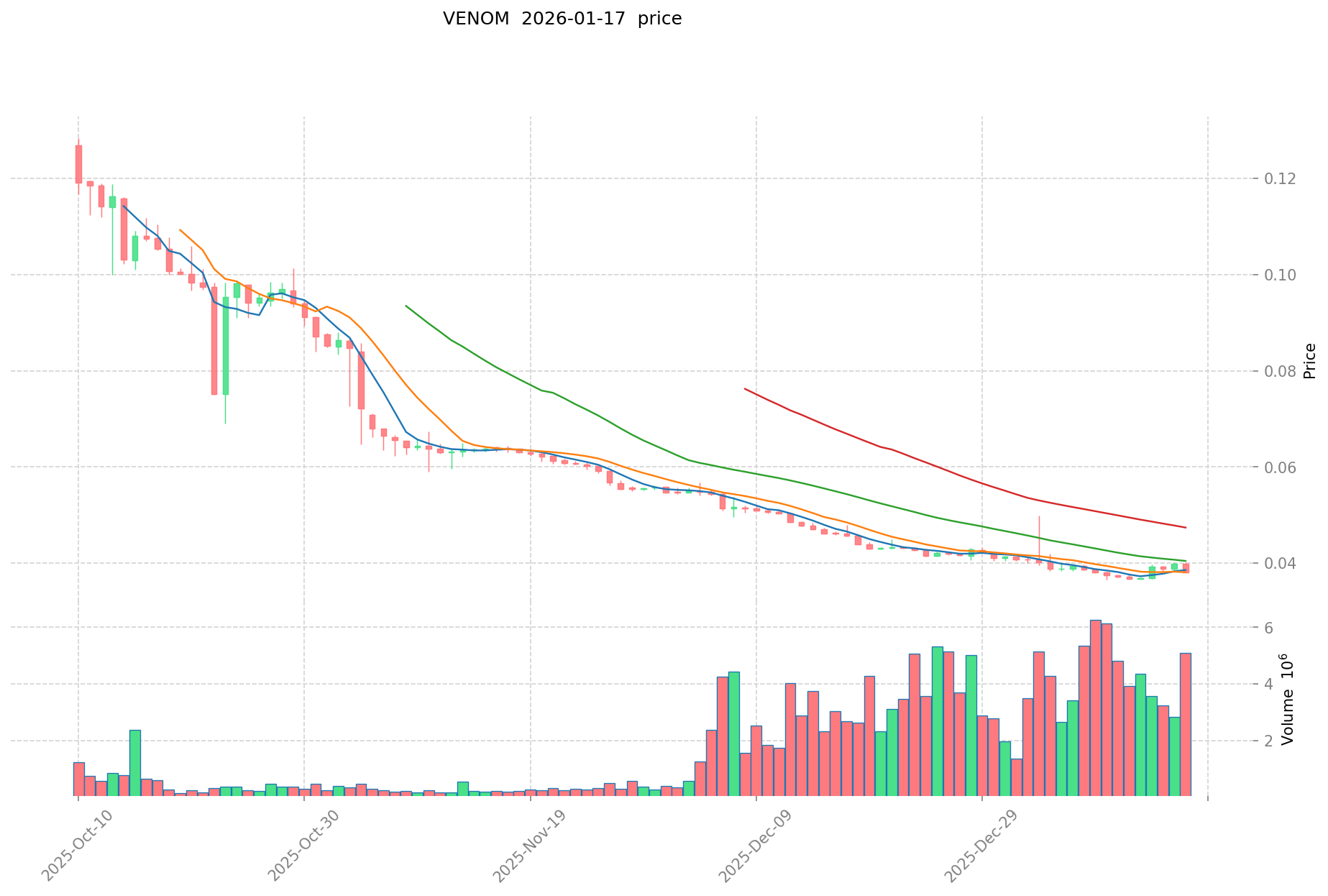
VENOM is an emerging asset in the cryptocurrency sector. As of January 18, 2026, VENOM maintains a market capitalization of approximately $86.31 million, with a circulating supply of about 2.13 billion tokens and a current price around $0.0405. Positioned as a Layer 0 asynchronous blockchain with dynamic sharding capabilities, VENOM has been focusing on scalability and efficiency in blockchain infrastructure. The project has established partnerships with governmental and corporate entities for implementing real-world asset tokenization, stablecoins, and CBDC projects. With a market ranking of 394 and trading on 5 exchanges, VENOM has attracted over 10.7 million holders. Recent price movements show an 8.81% increase over the past 7 days, though the 30-day performance indicates a decline of 9.52%. This article provides a comprehensive analysis of VENOM's investment characteristics, historical price trends, future price projections, and associated risks to assist investors in their research.
I. Venom (VENOM) Price History Review and Current Investment Value
- 2024: Venom experienced notable price fluctuations following its mainnet launch in March 2024, with the token showing varying performance across different market conditions.
- 2025: The token demonstrated recent short-term momentum, with a 6.16% increase over 24 hours and an 8.81% gain over 7 days as of January 18, 2026, though experiencing a decline of 9.52% over the past 30 days.
- Recent Period: Price movements have shown volatility, with the token trading between lower support levels and moderate resistance points during recent market cycles.
Current VENOM Investment Market Status (January 2026)
- VENOM current price: $0.0405
- 24-hour trading volume: $213,356.86
- Market capitalization: $86,313,081.47
- Circulating supply: 2,131,187,196.68 VENOM (representing 26.64% of total supply)
- Market share: 0.0087%
Click to view real-time VENOM market price
II. Core Factors Affecting Whether VENOM is a Good Investment
Supply Mechanism and Scarcity (VENOM Investment Scarcity)
- Total Supply: 7,293,224,263 VENOM with a maximum supply of 8,000,000,000 VENOM
- Current circulating supply represents approximately 26.64% of total supply, with 2,131,187,196.68 VENOM in circulation
- The controlled release schedule may influence token scarcity dynamics over time
- Investment consideration: The substantial gap between circulating and maximum supply suggests potential dilution risk as more tokens enter circulation
Institutional Investment and Mainstream Adoption (Institutional Investment in VENOM)
- Venom Foundation has established partnerships with the UAE government for implementing a national carbon credit system
- The project focuses on collaboration with enterprises and governments for fiat-backed stablecoins, CBDC implementation, and real-world asset tokenization
- Institutional adoption in regulated sectors such as carbon credits and government partnerships may provide long-term value support
- Current holder count stands at 10,705,714, indicating a growing user base
Macroeconomic Environment's Impact on VENOM Investment
- As a Layer 0 blockchain protocol, VENOM's investment value may be influenced by broader cryptocurrency market trends and regulatory developments
- The focus on government partnerships and regulated asset tokenization may position VENOM differently from purely speculative digital assets
- Adoption in emerging markets and unbanked population segments represents a distinct use case compared to traditional store-of-value narratives
Technology and Ecosystem Development (Technology & Ecosystem for VENOM Investment)
- Dynamic sharding architecture: Enables scalability and network efficiency improvements
- Account abstraction and invisible gas fees: Technical features designed to enhance user experience and reduce friction
- Cross-chain communication capabilities: Allow interoperability with other blockchain networks
- Initial DeFi and Web3 ecosystem launched at mainnet deployment, with multiple projects having tested on Venom testnet prior to launch
- The balance between traditional financial systems and decentralized cryptocurrency features may support diverse application development
III. VENOM Future Investment Forecast and Price Outlook (Is Venom(VENOM) worth investing in 2026-2031)
Short-term Investment Forecast (2026, short-term VENOM investment outlook)
- Conservative Forecast: 0.023461 - 0.04045
- Neutral Forecast: 0.04045 - 0.049445
- Optimistic Forecast: 0.049445 - 0.057439
Mid-term Investment Outlook (2027-2029, mid-term Venom(VENOM) investment forecast)
- Market Stage Expectation: According to the prediction table, VENOM may experience moderate growth during this period, with projected average prices rising from 0.0489445 in 2027 to 0.0662806419 in 2029, representing a potential increase trend.
- Investment Return Forecast:
- 2027: 0.046497275 - 0.07048008
- 2028: 0.0423957259 - 0.0728489938
- 2029: 0.043082417235 - 0.076885544604
- Key Catalysts: Price movements may be influenced by broader crypto market conditions, technological developments within the Venom ecosystem, adoption of dynamic sharding capabilities, and partnerships with enterprises and governments for real-world asset tokenization projects.
Long-term Investment Outlook (Is VENOM a good long-term investment?)
- Base Scenario: 0.039062893987616 - 0.083487361659807 (assuming steady ecosystem development and moderate market conditions)
- Optimistic Scenario: 0.071583093252 - 0.08160472630728 (assuming enhanced adoption of DeFi and Web3 products within the Venom ecosystem and favorable market sentiment)
- Risk Scenario: Below 0.039062893987616 (under conditions of significant market downturns or reduced adoption rates)
Click to view VENOM long-term investment and price prediction: Price Prediction
2026-2031 Long-term Outlook
- Base Scenario: 0.04045 - 0.071583093252 (corresponding to steady progress and gradual mainstream application improvement)
- Optimistic Scenario: 0.071583093252 - 0.08160472630728 (corresponding to large-scale adoption and favorable market environment)
- Transformative Scenario: Above 0.083487361659807 (if the ecosystem achieves breakthrough progress and mainstream popularization)
- 2031-12-31 Predicted High: 0.083487361659807 (based on optimistic development assumptions)
Disclaimer: This forecast is based on historical data and current market trends. Cryptocurrency investments involve substantial risk, and past performance does not guarantee future results. Investors should conduct thorough research and consider their risk tolerance before making investment decisions.
| Year |
Predicted High Price |
Predicted Average Price |
Predicted Low Price |
Price Change |
| 2026 |
0.057439 |
0.04045 |
0.023461 |
0 |
| 2027 |
0.07048008 |
0.0489445 |
0.046497275 |
20 |
| 2028 |
0.0728489938 |
0.05971229 |
0.0423957259 |
47 |
| 2029 |
0.076885544604 |
0.0662806419 |
0.043082417235 |
63 |
| 2030 |
0.08160472630728 |
0.071583093252 |
0.06514061485932 |
76 |
| 2031 |
0.083487361659807 |
0.07659390977964 |
0.039062893987616 |
89 |
IV. Venom Investment Strategy and Risk Management (How to invest in Venom)
Investment Methodology (Venom investment strategy)
Long-term Holding (HODL Venom)
Long-term holding may be suitable for investors who believe in Venom's Layer 0 architecture and its partnerships with government entities. This approach focuses on holding VENOM tokens through market cycles, potentially benefiting from the project's infrastructure development and ecosystem expansion.
Active Trading
Active trading strategies involve technical analysis and swing trading based on price movements. Given Venom's 24-hour price change of 6.16% and 7-day change of 8.81%, traders may identify short-term opportunities. However, the 30-day decline of 9.52% demonstrates the volatility that traders must navigate.
Risk Management (Risk management for Venom investment)
Asset Allocation Ratio
- Conservative investors: May consider allocating 1-3% of their crypto portfolio to VENOM, given its mid-cap status (ranking #394) and relatively lower liquidity compared to top-tier assets.
- Aggressive investors: Could allocate 5-10% to capture potential upside from ecosystem development and government partnerships.
- Professional investors: May implement dynamic allocation strategies based on technical indicators and fundamental developments.
Risk Hedging Solutions
- Multi-asset portfolio: Combine VENOM with established cryptocurrencies and stablecoins to reduce concentration risk.
- Hedging tools: Consider using derivatives or maintaining stablecoin reserves to manage downside exposure during volatile periods.
Secure Storage
- Cold wallets: For long-term holdings, use hardware wallets or cold storage solutions to minimize exposure to online threats.
- Hot wallets: For active trading, maintain only necessary amounts in exchange wallets or hot wallets for quick access.
- Hardware wallet recommendations: Research reputable hardware wallet providers that support ERC-20 tokens for secure VENOM storage.
V. Venom Investment Risks and Challenges (Risks of investing in Venom)
Market Risks
- High volatility: VENOM's 24-hour trading volume of $213,356 suggests relatively limited liquidity, which can amplify price swings. The token's circulating supply represents only 26.64% of total supply, potentially creating supply-side pressures.
- Price fluctuations: The token has experienced significant volatility, with a 30-day decline of 9.52% despite recent positive momentum.
Regulatory Risks
- Policy uncertainty: As a project involving government partnerships for CBDC and carbon credit systems, Venom may face regulatory scrutiny in different jurisdictions.
- Compliance requirements: Changes in regulations regarding asset tokenization and stablecoins could impact the project's operational model.
Technical Risks
- Network security: As a Layer 0 blockchain with dynamic sharding, the platform's complexity introduces potential security considerations that require ongoing monitoring.
- Upgrade challenges: Implementation of new features such as account abstraction and cross-chain communication involves technical execution risks.
- Ecosystem dependency: The success of Venom's DeFi and Web3 ecosystem projects remains uncertain and requires sustained development and adoption.
VI. Conclusion: Is Venom a Good Investment?
Investment Value Summary
Venom presents an infrastructure-focused blockchain project with government partnerships and real-world asset tokenization capabilities. The project's Layer 0 architecture and dynamic sharding technology offer potential scalability advantages. However, with a market cap of approximately $86.3 million and ranking #394, VENOM represents a mid-cap investment with corresponding risk-reward characteristics. The token's price movements show both short-term positive momentum (6.16% in 24 hours, 8.81% in 7 days) and medium-term challenges (9.52% decline over 30 days).
Investor Recommendations
✅ Beginners: Consider dollar-cost averaging (DCA) with small allocations and prioritize secure wallet storage. Start with conservative position sizes while learning about the project's technical features and partnerships.
✅ Experienced investors: May explore swing trading opportunities based on technical analysis while maintaining a core long-term position. Monitor ecosystem developments and partnership announcements for strategic entry points.
✅ Institutional investors: Could evaluate Venom for strategic allocation within blockchain infrastructure portfolios, particularly for exposure to government-backed tokenization initiatives and CBDC development.
⚠️ Disclaimer: Cryptocurrency investments carry significant risks, including potential loss of principal. This content is for informational purposes only and does not constitute investment advice. Conduct thorough research and consider your financial situation before making investment decisions.
VII. FAQ
Q1: What makes Venom (VENOM) different from other Layer 1 blockchain projects?
Venom operates as a Layer 0 asynchronous blockchain with dynamic sharding capabilities, distinguishing it from traditional Layer 1 blockchains. Unlike many competing projects, Venom focuses on enterprise and governmental partnerships for implementing real-world asset tokenization, fiat-backed stablecoins, and CBDC projects. Its technical architecture includes account abstraction and invisible gas fees designed to enhance user experience, plus cross-chain communication capabilities for interoperability with other networks. The project's partnership with the UAE government for a national carbon credit system demonstrates its focus on regulated, real-world applications rather than purely speculative use cases.
Q2: Is VENOM suitable for long-term holding or short-term trading?
Both strategies have merit depending on investor profiles and objectives. Long-term holding may suit investors who believe in Venom's infrastructure development and government partnerships, with price predictions suggesting potential growth from $0.04045 in 2026 to $0.083487 by 2031. Short-term trading opportunities exist given the token's volatility (6.16% 24-hour change, 8.81% 7-day gain), though the 30-day decline of 9.52% highlights inherent risks. Conservative investors might allocate 1-3% of their crypto portfolio to VENOM for long-term exposure, while active traders could capitalize on price swings with proper risk management and technical analysis.
Q3: What are the main risks associated with investing in VENOM?
VENOM carries several notable risks: First, market volatility is amplified by relatively limited liquidity, with only $213,356 in 24-hour trading volume. Second, only 26.64% of total supply is currently circulating, creating potential dilution risk as more tokens enter the market. Third, regulatory uncertainty exists given the project's involvement with government CBDC and carbon credit systems, which may face jurisdiction-specific scrutiny. Fourth, technical risks related to the complex dynamic sharding architecture and ecosystem dependency on DeFi and Web3 project adoption require ongoing monitoring. Finally, network security considerations inherent in Layer 0 blockchain infrastructure demand sustained attention.
Q4: How does VENOM's token distribution affect its investment potential?
VENOM's token distribution reveals significant supply dynamics that investors should consider. With a circulating supply of 2.13 billion tokens representing only 26.64% of the 8 billion maximum supply, substantial token unlocks could create selling pressure and impact price stability. This controlled release schedule influences scarcity dynamics over time, potentially affecting long-term price appreciation. The current holder count of 10.7 million suggests growing adoption, but the gap between circulating and maximum supply presents dilution risk. Investors should monitor token release schedules and vesting periods when evaluating entry points and long-term holding strategies.
Q5: What role do Venom's government partnerships play in its investment thesis?
Venom's government partnerships constitute a core component of its investment value proposition. The collaboration with the UAE government for implementing a national carbon credit system demonstrates real-world utility and regulatory acceptance. These partnerships for CBDC implementation and real-world asset tokenization differentiate VENOM from purely speculative digital assets by providing tangible use cases. Institutional adoption in regulated sectors may provide long-term value support and reduce certain regulatory risks. However, these partnerships also introduce dependencies on government policy changes and regulatory frameworks, which could either support or constrain the project's growth trajectory.
Q6: How should investors approach position sizing for VENOM?
Position sizing should align with risk tolerance and investment experience. Conservative investors are recommended to allocate 1-3% of their cryptocurrency portfolio to VENOM, given its mid-cap status (ranking #394) and relatively lower liquidity compared to major assets. Aggressive investors with higher risk tolerance could consider 5-10% allocations to capture potential upside from ecosystem development. Professional investors may implement dynamic allocation strategies based on technical indicators and fundamental developments. Regardless of allocation size, diversification across multiple assets, combined with secure storage practices using cold wallets for long-term holdings, remains essential for risk management.
Q7: What are the projected price scenarios for VENOM through 2031?
Price projections for VENOM vary based on adoption and market conditions. In the base scenario, assuming steady ecosystem development and moderate market conditions, prices may range from $0.04045 in 2026 to $0.076594 by 2031. The optimistic scenario, contingent on enhanced DeFi and Web3 adoption within the Venom ecosystem, projects potential highs of $0.08349 by 2031. Conservative projections for 2026 suggest a range of $0.02346-$0.04045, while neutral forecasts indicate $0.04045-$0.04945. These projections assume continued technological development, partnership expansion, and favorable market sentiment, though actual performance may deviate significantly based on unforeseen market dynamics and regulatory changes.
Q8: What security measures should VENOM investors implement?
Security practices are critical for VENOM investment protection. For long-term holdings, investors should utilize hardware wallets or cold storage solutions to minimize exposure to online threats and potential exchange hacks. Hot wallets should maintain only necessary amounts for active trading purposes, reducing risk exposure while enabling quick market access. Multi-signature wallets may provide additional security layers for larger holdings. Investors should research reputable hardware wallet providers that support ERC-20 tokens for secure VENOM storage. Additionally, implementing portfolio diversification across multiple assets, maintaining stablecoin reserves for risk hedging, and regularly updating security protocols help protect against both technical vulnerabilities and market volatility.
* The information is not intended to be and does not constitute financial advice or any other recommendation of any sort offered or endorsed by Gate.