Venus (XVS) is a governance token for a decentralized finance lending platform on Binance Smart Chain, currently trading at $5.71 with a $95.63 million market cap. This comprehensive analysis evaluates XVS as an investment through multiple dimensions: tokenomics with 16.76 million circulating tokens (55.85% of max supply), historical price performance showing 31.16% 30-day gains despite 41.48% yearly decline, and future price forecasts ranging from $5.08-$6.00 in 2026 to $10.86 by 2031. The article examines Venus's DeFi lending utility, technology stack, and governance mechanisms while addressing key investment considerations for different investor profiles. Investment strategies include long-term holding and active trading approaches with detailed risk management frameworks covering asset allocation, hedging solutions, and secure storage. Critical risk factors include market volatility, regulatory uncertainty, smart contract vulnerabilities, and competitive pressures within the DeFi ecosystem. Suitable for i
Introduction: Venus (XVS) Investment Position and Market Prospects
Venus (XVS) is a significant asset in the cryptocurrency space, operating as a decentralized finance (DeFi) lending and stablecoin issuance platform built on Binance Smart Chain (BSC). Since its launch in 2020, Venus has established itself within the DeFi lending market. As of January 17, 2026, XVS holds a market capitalization of approximately $95.63 million, with a circulating supply of about 16.76 million tokens, and the current price is around $5.71. With its positioning as a BEP-20 governance token, XVS has become a focal point for investors considering "Is Venus (XVS) a good investment?" This article provides a comprehensive analysis of XVS's investment value, historical price trends, future price projections, and associated investment risks to serve as a reference for investors.
As of the current date, XVS ranks 364th among cryptocurrencies by market capitalization, representing approximately 0.0050% of the total crypto market share. The token has demonstrated notable short-term performance, with a 10.07% increase over the past 7 days and a 31.16% gain over the past 30 days. The platform serves as a governance mechanism where XVS holders can participate in protocol decisions, including product upgrades, adding new collateral types, and adjusting platform parameters. With 78,181 holders and listings on 22 exchanges, Venus has established a measurable presence in the DeFi ecosystem. The token's circulating supply represents approximately 55.85% of its maximum supply of 30 million tokens, indicating a controlled token distribution model.
I. Venus (XVS) Price History Review and Current Investment Value Status
XVS Historical Price Trend and Investment Returns
- 2021: During May 2021, XVS experienced a significant price surge, rising from approximately $2 to $144, driven by whale accumulation. However, following what was described as an "air-for-Bitcoin" incident, the token underwent a sharp decline. Venus Protocol accumulated bad debts approaching $100 million, and community confidence was severely impacted.
- Post-2021 Decline: Following the 2021 peak, XVS has declined by over 90% from its May 2021 levels. The price fell from its elevated position to significantly lower valuations, reflecting broader market corrections and project-specific challenges.
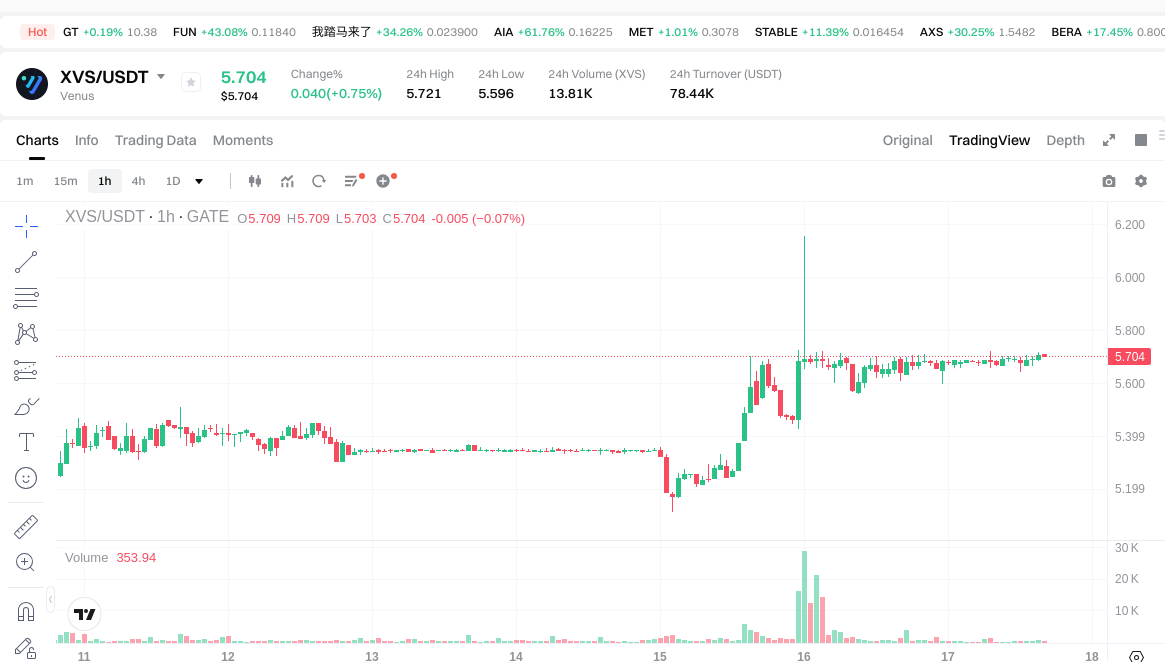
- Current Period (2026): As of January 17, 2026, XVS is trading at $5.707, representing a one-year decline of 41.48% and maintaining substantially lower levels compared to its 2021 performance.
Current XVS Investment Market Status (January 2026)
- XVS Current Price: $5.707
- 24-hour Price Change: +0.22%
- 24-hour Trading Volume: $77,380.76 thousand
- Market Capitalization: $95,627,661.65
- Circulating Supply: 16,756,204.95 XVS
- Total Supply: 29,745,107.99 XVS
- Market Cap to Fully Diluted Valuation Ratio: 55.85%
- Token Holders: 78,181
- Listed on Exchanges: 22
Click to view real-time XVS market price
II. Core Factors Influencing Whether XVS is a Good Investment (Is Venus(XVS) a Good Investment)
Supply Mechanism and Scarcity (XVS investment scarcity)
- Supply mechanism influences price and investment value
- Venus (XVS) has a maximum supply of 30,000,000 tokens, with a current circulating supply of approximately 16,756,204.95 tokens as of January 17, 2026, representing a circulation ratio of about 55.85%
- The relatively limited maximum supply creates potential scarcity, which could support long-term investment considerations
- Investment significance: scarcity serves as a key element in supporting long-term investment potential
Technology and Ecosystem Development (Technology & Ecosystem for XVS investment)
- Venus operates as a decentralized finance (DeFi) lending and stablecoin issuance platform built on Binance Smart Chain (BSC)
- The platform allows users to participate in lending markets and issue synthetic stablecoin assets through BEP-20 collateral assets
- XVS functions as the native BEP-20 governance token, enabling participation in platform governance including product upgrades, addition of new collateral types, and adjustment of platform parameters
- DeFi applications provide practical utility that may contribute to the token's investment value proposition
- As of January 17, 2026, the platform has attracted approximately 78,181 holders, indicating a degree of community adoption
- As of January 17, 2026, XVS is trading at approximately $5.707, with recent price movements showing a 0.26% change over 1 hour, 0.22% over 24 hours, and 10.07% over 7 days
- The 30-day price change reflects a 31.16% increase, while the 1-year performance shows a decline of 41.48%
- The token's market capitalization stands at approximately $95,627,661.65, with a fully diluted market cap of $169,755,331.28
- XVS has traded on 22 exchanges, providing liquidity options for investors
- Historical price data indicates the token has experienced significant volatility, with prices ranging between different levels since its launch in October 2020
III. XVS Future Investment Forecast and Price Outlook (Is Venus(XVS) worth investing in 2026-2031)
Short-term Investment Forecast (2026, short-term XVS investment outlook)
- Conservative forecast: $5.08 - $5.50
- Neutral forecast: $5.50 - $5.85
- Optimistic forecast: $5.85 - $6.00
Mid-term Investment Outlook (2027-2029, mid-term Venus(XVS) investment forecast)
- Market stage expectation: Venus may experience gradual growth driven by DeFi market expansion and platform governance improvements. The token could benefit from increased adoption of decentralized lending protocols on BSC.
- Investment return forecast:
- 2027: $5.26 - $6.61
- 2028: $4.11 - $7.97
- 2029: $6.53 - $9.51
- Key catalysts: Platform parameter adjustments, addition of new collateral types, product upgrades, and broader DeFi sector developments.
Long-term Investment Outlook (Is XVS a good long-term investment?)
- Base scenario: $7.31 - $9.80 (assuming steady platform development and moderate market conditions)
- Optimistic scenario: $9.80 - $10.86 (assuming enhanced protocol adoption and favorable DeFi market trends)
- Risk scenario: $4.00 - $7.00 (under sustained market weakness or significant competitive pressure)
Click to view XVS long-term investment and price forecast: Price Prediction
2026-2031 Long-term Outlook
- Base scenario: $7.31 - $9.05 (corresponding to steady progress and gradual mainstream application growth)
- Optimistic scenario: $9.05 - $10.86 (corresponding to large-scale adoption and favorable market environment)
- Transformative scenario: Above $10.86 (if ecosystem achieves breakthrough developments and mainstream popularization)
- 2031-12-31 predicted high: $10.86 (based on optimistic development assumptions)
Disclaimer: The above forecasts are for reference purposes only and do not constitute investment advice. Cryptocurrency markets involve substantial risk, and investors should conduct independent research and risk assessment.
| Year |
Predicted High Price |
Predicted Average Price |
Predicted Low Price |
Price Change |
| 2026 |
5.9892 |
5.704 |
5.07656 |
0 |
| 2027 |
6.606658 |
5.8466 |
5.26194 |
2 |
| 2028 |
7.97008512 |
6.226629 |
4.10957514 |
9 |
| 2029 |
9.5117984604 |
7.09835706 |
6.5304884952 |
24 |
| 2030 |
9.799991757036 |
8.3050777602 |
7.308468428976 |
45 |
| 2031 |
10.8630417103416 |
9.052534758618 |
7.51360384965294 |
58 |
IV. Venus Investment Strategy and Risk Management (How to invest in DeFi Lending Tokens)
Investment Methodology (Venus investment strategy)
Long-term Holding (HODL Venus)
For conservative investors seeking exposure to decentralized finance lending protocols, a long-term holding strategy may be considered. This approach focuses on Venus Protocol's position within the BSC ecosystem and its governance token utility. Investors adopting this strategy typically:
- Monitor protocol development and governance proposals
- Evaluate total value locked (TVL) trends and platform usage metrics
- Consider the token's role in platform governance and parameter adjustments
- Assess competition from other DeFi lending platforms
Active Trading Strategy
Active traders may utilize technical analysis and momentum-based approaches when trading XVS. Key considerations include:
- Technical indicators: Support levels around $5.596 (24H low) and resistance near $5.721 (24H high) based on recent data
- Volume analysis: Daily trading volume of approximately $77,380.76 provides liquidity context
- Trend identification: Recent 7-day performance shows 10.07% increase, while 30-day data indicates 31.16% gain
- Historical volatility: Price has ranged from $1.65 (October 6, 2020) to $146.82 (May 10, 2021)
Risk Management (Risk management for Venus investment)
Asset Allocation Ratios
Conservative Investors:
- Allocate 1-3% of crypto portfolio to DeFi lending tokens
- Focus on established protocols with proven track records
- Maintain larger positions in major cryptocurrencies
Aggressive Investors:
- May allocate 5-10% to DeFi lending protocol tokens
- Balance exposure across multiple DeFi categories
- Monitor protocol metrics and governance changes actively
Professional Investors:
- Employ dynamic allocation based on market conditions
- Utilize derivatives and hedging strategies when available
- Conduct thorough due diligence on smart contract audits
Risk Hedging Solutions
Multi-asset Portfolio Construction:
- Diversify across different blockchain ecosystems
- Balance DeFi exposure with established digital assets
- Consider stablecoin allocations for liquidity management
Risk Mitigation Tools:
- Set stop-loss orders at predetermined levels
- Use position sizing based on risk tolerance
- Monitor protocol health indicators regularly
Secure Storage Solutions
Cold and Hot Wallet Management:
- Cold storage: For long-term holdings, use hardware wallets or air-gapped solutions
- Hot wallets: Maintain minimal amounts for active trading on reputable exchanges
- Multi-signature wallets: Consider for larger holdings
Hardware Wallet Recommendations:
- Research BSC-compatible hardware wallet solutions
- Verify official contract address (0xcf6bb5389c92bdda8a3747ddb454cb7a64626c63 on BSC)
- Implement proper backup procedures for recovery phrases
V. Venus Investment Risks and Challenges (Risks of investing in DeFi Lending Tokens)
Market Risks
High Volatility:
- XVS has experienced significant price fluctuations, with 1-year performance showing -41.48% decline
- Daily price ranges can vary substantially, as evidenced by 24H range between $5.596 and $5.721
- Market capitalization of approximately $95.63 million suggests moderate liquidity conditions
Price Manipulation Concerns:
- Lower market cap tokens may face liquidity challenges
- Trading across 22 exchanges provides some distribution but concentration risks remain
- Monitor unusual volume spikes or coordinated trading patterns
Regulatory Risks
Jurisdictional Uncertainty:
- DeFi lending protocols operate in evolving regulatory environments
- Different countries maintain varying approaches to DeFi regulation
- BSC-based projects may face additional scrutiny depending on jurisdiction
Compliance Considerations:
- Potential future regulatory requirements for DeFi protocols
- KYC/AML requirements may impact protocol accessibility
- Tax treatment varies significantly across jurisdictions
Technical Risks
Network Security Vulnerabilities:
- Smart contract risks inherent in DeFi protocols
- Dependency on BSC network security and performance
- Historical DeFi exploits highlight importance of audit verification
Upgrade Implementation Risks:
- Protocol upgrades require governance approval and technical execution
- Migration risks during major platform updates
- Potential for temporary service disruptions during maintenance
Operational Dependencies:
- Reliance on oracle systems for price feeds
- Smart contract immutability versus upgrade requirements
- Integration risks with other DeFi protocols
VI. Conclusion: Is DeFi Lending Token a Good Investment?
Investment Value Summary
Venus (XVS) represents participation in a DeFi lending protocol built on Binance Smart Chain, offering governance rights and protocol exposure. The token's recent 30-day performance of 31.16% contrasts with its 1-year decline of -41.48%, illustrating the significant price volatility characteristic of DeFi governance tokens. With a circulating supply of approximately 16.76 million tokens (55.85% of max supply) and market capitalization around $95.63 million, Venus maintains a position within the DeFi lending sector.
The protocol's focus on synthetic stablecoin issuance through BEP-20 collateral assets provides specific utility within the BSC ecosystem. However, investors should carefully evaluate competition from other lending protocols, smart contract risks, and the evolving DeFi landscape before making allocation decisions.
Investor Recommendations
✅ Novice Investors:
- Consider dollar-cost averaging approach to manage volatility
- Prioritize secure storage solutions with hardware wallets
- Allocate only capital you can afford to lose entirely
- Research DeFi lending mechanics before investing
- Start with smaller positions to understand price dynamics
✅ Experienced Investors:
- Implement swing trading strategies based on technical analysis
- Diversify across multiple DeFi protocols and categories
- Monitor protocol TVL, governance proposals, and competitive positioning
- Use risk management tools including stop-losses and position sizing
- Stay informed about BSC ecosystem developments
✅ Institutional Investors:
- Conduct comprehensive due diligence on smart contract audits
- Evaluate strategic positioning within DeFi portfolio allocation
- Consider liquidity requirements and exit strategies
- Monitor regulatory developments affecting DeFi protocols
- Implement robust custody and security frameworks
⚠️ Important Disclaimer
Cryptocurrency investments carry substantial risks including potential total loss of capital. Digital asset markets exhibit extreme volatility, with prices subject to rapid and significant fluctuations. DeFi protocols face additional risks including smart contract vulnerabilities, regulatory uncertainty, and technological dependencies. This content provides informational analysis only and does not constitute financial advice, investment recommendations, or solicitation to buy or sell any digital assets. Investors should conduct independent research, assess their risk tolerance, and consult qualified financial advisors before making investment decisions. Past performance does not indicate future results.
VII. FAQ
Q1: What is Venus (XVS) and what is its primary function in the DeFi ecosystem?
Venus (XVS) is a BEP-20 governance token for a decentralized finance (DeFi) lending and stablecoin issuance platform built on Binance Smart Chain (BSC). As a governance token, XVS enables holders to participate in protocol decisions including product upgrades, adding new collateral types, and adjusting platform parameters. The Venus Protocol allows users to participate in lending markets and issue synthetic stablecoin assets through BEP-20 collateral assets, positioning itself as a comprehensive DeFi solution within the BSC ecosystem.
Q2: How has Venus (XVS) performed historically, and what is its current market position?
Venus experienced significant volatility since its launch in October 2020. The token reached its all-time high of $146.82 in May 2021 but subsequently declined by over 90% from that peak. As of January 17, 2026, XVS trades at approximately $5.71, representing a 1-year decline of 41.48%. However, recent performance shows positive momentum with a 10.07% increase over the past 7 days and 31.16% gain over 30 days. The token maintains a market capitalization of approximately $95.63 million and ranks 364th among cryptocurrencies, with 78,181 holders and listings on 22 exchanges.
Q3: What is the supply structure of XVS, and how does it impact investment considerations?
XVS has a maximum supply of 30 million tokens, with approximately 16.76 million tokens currently in circulation as of January 17, 2026, representing a circulation ratio of 55.85%. The total supply stands at approximately 29.75 million tokens, indicating that most tokens have already been minted. This relatively limited maximum supply creates potential scarcity, which could serve as a supporting factor for long-term investment considerations. The controlled token distribution model with over half of the maximum supply already circulating provides transparency regarding future dilution potential.
Q4: What are the primary risks associated with investing in Venus (XVS)?
Venus faces multiple investment risks including high market volatility (evidenced by its 90%+ decline from 2021 peaks), smart contract vulnerabilities inherent in DeFi protocols, and dependency on BSC network security. The token has experienced significant price fluctuations, with its 1-year performance showing a 41.48% decline. Additional risks include regulatory uncertainty affecting DeFi lending protocols, competition from other lending platforms, potential liquidity challenges given its moderate market capitalization of $95.63 million, and operational dependencies on oracle systems and cross-protocol integrations. Investors should also consider the historical bad debt incident in 2021 that severely impacted community confidence.
Q5: What is the long-term price forecast for Venus (XVS) through 2031?
Based on analytical projections, Venus price forecasts vary by scenario. For 2026, predictions range from $5.08 (conservative) to $6.00 (optimistic). Mid-term forecasts suggest potential growth: $5.26-$6.61 for 2027, $4.11-$7.97 for 2028, and $6.53-$9.51 for 2029. Long-term projections for 2031 indicate a potential high of $10.86 under optimistic development assumptions, with a predicted average price of $9.05 and low of $7.51. However, these forecasts depend on numerous factors including protocol adoption, DeFi market trends, governance improvements, and competitive positioning. Investors should note that cryptocurrency price predictions carry significant uncertainty and should not be the sole basis for investment decisions.
Q6: What investment strategy is most suitable for different types of XVS investors?
Conservative investors should consider a long-term holding (HODL) strategy, allocating 1-3% of their crypto portfolio to DeFi lending tokens while monitoring protocol development and TVL trends. Active traders may employ technical analysis with attention to support levels around $5.60 and resistance near $5.72, utilizing the token's recent positive momentum. Aggressive investors might allocate 5-10% to DeFi protocol tokens while balancing exposure across multiple categories. All investors should implement proper risk management including stop-loss orders, position sizing based on risk tolerance, and secure storage solutions using hardware wallets for long-term holdings. Dollar-cost averaging is recommended for managing volatility, particularly for novice investors.
Q7: How does Venus (XVS) compare to other DeFi lending protocols in terms of investment value?
Venus operates specifically within the BSC ecosystem as a lending and synthetic stablecoin platform, differentiating itself through its BEP-20 token standard and focus on collateral-based stablecoin issuance. With 78,181 holders and presence on 22 exchanges, Venus has established measurable adoption. However, investors should evaluate Venus relative to competing DeFi lending protocols by comparing metrics such as total value locked (TVL), governance participation rates, audit quality, and historical security records. The protocol's positioning on BSC provides exposure to the Binance ecosystem but also concentrates platform risk. Venus's governance mechanism allowing holder participation in protocol decisions represents a key value proposition, though competition from established lending protocols across multiple chains requires careful comparative analysis.
Q8: What are the key catalysts that could drive Venus (XVS) price appreciation in the future?
Several factors could potentially influence Venus price appreciation: platform parameter adjustments and governance improvements that enhance protocol efficiency, addition of new collateral types expanding utility, successful product upgrades increasing functionality, broader DeFi sector growth driving increased lending demand, enhanced adoption of decentralized protocols on BSC, positive momentum in the synthetic stablecoin market, increased total value locked indicating growing platform usage, and mainstream recognition of DeFi lending solutions. Additionally, favorable regulatory clarity for DeFi protocols, strategic partnerships within the BSC ecosystem, and successful competition against other lending platforms could serve as catalysts. However, investors should recognize that these potential catalysts carry execution risks and depend on favorable market conditions.
* The information is not intended to be and does not constitute financial advice or any other recommendation of any sort offered or endorsed by Gate.