This comprehensive guide evaluates whether VeThor (VTHO) represents a viable investment opportunity in 2024-2031. VTHO, the gas token powering the VeChainThor blockchain, faces a complex investment landscape marked by dual-token economics, enterprise adoption potential, and significant market volatility. The analysis examines VTHO's price history, core value drivers including network utility and StarGate staking mechanisms, and detailed price forecasts ranging from $0.000602 to $0.001550 across multiple scenarios. Key investment strategies for beginners, experienced, and institutional investors are outlined with specific allocation recommendations and risk management protocols. Critical risks include market volatility, regulatory uncertainty, and technical dependencies, alongside technical analysis of liquidity constraints and competitive pressures. The article concludes that VTHO investment suitability depends on individual risk tolerance, portfolio diversification, and conviction in VeChain ecosystem expans
Introduction: VeThor (VTHO) Investment Position and Market Outlook
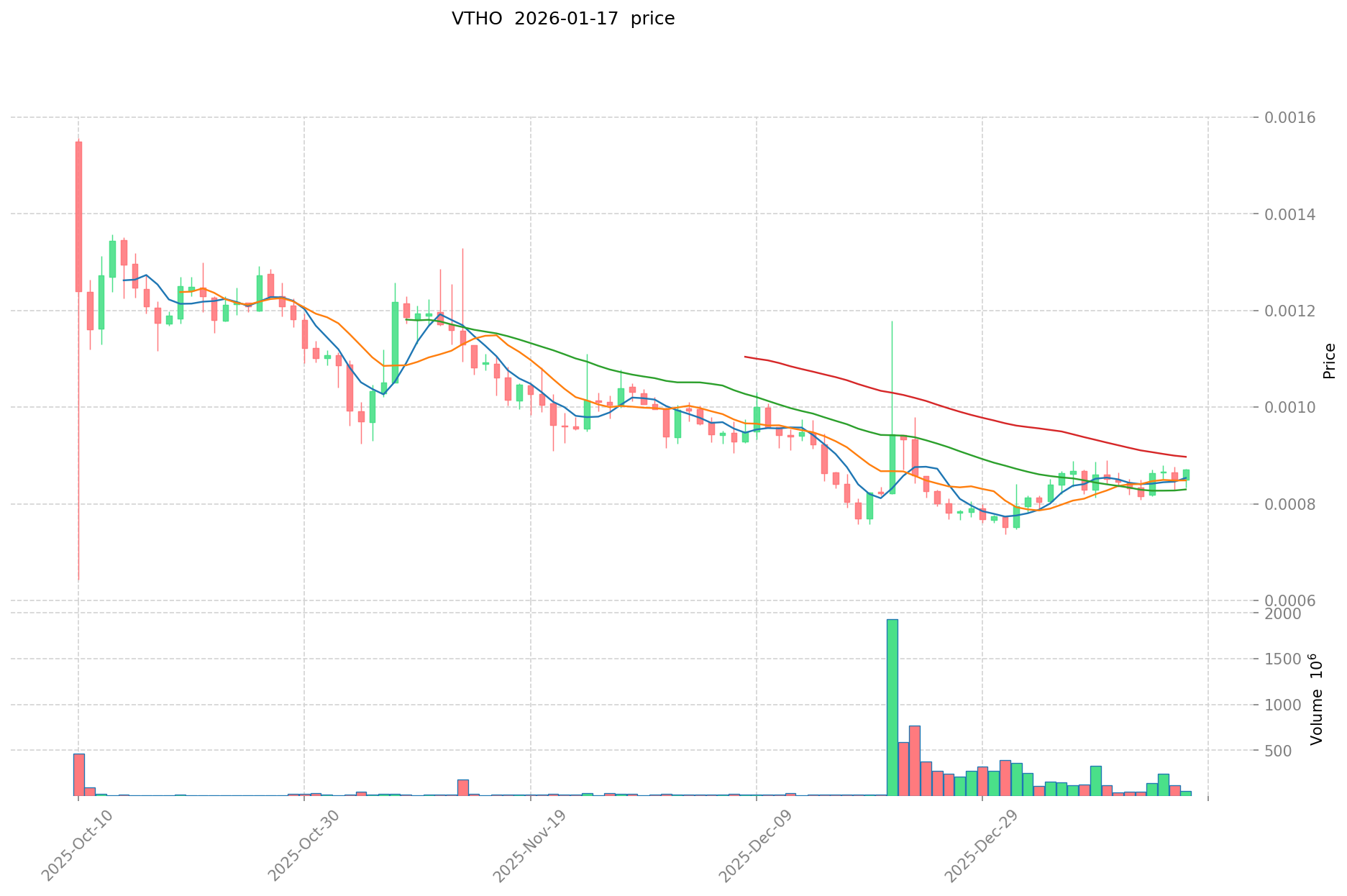
VeThor Token (VTHO) serves as a functional asset within the VeChainThor blockchain ecosystem, operating as the gas token that powers transaction execution, smart contract operations, and on-chain activities. Since its launch in 2018, VTHO has established its role in supporting blockchain adoption for real-world applications. As of January 18, 2026, VTHO maintains a market capitalization of approximately $85.04 million, with a circulating supply of around 97.51 billion tokens and a current price of $0.0008722. With nearly 100% of its total supply in circulation and availability on 22 exchanges, VTHO has developed a presence in the cryptocurrency market.
The token functions within VeChain's dual-token model, which separates value storage (VET) from utility (VTHO), aiming to provide cost predictability and network scalability. VTHO can be earned through the StarGate staking program, creating additional utility for participants in the VeChain ecosystem. As a VIP-180 Standard token, VTHO supports VeChain's objective of facilitating blockchain integration into practical applications.
Recent price movements show a 2.91% increase over 24 hours and an 11.42% gain over 30 days, though the token has experienced a 67.60% decline over the past year. When considering "Is VeThor (VTHO) a good investment?", it is important to examine multiple factors including its technical functionality, market position, historical performance, and associated risks. This article provides an analysis of VTHO's investment characteristics, historical trends, price outlook, and risk considerations to assist in research and evaluation.
I. VeThor (VTHO) Price History and Current Investment Status
- 2018: Token launch on VeChainThor blockchain → Price remained near $0.005 mark during initial period
- 2018 August: Price reached elevated levels → VTHO traded at $0.04671227 during this period
- 2020 March: Market correction phase → Price declined to $0.00015238
- 2021 Q1-Q2: Broader crypto market expansion → Price movements occurred alongside VET ecosystem development
Current VTHO Investment Market Status (January 2026)
- Current VTHO price: $0.0008722
- 24-hour trading volume: $27,309.50
- Market capitalization: $85.04 million
- Circulating supply: 97.51 billion VTHO
- Market share: 0.0025%
Click to view real-time VTHO market price
II. Core Factors Influencing Whether VTHO Is a Good Investment
Supply Mechanism and Scarcity (VTHO Investment Scarcity)
- Dual-token model separates value storage (VET) from utility (VTHO), with VTHO serving as gas for transactions and smart contracts → influences price dynamics and investment characteristics
- Total supply stands at 97,563,111,094 VTHO with unlimited maximum supply, while circulating supply reaches 97,505,374,507 (99.94% circulation ratio)
- VTHO generation occurs through VET holdings via the StarGate staking program, providing predictable token accumulation for ecosystem participants
- Investment significance: The continuous generation mechanism and utility-driven demand create a balance between supply expansion and consumption, forming the foundation for evaluating long-term investment potential
Institutional Investment and Mainstream Adoption (Institutional Investment in VTHO)
- VeChain's enterprise partnerships in logistics and sustainability sectors drive network activity, which directly correlates with VTHO consumption and utility value
- The VIP-180 standard compliance positions VTHO for potential integration across broader VeChain ecosystem applications
- VTHO's price trajectory shows correlation with VET performance, reflecting interconnected adoption patterns within the dual-token structure
- Network usage across enterprise use cases influences VTHO transaction demand, creating utility-based value proposition distinct from speculative assets
Macroeconomic Environment's Impact on VTHO Investment
- VTHO demonstrated -67.60% change over the past year, reflecting sensitivity to broader cryptocurrency market cycles and risk sentiment
- Utility token characteristics create exposure to both crypto market conditions and VeChain network adoption rates
- Market volatility and regulatory developments in the cryptocurrency sector may impact VTHO's price stability and investment appeal
- Current market capitalization of $85,044,187.65 represents 0.0025% market dominance, indicating positioning within the broader digital asset landscape
Technology and Ecosystem Development (Technology & Ecosystem for VTHO Investment)
- VIP-180 standard implementation supports token functionality across the VeChainThor blockchain infrastructure
- VTHO consumption model ties token value directly to network transaction volume and smart contract execution
- StarGate staking mechanism creates yield-generating opportunities for VET holders, establishing VTHO as an earned utility asset
- Expanding VeChain ecosystem applications in real-world use cases may influence VTHO consumption patterns and long-term utility demand
III. VTHO Future Investment Forecast and Price Outlook (Is VeThor(VTHO) worth investing in 2026-2031)
Short-term Investment Forecast (2026, short-term VTHO investment outlook)
- Conservative estimate: $0.000602 - $0.000778
- Neutral estimate: $0.000873 - $0.000973
- Optimistic estimate: $0.001070 - $0.001073
Mid-term Investment Outlook (2027-2029, mid-term VeThor(VTHO) investment forecast)
- Market stage expectation: During this period, VTHO may experience gradual growth driven by expanding utility within the VeChainThor ecosystem and increasing transaction demand.
- Investment return forecast:
- 2027: $0.000778 - $0.001070
- 2028: $0.000940 - $0.001236
- 2029: $0.000666 - $0.001219
- Key catalysts: Growth in VeChain ecosystem adoption, enterprise partnerships driving transaction volume, and developments in the dual-token model utility.
Long-term Investment Outlook (Is VTHO a good long-term investment?)
- Baseline scenario: $0.000634 - $0.001362 (assuming steady ecosystem development and moderate transaction growth)
- Optimistic scenario: $0.001362 - $0.001550 (assuming accelerated enterprise adoption and expanded blockchain applications)
- Risk scenario: Below $0.000634 (under conditions of reduced network activity or competitive pressures)
Click to view VTHO long-term investment and price forecast: Price Prediction
2026-2031 Long-term Outlook
- Base scenario: $0.000602 - $0.001362 (corresponding to steady progress and gradual mainstream application growth)
- Optimistic scenario: $0.001219 - $0.001550 (corresponding to large-scale adoption and favorable market conditions)
- Transformative scenario: Above $0.001550 (in case of breakthrough ecosystem developments and mainstream adoption)
- December 31, 2031 projected high: $0.001550 (based on optimistic development assumptions)
Disclaimer: The forecasts presented are derived from technical analysis and historical data patterns. Cryptocurrency markets involve significant volatility and risk. These projections should not be construed as financial advice, and investors should conduct independent research before making investment decisions.
| Year |
Predicted High Price |
Predicted Average Price |
Predicted Low Price |
Price Change |
| 2026 |
0.001073421 |
0.0008727 |
0.000602163 |
0 |
| 2027 |
0.00107036655 |
0.0009730605 |
0.0007784484 |
11 |
| 2028 |
0.00123627336525 |
0.001021713525 |
0.000939976443 |
17 |
| 2029 |
0.001219312920735 |
0.001128993445125 |
0.000666106132623 |
29 |
| 2030 |
0.001549882201467 |
0.00117415318293 |
0.000634042718782 |
34 |
| 2031 |
0.001416498399886 |
0.001362017692198 |
0.000762729907631 |
56 |
IV. VTHO Investment Strategy and Risk Management (How to invest in VTHO)
Investment Methodology (VTHO investment strategy)
Long-term Holding (HODL VTHO): Suitable for Conservative Investors
Long-term holding represents a strategy where investors acquire VTHO and maintain positions over extended periods, regardless of short-term price fluctuations. This approach aligns with investors who believe in VeChain's ecosystem expansion and increasing transaction demand on the VeChainThor blockchain.
Given VTHO's role as the utility token for network operations, long-term holders may benefit from:
- Continuous generation through VET staking via the StarGate program
- Potential value appreciation as network activity increases
- Reduced exposure to short-term volatility
This strategy requires patience and conviction in VeChain's mission to support blockchain adoption in real-world applications. Conservative investors should consider VTHO as part of a diversified portfolio rather than a concentrated position.
Active Trading: Technical Analysis and Swing Operations
Active trading involves leveraging technical analysis tools and market timing to capitalize on VTHO's price movements. Recent data shows:
- 24-hour price range: $0.0008386 - $0.0008908
- 24-hour change: +2.91%
- 7-day change: +2.84%
- 30-day change: +11.42%
Traders employing this approach typically:
- Monitor short-term price patterns and volume indicators
- Execute positions based on support and resistance levels
- Utilize the dual-token model dynamics between VET and VTHO
This methodology demands technical expertise, market awareness, and risk tolerance for potential losses. The availability of VTHO on 22 exchanges provides adequate liquidity for active trading strategies.
Risk Management (Risk management for VTHO investment)
Asset Allocation Ratios: Conservative / Aggressive / Professional Investors
Conservative Investors:
- VTHO allocation: 1-3% of total crypto portfolio
- Focus on diversification across multiple asset classes
- Prioritize capital preservation over high returns
Aggressive Investors:
- VTHO allocation: 5-10% of crypto portfolio
- Higher risk tolerance for potential growth opportunities
- Active monitoring of VeChain ecosystem developments
Professional Investors:
- Strategic allocation based on comprehensive analysis
- Integration with broader blockchain utility token strategies
- Consideration of VTHO's role within supply chain and enterprise adoption trends
Risk Hedging Solutions: Multi-asset Portfolio + Hedging Instruments
Diversification across different asset categories can mitigate VTHO-specific risks:
- Combine VTHO with established cryptocurrencies (BTC, ETH)
- Include stablecoins for liquidity and stability
- Consider correlation patterns with VET holdings
- Explore derivative instruments where available for institutional investors
Balanced portfolio construction reduces exposure to single-token volatility while maintaining upside potential from VeChain ecosystem growth.
Secure Storage: Hot and Cold Wallets + Hardware Wallet Recommendations
Storage Best Practices:
Hot Wallets (for active trading):
- Exchange wallets with two-factor authentication
- Mobile wallets for accessibility and staking features
- Suitable for amounts needed for frequent transactions
Cold Storage (for long-term holding):
- Hardware wallets providing offline security
- Paper wallets for maximum isolation from network threats
- Recommended for significant VTHO holdings
Security Considerations:
- Never share private keys or recovery phrases
- Verify contract address (0x0000000000000000000000000000456e65726779 on VET chain)
- Use official VeChain wallets that support VIP-180 standard tokens
- Implement multi-signature solutions for institutional holdings
V. VTHO Investment Risks and Challenges (Risks of investing in VTHO)
Market Risks: High Volatility and Price Manipulation
VTHO exhibits characteristics common to utility tokens in the cryptocurrency market:
High Volatility:
- Historical price range: All-time high of $0.04671227 (August 2018) to all-time low of $0.00015238 (March 2020)
- Current price ($0.0008722) represents approximately 98.1% decline from peak levels
- One-year performance: -67.60%, indicating substantial downward pressure
Liquidity Considerations:
- 24-hour trading volume: approximately $27,309
- Market capitalization: $85.04 million (ranking #399)
- Relatively modest market dominance of 0.0025%
Lower liquidity compared to major cryptocurrencies may result in:
- Wider bid-ask spreads
- Increased susceptibility to large order impacts
- Potential for heightened volatility during low-volume periods
Price Manipulation Risks:
- Smaller market cap tokens may face manipulation attempts
- Concentration of holdings could influence price movements
- Investors should monitor unusual trading patterns and volume anomalies
Regulatory Risks: Policy Uncertainty Across Jurisdictions
The regulatory landscape for utility tokens remains in flux globally:
Jurisdictional Variations:
- Different countries maintain distinct approaches to cryptocurrency classification
- Utility tokens may face evolving compliance requirements
- Cross-border transactions subject to multiple regulatory frameworks
Potential Regulatory Impacts:
- Changes in token classification could affect trading availability
- Enhanced compliance requirements may influence exchange listings
- Tax treatment variations across jurisdictions affect investor returns
VeChain-Specific Considerations:
- Enterprise-focused blockchain may attract regulatory scrutiny in business applications
- Supply chain use cases intersect with international trade regulations
- Ongoing need to monitor regulatory developments in key markets
Investors should:
- Stay informed about regulatory changes in their jurisdiction
- Ensure compliance with local tax and reporting requirements
- Consider potential impacts of regulatory shifts on VTHO utility and value
Technical Risks: Network Security Vulnerabilities and Upgrade Failures
Network Security Concerns:
As a blockchain utility token, VTHO faces inherent technical risks:
- Smart contract vulnerabilities could impact token functionality
- Potential for network attacks affecting transaction processing
- Dependency on VeChainThor blockchain's overall security architecture
Upgrade and Development Risks:
Protocol Updates:
- Network upgrades may introduce unforeseen technical issues
- Consensus mechanism changes could affect VTHO generation or utility
- Backward compatibility challenges during major updates
Dual-Token Model Dependencies:
- VTHO's value closely linked to VET ecosystem health
- Changes to VTHO generation rates or consumption mechanisms could impact economics
- StarGate staking program modifications may affect investor incentives
Technological Competition:
- Emergence of alternative blockchain solutions for supply chain and enterprise applications
- Evolution of gas fee models on competing platforms
- Technological obsolescence risks in rapidly evolving blockchain landscape
Mitigation Strategies:
- Monitor official VeChain development channels for security updates
- Participate in community governance discussions when available
- Diversify across multiple blockchain ecosystems to reduce single-network dependency
VI. Conclusion: Is VTHO a Good Investment?
Investment Value Summary
VTHO presents a distinctive investment proposition as the utility token of the VeChainThor blockchain. Its value derives from practical network functionality rather than speculative sentiment alone, positioning it within the utility token category of the cryptocurrency market.
Long-term Potential Considerations:
- Growth tied to VeChain ecosystem expansion and enterprise adoption
- Increasing transaction demand could enhance utility value over time
- Dual-token model provides structural framework for value accumulation
- Real-world application focus differentiates from purely speculative tokens
Short-term Volatility Realities:
- Significant price fluctuations characteristic of smaller-cap cryptocurrencies
- Recent one-year decline of 67.60% illustrates downside risks
- Current price substantially below historical peak levels
- Market capitalization ranking of #399 indicates modest market presence
Investor Recommendations
✅ Beginners:
- Dollar-Cost Averaging: Implement regular, fixed-amount purchases to reduce timing risk
- Secure Storage: Utilize hardware wallets or reputable cold storage solutions for holdings
- Education First: Understand VeChain ecosystem fundamentals and VTHO's utility role before investing
- Position Sizing: Limit VTHO to small percentage of overall portfolio (1-3%)
- Avoid Leverage: Refrain from margin trading or leveraged positions given volatility
✅ Experienced Investors:
- Swing Trading: Leverage technical analysis for short-to-medium term position management
- Portfolio Integration: Consider VTHO within broader utility token allocation strategy
- Risk Monitoring: Actively track VeChain development updates and ecosystem metrics
- Diversification: Balance VTHO with established cryptocurrencies and traditional assets
- Staking Participation: Explore StarGate staking program for VTHO generation through VET holdings
✅ Institutional Investors:
- Strategic Allocation: Evaluate VTHO as potential component of blockchain infrastructure exposure
- Due Diligence: Conduct comprehensive analysis of VeChain's enterprise partnerships and adoption trajectory
- Risk Assessment: Incorporate liquidity, regulatory, and technical risk frameworks
- Position Management: Implement professional custody solutions and compliance procedures
- Long-term Perspective: Align investments with multi-year outlook on blockchain utility adoption
⚠️ Important Disclaimer
Cryptocurrency investments carry substantial risk and may not be suitable for all investors. VTHO exhibits high volatility, regulatory uncertainty, and technical risks that could result in partial or total loss of invested capital. This analysis provides informational content based on available data and does not constitute financial advice, investment recommendations, or endorsement of any particular strategy. Prospective investors should:
- Conduct independent research and due diligence
- Consult qualified financial advisors familiar with cryptocurrency markets
- Only invest amounts they can afford to lose completely
- Understand that past performance does not indicate future results
- Recognize that cryptocurrency regulations continue evolving globally
Investment decisions remain the sole responsibility of individual investors, who should carefully assess their financial situation, risk tolerance, and investment objectives before allocating capital to VTHO or any cryptocurrency asset.
VII. FAQ
Q1: What is the primary difference between VeThor (VTHO) and VeChain (VET)?
VET serves as the value storage token while VTHO functions as the gas token for transaction execution. VET holders generate VTHO passively through the StarGate staking program, with VTHO consumed during smart contract operations and on-chain activities. This dual-token model separates investment value (VET) from network utility costs (VTHO), aiming to provide transaction cost predictability for enterprise users while creating distinct use cases for each token within the VeChainThor ecosystem.
Q2: How does VTHO generation work through the StarGate staking program?
VTHO generation occurs automatically when holding VET tokens. VET holders earn VTHO continuously through the StarGate mechanism without needing to lock or stake their VET holdings actively. The generation rate determines how much VTHO each VET produces over time, creating a predictable accumulation mechanism. This passive generation model allows investors to accumulate utility tokens simply by maintaining VET positions, providing ongoing yields that can be used for transactions or traded on exchanges.
Q3: Why has VTHO declined 67.60% over the past year despite positive short-term movements?
The 67.60% annual decline reflects broader cryptocurrency market corrections and reduced network activity affecting utility token demand. While recent performance shows 11.42% gains over 30 days and 2.91% daily increases, the longer-term trend indicates sustained downward pressure from market-wide volatility and potentially lower transaction volumes on the VeChainThor network. Utility tokens like VTHO depend heavily on actual network usage—if enterprise adoption slows or transaction demand decreases, consumption of VTHO as gas reduces, impacting price performance regardless of short-term rebounds.
Q4: What are the main risks associated with investing in VTHO?
Three primary risk categories affect VTHO investments: market risks including high volatility and limited liquidity (24-hour volume of approximately $27,309), regulatory risks from evolving cryptocurrency classification and compliance requirements across jurisdictions, and technical risks involving potential smart contract vulnerabilities and dependencies on VeChainThor blockchain security. Additionally, VTHO's unlimited maximum supply and continuous generation mechanism create ongoing selling pressure, while its modest market capitalization ranking (#399) and 0.0025% market dominance indicate susceptibility to price manipulation and liquidity challenges during market stress.
Q5: How should investors store VTHO securely?
Storage strategy depends on investment timeframe and usage needs. For active trading, hot wallets on reputable exchanges with two-factor authentication or mobile wallets supporting VIP-180 standard tokens provide accessibility. For long-term holding, cold storage solutions including hardware wallets offer maximum security by keeping private keys offline. Investors should verify the correct contract address (0x0000000000000000000000000000456e65726779 on VET chain), never share recovery phrases, and consider multi-signature solutions for institutional holdings. Significant positions warrant hardware wallet storage to mitigate exchange security risks.
Q6: What factors drive VTHO's long-term investment potential?
Long-term value derives from increasing transaction demand on the VeChainThor blockchain. As enterprise adoption expands across supply chain, logistics, and sustainability applications, VTHO consumption as transaction gas should correspondingly increase. The dual-token model creates structural demand—network growth directly translates to utility token usage. Price projections suggest potential ranges of $0.000634-$0.001362 by 2031 under baseline scenarios, with optimistic outcomes reaching $0.001550 assuming accelerated enterprise partnerships and mainstream blockchain adoption. However, realization depends on VeChain ecosystem development and competitive positioning against alternative blockchain platforms.
Q7: Is VTHO suitable for beginner cryptocurrency investors?
Beginners should approach VTHO cautiously given its high volatility, technical complexity, and utility-focused value proposition. For those interested, dollar-cost averaging represents the recommended entry strategy, limiting exposure to 1-3% of total portfolio allocation. Understanding VeChain's ecosystem fundamentals and VTHO's role as network gas proves essential before investment. Beginners must implement secure storage practices using hardware wallets, avoid leveraged positions entirely, and recognize that VTHO's 98.1% decline from all-time highs illustrates substantial downside risks. Educational foundation building should precede capital commitment to utility tokens.
Q8: How does VTHO compare to other utility tokens in the cryptocurrency market?
VTHO differentiates through its specific design within VeChain's dual-token architecture and enterprise-focused blockchain applications. Unlike single-token networks where the same asset serves both value storage and utility functions, VTHO exclusively handles transaction costs while VET maintains value. This specialization aims to stabilize operational expenses for enterprise users. However, VTHO's market capitalization of $85.04 million and #399 ranking place it significantly below major utility tokens. The enterprise adoption focus creates distinct growth drivers compared to DeFi-centric utility tokens, though this also means performance closely tracks VeChain's success in real-world business applications rather than speculative trading activity.
* The information is not intended to be and does not constitute financial advice or any other recommendation of any sort offered or endorsed by Gate.