This comprehensive analysis evaluates Victoria VR (VR) as a potential investment opportunity within the metaverse and virtual reality sector. As of January 2026, VR trades at $0.00391 with a $65.69 million market capitalization, ranked #456 globally. The article examines market performance, revealing a significant 74.11% year-over-year decline from its historical high of $0.615957 in December 2021. Key investment factors analyzed include fixed tokenomics (16.8 billion tokens in full circulation), platform ecosystem development, technological infrastructure on Ethereum, and competitive positioning against established technology companies. Price forecasts range from conservative to optimistic scenarios through 2031, with base projections of $0.0040-$0.0055. The analysis addresses critical risks including market volatility, liquidity constraints with only $83,033.55 daily trading volume, regulatory uncertainty, and intense competition. Suitable strategies vary by investor profile, from conservative dollar-cost a
Introduction: Victoria VR (VR)'s Investment Position and Market Outlook
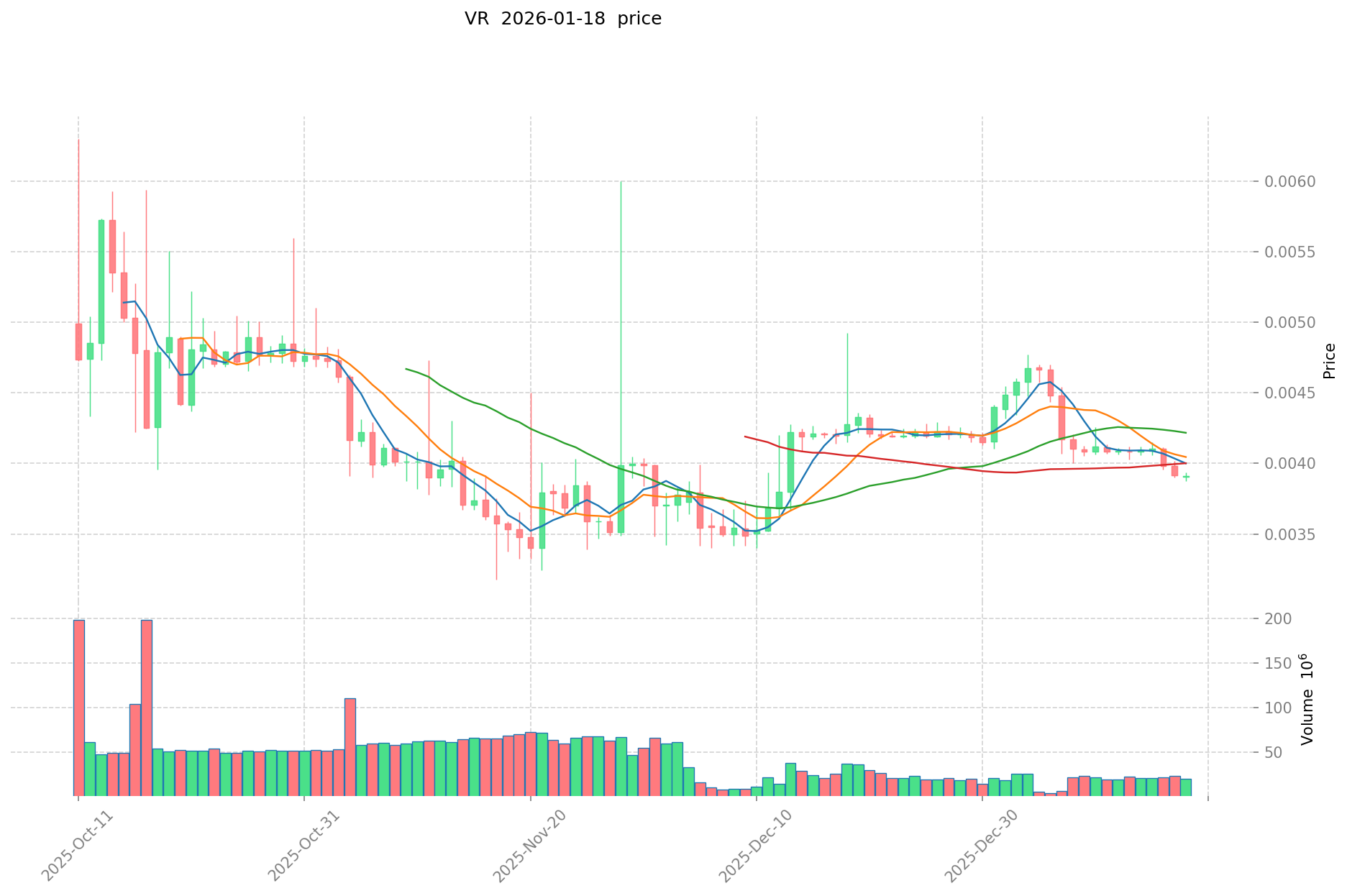
Victoria VR (VR) represents a notable asset in the cryptocurrency sector, positioning itself within the virtual reality and metaverse ecosystem. As of January 18, 2026, VR maintains a market capitalization of approximately $65.69 million, with a fully circulating supply of 16.8 billion tokens. The current price stands at around $0.00391, reflecting recent market dynamics across multiple timeframes. The token has experienced a decline of 0.02% over 24 hours, 4.43% over seven days, and 8.14% over 30 days, with a more substantial year-over-year decrease of 74.11%.
The Victoria VR project focuses on providing virtual reality technology designed for user engagement and content creation. The platform's architecture allows users to build and shape the virtual environment while rewarding creators and active participants through various mechanisms including staking and task completion. With approximately 13,000 holders and a market dominance of 0.0019%, VR operates within a specialized segment of the digital asset market.
Historical price data indicates that VR reached a notable price level of $0.615957 on December 11, 2021, while recording its lower price point of $0.00222735 on September 6, 2025. The token's 24-hour trading volume of approximately $83,033.55 suggests ongoing market activity. As investors evaluate whether Victoria VR represents a suitable addition to their portfolios, this analysis examines the asset's investment characteristics, historical performance patterns, price trajectory considerations, and associated risk factors to provide informational context for decision-making processes.
I. Victoria VR (VR) Price History Review and Current Investment Value
-
2018-2020: Global VR hardware shipments experienced substantial growth during this period. The expansion of virtual reality technology infrastructure and consumer adoption created favorable conditions for VR-related assets, though specific Victoria VR token performance data from this early period remains limited in available materials.
-
2021-2022: The VR sector witnessed a significant market correction. Industry reports indicate that in 2022, global VR shipments declined compared to the previous year, influenced by pricing strategies such as Quest 2's product positioning that affected consumer purchasing momentum. This broader market downturn likely impacted VR token valuations, with the asset experiencing downward pressure alongside the wider virtual reality hardware market.
-
2023-2024: The VR industry entered a recovery phase characterized by product optimization and ecosystem development. According to market analysis, global VR device shipments showed signs of stabilization, with projections suggesting potential growth trajectories. During this period, VR token price movements reflected both ongoing market volatility and emerging opportunities within the virtual reality sector, though investors continued to face challenges related to market maturity and adoption rates.
-
Recent Performance (2025-2026): As of early 2026, VR token has demonstrated mixed performance patterns. The asset recorded a 24-hour price change of -0.02%, a 7-day decline of -4.43%, and a 30-day decrease of -8.14%. Over a one-year timeframe, the token experienced a decline of -74.11%, indicating substantial volatility and challenging market conditions for holders during this period.
Current VR Investment Market Status (January 2026)
- VR Current Price: $0.00391 (as of January 18, 2026)
- 24-Hour Trading Volume: $83,033.55, indicating moderate trading activity levels
- Market Capitalization: $65.688 million, with a circulating supply of 16.8 billion tokens representing 100% of the maximum supply
- Market Share: 0.0019% of the broader cryptocurrency market
- Holder Distribution: Approximately 13,000 holders, suggesting a developing but limited user base
- Exchange Availability: Listed on 3 exchanges, with Gate.com being a primary trading platform
Click to view real-time VR market price
Investment considerations as of early 2026 include the token's significant year-over-year decline, moderate liquidity levels, and positioning within the competitive virtual reality and metaverse sectors. The VR industry context shows potential for recovery with new product iterations and pricing optimizations, though broader market adoption challenges persist. According to industry analysis, major players including Meta, Apple, and Samsung continue advancing VR/AR technologies, which may influence the overall ecosystem development. However, investment risks remain elevated due to market volatility, competitive pressures, and the nascent stage of virtual reality mass adoption. The token's fully diluted market cap matching its current market cap indicates complete circulation, eliminating future supply inflation concerns but also suggesting limited mechanisms for scarcity-driven value appreciation.
II. Core Factors Influencing Whether VR is a Good Investment
Supply Mechanism and Scarcity (VR Investment Scarcity)
- Fixed Supply Structure → Impact on Price and Investment Value
Victoria VR has a clearly defined supply structure with a maximum supply of 16.8 billion VR tokens, all of which are currently in circulation. This represents a 100% circulating supply ratio, meaning there is no additional token release pressure that could dilute holder value. The fully diluted market cap matches the current market cap at approximately $65.69 million, indicating complete price discovery without future inflation concerns.
- Investment Significance: Scarcity as a Foundation for Long-term Investment
The fixed supply cap creates a deflationary characteristic that may support long-term value retention. With no additional tokens scheduled for release, demand-side factors such as platform adoption and user growth could have more direct impacts on token valuation. However, the 100% circulation also means there is no supply-side constraint from locked tokens, which historically has provided upward price pressure in other projects during unlock periods.
Institutional Investment and Mainstream Adoption (Institutional Investment in VR)
- Holder Distribution Trends: Approximately 13,000 Holders
Victoria VR currently has around 13,000 token holders, suggesting a moderate level of community participation. The project maintains presence across 3 exchanges, indicating limited but established market access. The token operates on the Ethereum blockchain with the contract address 0x7d5121505149065b562c789a0145ed750e6e8cdd, providing transparency and security through Ethereum's established infrastructure.
- Platform Recognition and Market Position
Victoria VR ranks #456 by market capitalization with a market share of 0.0019%. The project's 24-hour trading volume of approximately $83,033 reflects moderate liquidity conditions. While the project has established presence through official channels including its website, Twitter, LinkedIn, and Instagram, there is limited publicly available information regarding specific institutional partnerships or enterprise-level adoption.
Macroeconomic Environment's Impact on VR Investment
- Market Sentiment and Broader Crypto Trends
As a smaller-cap virtual reality focused cryptocurrency project, Victoria VR's investment outlook is influenced by broader trends in both the cryptocurrency market and the metaverse sector. The project's market capitalization of approximately $65.69 million positions it as a mid-to-small cap asset, which typically exhibits higher volatility compared to larger cryptocurrencies. This characteristic may appeal to investors seeking growth potential while also presenting elevated risk profiles.
- Price Performance Context
Victoria VR's current price of $0.00391 represents substantial distance from its historical peak. Over the past year, the token has experienced a -74.11% decline, with additional negative performance across shorter timeframes: -8.14% over 30 days and -4.43% over 7 days. The 24-hour price change shows relative stability at -0.02%. These metrics suggest challenging market conditions that potential investors should consider when evaluating entry points.
Technology and Ecosystem Development (Technology & Ecosystem for VR Investment)
- Virtual Reality Platform Features
Victoria VR positions itself as a virtual reality world built from the ground up, designed to provide users with immersive VR technology experiences. The platform's architecture allows users to create, explore, and interact within the virtual environment. The ecosystem incorporates reward mechanisms for creators and active users through various activities including work contributions, voting participation, commenting, task completion, and VR token staking. Random real-world airdrops also serve as engagement incentives.
- Ecosystem Value Proposition
The project's value proposition centers on user-generated content and community-driven world-building. The platform aims to create a self-sustaining virtual economy where creators are compensated for their contributions, potentially establishing long-term engagement loops. The reward distribution system may help maintain user retention and platform activity, which are critical factors for the token's utility and demand. However, the success of this model depends on sustained user adoption and content creation activity, which requires ongoing evaluation by potential investors.
Built on the Ethereum network, Victoria VR benefits from the security and decentralization of one of the most established blockchain platforms. This infrastructure choice provides access to Ethereum's extensive ecosystem of tools, wallets, and decentralized applications. The Ethereum foundation also enables smart contract functionality that supports the project's reward distribution and governance mechanisms.
III. VR Future Investment Forecast and Price Outlook (Is Victoria VR(VR) worth investing in 2026-2031)
Short-term Investment Forecast (2026, short-term VR investment outlook)
- Conservative Forecast: $0.00278 - $0.00350
- Neutral Forecast: $0.00350 - $0.00392
- Optimistic Forecast: $0.00392 - $0.00419
Mid-term Investment Outlook (2027-2029, mid-term Victoria VR(VR) investment forecast)
-
Market Phase Expectation: Victoria VR is anticipated to navigate a consolidation and gradual expansion phase during 2027-2029, as virtual reality applications continue to mature across gaming, entertainment, and metaverse sectors. The token's performance may be influenced by broader adoption trends in immersive technologies and platform development progress.
-
Investment Return Forecast:
- 2027: $0.00231 - $0.00450
- 2028: $0.00303 - $0.00479
- 2029: $0.00371 - $0.00625
-
Key Catalysts: Platform ecosystem development, user acquisition growth, strategic partnerships in the VR and metaverse space, broader cryptocurrency market sentiment, and technological advancements in virtual reality infrastructure.
Long-term Investment Outlook (Is VR a good long-term investment?)
- Base Scenario: $0.0040 - $0.0055 (assuming steady ecosystem development and sustained user engagement in the Victoria VR platform)
- Optimistic Scenario: $0.0055 - $0.0081 (assuming accelerated adoption of VR technologies, successful platform expansion, and favorable market conditions for metaverse projects)
- Risk Scenario: $0.0023 - $0.0037 (in case of prolonged market downturns, technological setbacks, or increased competition in the virtual reality sector)
For detailed VR long-term investment and price predictions, visit: Price Prediction
2026-01-18 - 2031 Long-term Outlook
- Base Scenario: $0.0040 - $0.0055 (corresponding to steady progress and gradual mainstream application adoption)
- Optimistic Scenario: $0.0055 - $0.0081 (corresponding to large-scale adoption and favorable market environment)
- Transformative Scenario: Above $0.0081 (if the ecosystem achieves breakthrough progress and mainstream popularization)
- 2031-12-31 Predicted High: $0.0081 (based on optimistic development assumptions)
Disclaimer: The above forecasts are based on technical analysis and market research available as of January 2026. Cryptocurrency investments carry substantial risk, and actual prices may vary significantly from predictions due to market volatility, regulatory changes, technological developments, and macroeconomic factors. These projections should not be construed as investment advice, and investors should conduct their own thorough research and risk assessment before making any investment decisions.
| Year |
Predicted High Price |
Predicted Average Price |
Predicted Low Price |
Price Change |
| 2026 |
0.00418691 |
0.003913 |
0.00277823 |
0 |
| 2027 |
0.00449545005 |
0.004049955 |
0.00230847435 |
3 |
| 2028 |
0.004785426828 |
0.004272702525 |
0.00303361879275 |
9 |
| 2029 |
0.00625010925357 |
0.0045290646765 |
0.00371383303473 |
15 |
| 2030 |
0.005551274573986 |
0.005389586965035 |
0.00474283652923 |
37 |
| 2031 |
0.008096237538875 |
0.00547043076951 |
0.004048118769437 |
39 |
IV. Victoria VR Investment Strategy and Risk Management (How to invest in VR)
Investment Strategy (Victoria VR investment strategy)
Long-term Holding (HODL Victoria VR)
Long-term holding may be suitable for conservative investors who believe in the fundamental value proposition of virtual reality metaverse platforms. This approach involves purchasing VR tokens and maintaining positions through market cycles, potentially benefiting from the long-term development of the Victoria VR ecosystem. Given the current price of $0.00391 compared to its all-time high of $0.615957 (recorded on December 11, 2021), investors should carefully evaluate whether the current valuation represents a reasonable entry point relative to the project's development stage and competitive positioning.
Active Trading
Active trading strategies rely on technical analysis and swing trading approaches to capitalize on Victoria VR's price movements. With 24-hour trading volume of approximately $83,033.55 and recent price fluctuations showing -0.02% in 24 hours, -4.43% over 7 days, and -8.14% over 30 days, traders may identify potential opportunities in short-term price movements. However, the relatively modest trading volume suggests lower liquidity compared to major cryptocurrencies, which may impact execution and increase slippage risks.
Risk Management (Risk management for Victoria VR investment)
Asset Allocation Ratio
- Conservative Investors: May consider allocating no more than 1-3% of their cryptocurrency portfolio to VR tokens, given the project's relatively smaller market capitalization of approximately $65.69 million and ranking at #456.
- Aggressive Investors: Could potentially allocate 5-10% of their crypto portfolio, accepting higher volatility in exchange for potential growth opportunities in the metaverse and virtual reality sector.
- Professional Investors: Should conduct comprehensive due diligence on the project's technology, team, roadmap, and competitive landscape before determining appropriate allocation levels.
Risk Hedging Strategies
Investors may consider diversifying across multiple metaverse and virtual reality projects rather than concentrating exclusively in Victoria VR. A balanced portfolio approach could include a mix of established cryptocurrencies, other metaverse tokens, and traditional assets to mitigate sector-specific risks. Additionally, implementing stop-loss orders and position sizing strategies can help manage downside exposure during periods of heightened volatility.
Secure Storage
- Cold Wallet Storage: For long-term holdings, hardware wallets provide enhanced security by keeping private keys offline and protected from online threats.
- Hot Wallet Solutions: For active traders requiring frequent access, reputable software wallets with multi-factor authentication offer a balance between accessibility and security.
- Exchange Storage: While convenient for trading, keeping significant amounts on exchanges carries counterparty risk and should generally be avoided for long-term storage.
Given that VR is an ERC-20 token (contract address: 0x7d5121505149065b562c789a0145ed750e6e8cdd), investors should ensure their chosen wallet solution supports Ethereum-based tokens.
V. Victoria VR Investment Risks and Challenges (Risks of investing in VR)
Market Risks
High Volatility: Victoria VR has demonstrated significant price volatility, with the token declining approximately 74.11% over the past year and trading substantially below its all-time high. The price has ranged from a low of $0.00222735 (recorded on September 6, 2025) to its current level of $0.00391, indicating considerable price swings that may challenge investors' risk tolerance.
Liquidity Concerns: With a 24-hour trading volume of approximately $83,033.55 and availability on only 3 exchanges, VR tokens may face liquidity constraints compared to more widely traded cryptocurrencies. Lower liquidity can result in wider bid-ask spreads, increased slippage, and potential difficulty executing larger trades without significant price impact.
Regulatory Risks
The regulatory landscape for metaverse and virtual reality projects continues to evolve across different jurisdictions. Potential regulatory developments affecting virtual worlds, digital assets, user-generated content, and token economics could impact the Victoria VR platform's operations and token utility. Investors should monitor regulatory developments in their respective jurisdictions and major cryptocurrency markets, as policy changes could affect token accessibility, trading options, and overall project viability.
Technical Risks
Network Security: As an ERC-20 token built on the Ethereum blockchain, Victoria VR inherits both the security benefits and potential vulnerabilities of the Ethereum network. While Ethereum provides a robust foundation, smart contract vulnerabilities, potential bugs in the Victoria VR platform code, or security breaches could pose risks to token holders and platform users.
Development and Execution Risks: The success of Victoria VR depends on the team's ability to execute their roadmap, deliver on technical milestones, and compete effectively in the growing metaverse and virtual reality sector. Delays in development, technical challenges, or failure to attract and retain users could negatively impact the project's long-term prospects and token value.
Competitive Landscape: The metaverse and virtual reality sector has attracted significant investment and competition from both blockchain-native projects and established technology companies. Victoria VR's ability to differentiate itself, build a sustainable user base, and maintain relevance in an increasingly crowded market represents an ongoing challenge.
VI. Conclusion: Is VR a Good Investment?
Investment Value Summary
Victoria VR presents a speculative investment opportunity within the metaverse and virtual reality sector, with both potential upside and considerable risks. The project's vision of creating a user-generated virtual reality world with economic incentives for creators and active participants addresses an emerging market opportunity. However, the token's performance over the past year, with a decline of approximately 74.11%, reflects both sector-wide challenges and project-specific factors that investors must carefully consider.
The current market capitalization of approximately $65.69 million and ranking at #456 suggest Victoria VR remains a relatively small-cap project compared to major cryptocurrencies and even other metaverse tokens. While this positioning could offer growth potential if the project successfully executes its roadmap and gains adoption, it also indicates higher risk compared to more established projects.
Investor Recommendations
✅ Beginners: Consider a dollar-cost averaging approach with small, regular investments rather than large lump-sum positions. Prioritize secure storage solutions, preferably hardware wallets for long-term holdings, and invest only amounts you can afford to lose. Take time to understand the Victoria VR platform, its utility model, and the broader metaverse sector before committing capital.
✅ Experienced Investors: May explore swing trading opportunities based on technical analysis and market cycles, while maintaining a diversified portfolio across multiple metaverse and cryptocurrency projects. Consider the risk-reward profile relative to other opportunities in the sector and adjust position sizing accordingly. Monitor project development updates, community engagement metrics, and competitive dynamics.
✅ Institutional Investors: Should conduct comprehensive due diligence on the project's technology stack, team credentials, tokenomics, competitive positioning, and growth strategy before considering any strategic allocation. Evaluate Victoria VR within the context of broader metaverse and virtual reality investment themes, and assess whether the project's scale and maturity align with institutional investment criteria.
⚠️ Disclaimer: Cryptocurrency investments carry substantial risk due to price volatility, regulatory uncertainty, and technological challenges. This analysis is provided for informational purposes only and does not constitute investment advice. Investors should conduct their own research, assess their risk tolerance, and consider consulting with qualified financial advisors before making investment decisions.
VII. FAQ
Q1: What is Victoria VR (VR) and what makes it different from other metaverse projects?
Victoria VR is a blockchain-based virtual reality metaverse platform built on the Ethereum network that enables users to create, explore, and interact within immersive virtual environments. The project distinguishes itself through its comprehensive reward system that compensates creators and active participants through various mechanisms including staking, task completion, voting, and content creation. With a fixed maximum supply of 16.8 billion tokens (100% currently circulating), VR operates as an ERC-20 token (contract address: 0x7d5121505149065b562c789a0145ed750e6e8cdd). As of January 18, 2026, the token maintains a market capitalization of approximately $65.69 million with around 13,000 holders, positioning it as a mid-sized project within the competitive metaverse sector that focuses specifically on virtual reality technology integration.
Q2: How has Victoria VR performed historically and what is its current price trend?
Victoria VR has experienced significant volatility throughout its history. The token reached an all-time high of $0.615957 on December 11, 2021, but has since declined substantially to its current price of $0.00391 as of January 18, 2026—representing a year-over-year decrease of 74.11%. Recent performance shows a 24-hour decline of 0.02%, a 7-day drop of 4.43%, and a 30-day decrease of 8.14%. The token recorded its historical low of $0.00222735 on September 6, 2025. This performance reflects both broader market conditions in the cryptocurrency sector and specific challenges within the metaverse and virtual reality space, including competition from established technology companies and ongoing adoption challenges for VR technology.
Q3: What are the price predictions for Victoria VR from 2026 to 2031?
Short-term forecasts for 2026 suggest Victoria VR could trade between $0.00278-$0.00419 depending on market conditions, with conservative, neutral, and optimistic scenarios. Mid-term projections indicate potential ranges of $0.00231-$0.00450 for 2027, $0.00303-$0.00479 for 2028, and $0.00371-$0.00625 for 2029, reflecting anticipated consolidation and gradual expansion in the virtual reality sector. Long-term outlook for 2031 presents three scenarios: a base scenario of $0.0040-$0.0055 assuming steady ecosystem development, an optimistic scenario of $0.0055-$0.0081 with accelerated adoption, and a risk scenario of $0.0023-$0.0037 during prolonged market downturns. These forecasts depend on multiple factors including platform development progress, user adoption rates, technological advancements in VR, and overall cryptocurrency market sentiment.
Q4: What are the main risks associated with investing in Victoria VR?
Investing in Victoria VR carries several significant risks that potential investors should carefully evaluate. Market risks include high volatility demonstrated by the 74.11% year-over-year decline and relatively low liquidity with only $83,033.55 in 24-hour trading volume across 3 exchanges, which may result in wider bid-ask spreads and execution challenges. Regulatory risks stem from the evolving legal landscape for metaverse projects and digital assets, which could impact platform operations and token utility. Technical risks include potential smart contract vulnerabilities, development delays, and execution challenges in delivering the project roadmap. Additionally, Victoria VR faces intense competition from both blockchain-native metaverse projects and established technology companies entering the virtual reality space, which may affect its ability to attract and retain users in an increasingly crowded market.
Q5: What investment strategies are appropriate for different types of Victoria VR investors?
Investment strategies for Victoria VR should align with individual risk profiles and investment objectives. Conservative investors may consider allocating 1-3% of their cryptocurrency portfolio to VR tokens through a long-term holding (HODL) strategy, prioritizing secure cold wallet storage and dollar-cost averaging to minimize timing risk. Aggressive investors could allocate 5-10% while potentially incorporating active trading strategies based on technical analysis, though the modest trading volume requires careful attention to liquidity conditions. Beginners should start with small, regular investments using dollar-cost averaging, focus on understanding the platform's fundamentals and the broader metaverse sector, and never invest more than they can afford to lose. Experienced and institutional investors should conduct comprehensive due diligence on the project's technology, competitive positioning, and growth strategy while maintaining diversification across multiple metaverse projects to mitigate sector-specific risks.
Q6: How does Victoria VR's tokenomics affect its investment potential?
Victoria VR's tokenomics feature a fixed maximum supply of 16.8 billion tokens with 100% already in circulation, meaning the fully diluted market cap matches the current market cap of approximately $65.69 million. This complete circulation eliminates future supply inflation concerns and potential dilution from token unlocks, which can be advantageous for long-term holders as demand-side factors such as platform adoption and user growth have more direct impacts on token valuation. However, the 100% circulation also means there are no supply-side constraints from locked tokens that historically provide upward price pressure in other projects during gradual unlock periods. The token's utility centers on rewarding ecosystem participants through staking, content creation incentives, voting mechanisms, and task completion, creating potential demand drivers if the platform successfully attracts and retains an active user base.
Q7: Should I invest in Victoria VR in 2026, and what factors should influence this decision?
Whether Victoria VR represents a suitable investment in 2026 depends on individual circumstances, risk tolerance, and investment objectives. Potential positive factors include the project's positioning in the growing metaverse and virtual reality sector, fixed token supply eliminating inflation concerns, established presence on multiple exchanges, and reward mechanisms designed to drive platform engagement. However, significant considerations include the substantial 74.11% year-over-year price decline, relatively small market capitalization ranking at #456, modest trading volume suggesting limited liquidity, and intense competition in the metaverse space. The current price of $0.00391 represents approximately 99% below the all-time high, which could indicate either a potential value opportunity or reflect fundamental challenges. Investors should conduct thorough research on the project's development progress, competitive positioning, team execution capability, and broader market conditions before making any investment decision, treating Victoria VR as a speculative, high-risk allocation within a diversified portfolio.
* The information is not intended to be and does not constitute financial advice or any other recommendation of any sort offered or endorsed by Gate.