This comprehensive analysis examines Victoria VR (VR), an ERC-20 metaverse token with a current market capitalization of $65.69 million trading at $0.00391 as of January 2026. The article evaluates VR's investment potential by reviewing historical price movements, including the token's all-time high of $0.615957 in December 2021 and recent 74.05% annual decline, while analyzing core investment factors including fixed token supply, ecosystem technology development, and macroeconomic influences. Investment forecasts present multiple scenarios through 2031, with base projections ranging from $0.00448-$0.00698 and optimistic scenarios reaching $0.00820-$0.01124. The guide outlines tailored investment strategies for different investor profiles—from conservative dollar-cost averaging approaches to active trading techniques—while emphasizing critical risk management through portfolio allocation, hedging strategies, and secure token storage. Comprehensive risk analysis addresses market volatility, regulatory uncertai
Introduction: Victoria VR (VR) Investment Status and Market Outlook
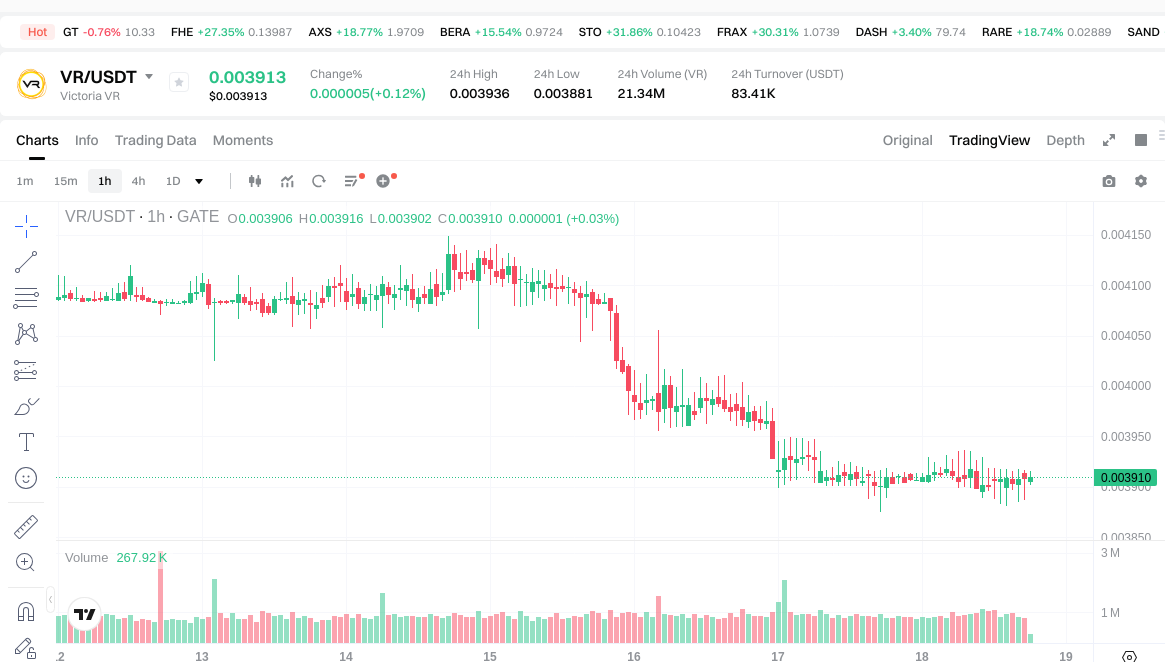
Victoria VR (VR) represents a notable asset in the cryptocurrency sector, operating within the virtual reality and blockchain gaming space. As of January 18, 2026, VR maintains a market capitalization of approximately $65.69 million, with a circulating supply of 16.8 billion tokens and a current price of around $0.00391. The token has experienced significant price fluctuations since its launch, reaching an all-time high of $0.615957 on December 11, 2021, and an all-time low of $0.00222735 on September 6, 2025.
The Victoria VR ecosystem is designed to provide users with immersive virtual reality experiences, allowing participants to create, interact, and earn rewards through various activities including content creation, staking, and community engagement. With approximately 13,000 token holders and trading availability on 3 exchanges, VR has established a presence in the market, though it represents a relatively modest 0.0019% market dominance.
Recent performance data indicates mixed market sentiment, with a 24-hour price increase of 0.48%, while showing declines of 4.29% over the past week and 8.39% over the past month. The one-year performance reflects a 74.05% decrease, highlighting the volatility inherent in this asset class. The token's fully diluted valuation matches its current market cap at $65.69 million, indicating that 100% of the maximum supply is already in circulation.
This analysis will examine Victoria VR's investment characteristics, historical price movements, future price projections, and associated risks to provide a comprehensive reference for those evaluating VR as a potential investment opportunity in the evolving virtual reality and blockchain gaming landscape.
I. Victoria VR (VR) Price History Review and Investment Value Status
Based on available reference materials, Victoria VR (VR) has experienced notable price fluctuations since its inception:
-
2021: The token was launched and subsequently experienced significant volatility. During December 2021, VR recorded a price level around $0.616, representing a period of elevated market interest in virtual reality and metaverse-related projects.
-
2022-2024: The broader VR/AR industry faced challenges, with global VR hardware shipments declining in 2022 due to pricing strategy impacts on consumer purchasing power. According to industry data, global VR device shipments reached 10.14 million units in 2022, showing a decrease compared to the previous year. However, projections suggested recovery potential, with anticipated shipments reaching 14.9 million units by 2024 as product pricing strategies optimized and new iterations emerged.
-
2025: Market conditions continued to evolve, with VR experiencing substantial price compression. By September 2025, the token traded near $0.00223, reflecting broader industry consolidation and market correction phases.
-
2026 (Current): As of January 18, 2026, VR trades at approximately $0.00391, representing partial recovery from 2025 lows but remaining significantly below historical peaks recorded in 2021.
Current VR Investment Market Status (January 2026)
- VR Current Price: $0.00391 USD
- 24-Hour Price Change: +0.48%
- 24-Hour Trading Volume: $83,730.32 USD
- Market Capitalization: $65.688 million USD
- Circulating Supply: 16.8 billion VR tokens (100% of total supply)
- Fully Diluted Valuation: $65.688 million USD
- Market Dominance: 0.0019% of crypto market
- Price Performance:
- 1 Hour: +0.1%
- 7 Days: -4.29%
- 30 Days: -8.39%
- 1 Year: -74.05%
- Total Token Holders: Approximately 13,000
- Exchange Listings: Available on 3 exchanges
Click to view real-time VR market price
The VR/AR industry context shows mixed signals for investment consideration. While the 2024 VR/AR sector recorded 93 financing events totaling $1.275 billion globally (with Chinese market accounting for 28 events worth $189 million), the industry faces ongoing challenges. Notably, 2024 saw over 30 large-scale VR theme park projects in China close or transform due to operational difficulties, resulting in investment losses exceeding 10 billion yuan. Industry observers note that high initial costs remain a substantial barrier to broader VR adoption, though the sector continues to demonstrate technological advancement and emerging application scenarios.
The investment landscape for VR tokens remains characterized by high volatility and significant risks, typical of early-stage virtual reality and metaverse-related digital assets. Market participants should consider the substantial price fluctuations observed over the token's history when evaluating potential investment positions.
II. Core Factors Influencing Whether VR is a Good Investment
Supply Mechanism and Scarcity (VR Investment Scarcity)
- Fixed Maximum Supply: Victoria VR has a maximum supply of 16,800,000,000 tokens, with 100% currently in circulation. This capped supply model establishes a fixed scarcity framework that may influence long-term value dynamics.
- Circulating Supply Status: With total supply matching circulating supply (16,800,000,000 VR), there is no additional token unlock pressure that could dilute holder positions in the near term.
- Investment Implication: The fully diluted nature of VR's token economics removes future inflation risk from new token releases, though scarcity alone does not guarantee appreciation without corresponding demand growth.
Institutional Investment and Mainstream Adoption (Institutional Investment in VR)
- Holder Base: Victoria VR currently has approximately 13,000 token holders, indicating a relatively modest community size compared to major cryptocurrency projects.
- Exchange Presence: The token is listed on 3 exchanges, suggesting limited mainstream exchange integration at present.
- Adoption Context: While Victoria VR aims to create a virtual reality metaverse ecosystem with user-generated content and reward mechanisms, concrete data on institutional holdings or major enterprise partnerships is not available in current materials.
Macroeconomic Environment's Impact on VR Investment
- Market Positioning: Victoria VR operates within the virtual reality and metaverse sector, which may be influenced by broader technological adoption trends and risk appetite in digital asset markets.
- Economic Sensitivity: As with many cryptocurrency projects, VR's investment appeal may fluctuate with changes in monetary policy, interest rate environments, and overall market liquidity conditions.
- Risk Consideration: The token's substantial decline over the past year (down 74.05% annually as of January 18, 2026) reflects sensitivity to market cycles and suggests exposure to broader macroeconomic pressures affecting speculative digital assets.
Technology and Ecosystem Development (Technology & Ecosystem for VR Investment)
- Platform Vision: Victoria VR is designed as a blockchain-based virtual reality world where users can create content, participate in governance, and earn rewards through various activities including staking, voting, and task completion.
- Token Utility: The VR token functions within the ecosystem for rewarding creators and active users, with mechanisms for staking and participation incentives built into the platform design.
- Ecosystem Scope: The project positions itself at the intersection of virtual reality technology and blockchain, though specific details on technical upgrades, DeFi integration, NFT functionality, or major application developments are not provided in available materials.
- Development Context: Victoria VR is deployed as an ERC-20 token on the Ethereum network, leveraging Ethereum's established infrastructure for its token operations.
III. VR Future Investment Forecast and Price Outlook (Is Victoria VR(VR) worth investing in 2026-2031)
Short-term Investment Forecast (2026, short-term VR investment outlook)
Based on available data, the short-term price trajectory for Victoria VR (VR) in 2026 suggests the following potential ranges:
- Conservative forecast: $0.00364 - $0.00391
- Neutral forecast: $0.00391 - $0.00454
- Optimistic forecast: $0.00454 - $0.00516
The token's recent 24-hour performance showed a modest increase of 0.48%, with trading between $0.003881 and $0.003936. Market sentiment appears cautiously neutral, with the token currently ranking #454 by market capitalization at approximately $65.69 million.
Mid-term Investment Outlook (2027-2029, mid-term Victoria VR(VR) investment forecast)
-
Market stage expectations: The mid-term period may reflect gradual market maturation, with price movements influenced by broader virtual reality sector developments and user adoption trends within the Victoria VR ecosystem.
-
Investment return forecasts:
- 2027: $0.00304 - $0.00513
- 2028: $0.00256 - $0.00672
- 2029: $0.00375 - $0.00820
-
Key catalysts: Potential factors include platform ecosystem expansion, user base growth, technological enhancements in VR integration, partnerships within the metaverse sector, and overall cryptocurrency market conditions.
Long-term Investment Outlook (Is VR a good long-term investment?)
The extended timeline through 2031 presents varying scenarios based on different development assumptions:
- Base scenario: $0.00448 - $0.00698 (assuming steady platform development and moderate user growth)
- Optimistic scenario: $0.00820 - $0.01124 (assuming accelerated adoption and favorable market conditions)
- Risk scenario: Below $0.00256 (under adverse market conditions or reduced platform engagement)
For comprehensive VR long-term investment analysis and price predictions: Price Prediction
2026-01-18 - 2031 Long-term Outlook
- Base scenario: $0.00448 - $0.00845 (corresponding to steady progress and gradual mainstream application growth)
- Optimistic scenario: $0.00820 - $0.01124 (corresponding to large-scale adoption and favorable market environment)
- Transformative scenario: Above $0.01124 (if ecosystem achieves breakthrough developments and mainstream penetration)
- 2031-12-31 projected high: $0.01124 (based on optimistic development assumptions)
Disclaimer: These forecasts represent analytical projections based on available data and market trends. Cryptocurrency markets involve substantial risk and volatility. Price predictions should not be construed as investment advice, and actual performance may differ materially from projections. Investors should conduct independent research and consider their risk tolerance before making investment decisions.
| Year |
Predicted High Price |
Predicted Average Price |
Predicted Low Price |
Price Change |
| 2026 |
0.00516252 |
0.003911 |
0.00363723 |
0 |
| 2027 |
0.0051265388 |
0.00453676 |
0.0030396292 |
16 |
| 2028 |
0.006715992666 |
0.0048316494 |
0.002560774182 |
23 |
| 2029 |
0.00819882586686 |
0.005773821033 |
0.00375298367145 |
47 |
| 2030 |
0.0099205792989 |
0.00698632344993 |
0.005169879352948 |
78 |
| 2031 |
0.011243090327972 |
0.008453451374415 |
0.00448032922844 |
116 |
Investment Strategy (Victoria VR investment strategy)
Long-term Holding (HODL VR)
For conservative investors, a long-term holding strategy may be considered with Victoria VR. This approach focuses on the project's vision of creating an immersive virtual reality ecosystem where users can create, interact, and earn rewards. The platform's design emphasizes user-generated content and community engagement, with reward mechanisms for creators, voters, and active participants through VR token staking and task completion.
Given the total and maximum supply of 16.8 billion tokens with 100% already in circulation, there is no future dilution risk from additional token releases. However, investors should carefully evaluate the project's development progress and user adoption metrics before committing to long-term positions.
Active Trading
Active traders may utilize technical analysis and momentum strategies when trading VR tokens. Recent price data shows short-term volatility, with 24-hour changes of +0.48% and weekly fluctuations of -4.29%. The token's trading range between $0.003881 and $0.003936 within 24 hours suggests opportunities for short-term trading strategies.
Traders should monitor key support and resistance levels, with the current price of $0.00391 significantly below its historical high of $0.615957 (recorded on December 11, 2021). Technical indicators, volume patterns (daily volume: $83,730), and market sentiment should inform entry and exit decisions.
Risk Management (Risk management for Victoria VR investment)
Asset Allocation Ratio
- Conservative Investors: Consider allocating no more than 1-3% of crypto portfolio to VR tokens, given its mid-cap status (market cap: $65.69 million) and volatility characteristics.
- Moderate Investors: May allocate 3-7% depending on risk tolerance and conviction in the metaverse sector.
- Experienced Investors: Could allocate 7-15% as part of a diversified metaverse and gaming token strategy, with regular rebalancing based on performance and market conditions.
Risk Hedging Strategies
- Multi-Asset Portfolio: Combine VR holdings with established cryptocurrencies and stablecoins to reduce concentration risk.
- Correlation Analysis: Monitor correlation with other metaverse tokens and broader crypto market trends.
- Position Sizing: Implement strict position limits based on individual risk tolerance and portfolio size.
Secure Storage
- Hot Wallets: For active trading portions, use reputable exchanges or mobile wallets with two-factor authentication enabled.
- Cold Wallets: For long-term holdings, consider hardware wallets that support ERC-20 tokens, as VR is deployed on the Ethereum network (contract address: 0x7d5121505149065b562c789a0145ed750e6e8cdd).
- Multi-Signature Solutions: For larger holdings, explore multi-signature wallet options for enhanced security.
Market Risk
Victoria VR exhibits significant price volatility, characteristic of mid-cap metaverse tokens. The token has experienced a -74.05% decline over the past year, demonstrating substantial downside risk. With a 24-hour price change of only +0.48% and relatively modest trading volume of $83,730, the market shows limited liquidity, which can amplify price swings during periods of buying or selling pressure.
The token's market capitalization of approximately $65.69 million represents just 0.0019% of the total crypto market, indicating limited market influence and higher susceptibility to broader market movements. Price manipulation risks may be elevated in lower-liquidity environments, where large orders can disproportionately impact price discovery.
Regulatory Risk
As a metaverse and virtual reality platform token, Victoria VR faces evolving regulatory frameworks across different jurisdictions. Regulatory developments concerning:
- Virtual asset classification and securities laws
- Metaverse platform governance and user protection
- Cross-border digital asset transactions
- Gaming and virtual economy regulations
These factors may create uncertainty regarding operational compliance and market access. Different countries maintain varying stances on cryptocurrency projects, which could affect the platform's ability to expand its user base globally.
Technical Risk
- Smart Contract Vulnerabilities: As an ERC-20 token on Ethereum, VR is subject to smart contract risks. Any coding flaws or security vulnerabilities could potentially be exploited, affecting token holders.
- Platform Development Risk: The success of Victoria VR depends on continuous platform development and user adoption. Delays in technical implementation or failure to deliver promised features could negatively impact token value.
- Network Dependency: Being built on Ethereum exposes VR to the base layer's technical challenges, including network congestion and gas fee volatility.
- Competitive Pressure: The metaverse sector faces intense competition from established projects and new entrants, requiring ongoing innovation to maintain relevance.
Investment Value Summary
Victoria VR represents a specialized investment in the metaverse and virtual reality sector. The project offers an immersive platform where users can create content, participate in governance, and earn rewards through various activities. With a fully circulating supply of 16.8 billion tokens and approximately 13,000 holders, the project has established a foundation within its niche.
However, the significant year-over-year decline of -74.05% and modest market capitalization of $65.69 million indicate that the token has faced considerable challenges. The relatively low trading volume and limited market dominance (0.0019%) suggest that liquidity and market depth remain concerns for potential investors.
Investor Recommendations
✅ Beginners:
- Consider dollar-cost averaging with very small position sizes (1-2% of crypto portfolio maximum)
- Utilize secure hardware wallet storage for any long-term holdings
- Thoroughly research the metaverse sector before investing
- Start with small amounts to understand price volatility patterns
✅ Experienced Investors:
- Employ tactical trading strategies based on technical analysis and momentum indicators
- Implement strict stop-loss orders to manage downside risk
- Diversify across multiple metaverse projects rather than concentrating in a single token
- Monitor platform development milestones and user adoption metrics
✅ Institutional Investors:
- Conduct comprehensive due diligence on the project team, technology, and competitive positioning
- Consider VR as part of a broader thematic allocation to metaverse and virtual reality sectors
- Implement robust risk management frameworks with position limits and regular rebalancing
- Evaluate liquidity constraints before establishing positions
⚠️ Disclaimer: Cryptocurrency investments carry substantial risk, including the potential for complete loss of capital. Victoria VR, like all digital assets, experiences high price volatility and faces multiple risk factors including market, regulatory, and technical challenges. This analysis is for informational purposes only and does not constitute investment advice. Investors should conduct their own research, assess their risk tolerance, and consult with qualified financial advisors before making any investment decisions.
VII. FAQ
Q1: What is Victoria VR (VR) and how does it work?
Victoria VR (VR) is an ERC-20 token that powers a blockchain-based virtual reality metaverse platform where users can create immersive content, participate in governance, and earn rewards. The platform operates on the Ethereum network and enables participants to engage in various activities including content creation, staking, voting, and task completion. The VR token serves as the primary medium of exchange and reward mechanism within the ecosystem, with a fixed maximum supply of 16.8 billion tokens, all of which are currently in circulation. As of January 18, 2026, the token maintains a market capitalization of approximately $65.69 million and trades at around $0.00391.
Q2: Is Victoria VR (VR) a good investment in 2026?
Victoria VR presents a high-risk, speculative investment opportunity with substantial volatility characteristics. The token has experienced a significant 74.05% decline over the past year, indicating considerable downside risk. With a modest market capitalization of $65.69 million, representing only 0.0019% market dominance, and limited liquidity evidenced by daily trading volume of $83,730, the investment carries elevated risk. Conservative investors should consider allocating no more than 1-3% of their crypto portfolio to VR, while experienced traders might utilize tactical strategies based on technical analysis. The investment suitability depends primarily on individual risk tolerance, portfolio diversification, and conviction in the metaverse sector's long-term growth potential.
Q3: What price predictions exist for Victoria VR through 2031?
Analytical projections for Victoria VR suggest varying scenarios based on different development assumptions. For 2026, conservative forecasts range from $0.00364 to $0.00391, while optimistic scenarios extend to $0.00516. Mid-term outlook for 2027-2029 shows potential ranges from $0.00304 (2027 low) to $0.00820 (2029 high). Long-term projections through 2031 present a base scenario of $0.00448-$0.00698, an optimistic scenario of $0.00820-$0.01124, and a transformative scenario exceeding $0.01124. The projected high for December 31, 2031 stands at $0.01124 under optimistic assumptions. However, these forecasts should be treated as analytical projections rather than guarantees, as cryptocurrency markets involve substantial volatility and unpredictability.
Q4: What are the main risks associated with investing in Victoria VR?
Victoria VR investments face multiple significant risk categories. Market risks include extreme price volatility demonstrated by the 74.05% annual decline, limited liquidity with modest trading volumes, and minimal market influence at 0.0019% dominance. Regulatory risks involve evolving frameworks for virtual asset classification, metaverse platform governance, and cross-border digital asset transactions across different jurisdictions. Technical risks encompass smart contract vulnerabilities inherent in ERC-20 tokens, platform development delays, network dependency on Ethereum's performance, and intense competitive pressure from established metaverse projects. Additionally, the relatively small holder base of approximately 13,000 participants and limited exchange listings on only 3 platforms present liquidity constraints and potential price manipulation risks.
Q5: How should investors store and secure Victoria VR tokens?
Victoria VR tokens, being ERC-20 assets deployed on Ethereum (contract address: 0x7d5121505149065b562c789a0145ed750e6e8cdd), require appropriate storage solutions based on investment strategy. For active trading portions, reputable exchanges or mobile wallets with two-factor authentication enabled provide convenience while maintaining security. For long-term holdings, hardware wallets that support ERC-20 tokens offer enhanced security through offline storage, protecting against online threats. Large holdings should consider multi-signature wallet solutions requiring multiple authorization signatures for transactions. Regardless of storage method, investors should maintain backup recovery phrases in secure physical locations, never share private keys, and regularly update wallet software to protect against security vulnerabilities.
Q6: What distinguishes Victoria VR from other metaverse projects?
Victoria VR differentiates itself through its focus on creating an immersive virtual reality ecosystem with user-generated content at its core. The platform emphasizes community engagement through comprehensive reward mechanisms for creators, voters, and active participants via VR token staking and task completion systems. Unlike some metaverse projects, Victoria VR has deployed 100% of its maximum supply of 16.8 billion tokens, eliminating future dilution risks from additional token releases. However, with approximately 13,000 token holders and availability on only 3 exchanges, the project maintains a relatively modest presence compared to major metaverse competitors. The platform's success depends on its ability to deliver on technological development promises and achieve meaningful user adoption in an increasingly competitive sector.
Q7: What investment strategies are suitable for Victoria VR tokens?
Investment approaches for Victoria VR should align with individual risk profiles and market perspectives. Conservative long-term holders (HODL strategy) might allocate 1-3% of their crypto portfolio to VR, focusing on the project's vision of building a virtual reality ecosystem while accepting the fully circulated supply structure. Active traders can utilize technical analysis and momentum strategies, monitoring key support and resistance levels, with particular attention to the substantial gap between current prices ($0.00391) and historical highs ($0.615957). Moderate investors may employ dollar-cost averaging strategies with 3-7% allocation, while experienced investors could allocate 7-15% as part of a diversified metaverse token strategy with regular rebalancing. All strategies should incorporate strict position sizing, correlation analysis with broader crypto markets, and secure storage practices appropriate to holding duration.
Q8: How does the broader VR/AR industry impact Victoria VR investment prospects?
The broader virtual reality and augmented reality industry context significantly influences Victoria VR investment considerations. Industry data indicates mixed signals: global VR device shipments reached 10.14 million units in 2022, with projections suggesting recovery to 14.9 million units by 2024 as pricing strategies optimized. However, the sector faces substantial challenges, as evidenced by the closure or transformation of over 30 large-scale VR theme park projects in China during 2024, resulting in investment losses exceeding 10 billion yuan. The 2024 VR/AR sector recorded 93 financing events totaling $1.275 billion globally, demonstrating continued investor interest despite operational difficulties. High initial costs remain a significant barrier to broader VR adoption, though technological advancement continues. These industry dynamics suggest that Victoria VR's success depends not only on platform-specific execution but also on broader sector maturation and mainstream VR/AR technology adoption.
* The information is not intended to be and does not constitute financial advice or any other recommendation of any sort offered or endorsed by Gate.