This comprehensive analysis evaluates Virtuals Protocol (VIRTUAL) as an investment opportunity, examining its current market position at $1.0697 with a $701.89 million market cap as of January 2026. The article reviews VIRTUAL's price history from its May 2024 launch at $0.132 through its peak of $5.14 in early 2025, highlighting significant market volatility and recovery patterns. Core investment factors include fixed token supply mechanics, institutional adoption across 44 exchanges including Gate, and growing AI-gaming ecosystem integration with 38 million cumulative agent interactions. The analysis presents multi-scenario price outlooks through 2031, outlines strategic investment approaches from dollar-cost averaging to active trading, and details essential risk management protocols including regulatory, technical, and liquidity considerations for diversified investor profiles.
Introduction: Virtuals Protocol (VIRTUAL)'s Investment Position and Market Outlook
VIRTUAL is a significant asset in the cryptocurrency field. As of January 14, 2026, Virtuals Protocol holds a market capitalization of approximately $701.89 million, with a circulating supply of about 656.15 million tokens, and the current price stands around $1.07. With its positioning as a gaming AI library and marketplace connecting AI contributors with game developers, VIRTUAL has gradually become a focal point for investors discussing "Is Virtuals Protocol (VIRTUAL) a good investment?" This article will comprehensively analyze VIRTUAL's investment value, historical trends, future price predictions, and investment risks to provide reference for investors.
I. Virtuals Protocol (VIRTUAL) Price History Review and Current Investment Value
-
2024: Following its May 2024 launch at $0.132, VIRTUAL experienced significant volatility, with prices declining to approximately $0.01973 by July 2024. Early investors who held through this period faced substantial downside risk as the asset searched for market equilibrium during its initial trading phase.
-
Late 2024 to Early 2025: VIRTUAL demonstrated a notable appreciation trajectory, with the token price climbing to approximately $5.14 by January 2, 2025. This period reflected growing market interest in AI-powered gaming infrastructure and represented a meaningful recovery from earlier lows, though such rapid appreciation also introduced heightened volatility concerns.
-
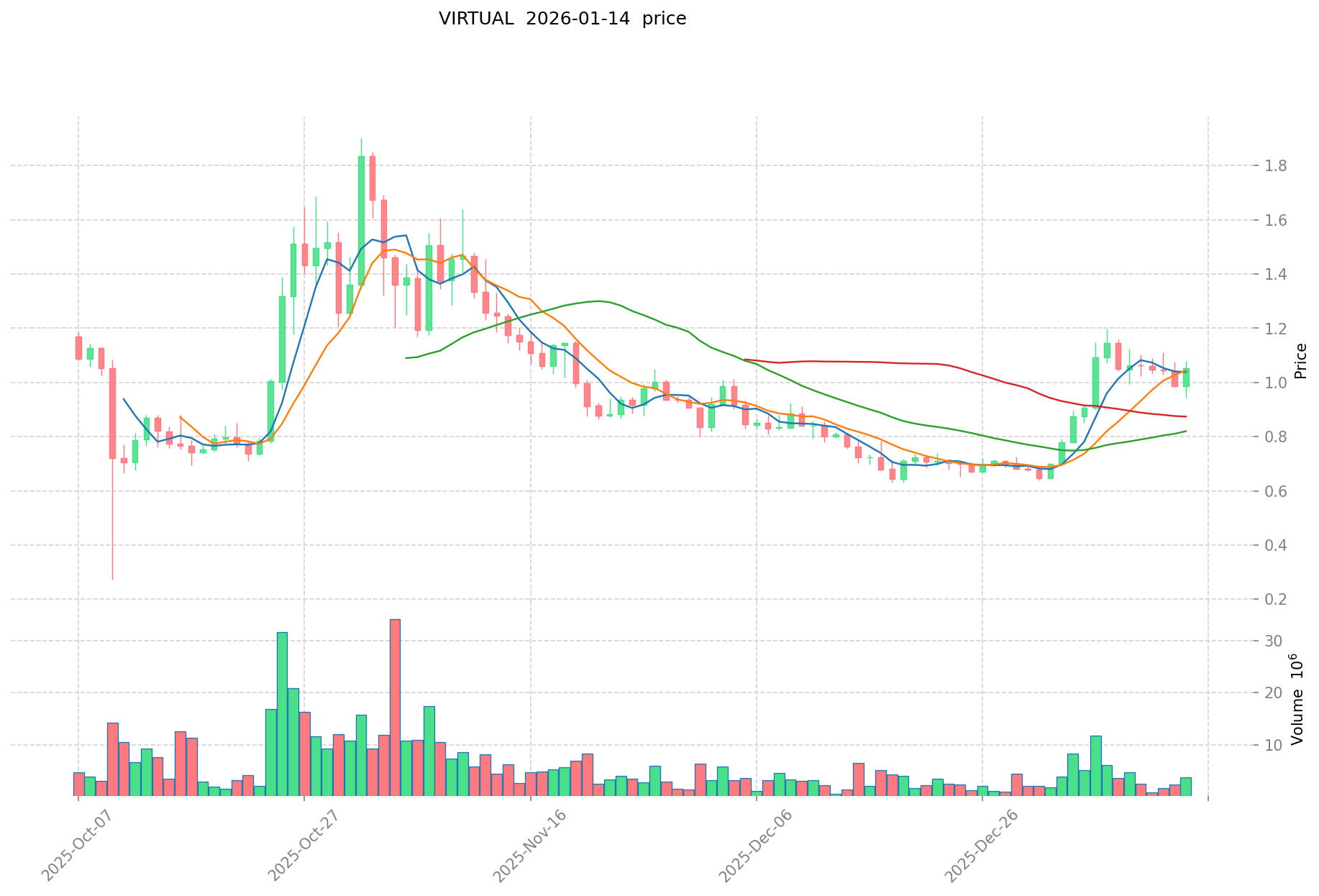
2025 Price Adjustment Phase: From the January 2025 peak, VIRTUAL underwent a market correction, with prices adjusting to approximately $1.07 by mid-January 2026. This movement from elevated levels to current pricing reflects typical crypto market cyclical behavior and profit-taking activities following substantial gains.
Current VIRTUAL Investment Market Status (January 2026)
- Current VIRTUAL Price: $1.0697 (as of January 14, 2026)
- Market Sentiment: Market emotion indicator shows neutral positioning (0 rating), suggesting balanced investor sentiment without extreme fear or greed dynamics
- 24-Hour Trading Volume: Approximately $4.83 million, indicating moderate but sustained market liquidity and participant engagement
- Institutional Positioning: VIRTUAL maintains presence across 44 cryptocurrency exchanges globally, with approximately 31,995 holders demonstrating retail and institutional distribution patterns
Click to view real-time VIRTUAL market price
II. Core Factors Influencing Whether VIRTUAL is a Good Investment
Supply Mechanism and Scarcity (VIRTUAL Investment Scarcity)
- Fixed Supply Model: VIRTUAL has a maximum supply of 1,000,000,000 tokens, with a current circulating supply of 656,151,369.81 tokens (approximately 65.62% of total supply). This fixed-cap design creates potential scarcity dynamics similar to deflationary asset models.
- Market Capitalization Position: As of January 14, 2026, VIRTUAL maintains a market capitalization of approximately $701.89 million, ranking #111 globally with a market share of 0.031%. The market cap to fully diluted valuation ratio stands at 65.62%, indicating a significant portion of tokens is already in circulation.
- Investment Significance: The predetermined supply ceiling and progressive token release schedule establish a structured scarcity framework that may support long-term valuation, though actual price performance depends on sustained demand and adoption metrics.
Institutional Investment and Mainstream Adoption (Institutional Investment in VIRTUAL)
- Platform Integration: VIRTUAL has gained notable visibility through listings on 44 cryptocurrency exchanges, including integration with Coinbase's infrastructure. The Coinbase x402 integration in late October 2025 reportedly contributed to a transaction volume increase, with agent-to-agent transactions exceeding 25,000 weekly interactions.
- Holder Distribution: The token maintains a holder base of approximately 31,995 addresses as of the reference date, suggesting a moderately distributed ownership structure across retail and potentially institutional participants.
- Market Infrastructure: VIRTUAL operates across multiple blockchain networks, with contract addresses on Base (Ethereum Layer 2) and Ethereum mainnet, providing diversified access points for different market participants and potential integration partners.
Macroeconomic Environment Impact on VIRTUAL Investment
- Sector-Specific Dynamics: As a token positioned within the AI agent and gaming sectors, VIRTUAL's investment profile correlates with broader trends in artificial intelligence adoption and metaverse development rather than traditional macroeconomic hedging narratives.
- Market Volatility Context: The token has demonstrated significant price volatility, with historical ranges from $0.01973 to $5.1428 between July 2024 and January 2025. Recent 30-day performance shows a 37.1% increase, while the 1-year trend indicates a -59.87% decline, reflecting sensitivity to sector-specific cycles and broader crypto market conditions.
- Risk Considerations: VIRTUAL's investment appeal is influenced by cryptocurrency market liquidity conditions, regulatory developments affecting AI and blockchain technologies, and the competitive landscape within decentralized AI infrastructure protocols.
Technology and Ecosystem Development (Technology & Ecosystem for VIRTUAL Investment)
- Platform Functionality: Virtuals Protocol functions as a decentralized infrastructure layer designed to connect AI contributors with game developers through SDK integration. The platform enables deployment of AI-powered NPCs and agents in gaming and metaverse environments.
- Cross-Chain Architecture: The protocol operates on Base (Ethereum Layer 2) with Solana compatibility, providing multi-chain functionality that may enhance accessibility and reduce transaction costs for developers and users.
- Ecosystem Metrics: Following the x402 integration, the platform has recorded over 38 million cumulative agent interactions. The protocol captures a 1% fee from agent interactions, with $VIRTUAL serving as the base liquidity pair for agent token pools and powering veVIRTUAL staking mechanisms for governance participation.
- Application Scope: Beyond gaming, the platform targets broader AI agent applications across metaverse environments and interactive digital experiences. The protocol positions itself within the estimated $52 billion AI agent economy, though actual market capture remains dependent on continued adoption and competitive differentiation.
III. VIRTUAL Future Investment Prediction and Price Outlook (Is Virtuals Protocol(VIRTUAL) worth investing in 2026-2031)
Short-term Investment Prediction (2026, short-term VIRTUAL investment outlook)
- Conservative Forecast: $0.89 - $1.06
- Neutral Forecast: $1.07 - $1.21
- Optimistic Forecast: $1.22 - $1.36
Mid-term Investment Outlook (2027-2029, mid-term Virtuals Protocol(VIRTUAL) investment forecast)
-
Market Phase Expectation: VIRTUAL may experience moderate growth as AI agent adoption expands within gaming and decentralized applications. The protocol's positioning as an AI agent marketplace could attract increased developer engagement and partnership integrations.
-
Investment Return Prediction:
- 2027: $1.06 - $1.64
- 2028: $1.36 - $1.60
- 2029: $1.41 - $2.06
-
Key Catalysts: Expansion of SDK adoption among game developers, integration of AI NPCs across gaming platforms, growth in AI agent vertical market capitalization, and potential partnerships with established gaming brands.
Long-term Investment Outlook (Is VIRTUAL a good long-term investment?)
- Base Scenario: $1.32 - $1.97 (assuming steady protocol development and moderate market adoption)
- Optimistic Scenario: $1.97 - $2.59 (assuming accelerated AI agent adoption and favorable crypto market conditions)
- Risk Scenario: Below $1.32 (under conditions of prolonged market downturns or competitive pressure)
Click to view VIRTUAL long-term investment and price prediction: Price Prediction
2026-2031 Long-term Outlook
- Base Scenario: $1.32 - $2.16 (corresponding to steady progress and gradual mainstream application enhancement)
- Optimistic Scenario: $1.97 - $2.59 (corresponding to large-scale adoption and favorable market environment)
- Transformative Scenario: Above $2.59 (if ecosystem achieves breakthrough progress and mainstream popularization)
- 2031-12-31 Predicted High: $2.59 (based on optimistic development assumptions)
Disclaimer: Price predictions are based on historical data analysis and current market trends. Cryptocurrency markets remain volatile and unpredictable. These forecasts should not be considered as investment advice, and actual results may differ materially from projections.
| Year |
Predicted High Price |
Predicted Average Price |
Predicted Low Price |
Price Change |
| 2026 |
1.360678 |
1.0714 |
0.889262 |
0 |
| 2027 |
1.64165265 |
1.216039 |
1.05795393 |
13 |
| 2028 |
1.600307324 |
1.428845825 |
1.35740353375 |
33 |
| 2029 |
2.05982414132 |
1.5145765745 |
1.408556214285 |
41 |
| 2030 |
2.1625124330711 |
1.78720035791 |
1.5906083185399 |
67 |
| 2031 |
2.58706187809262 |
1.97485639549055 |
1.323153784978668 |
84 |
IV. VIRTUAL Investment Strategy and Risk Management (How to invest in Virtuals Protocol)
Investment Methodology (VIRTUAL investment strategy)
Long-term Holding (HODL VIRTUAL)
For conservative investors seeking exposure to AI-gaming infrastructure, a buy-and-hold strategy may be suitable. This approach involves acquiring VIRTUAL tokens and maintaining positions through market cycles, banking on the protocol's long-term value proposition as a marketplace connecting AI contributors with game developers.
Active Trading
Experienced traders may pursue short-to-medium term opportunities using technical analysis. Given VIRTUAL's historical price range between $0.01973 and $5.1428, active trading strategies could capitalize on volatility patterns. Key considerations include monitoring volume trends (current 24h volume: $4.83M) and price movements across support/resistance levels.
Risk Management (Risk management for VIRTUAL investment)
Asset Allocation Ratios
- Conservative investors: 1-3% of crypto portfolio allocation
- Aggressive investors: 5-10% allocation with active monitoring
- Professional investors: Up to 15% with hedging mechanisms
Risk Hedging Approaches
- Multi-asset portfolio diversification across different crypto categories
- Correlation analysis with broader gaming/AI token sectors
- Stop-loss implementation at predetermined thresholds
Secure Storage
- Hot wallets: For active trading positions (exchange wallets with 2FA)
- Cold storage: For long-term holdings (hardware wallets recommended)
- Multi-signature solutions: For institutional-grade security
V. VIRTUAL Investment Risks and Challenges (Risks of investing in Virtuals Protocol)
Market Risk
- High volatility: VIRTUAL has experienced significant price fluctuations, with a 59.87% decline over the past year despite recent 30-day gains of 37.1%
- Liquidity considerations: Trading volume and market depth should be evaluated before large position entries
- Price dynamics: Current circulating supply represents 65.62% of total supply, with potential dilution effects
Regulatory Risk
- Evolving crypto regulations across jurisdictions may impact token accessibility
- AI-related regulatory frameworks could affect protocol operations
- Gaming industry regulations may influence adoption dynamics
Technical Risk
- Smart contract vulnerabilities on Base and Ethereum networks
- Protocol upgrade dependencies and potential implementation challenges
- Network security considerations for cross-chain operations
VI. Conclusion: Is Virtuals Protocol a Good Investment?
Investment Value Summary
VIRTUAL presents an intriguing value proposition at the intersection of AI and gaming infrastructure. The protocol's marketplace model connecting AI contributors with game developers addresses a specific niche within the blockchain gaming ecosystem. However, investors should note the significant price volatility, with the token currently trading at $1.0697 (approximately 79.2% below its historical high of $5.1428).
Investor Recommendations
✅ Beginners: Consider dollar-cost averaging (DCA) strategy with small, regular purchases. Prioritize secure storage using hardware wallets and limit exposure to 1-2% of total portfolio.
✅ Experienced Investors: Evaluate technical indicators and market cycles for potential entry/exit points. Implement position sizing based on risk tolerance and maintain diversification across gaming/AI token sectors.
✅ Institutional Investors: Conduct thorough due diligence on protocol fundamentals, team background, and partnership ecosystem. Consider strategic allocation as part of broader AI-gaming infrastructure exposure.
⚠️ Disclaimer: Cryptocurrency investments carry substantial risk, including potential total loss of capital. This analysis is for informational purposes only and does not constitute financial advice. Conduct independent research and consult qualified financial advisors before making investment decisions.
VII. FAQ
Q1: What is the minimum investment amount for buying VIRTUAL tokens?
There is no fixed minimum investment amount for VIRTUAL tokens. The actual minimum depends on the exchange platform you use and the current token price ($1.0697 as of January 14, 2026). Most exchanges allow purchases starting from $10-$20, which would equate to approximately 9-18 VIRTUAL tokens at current prices. However, beginners should consider starting with amounts they can afford to lose entirely, typically 1-2% of their investment portfolio, due to the high volatility characteristics of cryptocurrency markets.
Q2: How does VIRTUAL differ from other AI-related cryptocurrency projects?
VIRTUAL distinguishes itself through its specialized focus on gaming infrastructure. Unlike general-purpose AI tokens, Virtuals Protocol functions as a marketplace specifically connecting AI contributors with game developers through SDK integration. The platform enables deployment of AI-powered NPCs and agents in gaming environments, operates across Base (Ethereum Layer 2) and Solana networks, and has recorded over 38 million cumulative agent interactions following the x402 integration. This gaming-centric positioning differentiates it from broader AI infrastructure projects.
Q3: What caused VIRTUAL's significant price drop from $5.14 to $1.07?
The price decline from VIRTUAL's January 2, 2025 peak of $5.14 to the current $1.07 reflects typical cryptocurrency market correction patterns following rapid appreciation. Contributing factors include profit-taking activities after substantial gains, broader crypto market cyclical downturns, and natural price discovery mechanisms. The 79.2% decline aligns with historical volatility patterns in emerging AI-gaming tokens, emphasizing the importance of risk management and avoiding investment decisions based solely on peak pricing.
Q4: Can VIRTUAL tokens be staked for passive income?
Yes, VIRTUAL tokens can be staked through the veVIRTUAL mechanism. The protocol captures a 1% fee from agent interactions, and $VIRTUAL serves as the base liquidity pair for agent token pools while powering the veVIRTUAL staking system for governance participation. However, specific staking reward rates, lock-up periods, and participation requirements should be verified through official protocol documentation, as these parameters may change based on protocol governance decisions and ecosystem development.
Q5: What are the main tax implications of investing in VIRTUAL?
Tax treatment varies significantly by jurisdiction. In most countries, cryptocurrency transactions are considered taxable events, including purchases, sales, and exchanges of VIRTUAL tokens. Capital gains taxes typically apply when selling VIRTUAL at a profit, while losses may be deductible. Staking rewards generally count as taxable income at the time of receipt. Investors should maintain detailed transaction records and consult qualified tax professionals familiar with cryptocurrency regulations in their specific jurisdiction, as requirements differ substantially between countries.
Q6: How secure is the Virtuals Protocol platform for investors?
Virtuals Protocol operates on established blockchain networks (Base and Ethereum mainnet), inheriting their underlying security infrastructure. The protocol has smart contracts deployed at verified addresses on both networks. However, like all blockchain projects, it faces inherent risks including smart contract vulnerabilities, potential exploits, and network security considerations. Investors should implement personal security best practices including hardware wallet storage for long-term holdings, two-factor authentication on exchanges, and avoiding storing large amounts on centralized platforms. No blockchain platform can guarantee absolute security.
Q7: What indicators suggest VIRTUAL might reach $2.59 by 2031?
The $2.59 projection represents an optimistic scenario based on several assumptions: sustained expansion of AI agent adoption in gaming, successful SDK integration across major gaming platforms, growth in the estimated $52 billion AI agent economy, favorable cryptocurrency market conditions, and competitive advantage maintenance. Key performance indicators to monitor include developer adoption rates, monthly active agent interactions (currently 38 million cumulative), partnership announcements with established gaming brands, and holder growth beyond the current 31,995 addresses. However, this remains a projection subject to significant uncertainty.
Q8: Should I invest in VIRTUAL if I'm risk-averse?
VIRTUAL is generally not suitable for highly risk-averse investors. The token has demonstrated extreme volatility with a 59.87% decline over the past year despite recent gains, trading volume fluctuations, and operates in the emerging AI-gaming sector which carries technology adoption risks. Risk-averse investors seeking cryptocurrency exposure should consider more established assets with longer track records, larger market capitalizations, and lower volatility profiles. If considering VIRTUAL despite low risk tolerance, allocation should be minimal (1% or less of total portfolio) and only with capital prepared for potential total loss.
* The information is not intended to be and does not constitute financial advice or any other recommendation of any sort offered or endorsed by Gate.