This comprehensive analysis evaluates whether Walrus (WAL) represents a viable investment opportunity in the decentralized storage sector. As of January 2026, WAL trades at $0.1505 with a $188.13 million market cap, built on the Sui Network with innovative programmable storage capacity. The article examines WAL's price history, technical differentiators from competitors like Filecoin, and ecosystem adoption metrics including $5 million in transactions through platforms like Myriad. Price forecasts range from $0.18-$0.27 (base scenario) to $0.29-$0.40 (optimistic scenario) through 2031. The guide provides tailored investment strategies for conservative, aggressive, and professional investors, emphasizing risk management through portfolio diversification and secure wallet storage. Key risks include high volatility, regulatory uncertainty, and technical vulnerabilities, requiring thorough due diligence before investment decisions.
Introduction: Walrus (WAL) Investment Position and Market Outlook
Walrus (WAL) represents a notable asset in the cryptocurrency sector, focused on decentralized data storage solutions. As of January 16, 2026, WAL maintains a market capitalization of approximately $188.13 million, with a circulating supply of 1.25 billion tokens and a current trading price around $0.1505. The token holds a market ranking of 248, representing a 0.022% share of the overall cryptocurrency market.
Built on the Sui Network, Walrus addresses data storage challenges through an approach that distributes data across multiple global nodes rather than centralized servers. This methodology draws from earlier protocols like Filecoin and Arweave while incorporating programmable storage capacity managed through smart contracts. The platform supports various media types including large text files, videos, images, and audio content.
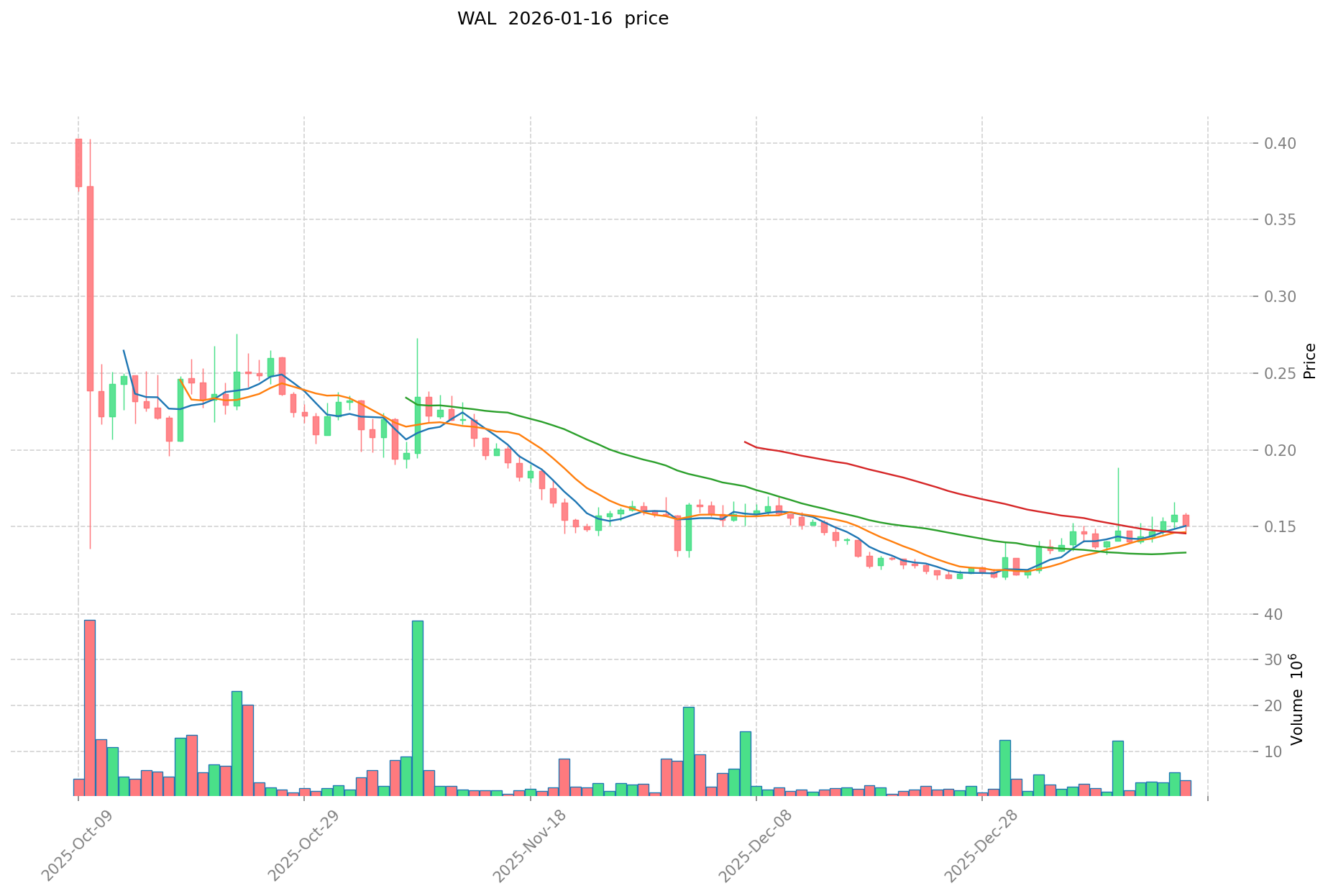
Recent price movements show WAL experienced a 7.03% increase over the past seven days and a 6.5% gain over the previous 30 days, though the 24-hour period reflected a 3.46% decline. The token's historical price range spans from $0.1154 to $0.9719, with the current price level suggesting potential volatility considerations for market participants.
With a fully diluted market cap of $752.5 million based on a maximum supply of 5 billion tokens, the circulating supply represents 25% of the total allocation. This article examines WAL's investment characteristics, historical performance patterns, potential price trajectories, and associated risk factors to provide analytical perspectives for those evaluating "Is Walrus (WAL) a good investment?" within the context of decentralized storage solutions in the digital asset ecosystem.
I. Walrus (WAL) Price History Review and Current Investment Value Status
- 2025, March: Token launch → WAL reached $0.9719
- 2025, December: Market adjustment → Price declined to $0.1154
- 2026, January: Recovery phase → Trading at $0.1505 with declining 24-hour momentum
Current WAL Investment Market Status (January 2026)
- WAL Current Price: $0.1505
- Market Sentiment (Fear & Greed Index): Neutral (market emotion indicator at 1)
- 24-Hour Trading Volume: $554,150.92
- Circulating Supply: 1,250,000,000 WAL (25% of total supply)
Click to view real-time WAL market price
II. Core Factors Influencing Whether WAL is a Good Investment
Supply Mechanism and Scarcity (WAL investment scarcity)
- Supply structure: WAL has a maximum supply of 5,000,000,000 tokens with 1,250,000,000 currently circulating (25% circulation ratio)
- Current market data: As of January 16, 2026, WAL is trading at $0.1505 with a market capitalization of $188,125,000
- Investment significance: The controlled token release mechanism and programmatic storage capacity management via smart contracts may provide scarcity dynamics that could support investment considerations
Institutional Investment and Mainstream Adoption (Institutional investment in WAL)
- Ecosystem integration: Walrus has been adopted by platforms such as Myriad, which has processed over $5,000,000 in transactions since launch, with all data stored on the Walrus network
- Use case expansion: The protocol supports applications across AI, consumer health technology, and autonomous agents, with weekly industry volume reportedly exceeding $2,300,000,000
- Policy environment: The decentralized nature of data storage may present regulatory considerations in different jurisdictions that could affect institutional adoption
Macroeconomic Environment Impact on WAL Investment
- Market conditions: As of January 16, 2026, cryptocurrency markets continue to be influenced by broader monetary policy shifts and interest rate environments
- Decentralized infrastructure positioning: Walrus positions itself as a data sovereignty solution, potentially attracting interest during periods of concern over centralized data control
- Risk factors: Geopolitical uncertainties and regulatory developments in the blockchain space may influence demand for decentralized storage solutions
Technology and Ecosystem Development (Technology & Ecosystem for WAL investment)
- Technical foundation: Built on the Sui Network, Walrus employs innovative encoding algorithms designed for fast data writes and reads, with options for data deletion
- Seal feature implementation: In 2025, Walrus introduced Seal, making it a decentralized data platform with built-in access control that allows developers to encrypt data and define access permissions enforced onchain
- Ecosystem applications: The platform supports use cases in AI model storage, autonomous agents, and financial applications, particularly for sensitive data in healthcare and DeFi sectors that require non-public data handling
III. WAL Future Investment Forecast and Price Outlook (Is Walrus(WAL) worth investing in 2026-2031)
Short-term Investment Forecast (2026, short-term WAL investment outlook)
- Conservative forecast: $0.12 - $0.15
- Neutral forecast: $0.15 - $0.17
- Optimistic forecast: $0.17 - $0.19
Based on the reference materials, WAL demonstrated a 7.03% increase over the past 7 days and a 6.5% increase over 30 days as of January 16, 2026. The current price stands at $0.1505, with 24-hour trading volume of $554,150. Short-term forecasts suggest moderate growth potential, though price movements may be influenced by market sentiment and the broader decentralized storage sector performance.
Mid-term Investment Outlook (2027-2029, mid-term Walrus(WAL) investment forecast)
-
Market stage expectation: Walrus may enter a phase of expanded adoption as a decentralized data storage network, particularly for storing rich media content such as videos, images, and audio files. Built on the Sui Network with programmable storage capacity through smart contracts, the project's innovative encoding algorithms may attract developers seeking fast read/write capabilities.
-
Investment return forecast:
- 2027: $0.09 - $0.18
- 2028: $0.10 - $0.22
- 2029: $0.10 - $0.29
-
Key catalysts: Growth drivers may include increased adoption of decentralized storage solutions, technical developments on the Sui Network, and competitive positioning relative to established protocols in the storage sector. The network's ability to maintain data availability even when parts of the network go offline could serve as a technical differentiator.
Long-term Investment Outlook (Is Walrus a good long-term investment?)
- Base scenario: $0.18 - $0.27 (assuming steady development and moderate market acceptance)
- Optimistic scenario: $0.29 - $0.40 (assuming accelerated adoption and favorable market conditions)
- Risk scenario: $0.09 - $0.15 (under challenging market conditions or increased competition)
Click to view WAL long-term investment and price forecast: Price Prediction
2026-2031 Long-term Outlook
- Base scenario: $0.15 - $0.27 USD (corresponding to steady progress and gradual mainstream application growth)
- Optimistic scenario: $0.27 - $0.40 USD (corresponding to large-scale adoption and favorable market environment)
- Transformative scenario: Above $0.40 USD (if the ecosystem achieves breakthrough progress and mainstream popularization)
- 2031-12-31 forecast high: $0.40 USD (based on optimistic development assumptions)
Disclaimer: The forecasts presented are based on available reference materials and historical price data. Cryptocurrency investments carry inherent risks, and past performance does not guarantee future results. These predictions should not be considered as investment advice. Market conditions, regulatory changes, technological developments, and competitive dynamics may significantly impact actual outcomes. Investors should conduct their own research and consider their risk tolerance before making investment decisions.
| Year |
Predicted High Price |
Predicted Average Price |
Predicted Low Price |
Price Change |
| 2026 |
0.186992 |
0.1508 |
0.123656 |
0 |
| 2027 |
0.18409664 |
0.168896 |
0.09120384 |
12 |
| 2028 |
0.2188554368 |
0.17649632 |
0.1006029024 |
17 |
| 2029 |
0.28663002368 |
0.1976758784 |
0.102791456768 |
31 |
| 2030 |
0.2930050707584 |
0.24215295104 |
0.1840362427904 |
60 |
| 2031 |
0.396016936130816 |
0.2675790108992 |
0.192656887847424 |
77 |
IV. Walrus Investment Strategy and Risk Management (How to invest in decentralized storage tokens)
Investment Methodology (Walrus investment strategy)
-
Long-term Holding (HODL Walrus): Suitable for conservative investors
Long-term holding strategies focus on the fundamental value proposition of Walrus as a decentralized storage network. Investors who believe in the evolution of decentralized data storage infrastructure may consider accumulating WAL tokens during market corrections and holding through market cycles. This approach requires patience and conviction in the protocol's technical innovations, including its encoding algorithms and programmable storage capacity built on the Sui Network.
-
Active Trading: Relies on technical analysis and swing trading
Active traders may leverage Walrus's price volatility for short-term gains. Technical analysis tools such as support and resistance levels, moving averages, and volume indicators can help identify entry and exit points. Given the 24-hour trading volume of approximately $554,150 and recent price fluctuations (ranging from $0.1468 to $0.1589 in the past 24 hours), traders should establish clear risk parameters and position sizing rules.
Risk Management (Risk management for Walrus investment)
-
Asset Allocation Ratios: Conservative / Aggressive / Professional investors
- Conservative investors: Allocate 1-3% of crypto portfolio to WAL, focusing on established projects with proven track records
- Aggressive investors: May allocate 5-10% of crypto portfolio to emerging infrastructure projects like Walrus
- Professional investors: Can consider higher allocations (10-15%) with sophisticated hedging strategies and deep market analysis
-
Risk Hedging Solutions: Multi-asset portfolio + hedging instruments
Diversification across different crypto categories (Layer 1 protocols, DeFi, storage solutions) can reduce concentration risk. Consider balancing Walrus exposure with more established assets. Monitor correlation patterns between WAL and broader market movements to adjust portfolio weights accordingly.
-
Secure Storage: Hot/cold wallets + hardware wallet recommendations
Given that Walrus operates on the Sui Network (contract address: 0x356a26eb9e012a68958082340d4c4116e7f55615cf27affcff209cf0ae544f59::wal::WAL), investors should use Sui-compatible wallets. For long-term holdings, hardware wallets supporting Sui ecosystem tokens provide enhanced security. Hot wallets may be suitable for active trading positions, while cold storage solutions are recommended for the majority of holdings.
V. Walrus Investment Risks and Challenges (Risks of investing in decentralized storage tokens)
-
Market Risks: High volatility and price manipulation concerns
Walrus has demonstrated significant price volatility, with the token experiencing swings from its historical high of $0.9719 (March 27, 2025) to a low of $0.1154 (December 30, 2025). The current market capitalization of approximately $188.1 million and relatively modest trading volume create conditions where large orders could impact price discovery. With only 25% of total supply currently circulating (1.25 billion out of 5 billion max supply), future token unlocks may create selling pressure.
-
Regulatory Risks: Policy uncertainty across different jurisdictions
Decentralized storage networks operate in a regulatory gray area across various jurisdictions. Different countries maintain varying approaches to cryptocurrency regulation, which could impact Walrus's adoption and token value. Changes in data storage regulations, privacy laws, or crypto classification rules could affect the protocol's operations and market perception.
-
Technical Risks: Network security vulnerabilities and upgrade failures
As a protocol built on the Sui Network, Walrus inherits both the benefits and risks of its underlying blockchain infrastructure. Technical challenges may include smart contract vulnerabilities, encoding algorithm failures, or issues with data retrieval mechanisms. The protocol's innovative approach to splitting and distributing data across nodes introduces complexity that requires ongoing maintenance and potential upgrades.
VI. Conclusion: Is decentralized storage token a Good Investment?
-
Investment Value Summary: Walrus presents notable long-term potential in the decentralized storage sector, though short-term price movements remain volatile.
The protocol addresses real-world storage needs with technical innovations including fast read/write capabilities and programmable storage capacity. Its position within the Sui ecosystem and learnings from earlier protocols like Filecoin and Arweave provide a foundation for potential growth. However, the token's price history shows considerable fluctuation, and the market capitalization remains relatively modest compared to established projects.
-
Investor Recommendations:
✅ Beginners: Consider dollar-cost averaging (DCA) strategies combined with secure wallet storage. Start with small allocations to understand market dynamics before increasing exposure.
✅ Experienced Investors: Employ swing trading techniques while maintaining a core position. Combine technical analysis with fundamental assessment of protocol development and adoption metrics.
✅ Institutional Investors: Evaluate strategic long-term allocation as part of broader Web3 infrastructure exposure, with proper due diligence on tokenomics and unlock schedules.
⚠️ Disclaimer: Cryptocurrency investment carries substantial risk. This content is for informational purposes only and does not constitute investment advice. Conduct thorough research and consider your financial situation before making investment decisions.
VII. FAQ
Q1: What is the current market position of Walrus (WAL) and how has its price performed historically?
As of January 16, 2026, Walrus (WAL) is trading at $0.1505 with a market capitalization of approximately $188.13 million, ranking #248 in the cryptocurrency market. The token has experienced significant volatility since its launch, reaching a historical high of $0.9719 in March 2025 before declining to $0.1154 in December 2025. Recent performance shows a 7.03% increase over the past 7 days and a 6.5% gain over 30 days, though it experienced a 3.46% decline in the 24-hour period. The circulating supply represents 25% of the maximum 5 billion token allocation, with a fully diluted market cap of $752.5 million.
Q2: What makes Walrus different from other decentralized storage solutions like Filecoin and Arweave?
Walrus distinguishes itself through programmable storage capacity managed via smart contracts on the Sui Network and innovative encoding algorithms designed for fast data reads and writes. Unlike traditional decentralized storage protocols, Walrus introduced the Seal feature in 2025, which provides built-in access control allowing developers to encrypt data and define access permissions enforced onchain. The protocol's technical architecture enables data availability even when parts of the network go offline, and it supports deletion capabilities. These features position Walrus particularly well for applications requiring sensitive data handling, such as AI model storage, healthcare data, and DeFi applications that need non-public data management.
Q3: What are the recommended investment strategies for different types of WAL investors?
Conservative investors should allocate 1-3% of their crypto portfolio to WAL, focusing on long-term holding (HODL) strategies through market cycles while accumulating during corrections. Aggressive investors may allocate 5-10% with active trading approaches, utilizing technical analysis to capitalize on price volatility within the $0.1468-$0.1589 range observed in recent 24-hour periods. Professional investors can consider 10-15% allocations with sophisticated hedging strategies. All investors should implement proper risk management, including diversification across different crypto categories, use of hardware wallets for secure storage, and dollar-cost averaging for beginners to reduce timing risk.
Q4: What is the long-term price forecast for Walrus through 2031?
Price forecasts suggest gradual growth potential through 2031 under various scenarios. The base scenario projects $0.18-$0.27 assuming steady development and moderate market acceptance. The optimistic scenario forecasts $0.29-$0.40 with accelerated adoption and favorable market conditions. By 2031, the predicted high reaches $0.40 under optimistic assumptions, with an average price around $0.27. However, a risk scenario exists where prices could remain in the $0.09-$0.15 range under challenging market conditions or increased competition. These forecasts depend on continued ecosystem development, mainstream adoption of decentralized storage solutions, and competitive positioning within the sector.
Q5: What are the primary risks associated with investing in Walrus (WAL)?
Investors face three main risk categories. Market risks include high volatility demonstrated by the 84% decline from its March 2025 high to December 2025 low, plus potential selling pressure from future token unlocks as only 25% of supply currently circulates. Regulatory risks stem from policy uncertainty across jurisdictions regarding decentralized storage networks and cryptocurrency classification, which could impact adoption and token value. Technical risks involve potential smart contract vulnerabilities, encoding algorithm failures, or issues with data retrieval mechanisms inherent in the protocol's innovative architecture. Additionally, the relatively modest 24-hour trading volume of $554,150 creates conditions where large orders could significantly impact price discovery.
Q6: How does Walrus's ecosystem adoption impact its investment value?
Ecosystem adoption serves as a key value driver for WAL investment. Platforms like Myriad have processed over $5 million in transactions since launch with all data stored on the Walrus network, demonstrating real-world utility. The protocol supports applications across AI, consumer health technology, and autonomous agents, with weekly industry volume reportedly exceeding $2.3 billion. This expanding use case portfolio addresses needs in sectors requiring sensitive data handling, particularly healthcare and DeFi applications. Walrus's technical foundation on the Sui Network and its programmable storage capacity provide developers with flexible infrastructure, potentially accelerating adoption. However, investors should monitor adoption metrics and competitive dynamics as the decentralized storage market evolves.
Q7: What security considerations should Walrus investors implement?
Given Walrus operates on the Sui Network (contract address: 0x356a26eb9e012a68958082340d4c4116e7f55615cf27affcff209cf0ae544f59::wal::WAL), investors must use Sui-compatible wallets for token storage. For long-term holdings representing the majority of positions, hardware wallets supporting the Sui ecosystem provide enhanced security against online threats. Hot wallets may be suitable for active trading positions requiring frequent access, but should contain only necessary funds for trading activities. Investors should implement multi-signature solutions where available, maintain secure backup procedures for wallet recovery phrases, and regularly update wallet software to address security vulnerabilities. Portfolio diversification across different crypto categories reduces concentration risk exposure.
Q8: What macroeconomic factors could influence Walrus's investment performance through 2026-2031?
Several macroeconomic factors may impact WAL's performance trajectory. Broader monetary policy shifts and interest rate environments affecting cryptocurrency markets as of January 2026 could influence capital flows into alternative assets like decentralized storage tokens. Walrus's positioning as a data sovereignty solution may attract interest during periods of heightened concern over centralized data control, potentially benefiting from privacy-focused investment trends. Geopolitical uncertainties and regulatory developments in the blockchain space could significantly affect demand for decentralized storage solutions. Additionally, institutional adoption patterns, mainstream acceptance of Web3 infrastructure, and competitive dynamics within the decentralized storage sector will likely play crucial roles in determining long-term price performance and market positioning.
* The information is not intended to be and does not constitute financial advice or any other recommendation of any sort offered or endorsed by Gate.