WINkLink (WIN) is a decentralized oracle token operating on the TRON network, serving as the native utility token for bridging real-world data with blockchain smart contracts. This comprehensive analysis evaluates WIN's investment potential through multiple lenses: its historical price performance from a $0.00289424 peak in April 2021 to current levels near $0.00002624, reflecting significant volatility and market challenges. The article addresses core investment factors including token supply mechanics, institutional adoption across 808,953 holders on 31 exchanges, and macroeconomic influences on oracle network demand. Price forecasts range from conservative $0.000020976 estimates to optimistic long-term scenarios reaching $0.000051096429577 by 2031, contingent on ecosystem expansion and blockchain adoption. The analysis provides tailored investment strategies for beginners, experienced traders, and institutional investors, alongside comprehensive risk management frameworks addressing market volatility, regu
Introduction: WINkLink (WIN) Investment Position and Market Outlook
WIN is a functional token within the cryptocurrency sector, launched in July 2019, and has established its presence in the decentralized oracle network domain. As of January 2026, WIN holds a market capitalization of approximately $26.07 million, with a circulating supply of around 993.70 billion tokens, and the current price stands at approximately $0.00002624. Positioned as a TRC-20 token operating on the TRON network, WIN serves as the native utility token for the WINkLink decentralized oracle platform, which aims to bridge real-world data with blockchain smart contracts. The token functions primarily in two capacities: rewarding nodes that provide reliable data feeds and enabling developers to compensate nodes for accessing trusted data sources. With 808,953 holders and availability on 31 exchanges, WIN has demonstrated a notable level of adoption since its inception. This article provides a comprehensive analysis of WIN's investment characteristics, historical price performance, future price projections, and associated investment risks to serve as a reference for potential investors evaluating the question "Is WINkLink (WIN) a suitable investment consideration?"
I. WIN Price History Review and Current Investment Value
- 2021: WIN reached a price peak in early April → Followed by subsequent market corrections
- 2026: Token experienced significant volatility → Price declined from higher levels to $0.00002556 range
- Recent Period: Market adjustment phase → Price fluctuated between $0.00002555 and $0.00002636
Current WIN Investment Market Status (January 2026)
- WIN current price: $0.00002624
- Market sentiment (Fear & Greed Index): Data not available in provided materials
- 24-hour trading volume: $34,346.05
- Institutional investor holdings: 808,953 holders recorded
Click to view real-time WIN market price
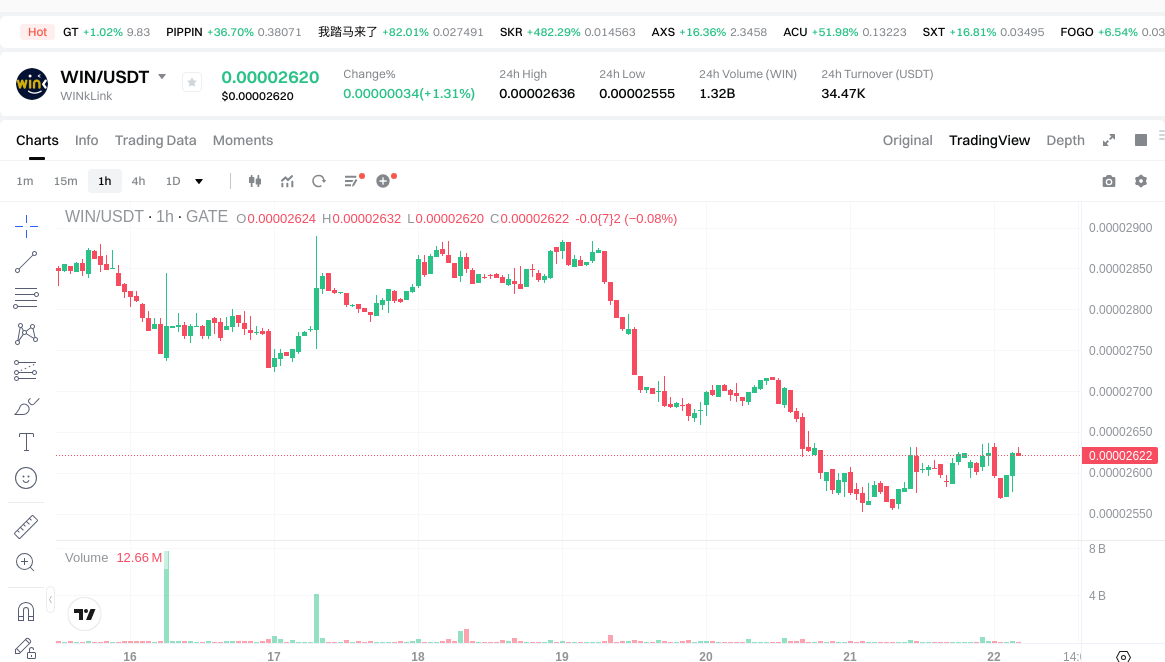
II. Core Factors Affecting Whether WIN is a Good Investment (Is WINkLink(WIN) a Good Investment)
Supply Mechanism and Scarcity (WIN investment scarcity)
- Fixed supply mechanism → Impacts price and investment value
- Token economics: WIN operates with a total supply of 999 billion tokens, with approximately 99.37 billion tokens currently in circulation (representing 100% of the circulating supply ratio)
- Investment significance: The defined supply structure provides a foundation for assessing long-term scarcity dynamics
Institutional Investment and Mainstream Adoption (Institutional investment in WIN)
- Network participation: As of the latest data, WIN has accumulated 808,953 holders across its ecosystem
- Platform integration: WIN is listed on 31 exchanges, indicating a degree of market accessibility and liquidity
- Regional considerations: Policy frameworks in different jurisdictions may influence the investment landscape for oracle-based tokens like WIN
Macroeconomic Environment's Impact on WIN Investment
- Monetary policy and interest rate changes → Alter investment attractiveness across digital asset markets
- Inflation dynamics: Oracle networks supporting smart contract data feeds may see varied demand patterns during different economic conditions
- Geopolitical uncertainty → Can shift investor attention toward diversified digital asset portfolios, including utility tokens
Technology and Ecosystem Development (Technology & Ecosystem for WIN investment)
- Decentralized oracle infrastructure: WINkLink provides data connectivity between real-world information and blockchain smart contracts, supporting developers in building data-driven applications
- Ecosystem utility: WIN tokens serve dual functions—rewarding nodes for providing reliable data streams and facilitating payment for data requests by developers
- Application expansion: The oracle network's role in connecting smart contracts to external data sources positions it within the broader DeFi and decentralized application landscape
III. WIN Future Investment Forecast and Price Outlook (Is WINkLink(WIN) worth investing in 2026-2031)
Short-term Investment Forecast (2026, short-term WIN investment outlook)
- Conservative forecast: $0.000020976 - $0.000024
- Neutral forecast: $0.00002622 - $0.000026
- Optimistic forecast: $0.0000277932 - $0.000028
Mid-term Investment Outlook (2027-2028, mid-term WINkLink(WIN) investment forecast)
-
Market stage expectation: The project may experience gradual growth as the decentralized oracle network continues to develop and expand its integration with real-world data streams. Market performance could be influenced by broader blockchain adoption trends and the evolution of smart contract applications.
-
Investment return forecast:
- 2027: $0.000014043432 - $0.000038619438
- 2028: $0.00002198472273 - $0.00003675058128
-
Key catalysts: Expansion of oracle network usage, increased developer adoption, potential partnerships within the blockchain ecosystem, and overall market sentiment toward decentralized infrastructure projects.
Long-term Investment Outlook (Is WIN a good long-term investment?)
-
Base scenario: $0.000032962711992 - $0.000053247457834 (assuming steady network growth and stable market conditions through 2030-2031)
-
Optimistic scenario: $0.000042023231801 - $0.000051096429577 (assuming enhanced oracle adoption, ecosystem expansion, and favorable regulatory environment)
-
Risk scenario: Below $0.000022955988092 (under conditions of prolonged market downturn, reduced blockchain activity, or increased competition from alternative oracle solutions)
View WIN long-term investment and price forecast: Price Prediction
2026-01-22 - 2031 Long-term Outlook
-
Base scenario: $0.000032962711992 - $0.000053247457834 (corresponding to steady progress and gradual mainstream application growth)
-
Optimistic scenario: $0.000042023231801 - $0.000051096429577 (corresponding to large-scale adoption and favorable market environment)
-
Transformative scenario: Above $0.000051096429577 (if ecosystem achieves breakthrough developments and mainstream adoption)
-
2031-12-31 predicted high: $0.000051096429577 (based on optimistic development assumptions)
Disclaimer: This forecast is for informational purposes only and should not be considered as investment advice. Cryptocurrency markets are highly volatile and subject to various risks. Past performance does not guarantee future results. Investors should conduct their own research and consider their risk tolerance before making any investment decisions.
| Year |
Predicted High Price |
Predicted Average Price |
Predicted Low Price |
Price Change |
| 2026 |
0.0000277932 |
0.00002622 |
0.000020976 |
0 |
| 2027 |
0.000038619438 |
0.0000270066 |
0.000014043432 |
2 |
| 2028 |
0.00003675058128 |
0.000032813019 |
0.00002198472273 |
25 |
| 2029 |
0.0000497379742 |
0.00003478180014 |
0.000022955988092 |
32 |
| 2030 |
0.000053247457834 |
0.00004225988717 |
0.000032962711992 |
61 |
| 2031 |
0.000051096429577 |
0.000047753672502 |
0.000042023231801 |
81 |
IV. WINkLink (WIN) Investment Strategy and Risk Management (How to invest in oracle tokens)
Investment Methodology (WIN investment strategy)
Long-term Holding (HODL WIN): Suitable for conservative investors
For investors seeking long-term exposure to the oracle sector on TRON, holding WIN tokens may provide potential value as the network continues to develop its data infrastructure services. This approach focuses on the token's utility within the WINkLink ecosystem, where it serves as the primary medium for node rewards and network payments. Conservative investors may consider accumulating positions during market corrections while maintaining a multi-year investment horizon.
Active Trading: Relies on technical analysis and swing trading
Active traders may leverage WIN's price volatility to capture short-term opportunities. Given the token's 24-hour trading volume of approximately $34,346 and observable price fluctuations (recent 7-day change of -9%), traders can employ technical indicators to identify entry and exit points. However, this strategy requires constant market monitoring and understanding of broader cryptocurrency market trends that influence WIN's price movements.
Risk Management (Risk management for WIN investment)
Asset Allocation Ratios: Conservative / Aggressive / Professional investors
- Conservative investors: Consider allocating 1-3% of cryptocurrency portfolio to WIN tokens, maintaining majority holdings in established assets
- Aggressive investors: May allocate 5-10% to oracle-related tokens including WIN, acknowledging higher risk tolerance
- Professional investors: Can implement dynamic allocation strategies based on market conditions and technical developments
Risk Hedging Solutions: Multi-asset portfolio + hedging instruments
Investors should diversify across multiple blockchain sectors rather than concentrating exclusively in oracle tokens. Potential hedging strategies include maintaining stablecoin reserves for opportunistic purchases during downturns and balancing WIN holdings with other TRON ecosystem tokens to manage platform-specific risks.
Secure Storage: Hot/cold wallets + hardware wallet recommendations
Given WIN's TRC-20 token standard on TRON, investors should utilize:
- Cold storage: Hardware wallets supporting TRON network for long-term holdings
- Hot wallets: TRON-compatible software wallets for active trading, maintaining only necessary amounts
- Security practices: Enable multi-factor authentication and regularly verify contract addresses (TLa2f6VPqDgRE67v1736s7bJ8Ray5wYjU7)
V. WINkLink (WIN) Investment Risks and Challenges (Risks of investing in oracle tokens)
Market Risk: High volatility and potential price manipulation
WIN demonstrates substantial price volatility, with 1-year performance showing a decline of approximately 71.12%. The token reached its highest price of $0.00289424 in April 2021 but recently traded near its recorded low of $0.00002556 in January 2026. With a relatively modest 24-hour trading volume and market capitalization of approximately $26.07 million, the token may be susceptible to liquidity constraints and sharp price movements during periods of market stress.
Regulatory Risk: Policy uncertainty across jurisdictions
As a decentralized oracle network operating globally, WINkLink faces varying regulatory approaches to blockchain infrastructure and data services. Different jurisdictions maintain distinct regulatory frameworks for oracle networks and utility tokens, creating potential compliance challenges. Changes in regulations affecting TRON network operations or oracle services could impact WIN's utility and adoption.
Technical Risk: Network security vulnerabilities and upgrade failures
The WINkLink network's functionality depends on maintaining secure and reliable data feeds for smart contracts. Potential technical risks include:
- Oracle network downtime affecting data delivery
- Smart contract vulnerabilities in the oracle infrastructure
- Node operator reliability concerns
- Potential issues during network upgrades or protocol changes
- Dependency on TRON network's operational stability
VI. Conclusion: Is oracle token a Good Investment?
Investment Value Summary: WIN presents opportunities within the oracle sector but carries substantial volatility characteristics. The token serves functional purposes within the WINkLink ecosystem, rewarding nodes for providing reliable data and facilitating payments for oracle services. However, recent price performance indicates significant market challenges, with year-over-year decline trends suggesting cautious evaluation is warranted.
Investor Recommendations:
✅ Beginners: Dollar-cost averaging approach + secure wallet storage
- Implement systematic small-amount purchases to average entry prices
- Use reputable TRON-compatible wallets with verified contract addresses
- Allocate only discretionary capital prepared for potential losses
- Focus on understanding oracle technology before increasing position sizes
✅ Experienced Investors: Swing trading + portfolio diversification
- Utilize technical analysis to identify potential trading ranges
- Maintain WIN as a minor component within broader oracle sector exposure
- Monitor TRON ecosystem developments affecting oracle demand
- Set clear risk parameters including stop-loss levels
✅ Institutional Investors: Strategic long-term positioning
- Evaluate WIN within comprehensive blockchain infrastructure thesis
- Consider oracle sector allocation across multiple networks
- Assess liquidity constraints for larger position sizes
- Monitor network metrics including node participation and data request volumes
⚠️ Disclaimer: Cryptocurrency investment involves substantial risk. This content is provided for informational purposes only and does not constitute investment advice. Investors should conduct thorough research and consider their financial circumstances before making investment decisions.
VII. FAQ
Q1: What is the primary function of WINkLink (WIN) token?
WIN serves as the native utility token for the WINkLink decentralized oracle platform operating on the TRON network. The token fulfills two core functions: rewarding nodes that provide reliable data feeds to smart contracts, and enabling developers to compensate nodes for accessing trusted real-world data sources. This dual-purpose design positions WIN as the economic incentive mechanism that maintains the oracle network's data integrity and operational sustainability.
Q2: How has WIN's price performed historically and what is its current market position?
WIN reached its historical peak of $0.00289424 in April 2021, but has experienced significant decline since then. As of January 2026, the token trades at approximately $0.00002624, representing a 71.12% decrease over the past year. The current market capitalization stands at approximately $26.07 million with 808,953 holders and availability across 31 exchanges. Recent performance shows a 7-day decline of 9%, indicating ongoing market challenges and volatility.
Q3: What are the realistic price projections for WIN in the next five years?
Short-term forecasts for 2026 range from $0.000020976 (conservative) to $0.0000277932 (optimistic). Mid-term projections for 2027-2028 suggest prices between $0.000014043432 and $0.00003675058128, depending on ecosystem adoption and market conditions. Long-term scenarios through 2031 project a base case of $0.000032962711992 to $0.000053247457834, with optimistic scenarios reaching $0.000042023231801 to $0.000051096429577. These forecasts assume varying levels of oracle network expansion and blockchain adoption trends.
Q4: What investment strategy is most appropriate for different investor types?
Conservative investors should consider allocating 1-3% of their cryptocurrency portfolio to WIN, implementing dollar-cost averaging during market corrections with a multi-year horizon. Aggressive investors may allocate 5-10% while employing active trading strategies based on technical analysis, though this requires constant market monitoring. Professional investors can utilize dynamic allocation strategies that adjust based on network metrics including node participation and data request volumes, while accounting for liquidity constraints in larger positions.
Q5: What are the primary risks associated with investing in WIN?
WIN faces three major risk categories: Market risk includes high volatility (71.12% annual decline) and potential liquidity constraints given its $26.07 million market cap. Regulatory risk stems from varying jurisdictional approaches to oracle networks and TRON operations, creating potential compliance uncertainties. Technical risk involves oracle network reliability, including potential downtime affecting data delivery, smart contract vulnerabilities, node operator concerns, and dependency on TRON network stability.
Q6: How does WIN's tokenomics structure impact its investment potential?
WIN operates with a fixed total supply of 999 billion tokens, with approximately 99.37 billion tokens currently in circulation (representing 100% of the circulating supply ratio). This defined supply structure provides a foundation for assessing long-term scarcity dynamics, though the large total supply may limit significant price appreciation without substantial demand growth. The token's utility within the WINkLink ecosystem—rewarding nodes and facilitating payments—creates ongoing demand that depends directly on oracle network usage and developer adoption rates.
Q7: What secure storage options should WIN investors consider?
Given WIN's TRC-20 standard on TRON, investors should implement layered security approaches. For long-term holdings, hardware wallets supporting TRON network provide optimal cold storage security. Active traders should maintain only necessary amounts in TRON-compatible hot wallets with multi-factor authentication enabled. Critical security practices include regularly verifying the official contract address (TLa2f6VPqDgRE67v1736s7bJ8Ray5wYjU7) and avoiding unverified platforms or wallets to prevent potential token loss.
Q8: Is WIN suitable as a long-term investment compared to other oracle solutions?
WIN's suitability for long-term investment depends on individual risk tolerance and confidence in TRON ecosystem growth. While the token provides functional utility within the WINkLink oracle network, its 71.12% annual decline and modest market capitalization suggest significant challenges compared to established oracle providers. Long-term viability requires successful expansion of oracle network usage, increased developer adoption, and favorable conditions within both the TRON ecosystem and broader blockchain infrastructure sector. Investors should compare WIN's development trajectory and network metrics against alternative oracle solutions before committing long-term capital.
* The information is not intended to be and does not constitute financial advice or any other recommendation of any sort offered or endorsed by Gate.