This comprehensive analysis examines Wirex Pay (WPAY), a governance token for a modular payment chain launched in October 2024, currently trading at $0.17034 with a $498 million market capitalization. The article evaluates WPAY's investment potential through multiple dimensions: historical price performance showing 66.45% year-over-year growth, fundamental factors including Polygon ZK technology integration and Visa partnerships, and price forecasts ranging from $0.1106-$0.3792 through 2031. The guide provides tailored investment strategies for beginners, experienced traders, and institutional investors, emphasizing dollar-cost averaging, swing trading opportunities, and portfolio diversification. Comprehensive risk analysis covers market volatility, regulatory uncertainty, technical dependencies, and liquidity constraints. Essential security protocols and realistic disclaimers help readers make informed decisions on Gate exchange, recognizing cryptocurrency investments carry substantial capital loss risks.
Introduction: Wirex Pay (WPAY) Investment Position and Market Outlook
WPAY is a notable asset in the cryptocurrency sector, launched in 2024, and has been making strides in the digital payments domain. As of January 15, 2026, Wirex Pay holds a market capitalization of approximately $498.09 million, with a circulating supply of around 2.92 billion tokens, and the current price stands at approximately $0.17034. Positioned as a modular payment chain that integrates blockchain technology with traditional finance, WPAY has emerged as a focal point for investors considering "Is Wirex Pay (WPAY) a good investment?" This article provides a comprehensive analysis of WPAY's investment value, historical trends, future price predictions, and associated investment risks to serve as a reference for investors.
Wirex Pay was incubated by Wirex, recognized in the crypto debit card market, and leverages Polygon ZK technology to facilitate transaction efficiency and security. With support alignment from Visa, the project emphasizes collaboration in advancing fintech innovation. Since its launch in October 2024 at an initial price of $0.05, WPAY has experienced price fluctuations, recording a low of $0.025 in October 2024 and reaching $0.26849 in November 2024. Over the past year, the token has shown a positive performance with an increase of 66.45%. Currently ranked 134th by market capitalization, WPAY represents 0.049% of the total crypto market, with a market cap to fully diluted valuation ratio of 29.24%. As the digital payments landscape continues to evolve, understanding WPAY's market dynamics and investment potential becomes increasingly relevant for portfolio considerations.
I. Wirex Pay (WPAY) Price History Review and Current Investment Value
- 2024: Token Launch and Initial Market Entry → WPAY was launched in October 2024 with a publishing price of $0.05, establishing its initial market presence.
- 2024: Post-Launch Price Movement → Following its October 2024 debut, WPAY experienced notable price activity, reaching a recorded low of $0.025 on October 8, 2024.
- 2024: November Price Development → By November 26, 2024, WPAY reached $0.26849, reflecting substantial upward movement from its initial pricing levels.
Current WPAY Investment Market Status (January 2026)
- WPAY Current Price: $0.17034
- Market Sentiment (Fear & Greed Index): Data indicates positive market sentiment with a year-over-year increase of 66.45%
- 24-Hour Trading Volume: $292,146.90
- Token Holder Base: 891 holders
- Market Capitalization: $498,086,448.16
- Circulating Supply: 2,924,072,139 WPAY (29.24% of total supply)
Click to view real-time WPAY market price
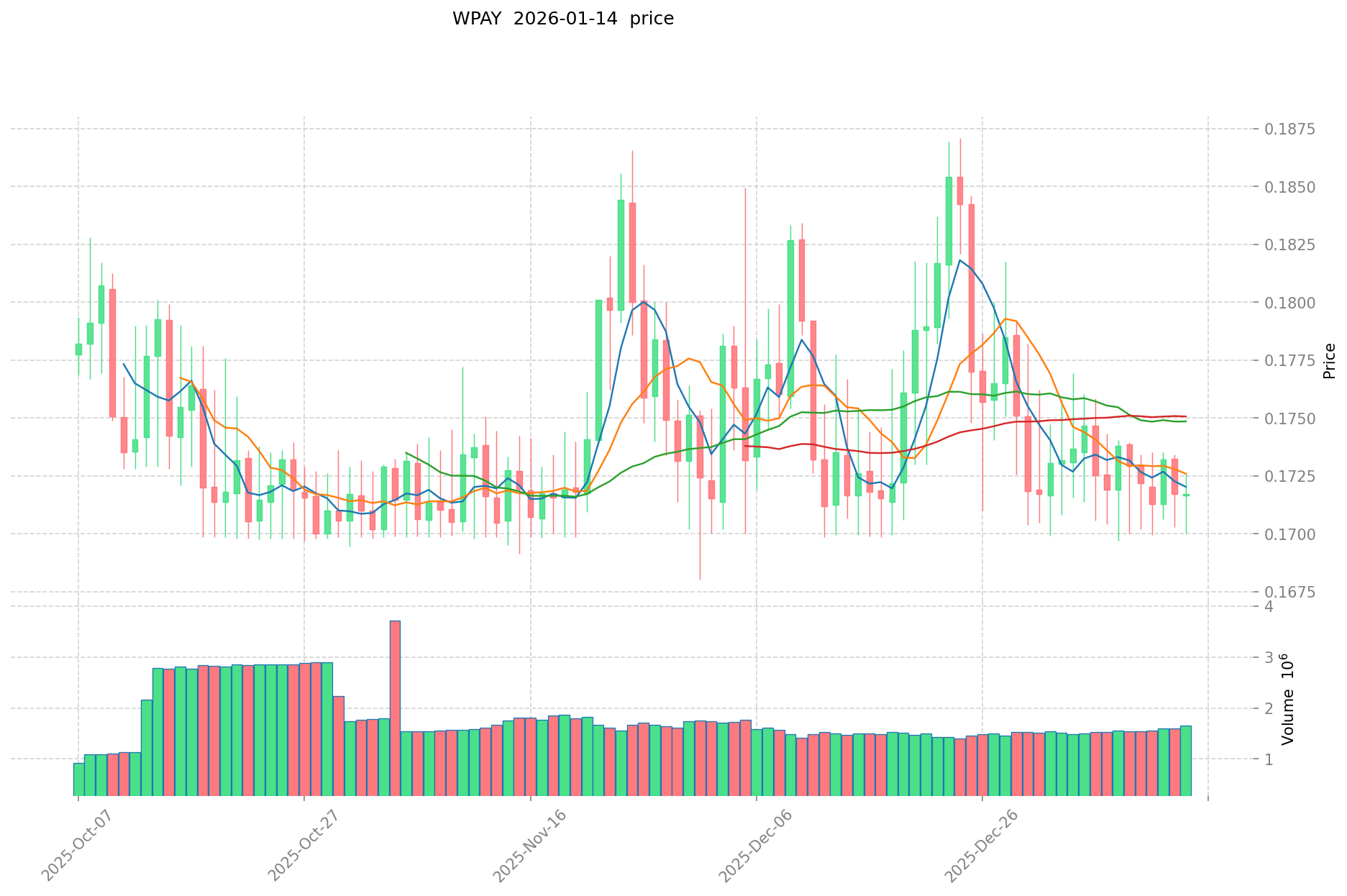
II. Core Factors Affecting Whether WPAY is a Good Investment (Is Wirex Pay(WPAY) a Good Investment)
Supply Mechanism and Scarcity (WPAY investment scarcity)
- Total Supply and Circulation → Impact on Price and Investment Value
- WPAY has a maximum supply of 10,000,000,000 tokens, with a current circulating supply of 2,924,072,139 tokens, representing approximately 29.24% of the total supply
- The circulating supply ratio suggests a significant portion remains to be released, which may influence future supply dynamics and price behavior
- Investment Significance: Understanding the supply structure is relevant for evaluating potential long-term investment considerations
Institutional Investment and Mainstream Adoption (Institutional investment in WPAY)
- Partnership and Support: Wirex Pay is supported by Visa, aligning with Visa's vision for the future of payments and emphasizing collaboration in driving fintech innovation
- Wirex Incubation: WPAY is incubated by Wirex, a recognized player in the crypto debit card market, which may contribute to its integration within digital payment ecosystems
- Holder Distribution: As of the reference date, WPAY has 891 holders, indicating an early stage of adoption and distribution
Macroeconomic Environment Impact on WPAY Investment
- Digital Payment Trends → Changes in consumer preferences toward blockchain-based payment solutions may affect WPAY's adoption and utility
- Regulatory Landscape → Evolving fintech and cryptocurrency regulations could influence WPAY's operational environment and investment attractiveness
- Market Volatility → WPAY experienced price fluctuations, with a 24-hour change of -0.38% and a 1-year change of 66.45%, reflecting sensitivity to market conditions
Technology and Ecosystem Development (Technology & Ecosystem for WPAY investment)
- Polygon ZK Integration: Wirex Pay leverages Polygon ZK technology to offer transaction efficiency and security, which may enhance its technical infrastructure
- Modular Payment Chain Design: The platform is designed as a modular payment chain, integrating blockchain technology with traditional finance to support digital payment applications
- Governance and Ecosystem Participation: WPAY serves as a governance token, allowing holders to participate in the platform's DAO and vote on proposals, potentially contributing to ecosystem engagement and development
III. WPAY Future Investment Forecast and Price Outlook (Is Wirex Pay (WPAY) worth investing in 2026-2031)
Short-term Investment Forecast (2026, short-term WPAY investment outlook)
- Conservative estimate: $0.1106 - $0.1701
- Neutral estimate: $0.1701 - $0.2143
- Optimistic estimate: $0.2143 and above
Mid-term Investment Outlook (2027-2029, mid-term Wirex Pay (WPAY) investment forecast)
-
Market stage expectation: WPAY may experience gradual growth as the digital payment ecosystem evolves and the Wirex Pay chain develops. The token could benefit from increased adoption of blockchain-based payment solutions and partnerships within the fintech sector.
-
Investment return forecast:
- 2027: $0.1192 - $0.2825
- 2028: $0.2041 - $0.2564
- 2029: $0.2074 - $0.3580
-
Key catalysts: Platform development progress, expansion of Wirex Pay chain adoption, strategic partnerships (particularly with Visa and within the Polygon ecosystem), regulatory clarity for digital payment solutions, and overall market sentiment toward payment-focused blockchain projects.
Long-term Investment Outlook (Is Wirex Pay a good long-term investment?)
- Base scenario: $0.1966 - $0.3750 (assuming steady ecosystem development and moderate market acceptance)
- Optimistic scenario: $0.3387 - $0.3792 (assuming accelerated adoption of Wirex Pay chain and favorable market conditions)
- Risk scenario: Below $0.1106 (in case of project setbacks, competitive pressures, or adverse regulatory developments)
Click to view WPAY long-term investment and price prediction: Price Prediction
2026-2031 Long-term Outlook
- Base scenario: $0.1701 - $0.3024 (corresponding to steady progress and gradual mainstream application adoption)
- Optimistic scenario: $0.2825 - $0.3750 (corresponding to large-scale adoption and favorable market environment)
- Transformative scenario: Above $0.3792 (if the ecosystem achieves breakthrough developments and mainstream popularization)
- 2031-12-31 predicted high: $0.3692 (based on optimistic development assumptions)
Disclaimer: Price predictions are based on historical data and market analysis models and should not be considered as investment advice. Cryptocurrency markets are highly volatile and subject to various risks. Past performance does not guarantee future results. Investors should conduct their own research and consider their risk tolerance before making investment decisions.
| Year |
Predicted High Price |
Predicted Average Price |
Predicted Low Price |
Price Change |
| 2026 |
0.2143134 |
0.17009 |
0.1105585 |
0 |
| 2027 |
0.282536499 |
0.1922017 |
0.119165054 |
12 |
| 2028 |
0.25635862746 |
0.2373690995 |
0.20413742557 |
39 |
| 2029 |
0.357952602046 |
0.24686386348 |
0.2073656453232 |
44 |
| 2030 |
0.37498620862612 |
0.302408232763 |
0.19656535129595 |
77 |
| 2031 |
0.36917997055707 |
0.33869722069456 |
0.209992276830627 |
98 |
IV. Wirex Pay Investment Strategy and Risk Management (How to invest in Wirex Pay)
Investment Methodology (Wirex Pay investment strategy)
Long-term Holding (HODL Wirex Pay)
Long-term holding represents a suitable approach for conservative investors who believe in the fundamental value proposition of Wirex Pay. This strategy involves acquiring WPAY tokens and maintaining positions over extended periods, potentially benefiting from the project's development trajectory and broader adoption of blockchain-based payment solutions. Investors following this approach typically focus on the project's integration with traditional finance systems and its backing by established entities in the payment industry.
Active Trading
Active trading strategies for WPAY rely on technical analysis and swing trading methodologies. Given the token's price fluctuations, traders may identify opportunities through chart patterns, volume indicators, and momentum signals. The 24-hour trading volume of approximately $292,146 suggests moderate liquidity for short-term trading activities. Traders should monitor key support and resistance levels, with recent data showing a 24-hour high of $0.17245 and low of $0.1699.
Risk Management (Risk management for Wirex Pay investment)
Asset Allocation Ratios
Conservative Investors: May consider allocating 1-3% of their cryptocurrency portfolio to WPAY, prioritizing established assets while maintaining minimal exposure to newer payment-focused tokens.
Aggressive Investors: Could allocate 5-10% of their cryptocurrency holdings to WPAY, accepting higher volatility in exchange for potential growth opportunities in the digital payments sector.
Professional Investors: Might implement dynamic allocation strategies ranging from 3-15%, adjusting positions based on technical indicators, market conditions, and project development milestones.
Risk Hedging Solutions
Implementing a diversified portfolio approach helps mitigate concentration risk. Investors may consider:
- Combining WPAY with established cryptocurrencies to balance portfolio volatility
- Maintaining positions in different blockchain ecosystems beyond Polygon
- Utilizing stablecoin allocations as a buffer against market downturns
- Considering traditional hedging instruments where available
Secure Storage
Cold Wallet Solutions: For long-term holders, transferring WPAY tokens to cold storage wallets significantly reduces exposure to online security threats. Hardware wallets compatible with ERC-20 tokens provide robust security for substantial holdings.
Hot Wallet Considerations: Active traders may maintain a portion of holdings in hot wallets for trading purposes, while keeping the majority in cold storage. Selecting reputable wallet providers with strong security track records remains essential.
Hardware Wallet Recommendations: Devices supporting Polygon network and ERC-20 tokens offer secure storage options. Users should verify compatibility with WPAY's contract address (0x7ABE9Edf5C544A04dA83e9110CF46DBC4759170c) before transferring assets.
V. Wirex Pay Investment Risks and Challenges (Risks of investing in Wirex Pay)
Market Risk
High Volatility: WPAY exhibits notable price fluctuations, with historical data showing a range between $0.025 (recorded on October 8, 2024) and $0.26849 (recorded on November 26, 2024). Such volatility presents both opportunities and risks for investors, requiring careful position sizing and risk tolerance assessment.
Price Manipulation Concerns: With a circulating supply of approximately 2.92 billion tokens (29.24% of maximum supply) and 891 holders, the token's distribution characteristics warrant consideration. The relatively concentrated supply and moderate trading volume may present liquidity challenges during significant market movements.
Regulatory Risk
Policy Uncertainty Across Jurisdictions: Digital payment tokens face varying regulatory frameworks globally. The evolving nature of cryptocurrency regulations, particularly regarding payment-focused projects, introduces uncertainty. Investors should monitor regulatory developments in key markets where payment services operate.
Compliance Requirements: Projects integrating with traditional finance systems and partnering with established payment networks must navigate complex compliance landscapes. Changes in regulatory requirements could impact operational capabilities and market positioning.
Technical Risk
Network Security Vulnerabilities: As a project built on blockchain infrastructure, WPAY faces inherent technical risks. Smart contract vulnerabilities, network congestion, or security exploits could affect token functionality and investor holdings. The reliance on Polygon ZK technology introduces dependencies on the underlying infrastructure's security and performance.
Upgrade Failures: Technical upgrades and protocol modifications carry execution risks. Implementation challenges, unexpected bugs, or compatibility issues during network updates could temporarily or permanently impact token utility and value.
Integration Dependencies: The project's success depends partly on maintaining integrations with traditional payment systems and blockchain infrastructure. Technical disruptions or strategic changes by partner platforms could affect operational continuity.
VI. Conclusion: Is Wirex Pay a Good Investment?
Investment Value Summary
Wirex Pay presents a value proposition centered on bridging blockchain technology with traditional payment systems. The project's positioning in the digital payments sector, combined with its technological foundation, suggests potential for long-term development. However, investors should recognize that short-term price movements may exhibit considerable volatility, as evidenced by the token's historical price range.
The token's market capitalization of approximately $498 million and ranking position indicate established market presence, while the 29.24% circulating supply ratio suggests significant future token unlocks that could influence supply dynamics.
Investor Recommendations
✅ Beginners
Dollar-Cost Averaging: New investors may consider systematic, periodic investments rather than lump-sum purchases to mitigate timing risk and average entry prices over time.
Secure Storage Practices: Prioritize learning proper wallet management and transferring holdings to secure storage solutions. Begin with small amounts while developing familiarity with cryptocurrency security practices.
✅ Experienced Investors
Swing Trading Opportunities: Leverage technical analysis skills to identify potential entry and exit points based on price patterns and volume indicators.
Portfolio Integration: Incorporate WPAY as part of a diversified cryptocurrency allocation, balancing exposure across different sectors and risk profiles.
✅ Institutional Investors
Strategic Long-term Positioning: Consider WPAY within the context of broader digital payments sector exposure, evaluating the project's competitive positioning and partnership ecosystem.
Due Diligence Framework: Implement comprehensive analysis covering technical infrastructure, team capabilities, regulatory compliance, and market dynamics before establishing positions.
⚠️ Important Notice
Cryptocurrency investments carry substantial risk, including the potential for complete loss of capital. Price volatility, regulatory changes, technical failures, and market manipulation represent significant risk factors. This analysis provides informational content only and does not constitute investment advice, financial guidance, or recommendations to buy, sell, or hold any cryptocurrency. Investors should conduct independent research, assess personal risk tolerance, and consider consulting qualified financial advisors before making investment decisions.
VII. FAQ
Q1: What is Wirex Pay (WPAY) and what makes it unique in the cryptocurrency payment sector?
Wirex Pay (WPAY) is a governance token for a modular payment chain that bridges blockchain technology with traditional finance systems, launched in October 2024 at an initial price of $0.05. The project distinguishes itself through several key features: it leverages Polygon ZK technology for enhanced transaction efficiency and security, is incubated by Wirex (a recognized player in the crypto debit card market), and maintains strategic alignment with Visa for advancing fintech innovation. As a governance token, WPAY enables holders to participate in the platform's DAO and vote on proposals, potentially contributing to ecosystem development. With a current market capitalization of approximately $498 million and ranking 134th in the crypto market, WPAY represents approximately 0.049% of the total cryptocurrency market as of January 2026.
Q2: How has WPAY performed since its launch and what is its current market position?
Since launching in October 2024, WPAY has demonstrated notable price volatility with a positive overall trajectory. The token experienced a low of $0.025 on October 8, 2024, followed by a significant rally to $0.26849 on November 26, 2024. As of January 15, 2026, WPAY trades at approximately $0.17034, reflecting a year-over-year increase of 66.45%. The token currently has a circulating supply of 2.92 billion tokens (29.24% of the maximum supply of 10 billion), with 891 holders and a 24-hour trading volume of $292,146.90. The market cap to fully diluted valuation ratio stands at 29.24%, indicating significant future token unlocks that may influence supply dynamics and price behavior over time.
Q3: What are the price predictions for WPAY through 2031?
Price forecasts for WPAY suggest varied scenarios based on different market conditions and adoption rates. For 2026, conservative estimates range from $0.1106 to $0.1701, neutral estimates from $0.1701 to $0.2143, and optimistic projections above $0.2143. Mid-term forecasts show potential growth: 2027 ($0.1192-$0.2825), 2028 ($0.2041-$0.2564), and 2029 ($0.2074-$0.3580). Long-term projections for 2031 reach as high as $0.3692 under optimistic development assumptions, with a base scenario ranging from $0.1966 to $0.3750. However, these predictions depend on numerous factors including platform development progress, Wirex Pay chain adoption, strategic partnerships, regulatory clarity, and overall market sentiment toward payment-focused blockchain projects. Past performance does not guarantee future results, and cryptocurrency markets remain highly volatile.
Q4: What investment strategies are appropriate for different types of WPAY investors?
Investment approaches for WPAY should align with individual risk tolerance and experience levels. Beginners may benefit from dollar-cost averaging—making systematic, periodic investments to mitigate timing risk—while prioritizing secure storage practices and starting with small amounts to develop cryptocurrency security familiarity. Experienced investors can leverage swing trading opportunities by applying technical analysis to identify entry and exit points based on price patterns and volume indicators, integrating WPAY as part of a diversified cryptocurrency allocation. Institutional investors should consider strategic long-term positioning within the broader digital payments sector context, implementing comprehensive due diligence covering technical infrastructure, team capabilities, regulatory compliance, and market dynamics. Conservative investors might allocate 1-3% of their cryptocurrency portfolio to WPAY, while aggressive investors could consider 5-10%, and professional investors might implement dynamic allocation strategies ranging from 3-15% based on market conditions.
Q5: What are the primary risks associated with investing in WPAY?
WPAY investment carries multiple significant risk categories that require careful consideration. Market risks include high volatility (historical price range from $0.025 to $0.26849), potential price manipulation concerns due to relatively concentrated supply (29.24% circulating) and moderate trading volume, and liquidity challenges during significant market movements with only 891 current holders. Regulatory risks encompass policy uncertainty across jurisdictions, evolving cryptocurrency regulations particularly regarding payment-focused projects, and compliance requirements for integrating with traditional finance systems. Technical risks involve potential network security vulnerabilities, smart contract exploits, dependency on Polygon ZK infrastructure security and performance, upgrade failures during protocol modifications, and integration dependencies with traditional payment systems and blockchain infrastructure. These risks represent substantial exposure, including potential for complete loss of capital, requiring thorough independent research and risk tolerance assessment before investment decisions.
Q6: How does WPAY's supply mechanism impact its investment potential?
WPAY's supply structure significantly influences its investment characteristics and future price dynamics. With a maximum supply of 10 billion tokens and current circulating supply of approximately 2.92 billion (29.24%), roughly 70% of tokens remain to be released into circulation. This substantial portion of unreleased supply suggests significant future token unlocks that may create downward pressure on price through increased supply. The relatively low holder count of 891 and moderate 24-hour trading volume of $292,146.90 indicate early-stage distribution and potential concentration risks. The market cap to fully diluted valuation ratio of 29.24% reflects the gap between current valuation and fully diluted potential, which investors should consider when evaluating long-term price appreciation prospects. Understanding this supply structure is crucial for assessing potential dilution effects, future distribution schedules, and their implications for investment strategies and position sizing.
Q7: What role do strategic partnerships play in WPAY's investment thesis?
Strategic partnerships constitute a fundamental component of WPAY's value proposition and investment potential. The project's most significant partnership involves Visa support, aligning with Visa's vision for the future of payments and emphasizing collaboration in driving fintech innovation—this relationship potentially provides market credibility, access to traditional payment networks, and pathways for mainstream adoption. Wirex's incubation of the project leverages the company's established presence in the crypto debit card market, contributing to potential integration within existing digital payment ecosystems. The utilization of Polygon ZK technology represents another strategic alignment, connecting WPAY to a broader blockchain infrastructure ecosystem. These partnerships may accelerate development timelines, enhance market positioning, and facilitate regulatory navigation. However, investors should recognize that partnership dependencies also introduce risks—strategic changes by partner platforms, technical disruptions in integrated systems, or shifts in partner priorities could affect operational continuity and market perception of WPAY's long-term viability.
Q8: What security measures should investors implement when holding WPAY?
Proper security practices are essential for protecting WPAY holdings against theft, loss, and unauthorized access. For long-term holders, cold wallet solutions—hardware devices that store private keys offline—significantly reduce exposure to online security threats and hacking attempts. Hardware wallets compatible with ERC-20 tokens and supporting the Polygon network offer robust security for substantial holdings. Investors should verify compatibility with WPAY's contract address (0x7ABE9Edf5C544A04dA83e9110CF46DBC4759170c) before transferring assets. Active traders may maintain a portion of holdings in hot wallets for immediate trading access while keeping the majority in cold storage to balance security with functionality. Additional security measures include enabling two-factor authentication on exchange accounts, using unique strong passwords, maintaining backup seed phrases in secure physical locations, regularly updating wallet software, and avoiding sharing wallet information or private keys. Selecting reputable wallet providers with strong security track records and established user bases provides additional protection layers for cryptocurrency holdings.
* The information is not intended to be and does not constitute financial advice or any other recommendation of any sort offered or endorsed by Gate.