WOO is the native token of WOO Network, a trading platform bridging centralized and decentralized markets, with a current price of $0.03135 and market cap of $59.24 million as of January 2026. This comprehensive analysis examines WOO's investment potential across multiple dimensions: historical price performance (from $1.78 all-time high to current levels), ecosystem components (WOO X exchange, WOOFi DEX, WOOFi Pro), and fundamental factors including deflationary tokenomics and institutional backing from Binance Labs and Dragonfly Capital. The article evaluates investment strategies suitable for different investor types, presents price forecasts through 2031 across conservative, neutral, and optimistic scenarios, and provides critical risk assessment covering market volatility, regulatory uncertainty, and technical vulnerabilities. Readers gain actionable insights into WOO's utility within the ecosystem, staking reward mechanisms distributing over $10 million annually in USDC, trading opportunities on Gate an
Introduction: WOO Network (WOO) Investment Position and Market Outlook
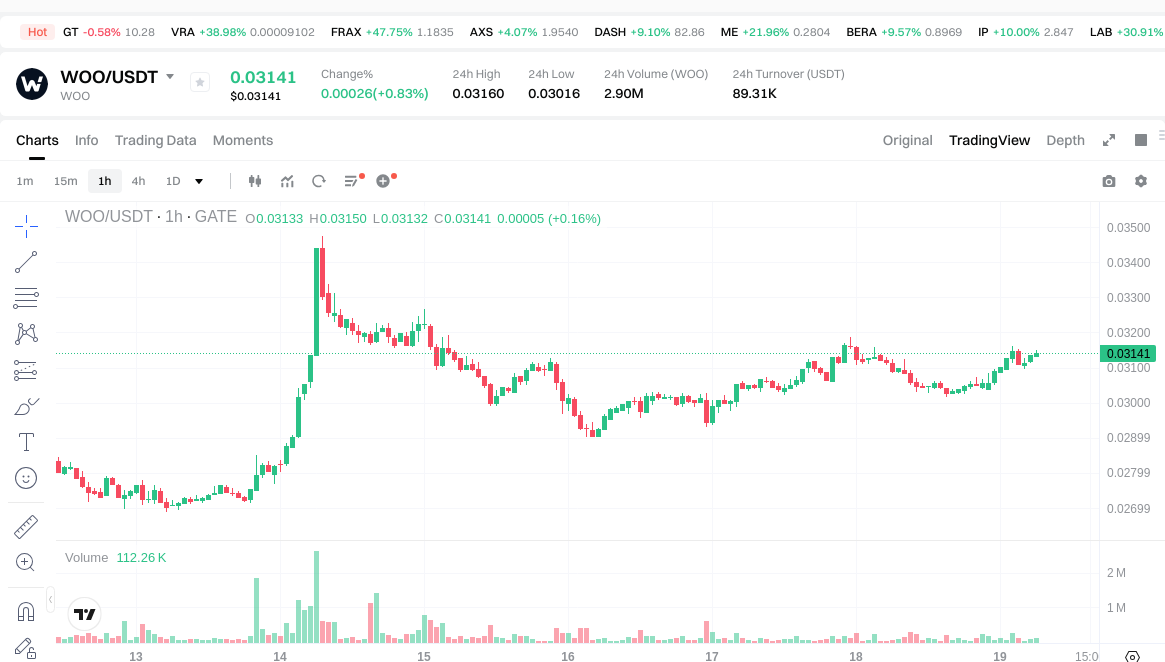
WOO is a notable digital asset in the cryptocurrency space, serving as the native token of a next-generation trading platform that bridges centralized (CeFi) and decentralized (DeFi) markets. Incubated by quantitative trading firm Kronos Research, WOO has established its presence in the liquidity provision and trading infrastructure sector. As of January 19, 2026, WOO maintains a market capitalization of approximately $59.24 million, with a circulating supply of around 1.89 billion tokens. The current price stands at approximately $0.03135, with the token trading on 33 exchanges and held by 19,580 addresses.
The WOO ecosystem encompasses multiple components: WOO X (a customizable centralized exchange), WOOFi (a multichain decentralized exchange supporting spot, perpetual contracts, and yield vaults), and WOOFi Pro (an on-chain order book platform). The token serves multiple functions within this ecosystem, including staking, fee discounts, and reward distribution. Since 2024, over $10 million has been distributed to the community through staking rewards, with protocol revenues aggregated in USDC and shared with token holders. With over 86% of tokens currently in circulation and a deflationary model supported by periodic token burns, WOO presents a distinct tokenomic structure.
The project has received backing from institutional investors including Binance Labs, Dragonfly Capital, and Crypto.com Capital. Recent market performance shows varied trends across different timeframes: a 1.03% increase over 1 hour, 0.67% over 24 hours, 10.67% over 7 days, and 30.15% over 30 days, while experiencing an 85.83% decline over the past year. This article provides a comprehensive analysis of WOO's investment characteristics, historical price movements, future price projections, and associated risks to assist readers in evaluating the question: "Is WOO (WOO) a worthwhile consideration for portfolio allocation?"
I. WOO Price History Review and Investment Value Status
WOO has experienced notable price fluctuations since its launch, reflecting the broader dynamics of the cryptocurrency market and the evolution of its ecosystem.
-
2021: WOO reached a significant price level of $1.78 in November, driven by initial market enthusiasm and the growing adoption of WOO Network's liquidity solutions. Early investors during this period experienced substantial returns as the project gained traction among institutional traders and exchanges.
-
2022: The broader crypto market downturn impacted WOO's valuation, with prices declining from previous highs. This period tested investor confidence as the project continued to develop its infrastructure and expand its ecosystem offerings.
-
2025: WOO demonstrated resilience with the launch of WOO X Global's pre-launch perpetual contract markets and continued AI integration. The price showed recovery patterns, though volatility remained characteristic of the broader market environment.
-
December 2025: WOO reached a lower price point of $0.02175951, reflecting market-wide consolidation and token unlock pressures that affected many crypto assets during this period.
Current WOO Investment Market Status (January 2026)
- WOO current price: $0.03135
- Market sentiment: The token has shown a 1.03% increase over 1 hour, 0.67% over 24 hours, and 10.67% over 7 days, indicating recent positive momentum. However, the 1-year performance shows an 85.83% decline, reflecting the challenging market conditions faced by many altcoins.
- 24-hour trading volume: $86,296.11
- Circulating supply: 1,889,700,544 WOO (62.99% of total supply)
- Market capitalization: $59,242,112
- Token holder distribution: Over 19,580 addresses hold WOO tokens, with approximately 26.55% concentrated in the largest address. The remaining 36.42% is distributed among other addresses, suggesting a mix of institutional and retail participation.
Click to view real-time WOO market price
WOO's current market position reflects its role in connecting CeFi and DeFi liquidity infrastructure. The token's deflationary model through regular burns, combined with over 86% circulating supply, positions it within a mature distribution phase. Investment considerations should account for the platform's revenue-sharing mechanism, where protocol revenues are aggregated in USDC and distributed to stakers, as well as the competitive landscape in both centralized and decentralized trading environments.
II. Core Factors Influencing Whether WOO is a Good Investment
Supply Mechanism and Scarcity (WOO Investment Scarcity)
- Token Supply Structure → Impacts Price and Investment Value
- Current circulating supply: 1,889,700,544 WOO (approximately 63% of total supply)
- Total supply: 2,211,324,098 WOO
- Maximum supply: 3,000,000,000 WOO
- The project implements a deflationary model through regular token burns
- Investment Significance: The deflationary tokenomics and controlled supply may provide structural support for long-term investment considerations
Institutional Investment and Mainstream Adoption (Institutional Investment in WOO)
- Institutional Backing:
- WOO has received investment from notable institutions including Binance Labs, Dragonfly Capital, and Crypto.com Capital
- In 2025, FusionX Digital (a Web3 Private Equity fund) entered into a strategic partnership to acquire and operate the centralized exchange WOO X
- Ecosystem Integration:
- The platform serves institutions, exchanges, and retail users across CeFi and DeFi markets
- Current holder count: 19,580 addresses
- Listed on 33 exchanges as of January 2026
Macroeconomic Environment's Impact on WOO Investment
- Market Performance Context:
- 1-year price change: -85.83%
- 30-day price change: +30.15%
- 7-day price change: +10.67%
- Market Positioning:
- Market capitalization: $59,242,112 (ranked #494)
- Market dominance: 0.0020%
- Trading volume (24h): $86,296.11
Technology and Ecosystem Development (Technology & Ecosystem for WOO Investment)
- AI Integration: WOO incorporates AI technology to enable smarter trading strategies, social copy trading, and automated portfolio management
- Multi-Platform Ecosystem:
- WOO X: A customizable centralized exchange offering spot, perpetual trading, earning products, and social trading features
- WOOFi: A multi-chain decentralized exchange (DEX) supporting spot trading, perpetual contracts, and yield vaults
- WOOFi Pro: An on-chain order book trading platform combining centralized exchange-level performance with self-custody capabilities
- Value Distribution Mechanism:
- Protocol revenues are aggregated in USDC and distributed to stakers
- 80% of WOOFi revenue and 0.1 basis points of WOO X trading volume are redistributed to stakers monthly
- Since 2024, over $10 million has been distributed to the community through staking rewards
- Cross-Chain Liquidity: The platform focuses on solving fragmented liquidity issues and capturing cross-chain liquidity to simplify token swaps
- Zero-Fee Trading: WOO offers zero-fee trading designed to attract institutional and retail participants
III. WOO Future Investment Forecast and Price Outlook (Is WOO(WOO) worth investing in 2026-2031)
Short-term Investment Forecast (2026, short-term WOO investment outlook)
- Conservative forecast: $0.0236 - $0.0314
- Neutral forecast: $0.0314 - $0.0388
- Optimistic forecast: $0.0388 - $0.0462
Mid-term Investment Outlook (2027-2029, mid-term WOO(WOO) investment forecast)
- Market stage expectation: Gradual growth phase with potential stabilization as WOO Network continues ecosystem development and liquidity expansion across CeFi and DeFi platforms.
- Investment return forecast:
- 2027: $0.0314 - $0.0516
- 2028: $0.0231 - $0.0475
- 2029: $0.0273 - $0.0477
- Key catalysts: Ecosystem expansion, AI-enhanced trading tools adoption, staking rewards distribution, protocol revenue growth, and potential regulatory developments in digital asset markets.
Long-term Investment Outlook (Is WOO a good long-term investment?)
- Base scenario: $0.027 - $0.058 (assuming steady ecosystem growth and moderate market conditions through 2030-2031)
- Optimistic scenario: $0.047 - $0.078 (assuming strong adoption of WOO X, WOOFi, and WOOFi Pro platforms with increased institutional participation)
- Risk scenario: $0.023 - $0.035 (assuming adverse market conditions or intensified competition in liquidity provision space)
Check WOO long-term investment and price forecast: Price Prediction
2026-01-19 - 2031 Long-term Outlook
- Base scenario: $0.027 - $0.047 USD (corresponding to steady progress and mainstream application gradual improvement)
- Optimistic scenario: $0.047 - $0.078 USD (corresponding to large-scale adoption and favorable market environment)
- Transformative scenario: Above $0.078 USD (such as breakthrough progress in ecosystem and mainstream popularization)
- 2031-12-31 predicted high: $0.078 USD (based on optimistic development assumptions)
Disclaimer: These forecasts are based on current market data and predictive models. Cryptocurrency markets are highly volatile and unpredictable. Past performance does not guarantee future results. This information is for reference only and does not constitute investment advice. Investors should conduct their own research and consider their risk tolerance before making investment decisions.
| Year |
Predicted High Price |
Predicted Average Price |
Predicted Low Price |
Price Change |
| 2026 |
0.0462021 |
0.03143 |
0.0235725 |
0 |
| 2027 |
0.0516253465 |
0.03881605 |
0.0314410005 |
23 |
| 2028 |
0.0474817331625 |
0.04522069825 |
0.0230625561075 |
44 |
| 2029 |
0.047741752177437 |
0.04635121570625 |
0.027347217266687 |
47 |
| 2030 |
0.057867175248467 |
0.047046483941843 |
0.035284862956382 |
50 |
| 2031 |
0.07763610780083 |
0.052456829595155 |
0.027277551389481 |
67 |
IV. WOO Investment Strategy and Risk Management (How to invest in WOO)
Investment Methodology (WOO investment strategy)
Long-term Holding (HODL WOO): Suitable for Conservative Investors
Long-term holding represents a passive investment approach that may be appropriate for investors with a lower risk tolerance. This strategy involves acquiring WOO tokens and maintaining positions over extended periods, potentially benefiting from the platform's ecosystem development. WOO's deflationary token model, achieved through regular token burns, may influence long-term supply dynamics. The staking mechanism, which distributes protocol revenues in USDC to stakers, provides a potential yield-generating component for long-term holders.
Active Trading: Technical Analysis and Swing Trading
Active trading strategies rely on technical analysis and market timing to capitalize on price movements. WOO has demonstrated notable volatility, with a 30-day price change of 30.15% and a 7-day change of 10.67% as of January 19, 2026. The 24-hour trading volume of approximately $86,296 suggests a level of market activity that may support active trading strategies. Traders may utilize WOO X's customizable CeFi exchange or WOOFi Pro's on-chain order book platform for executing trades. The platform's AI-enhanced tools, which enable trading strategies and automated portfolio management, may provide additional resources for active traders.
Risk Management (Risk management for WOO investment)
Asset Allocation Ratios: Conservative / Aggressive / Professional Investors
Conservative Investors: May consider allocating a smaller percentage (1-5%) of their overall portfolio to WOO, balancing exposure to the cryptocurrency sector while limiting potential downside risk. This allocation acknowledges the high volatility inherent in cryptocurrency markets while providing limited exposure to potential upside.
Aggressive Investors: Those with higher risk tolerance might allocate a larger portion (5-15%) of their portfolio to WOO, accepting increased volatility in exchange for potentially greater returns. This approach assumes a longer investment horizon and the capacity to withstand significant price fluctuations.
Professional Investors: Institutional or experienced investors may incorporate WOO as part of a diversified cryptocurrency portfolio, potentially allocating 3-10% based on comprehensive risk assessment, market analysis, and investment mandates. Professional investors may leverage advanced trading tools and strategies available within the WOO ecosystem.
Diversification remains a fundamental risk management principle. Investors may consider:
- Multi-Asset Allocation: Combining WOO holdings with other cryptocurrency assets, stablecoins, and traditional financial instruments to reduce concentration risk.
- Stablecoin Reserves: Maintaining a portion of the portfolio in stablecoins (such as USDC, which is used for WOO staking rewards) to provide liquidity and flexibility for rebalancing.
- Derivatives and Hedging: Utilizing perpetual contracts available on WOOFi to hedge directional exposure or manage portfolio risk during periods of heightened volatility.
Secure Storage: Hot and Cold Wallets + Hardware Wallet Recommendations
Secure custody of WOO tokens is essential for protecting against unauthorized access and potential loss:
- Cold Storage: Hardware wallets such as Ledger or Trezor provide offline storage solutions, reducing exposure to online security threats. This method is recommended for long-term holdings and larger amounts.
- Hot Wallets: Software wallets or exchange wallets may be used for smaller amounts intended for active trading or staking. WOO is available on multiple platforms, including WOO X, and supports self-custody through WOOFi Pro.
- Multi-Signature Solutions: For institutional investors or large holdings, multi-signature wallets add an additional layer of security by requiring multiple approvals for transactions.
- Contract Address Verification: WOO tokens are deployed on Ethereum (0x4691937a7508860f876c9c0a2a617e7d9e945d4b) and BSC (0x4691937a7508860f876c9c0a2a617e7d9e945d4b). Investors should verify contract addresses before interacting with tokens to avoid fraudulent assets.
V. WOO Investment Risks and Challenges (Risks of investing in WOO)
Market Risk: High Volatility and Price Manipulation
Cryptocurrency markets, including WOO, are characterized by substantial price volatility. WOO's 1-year price change of -85.83% as of January 19, 2026, illustrates the potential for significant value fluctuations. The token reached an all-time high of $1.78 on November 15, 2021, and an all-time low of $0.02175951 on December 19, 2025, demonstrating a wide historical price range.
The current trading volume of approximately $86,296 and a market capitalization of roughly $59.24 million may present liquidity considerations. Relatively lower trading volumes can contribute to price volatility and potential slippage during large transactions. Additionally, cryptocurrency markets may be susceptible to manipulation, including wash trading, pump-and-dump schemes, and coordinated trading activities that can distort price signals.
Regulatory Risk: Policy Uncertainty Across Jurisdictions
The regulatory landscape for cryptocurrencies varies significantly across jurisdictions and continues to evolve. Potential regulatory developments that may impact WOO include:
- Classification and Compliance: Regulatory authorities may classify WOO tokens differently (as securities, commodities, or utility tokens), potentially affecting trading, custody, and tax treatment.
- Exchange and Trading Restrictions: Regulatory actions targeting cryptocurrency exchanges or trading platforms could impact WOO's accessibility and liquidity.
- Cross-Border Operations: WOO's ecosystem includes both centralized (WOO X) and decentralized (WOOFi, WOOFi Pro) components operating across multiple jurisdictions, creating complex compliance considerations.
- Staking and Yield Products: Regulatory scrutiny of yield-generating products and staking services may affect WOO's staking mechanism and revenue distribution model.
Investors should monitor regulatory developments in their respective jurisdictions and consider potential compliance obligations, including tax reporting requirements.
Technical Risk: Network Security Vulnerabilities and Upgrade Failures
Technical risks associated with WOO investment include:
- Smart Contract Vulnerabilities: WOO tokens are deployed on Ethereum and BSC, and the protocol's smart contracts may contain vulnerabilities that could be exploited, potentially resulting in loss of funds.
- Network Dependencies: WOO's functionality relies on the underlying blockchain networks (Ethereum and BSC). Network congestion, high transaction fees, or technical issues on these networks may impact WOO token transfers and protocol operations.
- Protocol Upgrades: The WOO ecosystem includes multiple interconnected platforms (WOO X, WOOFi, WOOFi Pro). Technical issues during platform upgrades or integration failures could temporarily disrupt services or, in severe cases, result in loss of funds.
- Custody and Key Management: As with all cryptocurrencies, loss of private keys results in permanent loss of access to WOO tokens. Security breaches of custodial services or individual wallet compromises represent ongoing risks.
- Dependency on Kronos Research: WOO was incubated by quantitative trading firm Kronos Research. Significant operational, financial, or reputational issues affecting Kronos Research could potentially impact WOO's ecosystem and token value.
VI. Conclusion: Is WOO a Good Investment?
Investment Value Summary
WOO presents a multifaceted investment proposition within the cryptocurrency sector. The platform's approach to connecting centralized and decentralized liquidity, combined with its ecosystem of trading products (WOO X, WOOFi, and WOOFi Pro), addresses specific market needs related to liquidity fragmentation and trading efficiency. The token's utility within the ecosystem includes staking, fee discounts, and participation in protocol revenue distribution through USDC rewards.
The deflationary token model, with over 86% of tokens in circulation and regular burns, represents a supply-side dynamic that may influence long-term value. Backing from notable investors including Binance Labs, Dragonfly Capital, and Crypto.com Capital provides institutional credibility. However, the token's substantial 1-year decline of -85.83% and high volatility underscore the significant price risks inherent in this investment.
Investor Recommendations
✅ Beginners: Consider a measured approach through dollar-cost averaging (DCA) combined with secure storage solutions. New investors should prioritize understanding the WOO ecosystem, its utility, and the broader cryptocurrency market dynamics before making significant allocations. Hardware wallets are recommended for secure storage.
✅ Experienced Investors: May explore active trading strategies leveraging technical analysis and the WOO ecosystem's trading platforms. Portfolio diversification across multiple cryptocurrency assets and strategic position sizing based on risk tolerance may be appropriate. The staking mechanism offers potential yield generation for those comfortable with the associated risks.
✅ Institutional Investors: Could consider WOO as part of a strategic cryptocurrency allocation, particularly if seeking exposure to liquidity provision and trading infrastructure within the digital asset space. Thorough due diligence on technical architecture, regulatory compliance, and operational risk is essential.
⚠️ Disclaimer: Cryptocurrency investments involve substantial risk and high volatility. This content is provided for informational purposes only and does not constitute investment advice, financial advice, trading advice, or recommendations of any kind. Past performance does not indicate future results. Investors should conduct their own research and consult with qualified financial advisors before making investment decisions.
VII. FAQ
Q1: What is WOO and what makes it different from other cryptocurrency projects?
WOO is the native token of WOO Network, a next-generation trading platform that bridges centralized (CeFi) and decentralized (DeFi) markets. What distinguishes WOO from other projects is its comprehensive ecosystem approach: it combines WOO X (a customizable centralized exchange), WOOFi (a multi-chain decentralized exchange supporting spot, perpetual contracts, and yield vaults), and WOOFi Pro (an on-chain order book platform). The platform was incubated by Kronos Research, a quantitative trading firm, and focuses on solving liquidity fragmentation across different blockchain networks. Unlike many tokens that serve primarily as governance or speculative assets, WOO provides tangible utility through staking rewards, fee discounts, and revenue sharing—with protocol revenues aggregated in USDC and distributed to stakers monthly. Since 2024, over $10 million has been distributed to the community through this mechanism.
Q2: How has WOO performed historically and what is its current market position?
WOO reached its all-time high of $1.78 in November 2021 during the broader cryptocurrency bull market and early adoption of WOO Network's liquidity solutions. However, the token has experienced significant volatility, reaching an all-time low of $0.02175951 in December 2025. As of January 19, 2026, WOO trades at approximately $0.03135 with a market capitalization of $59.24 million, ranking #494 by market cap. The token shows mixed performance across different timeframes: while it has declined 85.83% over the past year, it has gained 30.15% over 30 days and 10.67% over 7 days, indicating recent positive momentum. With a 24-hour trading volume of approximately $86,296 and 1.89 billion tokens in circulation (representing about 63% of total supply), WOO maintains a presence across 33 exchanges and is held by 19,580 addresses.
Q3: What are the main factors that could influence WOO's future price?
Several key factors may impact WOO's future valuation: First, the token's deflationary model through regular burns and controlled supply (with over 86% already in circulation) creates scarcity dynamics that may provide structural price support. Second, adoption and growth of the WOO ecosystem—particularly WOO X, WOOFi, and WOOFi Pro platforms—will directly affect demand for the token and protocol revenue generation. Third, the AI integration for smarter trading strategies and automated portfolio management may attract both institutional and retail users, increasing platform utility. Fourth, institutional backing from Binance Labs, Dragonfly Capital, and Crypto.com Capital provides credibility, while the 2025 strategic partnership with FusionX Digital for operating WOO X could drive platform growth. Finally, broader cryptocurrency market conditions, regulatory developments, and competition in the liquidity provision space will significantly influence WOO's performance.
Q4: What investment strategies are suitable for different types of WOO investors?
Conservative investors may consider a 1-5% portfolio allocation to WOO using a long-term holding (HODL) strategy, potentially participating in the staking mechanism to earn USDC-denominated protocol revenue distributions. This approach reduces trading frequency and focuses on the platform's ecosystem development over time. Aggressive investors with higher risk tolerance might allocate 5-15% of their portfolio and employ active trading strategies, leveraging WOO's demonstrated volatility (30-day change of 30.15%) and utilizing technical analysis tools available on WOO X or WOOFi Pro. Professional and institutional investors could allocate 3-10% as part of a diversified cryptocurrency portfolio, conducting comprehensive due diligence on technical architecture and regulatory compliance. Regardless of investor type, risk management through diversification, maintaining stablecoin reserves, and using secure storage solutions (hardware wallets for long-term holdings) is essential given cryptocurrency market volatility.
Q5: What are the primary risks associated with investing in WOO?
WOO investment carries several significant risks. Market risk is substantial, as evidenced by the token's 85.83% decline over the past year and wide historical price range from $1.78 (all-time high) to $0.02175951 (all-time low). The relatively low 24-hour trading volume of approximately $86,296 may result in liquidity concerns, price slippage, and potential vulnerability to market manipulation. Regulatory risk remains considerable, as evolving cryptocurrency regulations could impact WOO's classification, trading availability, and staking services across different jurisdictions. Technical risks include potential smart contract vulnerabilities on Ethereum and BSC networks, dependency on underlying blockchain performance, and operational challenges during platform upgrades. Additionally, WOO's connection to Kronos Research means that any significant issues affecting the quantitative trading firm could impact the ecosystem. Investors must also manage custody risks, as loss of private keys results in permanent loss of access to tokens.
Q6: How does WOO's staking mechanism work and what returns can investors expect?
WOO's staking mechanism allows token holders to lock their tokens and receive a portion of protocol revenues in return. Unlike many projects that distribute rewards in native tokens (which can be inflationary), WOO distributes staking rewards in USDC, a stablecoin, providing more predictable value to participants. The distribution formula includes 80% of WOOFi revenue and 0.1 basis points of WOO X trading volume, redistributed to stakers monthly. Since 2024, the protocol has distributed over $10 million to the community through this mechanism. The actual returns depend on total staked amount, protocol trading volumes, and individual staking duration. This revenue-sharing model aligns token holder interests with platform growth and provides a yield-generating component beyond price appreciation. However, investors should note that staking typically involves lock-up periods during which tokens cannot be traded, and the USDC rewards fluctuate based on protocol activity and market conditions.
Q7: What is WOO's long-term price outlook and is it a good long-term investment?
Price forecasts for WOO through 2031 vary based on different scenarios and market conditions. In a base scenario assuming steady ecosystem growth and moderate market conditions, WOO could trade between $0.027 and $0.058 by 2030-2031. An optimistic scenario, assuming strong adoption of WOO X, WOOFi, and WOOFi Pro with increased institutional participation, projects a range of $0.047 to $0.078. Conversely, a risk scenario considering adverse market conditions or intensified competition suggests a range of $0.023 to $0.035. The 2031 predicted high under optimistic assumptions is $0.078. Whether WOO represents a good long-term investment depends on individual risk tolerance, portfolio diversification, and conviction in the platform's ability to execute its roadmap. The project's deflationary tokenomics, revenue-sharing mechanism, and institutional backing provide fundamental support, but the substantial historical volatility and competitive landscape in liquidity provision require careful consideration. Investors must conduct their own research and understand that cryptocurrency markets are highly unpredictable, and past performance does not guarantee future results.
Q8: How should investors securely store WOO tokens?
Secure storage of WOO tokens is critical for protecting against unauthorized access and loss. For long-term holdings and larger amounts, cold storage using hardware wallets such as Ledger or Trezor is strongly recommended, as these devices keep private keys offline and away from potential online threats. For smaller amounts intended for active trading or staking, software wallets or exchange wallets may be appropriate, though they carry higher security risks. WOO is available on multiple platforms, including WOO X, and supports self-custody through WOOFi Pro. Institutional investors or those holding significant amounts should consider multi-signature wallet solutions, which require multiple approvals for transactions, adding an additional security layer. Before interacting with WOO tokens, investors must verify the correct contract addresses: Ethereum (0x4691937a7508860f876c9c0a2a617e7d9e945d4b) and BSC (0x4691937a7508860f876c9c0a2a617e7d9e945d4b) to avoid fraudulent assets. Implementing proper backup procedures for seed phrases and private keys, using strong passwords, enabling two-factor authentication, and maintaining operational security practices are essential components of a comprehensive storage strategy.
* The information is not intended to be and does not constitute financial advice or any other recommendation of any sort offered or endorsed by Gate.