This comprehensive analysis examines whether World Liberty Financial USD (USD1) represents a sound investment opportunity. USD1, a regulated dollar-backed stablecoin launched in April 2025 by World Liberty Financial and managed by BitGo Trust Company, maintains a $2.15 billion market cap with stable pricing near $1.00 as of January 2026. The article evaluates USD1's investment potential by analyzing its market history, institutional adoption across 34 exchanges, multi-chain deployment benefits, and regulatory compliance framework. It provides detailed price forecasts ranging from conservative to optimistic scenarios through 2031, explores practical investment strategies for beginners to institutional investors, and thoroughly addresses key risks including market volatility, regulatory changes, and technical vulnerabilities. Readers gain actionable insights on portfolio allocation, secure storage methods, passive income opportunities through DeFi protocols, and USD1's primary use cases for liquidity management
Introduction: World Liberty Financial USD (USD1) Investment Position and Market Outlook
USD1 represents a significant asset in the cryptocurrency field. As a fiat-backed digital asset launched in April 2025 by World Liberty Financial (WLFI), a Miami-based financial technology firm, it has established its position in the stablecoin market. As of January 14, 2026, USD1 maintains a market capitalization of approximately $2.15 billion, with a circulating supply of 2.15 billion tokens, and its current price hovers around $1.00. With its positioning as a regulated U.S. dollar-pegged stablecoin issued and managed by BitGo Trust Company, USD1 has gradually become a focal point when investors discuss "Is World Liberty Financial USD (USD1) a good investment?" This article comprehensively analyzes USD1's investment value, historical performance, future price projections, and investment risks to provide reference for investors.
I. World Liberty Financial USD (USD1) Price History Review and Current Investment Value
USD1 Historical Price Movement and Investment Returns
-
April 2025: USD1 was officially launched by World Liberty Financial (WLFI) as a fiat-backed stablecoin pegged 1:1 to the US dollar. The token was issued and managed by BitGo Trust Company, a regulated trust entity based in South Dakota.
-
June 2025: USD1 reached a notable price level of $1.971, which represented a significant deviation from its intended peg. This fluctuation occurred during a period of market expansion and increased adoption across multiple blockchain networks.
-
June 2025: Following the peak, USD1 experienced a correction to $0.9663, demonstrating price volatility despite its stablecoin design. The price movement reflected market dynamics and liquidity adjustments during the token's early circulation phase.
-
January 2026: USD1 has stabilized closer to its intended $1.00 peg, with the current price showing minor fluctuations within a narrow range, indicating improved market efficiency and liquidity management.
Current USD1 Investment Market Status (January 2026)
- Current USD1 Price: $1.00
- Market Emotion: Positive (market_emotion: 1)
- 24-Hour Trading Volume: $9,738,688.27
- Market Capitalization: $2,151,591,931
- Circulating Supply: 2,151,591,931 USD1 (100% of total supply)
- Holder Count: 168,182 holders
- Exchange Listings: 34 exchanges
Click to view real-time USD1 market price
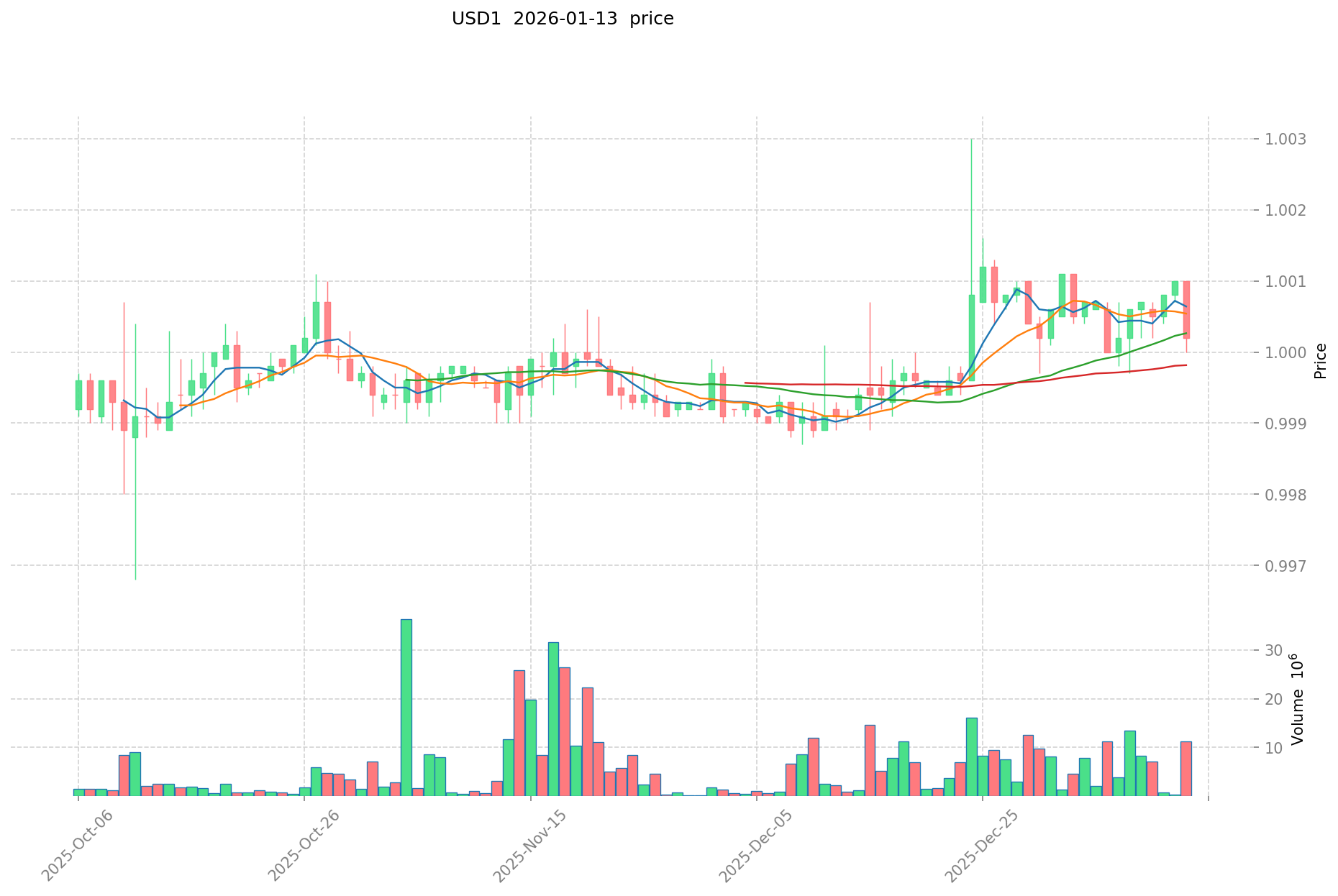
II. Core Factors Influencing Whether USD1 is a Good Investment
Supply Mechanism and Scarcity (USD1 Investment Scarcity)
- USD1 maintains a 1:1 peg with the U.S. dollar through fiat backing, which means its supply mechanism is designed for price stability rather than speculative appreciation
- The total supply currently stands at 2,151,591,931 USD1, with 100% circulating supply, indicating full token availability in the market
- As a stablecoin, USD1's design prioritizes liquidity and fungibility over scarcity-driven value appreciation, distinguishing it from traditional cryptocurrency investment assets
- Investment consideration: The absence of artificial scarcity suggests USD1 serves primarily as a transactional medium rather than a speculative store of value
Institutional Investment and Mainstream Adoption (Institutional Investment in USD1)
- USD1 is issued and managed by BitGo Trust Company, a regulated trust entity based in South Dakota, providing institutional-grade custody and compliance with U.S. regulatory standards
- The stablecoin has achieved substantial circulation, with over 168,182 holders across multiple blockchain networks as of January 14, 2026
- World Liberty Financial's launch of World Liberty Markets lending platform demonstrates ecosystem expansion, allowing USD1 holders to deploy the stablecoin in lending and borrowing activities
- The token is listed on 34 cryptocurrency exchanges with 24-hour trading volume of $9,738,688, indicating growing market liquidity and accessibility
- Regulatory compliance through a U.S.-based trust structure potentially positions USD1 favorably amid increasing regulatory scrutiny of stablecoin issuers
Macroeconomic Environment's Impact on USD1 Investment
- As a dollar-pegged stablecoin, USD1's value is directly tied to U.S. monetary policy and the strength of the U.S. dollar
- In periods of monetary tightening or rising interest rates, USD1 maintains its $1 peg but offers no yield advantage unless utilized in DeFi protocols or lending platforms
- During inflationary environments, USD1 shares the same purchasing power erosion characteristics as traditional U.S. dollars, lacking the potential hedge properties associated with non-pegged cryptocurrencies
- Geopolitical uncertainty may drive demand for dollar-denominated stablecoins as safe-haven assets within the cryptocurrency ecosystem, potentially increasing USD1 adoption
Technology and Ecosystem Development (Technology & Ecosystem for USD1 Investment)
- USD1 operates on multiple blockchain networks including Ethereum (ERC-20), Binance Smart Chain (BEP-20), Solana, Tron, and Aptos, providing cross-chain flexibility and broader market reach
- The integration with World Liberty Markets creates utility beyond simple value transfer, enabling USD1 to function within decentralized lending and borrowing protocols
- Multi-chain deployment strategy enhances accessibility and reduces transaction costs across different blockchain ecosystems
- The platform's focus on bridging traditional finance (TradFi) and decentralized finance (DeFi) may support long-term adoption if regulatory clarity improves and institutional DeFi participation increases
III. USD1 Future Investment Forecast and Price Outlook (Is World Liberty Financial USD(USD1) worth investing in 2026-2031)
Short-term Investment Forecast (2026, short-term USD1 investment outlook)
- Conservative forecast: $0.91 - $1.00
- Neutral forecast: $1.00 - $1.21
- Optimistic forecast: $1.21 - $1.43
Mid-term Investment Outlook (2027-2029, mid-term World Liberty Financial USD(USD1) investment forecast)
- Market stage expectation: USD1 may experience gradual adoption expansion as a fiat-backed stablecoin, with potential growth driven by increased usage in digital transactions and DeFi integration across multiple blockchain networks.
- Investment return forecast:
- 2027: $0.88 - $1.47
- 2028: $1.23 - $1.60
- 2029: $1.08 - $1.98
- Key catalysts: Regulatory compliance maintained through BitGo Trust Company oversight, multi-chain deployment expansion (currently available on BSC, ETH, TRX, SOL, and APT networks), and growing holder base (currently 168,182 holders).
Long-term Investment Outlook (Is USD1 a good long-term investment?)
- Base scenario: $1.08 - $2.06 (assuming steady market growth and maintained regulatory compliance from 2025 onwards)
- Optimistic scenario: $2.06 - $3.05 (assuming accelerated adoption in digital payment ecosystems and expanded institutional usage)
- Risk scenario: $0.96 - $1.13 (under conditions of increased stablecoin market competition or regulatory challenges)
Check USD1 long-term investment and price forecast: Price Prediction
2026-01-14 to 2031 Long-term Outlook
- Base scenario: $1.13 - $2.06 (corresponding to steady progress and gradual mainstream application growth)
- Optimistic scenario: $2.40 - $3.06 (corresponding to large-scale adoption and favorable market conditions)
- Transformative scenario: Above $3.06 (if ecosystem achieves breakthrough developments and mainstream popularization)
- 2031-12-31 forecast high: $3.06 (based on optimistic development assumptions)
Disclaimer: Price forecasts are based on historical data analysis and market trend projections. Cryptocurrency markets remain highly volatile and unpredictable. These projections should not be considered as financial advice or guarantees of future performance. Investors should conduct independent research and consider their risk tolerance before making investment decisions.
| Year |
Predicted High Price |
Predicted Average Price |
Predicted Low Price |
Price Change |
| 2026 |
1.43 |
1 |
0.91 |
0 |
| 2027 |
1.47015 |
1.215 |
0.88695 |
21 |
| 2028 |
1.59766425 |
1.342575 |
1.235169 |
34 |
| 2029 |
1.98466149375 |
1.470119625 |
1.0878885225 |
47 |
| 2030 |
2.40107287753125 |
1.727390559375 |
1.08825605240625 |
72 |
| 2031 |
3.055062943310625 |
2.064231718453125 |
1.135327445149218 |
106 |
IV. USD1 Investment Strategy and Risk Management (How to invest in stablecoins)
Investment Methodology (USD1 investment strategy)
Holding USD1 as a Store of Value
For conservative investors, USD1 can serve as a stable digital asset alternative to traditional cash holdings. Given its design to maintain a 1:1 peg with the U.S. dollar and management by BitGo Trust Company under U.S. regulatory standards, the token offers a relatively stable option within the crypto ecosystem. Investors may consider holding USD1 to preserve capital during periods of market volatility in other cryptocurrencies, or to maintain liquidity while participating in decentralized finance (DeFi) protocols.
Active Trading Considerations
While USD1 is designed as a stablecoin, minor price fluctuations have been observed. Historical data shows the token traded between $0.9663 and $1.971, suggesting occasional deviations from its intended peg. Active traders may monitor these small variations, though the trading opportunities are significantly more limited compared to volatile cryptocurrencies. Technical analysis for stablecoins typically focuses on maintaining peg stability rather than identifying price trends.
Risk Management (Risk management for USD1 investment)
Asset Allocation Ratios
- Conservative Investors: May allocate 10-30% of their crypto portfolio to stablecoins like USD1 as a safety buffer and liquidity reserve
- Aggressive Investors: Might maintain 5-15% in stablecoins for strategic rebalancing and opportunistic deployment
- Professional Investors: Often utilize stablecoins as bridge assets, with allocation varying based on market conditions and trading strategies
Risk Hedging Solutions
A diversified approach combining multiple asset classes can help manage exposure. Investors might consider pairing USD1 holdings with other stablecoins to mitigate issuer-specific risks, while maintaining positions in traditional assets. Within the crypto space, USD1 can function as a hedging tool against volatility in other digital assets.
Secure Storage Methods
USD1 is available across multiple blockchain networks including BSC, ETH, TRX, SOL, and APT. Storage recommendations include:
- Hot Wallets: Suitable for active trading and frequent transactions, though carrying higher security risks
- Cold Wallets: Recommended for long-term storage, offering enhanced security through offline storage
- Hardware Wallets: Devices such as Ledger and Trezor provide robust security for storing USD1 across supported networks
Investors should verify contract addresses through official sources (BSC: 0x8d0d000ee44948fc98c9b98a4fa4921476f08b0d, ETH: 0x8d0d000ee44948fc98c9b98a4fa4921476f08b0d) to avoid interacting with fraudulent tokens.
V. USD1 Investment Risks and Challenges (Risks of investing in stablecoins)
Market Risks
While stablecoins are designed to minimize volatility, USD1 has experienced price fluctuations. The token's trading range suggests potential deviations from the $1.00 peg under certain market conditions. As of January 14, 2026, USD1 showed minor price movements with a 24-hour trading volume of approximately $9.74 million, indicating moderate liquidity that may vary across different exchanges and market conditions.
Regulatory Risks
Stablecoin regulation remains an evolving area globally. USD1 operates under U.S. regulatory oversight through BitGo Trust Company in South Dakota, which provides a framework of compliance. However, changes in federal or state-level regulations could impact the token's operations, redemption mechanisms, or availability across different jurisdictions. International users should be aware that regulatory approaches to stablecoins vary significantly by country.
Technical Risks
USD1's multi-chain deployment (BSC, ETH, TRX, SOL, APT) introduces several technical considerations:
- Smart Contract Vulnerabilities: Each blockchain implementation carries inherent smart contract risks
- Bridge Risks: Cross-chain transfers may involve third-party bridges with associated security considerations
- Network Dependencies: Performance and security depend on the underlying blockchain infrastructure
- Custody Risks: The centralized management structure requires trust in the issuing entity and custodian
Investors should monitor official communications regarding any technical updates or security assessments.
VI. Conclusion: Is USD1 a Good Investment?
Investment Value Summary
USD1 represents a fiat-backed stablecoin option within the digital asset ecosystem, designed to provide stability rather than appreciation. With 168,182 holders and availability on 34 exchanges as of January 2026, the token has achieved notable adoption since its April 2025 launch. The regulatory framework through BitGo Trust Company and multi-chain availability offer practical utility for users seeking dollar-denominated digital assets.
Investor Recommendations
✅ Beginners: USD1 can serve as an entry point into cryptocurrency, offering dollar stability while learning about digital asset storage and transactions. Focus on understanding wallet security and verifying contract addresses before transfers.
✅ Experienced Investors: Consider USD1 as a liquidity tool for portfolio rebalancing, DeFi participation, or temporary parking of funds during market volatility. Evaluate the stablecoin as part of a broader risk management strategy.
✅ Institutional Investors: USD1 may provide utility for treasury management, payment settlement, or as a bridge asset in trading operations, subject to due diligence on regulatory compliance and custodial arrangements.
⚠️ Disclaimer: Cryptocurrency investments carry inherent risks, including but not limited to market volatility, regulatory changes, and technical vulnerabilities. This analysis is provided for informational purposes only and does not constitute financial, investment, or legal advice. Investors should conduct thorough research and consider consulting with qualified professionals before making investment decisions.
VII. FAQ
Q1: What makes USD1 different from other stablecoins like USDT or USDC?
USD1 is distinguished by its regulatory structure and multi-chain deployment strategy. Issued and managed by BitGo Trust Company, a regulated trust entity based in South Dakota, USD1 operates under U.S. regulatory oversight with 1:1 U.S. dollar backing. Unlike some stablecoins, USD1 is available across five major blockchain networks (BSC, ETH, TRX, SOL, and APT), providing enhanced accessibility and lower transaction costs. As of January 2026, with 168,182 holders and listing on 34 exchanges, USD1 has achieved substantial adoption since its April 2025 launch. The token's integration with World Liberty Markets lending platform also creates additional utility beyond simple value transfer, enabling participation in decentralized lending and borrowing activities.
Q2: Is USD1 truly stable, given its historical price range of $0.9663 to $1.971?
While USD1 is designed to maintain a 1:1 peg with the U.S. dollar, historical data shows price deviations during its early circulation phase. The peak at $1.971 in June 2025 represented an atypical deviation during a period of market expansion and liquidity adjustments. By January 2026, USD1 has stabilized closer to its intended $1.00 peg with minor fluctuations, indicating improved market efficiency and liquidity management. These early-stage fluctuations are not uncommon for newly launched stablecoins as market makers establish liquidity and arbitrage mechanisms mature. Investors should monitor peg stability across different exchanges and understand that minor deviations may occur during periods of extreme market stress or low liquidity.
Q3: How secure is USD1 for long-term storage?
USD1's security depends on multiple factors including the underlying blockchain infrastructure, smart contract integrity, and custodial arrangements. The token operates across five blockchain networks, each with its own security profile. For long-term storage, investors should utilize cold storage solutions such as hardware wallets (Ledger, Trezor) rather than keeping significant amounts on exchanges or in hot wallets. Critical security practices include verifying official contract addresses (BSC: 0x8d0d000ee44948fc98c9b98a4fa4921476f08b0d, ETH: 0x8d0d000ee44948fc98c9b98a4fa4921476f08b0d) through official sources, avoiding phishing attempts, and understanding that the centralized management structure requires trust in BitGo Trust Company as the issuing entity. Multi-chain deployment introduces considerations regarding bridge security when transferring between networks.
Q4: Can USD1 generate passive income for holders?
As a stablecoin maintaining a $1.00 peg, USD1 itself does not appreciate in value like volatile cryptocurrencies. However, holders can deploy USD1 to generate yield through several mechanisms. The integration with World Liberty Markets lending platform allows USD1 holders to earn interest by supplying the stablecoin to lending protocols. Additionally, USD1 can be utilized in various DeFi applications across its supported blockchains, including liquidity provision, yield farming, and staking programs, subject to the risks inherent in each protocol. Conservative investors might maintain 10-30% of their crypto portfolio in stablecoins like USD1 as a liquidity reserve while exploring these yield-generating opportunities. Returns vary based on market conditions and protocol-specific factors, and investors should carefully evaluate the security and sustainability of any yield-generating strategy.
Q5: What regulatory risks should investors consider with USD1?
USD1 operates under U.S. regulatory oversight through BitGo Trust Company in South Dakota, providing a framework of compliance that distinguishes it from unregulated stablecoins. However, stablecoin regulation remains an evolving area globally. Potential regulatory changes at federal or state levels could impact USD1's operations, redemption mechanisms, or availability across different jurisdictions. International users should be aware that regulatory approaches to stablecoins vary significantly by country, and some jurisdictions may restrict or prohibit the use of certain digital assets. The centralized management structure means that regulatory actions targeting the issuer or custodian could affect token accessibility. Investors should monitor developments in U.S. stablecoin legislation and consider how potential regulatory changes might impact their ability to hold, transfer, or redeem USD1.
Q6: How should beginners approach investing in USD1?
Beginners should view USD1 as a stable entry point into cryptocurrency rather than a speculative investment. Start by understanding the fundamentals: USD1 is designed to maintain a $1.00 value and serves primarily as a digital dollar equivalent for transactions and value storage. Begin with small amounts to learn wallet management and transaction processes across supported blockchains. Focus on security practices including verifying contract addresses, using reputable wallets, and understanding the differences between hot and cold storage. For new investors, maintaining 10-30% of a crypto portfolio in stablecoins like USD1 provides a safety buffer while exploring other digital assets. Avoid expecting price appreciation—USD1's value proposition lies in stability and utility rather than capital gains. Consider USD1 as a tool for portfolio management and a stepping stone to understanding more complex cryptocurrency concepts before venturing into higher-risk digital assets.
Q7: What are the main use cases for USD1 in 2026?
As of January 2026, USD1 serves multiple practical functions within the digital asset ecosystem. Primary use cases include: (1) Portfolio liquidity management—providing a stable asset for rebalancing and temporarily parking funds during market volatility; (2) DeFi participation—enabling engagement with decentralized lending and borrowing through World Liberty Markets and other protocols; (3) Cross-border transactions—facilitating international transfers with lower costs compared to traditional banking systems; (4) Trading bridge asset—serving as a stable intermediary for exchanging between different cryptocurrencies across 34 listed exchanges; (5) Treasury management—offering businesses and institutional investors a dollar-denominated digital asset for payment settlement and operational needs. The multi-chain deployment (BSC, ETH, TRX, SOL, APT) expands accessibility and reduces transaction costs depending on network conditions, making USD1 versatile for various transaction types and blockchain ecosystems.
Q8: What factors could cause USD1 to lose its $1 peg?
Several risk factors could potentially affect USD1's peg stability: (1) Liquidity crises—insufficient liquidity on exchanges or in redemption mechanisms could cause temporary price deviations; (2) Custodial issues—problems with BitGo Trust Company's operations or reserve management could impact confidence and peg maintenance; (3) Regulatory intervention—sudden regulatory actions targeting the issuer or custodian could disrupt normal operations; (4) Market panic—extreme market conditions or loss of confidence in stablecoins generally could trigger redemption rushes; (5) Technical vulnerabilities—smart contract exploits or bridge compromises across the five supported blockchains could affect token integrity; (6) Reserve inadequacy—though designed with 1:1 backing, questions about reserve composition or verification could impact market confidence. The early price deviation to $1.971 in June 2025 demonstrates that newly launched stablecoins may experience peg instability during initial circulation phases. Investors should monitor peg stability metrics, reserve attestations, and maintain awareness of broader stablecoin market dynamics when holding USD1.
* The information is not intended to be and does not constitute financial advice or any other recommendation of any sort offered or endorsed by Gate.