This comprehensive analysis examines World Liberty Financial (WLFI) as an investment opportunity, evaluating its market position, historical performance, and risk-return profile. WLFI, a governance token for USD-based stablecoin infrastructure, trades at $0.1704 with a $4.20 billion market cap as of January 2026. The article reviews WLFI's price history from $0.46 in September 2025 to current levels, analyzes core valuation factors including supply mechanisms, institutional adoption, and ecosystem development, and projects 2026-2031 price ranges from $0.134 to $0.378 under various scenarios. Investment strategies accommodate different risk profiles through dollar-cost averaging for beginners, swing trading for experienced investors, and strategic allocation for institutions. Key risks include market volatility, regulatory uncertainty around stablecoin compliance, and technical vulnerabilities across multiple blockchain networks. The analysis concludes WLFI presents moderate-to-high risk opportunities continge
Introduction: World Liberty Financial (WLFI) Investment Position and Market Outlook
WLFI is an emerging governance token in the cryptocurrency space. As of January 13, 2026, World Liberty Financial (WLFI) has achieved a market capitalization of approximately $4.20 billion, with a circulating supply of around 24.67 billion tokens, and the current price stands at approximately $0.1704. Ranked 33rd by market cap with a 0.51% market dominance, WLFI serves as a governance token powering a DeFi protocol focused on promoting USD-based stablecoins. With its positioning as a bridge between Web2 and Web3, WLFI has gradually become a focal point when investors discuss "Is World Liberty Financial (WLFI) a good investment?" This article comprehensively analyzes WLFI's investment value, historical trends, future price projections, and investment risks to provide reference for investors.
I. World Liberty Financial (WLFI) Price History Review and Current Investment Value
- 2025 (September 1): WLFI reached a notable price level of $0.46 → Early investors experienced significant returns during this period
- 2025 (October 10): Token price declined to approximately $0.0915 → WLFI underwent considerable volatility reflecting broader market adjustments
- 2025 (Year-end to 2026): Market stabilization phase → Price recovered from lower levels to approximately $0.17
Current WLFI Investment Market Status (January 2026)
- WLFI current price: $0.1704 USD
- Market sentiment: Data indicates mixed sentiment with 24-hour price change of +2.16%
- 24-hour trading volume: Approximately $2.92 million
- Market capitalization: $4.20 billion with circulating supply of 24.67 billion WLFI tokens
Click to view real-time WLFI market price
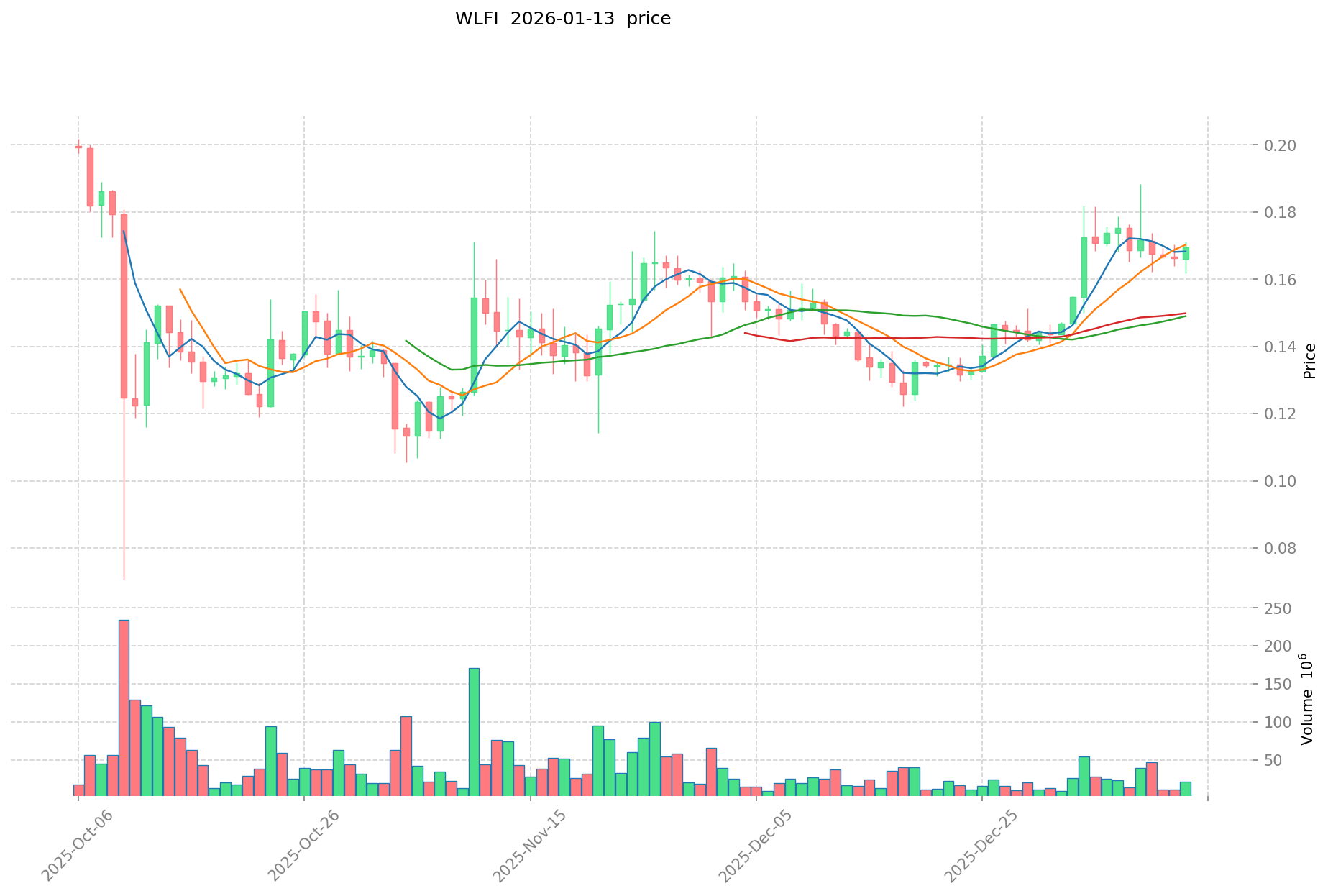
II. Core Factors Influencing Whether WLFI is a Good Investment
Supply Mechanism and Scarcity (WLFI Investment Scarcity)
- Total supply capped at 100 billion tokens with current circulation of approximately 24.67 billion WLFI → supply dynamics may influence price discovery and investment considerations
- Maximum supply framework provides a defined token economics structure → circulating supply represents roughly 24.67% of total supply as of January 2026
- Investment perspective: token supply structure represents one factor among many that market participants may evaluate when assessing long-term positioning
Institutional Investment and Mainstream Adoption (Institutional Investment in WLFI)
- Project development includes ongoing token buyback activities → World Liberty Financial has conducted open on-chain purchases using USD1 stablecoin to acquire WLFI tokens from secondary markets
- Recent buyback operations included approximately 59 million WLFI tokens acquired via CoW Swap decentralized exchange → represents deflationary mechanism implementation
- Market presence across approximately 50 exchanges → provides accessibility for various participant categories
Macroeconomic Environment's Impact on WLFI Investment
- Protocol positioning as USD-based stablecoin promoter → alignment with dollar digitization narrative within broader macroeconomic context
- DeFi sector dynamics and regulatory environment evolution → may influence governance token valuation frameworks
- Market volatility patterns observed throughout 2025 → price fluctuations ranged from $0.0706 to higher levels, reflecting sensitivity to market conditions
Technology and Ecosystem Development (Technology & Ecosystem for WLFI Investment)
- Governance token functionality within DeFi protocol framework → designed to support USD-based stablecoin infrastructure
- Multi-chain deployment structure → contract addresses established on Ethereum (ERC-20), Solana, and BSC networks
- Protocol focus on bridging Web2 and Web3 ecosystems → positioning targets institutional and retail capital access applications
- USD1 stablecoin integration within ecosystem → backed by interest-generating assets with approximately $3.8 billion in circulation as referenced in available materials
III. WLFI Future Investment Prediction and Price Outlook (Is World Liberty Financial(WLFI) worth investing in 2026-2031)
Short-term Investment Outlook (2026, short-term WLFI investment outlook)
- Conservative Estimate: $0.134 - $0.170
- Neutral Estimate: $0.170 - $0.199
- Optimistic Estimate: $0.199 - $0.228
Based on current market conditions, WLFI demonstrates moderate volatility with a 24-hour trading volume exceeding $2.9 million. The token has shown resilience with a 2.16% increase over the past 24 hours, though it experienced a -2.3% correction over the weekly timeframe. Technical indicators suggest the token is consolidating around the $0.170 level, with potential upward movement contingent on sustained trading volume above $200 million and breaking through the resistance at $0.172.
Mid-term Investment Forecast (2027-2029, mid-term World Liberty Financial(WLFI) investment forecast)
-
Market Phase Expectation: Expansion phase driven by regulatory developments and USD1 stablecoin adoption across multiple blockchain networks
-
Investment Return Projection:
- 2027: $0.169 - $0.245 (approximately 16% average price appreciation)
- 2028: $0.167 - $0.331 (approximately 30% average price appreciation)
- 2029: $0.160 - $0.368 (approximately 62% average price appreciation)
-
Key Catalysts: Federal trust banking license application outcome, USD1 stablecoin market penetration, institutional partnerships, and integration with DeFi platforms. The project's subsidiary WLTC Holdings has submitted applications for national trust banking licenses, which could provide regulatory legitimacy and competitive advantages in the stablecoin market currently dominated by established players.
Long-term Investment Outlook (Is WLFI a good long-term investment?)
- Base Scenario: $0.228 - $0.377 (assuming steady protocol development and moderate USD1 adoption)
- Optimistic Scenario: $0.331 - $0.370 (assuming favorable regulatory outcomes and accelerated institutional adoption)
- Risk Scenario: Below $0.134 (under adverse regulatory conditions or significant market downturns)
For detailed WLFI long-term investment analysis and price predictions: Price Prediction
2026-2031 Long-term Outlook
- Base Scenario: $0.170 - $0.346 (corresponding to steady progress and gradual mainstream application growth)
- Optimistic Scenario: $0.228 - $0.378 (corresponding to large-scale adoption and favorable market conditions)
- Transformative Scenario: Above $0.400 (contingent on breakthrough ecosystem developments and mainstream integration)
- December 31, 2031 Projected High: $0.378 (based on optimistic development assumptions)
The long-term outlook remains contingent on several factors including the approval timeline from the U.S. Office of the Comptroller of the Currency (OCC), USD1's competitive positioning against USDT and USDC in the $250 billion stablecoin market, and the project's ability to maintain transparency regarding its associations. Current circulating supply stands at 24.67 billion tokens out of a maximum supply of 100 billion, indicating significant future supply considerations.
Disclaimer: This analysis is provided for informational purposes only and does not constitute financial advice. Cryptocurrency investments carry substantial risk, and past performance does not guarantee future results. Market predictions are subject to high uncertainty and may not materialize as projected. Investors should conduct independent research and consider their risk tolerance before making investment decisions.
| Year |
Predicted High Price |
Predicted Average Price |
Predicted Low Price |
Price Change |
| 2026 |
0.228068 |
0.1702 |
0.134458 |
0 |
| 2027 |
0.24493482 |
0.199134 |
0.1692639 |
16 |
| 2028 |
0.3308312709 |
0.22203441 |
0.1665258075 |
30 |
| 2029 |
0.3676556777985 |
0.27643284045 |
0.160331047461 |
62 |
| 2030 |
0.370350897992887 |
0.32204425912425 |
0.267296735073127 |
88 |
| 2031 |
0.377355360628839 |
0.346197578558568 |
0.228490401848655 |
103 |
IV. WLFI Investment Strategy and Risk Management (How to invest in DeFi governance tokens)
Investment Methodology (WLFI investment strategy)
-
Long-term Holding (HODL WLFI): Suitable for conservative investors who believe in the long-term vision of bridging Web2 and Web3 through USD-based stablecoins and DeFi protocols. This approach focuses on the governance token's potential role in supporting the U.S. Dollar's global dominance through decentralized finance infrastructure.
-
Active Trading: Relies on technical analysis and swing trading strategies. Given WLFI's price performance showing a 30-day gain of 19.54% but a 1-year decline of 25.49%, active traders may seek opportunities during volatility periods. The token's 24-hour trading volume of approximately $2.92 million suggests moderate liquidity for tactical positioning.
Risk Management (Risk management for WLFI investment)
-
Asset Allocation Ratio:
- Conservative investors: Limit exposure to 1-3% of total portfolio
- Aggressive investors: May allocate 5-10% with higher risk tolerance
- Professional investors: Consider strategic positions based on DeFi sector outlook and governance token dynamics
-
Risk Hedging Solutions: Employ multi-asset portfolio diversification combined with defensive instruments. Consider balancing WLFI exposure with established cryptocurrencies and traditional assets to mitigate concentration risk.
-
Secure Storage: Utilize cold wallet solutions for long-term holdings and hardware wallets for enhanced security. Given WLFI's presence across multiple chains (Ethereum, Solana, BSC), investors should verify contract addresses through official sources before any transactions.
V. WLFI Investment Risks and Challenges (Risks of investing in DeFi governance tokens)
-
Market Risk: The cryptocurrency demonstrates significant volatility, with historical price ranging from $0.0706 to $1.1. Current market capitalization stands at approximately $4.2 billion against a fully diluted valuation of $17.04 billion, indicating substantial token supply yet to enter circulation (24.67% of total supply currently circulating). Price fluctuations can be influenced by multiple factors including DeFi sector sentiment and broader market conditions.
-
Regulatory Risk: As a governance token linked to USD-based stablecoins and financial services, WLFI operates in an evolving regulatory landscape. Different jurisdictions maintain varying approaches to DeFi protocols and governance tokens, creating uncertainty. The project's focus on preserving the U.S. Dollar's dominance may attract regulatory scrutiny regarding compliance with financial regulations.
-
Technical Risk: Network security vulnerabilities present ongoing concerns across the multiple blockchain implementations (Ethereum, Solana, BSC). Smart contract risks, cross-chain bridge vulnerabilities, and potential protocol upgrade challenges could impact token value. The complexity of bridging Web2 and Web3 introduces additional technical implementation risks.
VI. Conclusion: Is WLFI a Good Investment?
-
Investment Value Summary: WLFI represents exposure to DeFi governance and USD-stablecoin infrastructure with a vision for mainstream adoption. The token shows mixed performance signals, with recent 30-day gains offset by longer-term declines. Its market position (ranking #33) and relatively low circulating supply ratio (24.67%) suggest potential for both opportunity and volatility.
-
Investor Recommendations:
✅ Beginners: Consider dollar-cost averaging (DCA) approach with secure wallet storage. Start with minimal allocation while learning about DeFi governance mechanisms and the project's development progress.
✅ Experienced Investors: Evaluate swing trading opportunities based on technical indicators, while maintaining a diversified portfolio approach. Monitor governance proposals and protocol developments for fundamental insights.
✅ Institutional Investors: Assess strategic long-term allocation potential within DeFi sector exposure, considering regulatory landscape and the project's positioning in USD-based stablecoin infrastructure.
⚠️ Disclaimer: Cryptocurrency investments carry substantial risk. This content is for informational purposes only and does not constitute investment advice. Conduct thorough research and consider consulting financial professionals before making investment decisions.
VII. FAQ
Q1: Is World Liberty Financial (WLFI) a good investment for beginners in 2026?
WLFI presents a moderate-to-high risk opportunity that may be suitable for beginners who adopt a cautious, educational approach with limited capital allocation (1-3% of portfolio). As a governance token with a current price of $0.1704 and market cap of $4.20 billion, WLFI has demonstrated significant volatility—ranging from $0.0706 to historical highs near $0.46 in 2025. Beginners should consider dollar-cost averaging (DCA) strategies and secure cold wallet storage while learning about DeFi governance mechanisms. The token's positioning in USD-based stablecoin infrastructure offers exposure to an emerging sector, but the 25.49% one-year decline and only 24.67% circulating supply indicate material risks that require careful consideration and ongoing education.
Q2: What is the realistic price prediction for WLFI by the end of 2026?
Based on current market conditions and technical analysis, WLFI's predicted price range for December 2026 spans from $0.134 (conservative estimate) to $0.228 (optimistic estimate), with an average projected price of approximately $0.170. The short-term outlook depends on several catalysts including sustained trading volume above $200 million, breaking through resistance at $0.172, and continued token buyback activities by World Liberty Financial. The optimistic scenario assumes favorable regulatory developments regarding the federal trust banking license application and increased USD1 stablecoin adoption across multiple blockchain networks. However, adverse market conditions or regulatory setbacks could result in prices remaining near current levels or declining toward the lower bound of projections.
Q3: How does WLFI compare to other DeFi governance tokens as an investment?
WLFI distinguishes itself through its specific focus on USD-based stablecoin infrastructure and bridging Web2-Web3 ecosystems, currently ranking #33 by market capitalization with 0.51% market dominance. Unlike many governance tokens that focus solely on protocol management, WLFI's value proposition is tied to the USD1 stablecoin's potential penetration in the $250 billion stablecoin market currently dominated by USDT and USDC. The project's institutional positioning—including the federal trust banking license application—differentiates it from purely decentralized governance models. However, with only 24.67 billion tokens circulating out of a 100 billion maximum supply, future dilution risk is higher than tokens with greater circulating percentages. The 24-hour trading volume of $2.92 million indicates moderate liquidity compared to leading DeFi governance tokens, which may affect execution for larger position sizing.
Q4: What are the main risks associated with investing in WLFI?
WLFI carries three primary risk categories that investors must carefully evaluate. First, market risk is substantial—the token has experienced volatility from $0.0706 to over $0.46, with current fully diluted valuation at $17.04 billion suggesting significant future supply pressure as only 24.67% of tokens are circulating. Second, regulatory risk presents ongoing uncertainty as the project operates in the evolving DeFi governance and stablecoin regulatory landscape; the outcome of the federal trust banking license application and potential compliance requirements could materially impact token utility and value. Third, technical risk exists across multiple dimensions including smart contract vulnerabilities on Ethereum, Solana, and BSC implementations, cross-chain bridge security concerns, and the complexity of executing the Web2-Web3 bridging vision. The project's association with specific political figures may also introduce reputational and regulatory scrutiny risks not present in purely decentralized protocols.
Q5: What investment strategy works best for WLFI—long-term holding or active trading?
The optimal strategy depends on investor profile and risk tolerance, with both approaches presenting distinct advantages for WLFI. Long-term holding (HODL) suits investors who believe in the fundamental thesis of USD-based stablecoin infrastructure growth and DeFi governance evolution, accepting the current 25.49% one-year decline as part of early-stage volatility. This approach benefits from potential regulatory clarity, USD1 adoption, and the deflationary impact of ongoing token buyback programs. Active trading may be more suitable given WLFI's demonstrated volatility—the 30-day gain of 19.54% and frequent price swings between support at $0.134 and resistance at $0.228 create tactical opportunities for swing traders using technical analysis. Conservative investors should limit allocation to 1-3% regardless of strategy, while more aggressive participants might allocate 5-10% with strict stop-loss protocols. Hybrid approaches combining core long-term positions with tactical trading allocations can balance conviction in the project's vision with opportunistic profit-taking during volatility.
Q6: How does the token supply mechanism affect WLFI's investment potential?
WLFI's supply dynamics present a double-edged consideration for investment analysis. The maximum supply of 100 billion tokens with only 24.67 billion currently circulating (24.67% of total supply) creates significant future dilution risk as the remaining 75.33% enters the market over time. This structure means the current market capitalization of $4.20 billion represents a fully diluted valuation of $17.04 billion—a 4x difference that could pressure prices as supply increases. However, the project's active token buyback program using USD1 stablecoin provides a deflationary counterbalance; recent operations acquired approximately 59 million WLFI tokens via CoW Swap decentralized exchange. The supply mechanism's investment impact depends on the pace of new token releases versus buyback activity and organic demand growth. Investors should monitor circulating supply changes and treasury buyback announcements as key indicators of supply-side pressure or support for price appreciation.
Q7: What role does USD1 stablecoin play in WLFI's investment value proposition?
USD1 stablecoin forms the core infrastructure that WLFI governance token is designed to support, creating a symbiotic relationship between the two assets. With approximately $3.8 billion in circulation and backing by interest-generating assets, USD1's adoption directly influences WLFI's utility and demand as a governance mechanism. The stablecoin's positioning to compete in the $250 billion stablecoin market against established players like USDT and USDC represents both significant opportunity and substantial challenge. WLFI token holders participate in governance decisions affecting USD1's development, risk parameters, and protocol direction, potentially creating value through effective decentralized management. The pending federal trust banking license application for WLTC Holdings (project subsidiary) could provide regulatory legitimacy that accelerates USD1 adoption, indirectly supporting WLFI value. Investors evaluating WLFI should monitor USD1 metrics including circulation growth, on-chain activity across Ethereum, Solana, and BSC networks, and competitive positioning against incumbent stablecoins as leading indicators of the governance token's fundamental demand drivers.
Q8: Should institutional investors consider WLFI for portfolio allocation in 2026?
Institutional investors may evaluate WLFI as a strategic exposure to DeFi governance and USD-based stablecoin infrastructure, but allocation decisions require careful due diligence of unique considerations. The token's positioning in bridging traditional finance (Web2) and decentralized finance (Web3) aligns with institutional interest in regulated DeFi exposure, particularly if the federal trust banking license application succeeds. Current market metrics—$4.20 billion market cap, ranking #33, and moderate $2.92 million daily trading volume—indicate developing but not mature institutional liquidity. The 24.67% circulating supply ratio presents concern regarding future dilution and token release schedules that institutions must model in valuation frameworks. Governance functionality offers active participation in protocol development, which some institutional mandates value for strategic influence. However, regulatory uncertainty, technical risks across multiple blockchain implementations, and relatively short operating history (price data from 2025 onwards) suggest limiting allocation to tactical rather than core portfolio positions. Institutions should implement robust custody solutions, conduct thorough smart contract audits, and establish clear governance participation frameworks before material capital deployment.
* The information is not intended to be and does not constitute financial advice or any other recommendation of any sort offered or endorsed by Gate.