This comprehensive analysis examines whether Wrapped Bitcoin (WBTC) represents a sound investment opportunity, evaluating its position as an ERC20 token bridging Bitcoin and Ethereum's DeFi ecosystem. The article explores WBTC's market fundamentals, currently ranking 14th by market capitalization at $11.46 billion with strong institutional backing from BitGo, Kyber Network, and Ren. Detailed price forecasts range from conservative to optimistic scenarios through 2031, with long-term projections reaching up to $184,269.69 under favorable conditions. The analysis encompasses investment strategies suitable for different investor profiles, identifies critical risks including custodial dependencies and regulatory uncertainties, and provides actionable guidance for portfolio allocation. Whether WBTC qualifies as a good investment depends on individual risk tolerance, investment timeframe, and portfolio objectives within the broader cryptocurrency landscape.
Introduction: Wrapped Bitcoin (WBTC)'s Investment Position and Market Outlook
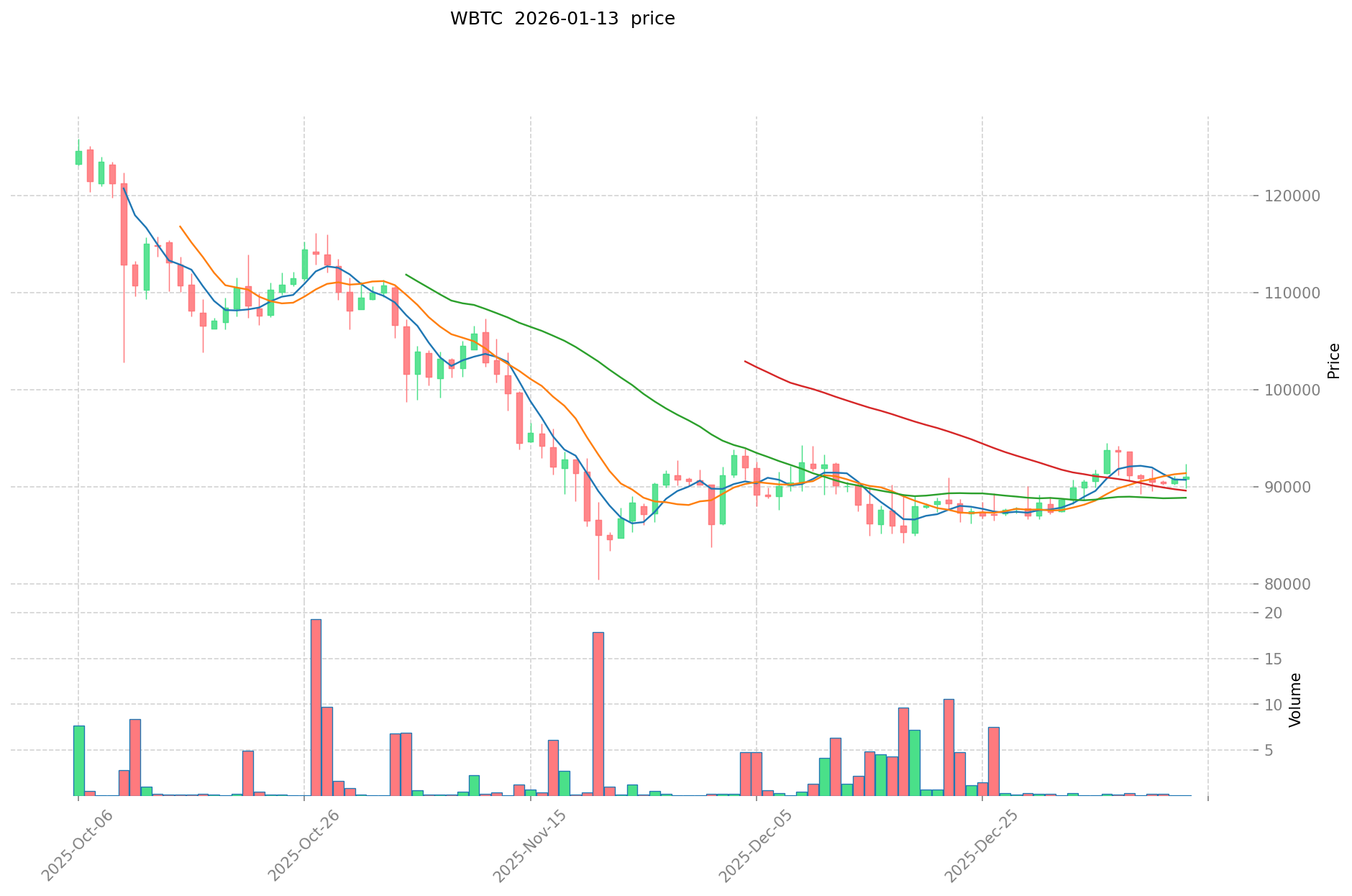
Wrapped Bitcoin (WBTC) represents a significant innovation in the cryptocurrency ecosystem as a bridge between Bitcoin and Ethereum's DeFi applications. As an ERC20 token pegged 1:1 to Bitcoin, WBTC has established itself as an important asset since its launch in January 2019. As of January 13, 2026, WBTC holds the 14th position by market capitalization, with a total market cap of approximately $11.46 billion and a circulating supply of 124,963.49 tokens. The current price stands at $91,709.3, with a 24-hour trading volume of $9,240.49.
Launched collaboratively by BitGo, Kyber Network, and Ren, WBTC enables Bitcoin holders to participate in Ethereum's decentralized finance ecosystem while maintaining exposure to Bitcoin's value. With over 83,041 holders and availability on 14 exchanges, the token has demonstrated notable adoption within the crypto community. The market capitalization to fully diluted valuation ratio of 96.77% indicates a relatively mature supply structure.
Recent price movements show mixed performance: a slight decline of 0.23% over 24 hours and 1.99% over 7 days, contrasted with a 1.95% gain over 30 days, though down 3.06% year-over-year. These fluctuations reflect the broader market dynamics and Bitcoin's price movements, given WBTC's 1:1 peg mechanism. Accounting for 0.35% of the total cryptocurrency market share, WBTC continues to draw attention from investors examining "Is Wrapped Bitcoin (WBTC) a good investment?"
This analysis will comprehensively examine WBTC's investment value, historical price trends, future price projections, and associated investment risks to provide reference information for potential investors.
I. WBTC Price Historical Review and Current Investment Value Status
- 2019: WBTC launched on Ethereum as a 1:1 Bitcoin-pegged ERC20 token by BitGo, Kyber Network, and Ren → early adopters gained exposure to Bitcoin within DeFi ecosystems
- 2022: During broader crypto market downturn → WBTC price declined alongside Bitcoin from peak levels toward lower ranges
- 2024-2025: Market recovery phase → WBTC price movements tracked Bitcoin's trajectory, with price ranging between approximately $60,000-$90,000 during this period
- August 2024: BitGo and BiT Global announced joint venture plans for WBTC custody diversification → triggered trust concerns within the community regarding custody arrangements
- Late 2024-Early 2025: Renewed institutional interest in Bitcoin → WBTC benefited from increased DeFi activity and cross-chain liquidity demand
Current WBTC Investment Market Status (January 2026)
- WBTC current price: $91,709.30
- Market capitalization: approximately $11.46 billion, ranking 14th among crypto assets
- 24-hour trading volume: approximately $847.5 million (9,240.49 BTC equivalent)
- Circulating supply: 124,963.49 WBTC tokens
- Custody structure: Bitcoin reserves held by custodians are verifiable on-chain, with minting requiring merchant approval
- Holder distribution: approximately 83,041 addresses hold WBTC across various DeFi protocols and exchanges
Click to view real-time WBTC market price
II. Core Factors Affecting Whether WBTC Is a Good Investment
Supply Mechanism and Scarcity (WBTC Investment Scarcity)
- WBTC maintains a 1:1 peg with Bitcoin through a custodian-backed minting and burning mechanism, where each token is backed by equivalent Bitcoin held on-chain
- The current circulating supply stands at approximately 124,963 WBTC tokens, representing roughly 96.77% of the fully diluted market cap
- Investment significance: The direct backing by Bitcoin and transparent on-chain verification mechanism provide scarcity assurance, though the supply can fluctuate based on market demand for Ethereum-based Bitcoin exposure
Institutional Investment and Mainstream Adoption (Institutional Investment in WBTC)
- WBTC was jointly launched by established entities including BitGo, Kyber Network, and Ren, providing institutional credibility to the token structure
- The token serves as a bridge for Bitcoin holders seeking access to Ethereum's DeFi ecosystem, with over 83,000 holders recorded
- As an ERC20 token, WBTC benefits from integration across decentralized exchanges and lending protocols, expanding its utility within the broader crypto investment landscape
Macroeconomic Environment's Impact on WBTC Investment
- WBTC's value closely tracks Bitcoin's market movements, making it subject to similar macroeconomic influences including monetary policy shifts and interest rate changes
- During periods of inflation concern, WBTC may benefit from Bitcoin's positioning as a potential inflation hedge asset
- Geopolitical uncertainty and regulatory developments affecting cryptocurrency markets can influence WBTC's investment demand, particularly as it operates across both Bitcoin and Ethereum regulatory frameworks
Technology and Ecosystem Development (Technology & Ecosystem for WBTC Investment)
- WBTC operates on the Ethereum network (contract address: 0x2260fac5e5542a773aa44fbcfedf7c193bc2c599), leveraging Ethereum's established infrastructure and developer community
- The token's integration within DeFi protocols enables various use cases including lending, borrowing, and liquidity provision, enhancing its utility beyond simple Bitcoin exposure
- The transparent custodian model with on-chain verification provides technological assurance for investors, though it introduces dependency on both Ethereum network performance and custodian reliability
III. WBTC Future Investment Forecast and Price Outlook (Is Wrapped Bitcoin(WBTC) worth investing in 2026-2031)
Short-term Investment Forecast (2026, short-term WBTC investment outlook)
- Conservative forecast: $82,591.92 - $91,768.80
- Neutral forecast: $91,768.80 - $105,075.28
- Optimistic forecast: $105,075.28 - $118,381.75
Mid-term Investment Outlook (2027-2029, mid-term Wrapped Bitcoin(WBTC) investment forecast)
-
Market stage expectation: WBTC may experience moderate growth with increasing adoption across DeFi platforms and cross-chain applications, supported by the underlying Bitcoin market dynamics and expanding use cases in decentralized finance ecosystems.
-
Investment return forecast:
- 2027: $63,045.17 - $148,156.14 (representing a potential year-over-year change of approximately 14%)
- 2028: $101,292.57 - $151,938.85 (representing a potential year-over-year change of approximately 38%)
- 2029: $116,992.91 - $144,848.37 (representing a potential year-over-year change of approximately 51%)
-
Key catalysts: Integration with major DeFi protocols, Bitcoin market performance, institutional adoption of tokenized Bitcoin products, regulatory clarity regarding wrapped assets, and technological improvements in cross-chain interoperability.
Long-term Investment Outlook (Is WBTC a good long-term investment?)
- Baseline scenario: $100,864.60 - $167,634.13 by 2030 (assuming steady Bitcoin market growth and continued DeFi ecosystem expansion)
- Optimistic scenario: $154,848.48 - $184,269.69 by 2031 (assuming accelerated institutional adoption and significant expansion of wrapped Bitcoin use cases across multiple blockchain networks)
- Risk scenario: Below $82,591.92 (under conditions of regulatory restrictions on wrapped assets, security vulnerabilities, or significant Bitcoin market downturns)
View long-term WBTC investment and price predictions: Price Prediction
2026-01-13 - 2031 Long-term Outlook
- Base scenario: $100,864.60 - $167,634.13 (corresponding to steady progress and stable growth in mainstream applications)
- Optimistic scenario: $154,848.48 - $184,269.69 (corresponding to large-scale adoption and favorable market conditions)
- Transformative scenario: Above $184,269.69 (subject to breakthrough developments in the ecosystem and mainstream adoption)
- 2031-12-31 predicted high: $184,269.69 (based on optimistic development assumptions)
Disclaimer: These price forecasts are based on historical data analysis and market modeling. Cryptocurrency markets are highly volatile and influenced by numerous factors including regulatory changes, market sentiment, technological developments, and macroeconomic conditions. Past performance does not guarantee future results. These projections should not be considered as investment advice, and investors should conduct their own research and consult with financial professionals before making investment decisions.
| Year |
Predicted High Price |
Predicted Average Price |
Predicted Low Price |
Price Change |
| 2026 |
118381.752 |
91768.8 |
82591.92 |
0 |
| 2027 |
148156.13916 |
105075.276 |
63045.1656 |
14 |
| 2028 |
151938.849096 |
126615.70758 |
101292.566064 |
38 |
| 2029 |
144848.36947152 |
139277.278338 |
116992.91380392 |
51 |
| 2030 |
167634.1322076168 |
142062.82390476 |
100864.6049723796 |
54 |
| 2031 |
184269.688886864196 |
154848.4780561884 |
91360.602053151156 |
68 |
IV. WBTC Investment Strategy and Risk Management (How to invest in Wrapped Bitcoin)
Investment Methodology (WBTC investment strategy)
Long-term Holding (HODL WBTC)
For conservative investors seeking stable exposure to Bitcoin within the Ethereum ecosystem, long-term holding of WBTC may be considered as an approach. This strategy involves purchasing WBTC and maintaining the position over extended periods, potentially benefiting from Bitcoin's long-term price appreciation while maintaining compatibility with Ethereum-based DeFi protocols. Investors following this approach typically focus on fundamental factors rather than short-term price movements.
Active Trading
Active trading strategies rely on technical analysis and momentum-based operations. Traders may utilize various indicators and chart patterns to identify entry and exit points, attempting to capitalize on WBTC's price fluctuations. Given WBTC's price correlation with Bitcoin, traders often monitor both WBTC-specific metrics and broader Bitcoin market dynamics. Technical tools such as moving averages, support and resistance levels, and volume analysis are commonly employed in this approach.
Risk Management (Risk management for WBTC investment)
Asset Allocation Ratios
- Conservative Investors: May consider allocating a smaller percentage (typically 1-5%) of their overall portfolio to WBTC, maintaining majority holdings in traditional assets
- Aggressive Investors: Might allocate a moderate portion (5-15%) to WBTC as part of a broader cryptocurrency exposure strategy
- Professional Investors: Could implement more substantial allocations (15-30%+) based on sophisticated risk assessment models and market analysis
Risk Hedging Approaches
Implementing a multi-asset portfolio strategy can help mitigate concentration risk. Investors may consider:
- Diversifying across different cryptocurrency categories and traditional assets
- Utilizing derivative instruments available on certain platforms for hedging purposes
- Maintaining stablecoin reserves for opportunistic rebalancing
- Setting predetermined stop-loss levels and position sizing rules
Secure Storage Solutions
Cold Wallet Storage: For long-term holdings, cold storage solutions provide enhanced security by keeping private keys offline. Hardware wallets from established manufacturers offer robust protection against online threats.
Hot Wallet Considerations: For active trading or DeFi participation, hot wallets provide convenience but require heightened security awareness. Users should implement multi-factor authentication and regularly update security protocols.
Hardware Wallet Recommendations: Industry-standard hardware wallets that support ERC20 tokens can be used for WBTC storage, providing a balance between security and accessibility.
V. WBTC Investment Risks and Challenges (Risks of investing in Wrapped Bitcoin)
Market Risks
Price Volatility: WBTC exhibits substantial price fluctuations, mirroring Bitcoin's inherent volatility. Historical data shows WBTC has experienced significant price swings, with 24-hour changes reaching several percentage points. The token's price movements closely track Bitcoin's performance, meaning investors are exposed to the same volatility characteristics as the underlying asset.
Market Dynamics: Trading volume and liquidity conditions can vary across different exchanges and time periods, potentially affecting execution prices during periods of heightened market activity.
Regulatory Risks
Jurisdictional Uncertainty: Different countries maintain varying regulatory frameworks regarding cryptocurrency assets. Policy developments in major markets can influence WBTC's operational environment and market accessibility.
Compliance Evolution: The regulatory landscape for wrapped tokens and custodial arrangements continues to develop, potentially introducing new compliance requirements or operational constraints for WBTC's custodian and merchant network.
Technical Risks
Smart Contract Vulnerabilities: As an ERC20 token operating on Ethereum, WBTC is subject to smart contract risks. While the token has undergone auditing processes, the possibility of undiscovered vulnerabilities in the contract code or Ethereum network itself cannot be entirely eliminated.
Custodial Arrangement Risks: WBTC's architecture relies on custodians holding Bitcoin reserves that back the issued tokens. This introduces counterparty risk related to the custodian's operational security, solvency, and adherence to the protocol's rules.
Network Dependencies: WBTC's functionality depends on Ethereum network performance. Network congestion, high gas fees, or potential technical issues on Ethereum can affect transaction processing and user experience.
Redemption Process Risks: The mechanism for converting WBTC back to Bitcoin involves specific procedures through authorized merchants and custodians. Delays or complications in this process could potentially affect liquidity during periods of high redemption demand.
VI. Conclusion: Is Wrapped Bitcoin a Good Investment?
Investment Value Summary
WBTC represents a bridge between Bitcoin and the Ethereum ecosystem, offering Bitcoin holders access to DeFi applications while maintaining exposure to Bitcoin's price movements. The token has established a notable market position, with a market capitalization exceeding $11 billion and presence on multiple trading platforms. However, price volatility remains a defining characteristic, with fluctuations observable across various timeframes.
The token's value proposition centers on its utility within Ethereum-based applications rather than independent technological innovation. Its performance is intrinsically linked to Bitcoin's price trajectory and the continued demand for Bitcoin-backed tokens within DeFi protocols.
Investor Recommendations
✅ New Investors
- Consider dollar-cost averaging strategies to mitigate timing risks
- Prioritize secure storage solutions, utilizing hardware wallets or reputable custodial services
- Allocate only capital that can withstand significant volatility
- Thoroughly research the redemption mechanism and custodial structure before investing
✅ Experienced Investors
- Evaluate WBTC within the context of broader cryptocurrency portfolio construction
- Monitor both WBTC-specific metrics and underlying Bitcoin market dynamics
- Assess opportunities for utilizing WBTC in DeFi protocols while understanding associated risks
- Implement position sizing appropriate to risk tolerance and portfolio objectives
✅ Institutional Investors
- Conduct comprehensive due diligence on custodial arrangements and operational frameworks
- Evaluate WBTC's role in strategic cryptocurrency exposure within regulatory constraints
- Consider liquidity requirements and redemption mechanisms in allocation decisions
- Assess counterparty risks and implement appropriate monitoring protocols
⚠️ Disclaimer: Cryptocurrency investments involve substantial risk and may not be suitable for all investors. Price volatility can result in significant losses. This content is provided for informational purposes only and does not constitute investment advice, financial advice, trading advice, or recommendations. Investors should conduct independent research and consult qualified financial professionals before making investment decisions.
VII. FAQ
Q1: What is Wrapped Bitcoin (WBTC) and how does it maintain its 1:1 peg to Bitcoin?
WBTC is an ERC20 token on the Ethereum blockchain that maintains a 1:1 peg with Bitcoin through a custodian-backed mechanism. For every WBTC token issued, an equivalent amount of Bitcoin is held in reserve by authorized custodians, with the reserves being verifiable on-chain. The minting process requires approval from authorized merchants, and the burning mechanism allows users to redeem their WBTC for Bitcoin through the same network. This structure enables Bitcoin holders to participate in Ethereum's DeFi ecosystem while maintaining exposure to Bitcoin's value.
Q2: Is WBTC a good investment for long-term holders?
WBTC may be considered by long-term investors seeking Bitcoin exposure within the Ethereum ecosystem, though it carries significant considerations. The token's value directly tracks Bitcoin's performance, meaning investors gain similar exposure to Bitcoin's long-term price trajectory while accessing Ethereum-based DeFi applications. However, investors must account for additional risks including custodial dependencies, smart contract vulnerabilities, and regulatory uncertainties surrounding wrapped tokens. Conservative investors might consider WBTC as a modest portfolio allocation (1-5%), while more aggressive investors could allocate larger portions based on their risk tolerance and cryptocurrency investment strategy.
Q3: What are the main risks associated with investing in WBTC?
WBTC investment carries several distinct risk categories. Market risks include substantial price volatility that mirrors Bitcoin's fluctuations, with potential multi-percentage point changes within 24-hour periods. Technical risks encompass smart contract vulnerabilities on Ethereum, custodial arrangement dependencies, and potential network congestion affecting transaction processing. Regulatory risks involve evolving compliance frameworks across different jurisdictions and uncertain policy developments regarding wrapped tokens. Additionally, redemption process risks exist where converting WBTC back to Bitcoin involves specific procedures through authorized merchants, which could experience delays during periods of high demand.
Q4: How does WBTC differ from holding Bitcoin directly?
While WBTC maintains a 1:1 value peg with Bitcoin, it differs operationally and structurally from direct Bitcoin ownership. WBTC exists as an ERC20 token on Ethereum rather than on Bitcoin's native blockchain, enabling compatibility with Ethereum-based DeFi protocols, decentralized exchanges, and lending platforms. However, this introduces custodial dependencies not present in direct Bitcoin ownership, as WBTC requires trusted custodians to hold the underlying Bitcoin reserves. Direct Bitcoin ownership provides self-custody options without intermediaries, while WBTC trades Ethereum ecosystem utility for additional counterparty and smart contract risks.
Q5: What is the predicted price outlook for WBTC through 2031?
Price forecasts for WBTC suggest varied scenarios based on different market conditions. Short-term projections for 2026 range from $82,591.92 to $118,381.75 depending on market sentiment. Mid-term forecasts through 2027-2029 show potential growth driven by DeFi adoption and Bitcoin market performance, with 2029 estimates ranging from $116,992.91 to $144,848.37. Long-term projections for 2031 span from $91,360.60 in conservative scenarios to $184,269.69 in optimistic scenarios assuming accelerated institutional adoption. However, these projections are subject to significant uncertainty given cryptocurrency market volatility, regulatory developments, and macroeconomic conditions.
Q6: How should investors approach WBTC allocation in their portfolio?
Portfolio allocation strategies for WBTC vary based on investor risk profiles and investment objectives. Conservative investors may consider allocating 1-5% of their overall portfolio to WBTC, maintaining majority holdings in traditional assets while gaining modest cryptocurrency exposure. Aggressive investors might allocate 5-15% as part of a broader cryptocurrency strategy, accepting higher volatility for potential returns. Professional investors with sophisticated risk management systems could implement allocations of 15-30%+ based on detailed market analysis and hedging strategies. Regardless of allocation size, investors should implement proper security measures, diversify across asset categories, and maintain capital reserves for rebalancing opportunities.
Q7: What factors could significantly impact WBTC's future value?
Multiple factors influence WBTC's investment trajectory. Primary drivers include Bitcoin's price performance, as WBTC maintains a direct peg to the underlying asset. Ethereum ecosystem developments affect WBTC utility, including DeFi protocol adoption, network upgrades, and gas fee dynamics. Regulatory developments regarding wrapped tokens and custodial arrangements could introduce operational constraints or enhanced legitimacy. Institutional adoption patterns, particularly regarding tokenized Bitcoin products and cross-chain applications, may expand demand. Technical considerations including smart contract security, custodian operational reliability, and cross-chain interoperability advancements also play significant roles in WBTC's long-term value proposition.
* The information is not intended to be and does not constitute financial advice or any other recommendation of any sort offered or endorsed by Gate.