This comprehensive guide evaluates whether XDB CHAIN (XDB) represents a viable investment opportunity by analyzing market fundamentals, historical performance, and future prospects. As a protocol-layer blockchain supporting consumer digital assets including branded tokens, NFTs, and stablecoins, XDB CHAIN implements a deflationary buyback and burn (BBB) mechanism to enhance tokenomics. However, the token has declined 99% from its 2021 peak of $0.850722 to current levels around $0.0001989, with limited liquidity and modest market capitalization of $3.39 million. The analysis examines short and long-term price forecasts through 2031, outlines tailored investment strategies for beginners through institutional investors, and identifies critical risks including market volatility, regulatory uncertainty, and technical vulnerabilities. The article provides risk management frameworks, secure storage recommendations, and practical guidance to help investors make informed decisions on Gate exchange regarding XDB alloca
Introduction: XDB CHAIN (XDB) Investment Position and Market Outlook
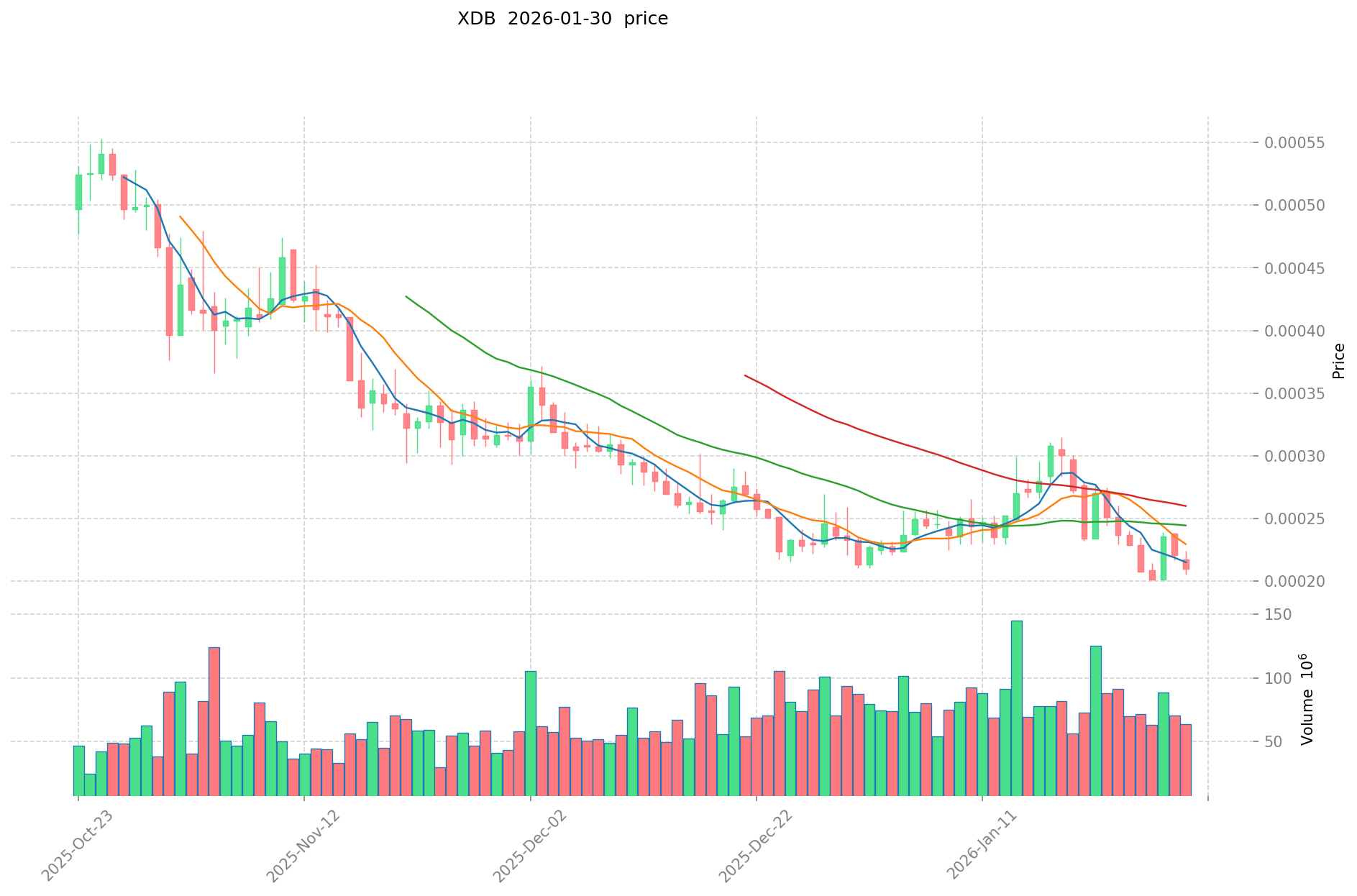
XDB is an important asset in the cryptocurrency field. As the native token of XDB CHAIN, it was launched in September 2019 and has been positioned as a Real World Asset (RWA). The platform was created to support the fast and affordable transfer of consumer digital assets such as branded tokens (BCO), non-fungible tokens (NFTs), and stablecoins. As of January 30, 2026, XDB has a market capitalization of approximately $3.39 million, with a circulating supply of around 17.06 billion tokens, and the current price is maintained at approximately $0.0001989. With its positioning as a protocol layer blockchain "empowering brands and consumers of tomorrow," XDB has gradually become a focal point for investors discussing "Is XDB CHAIN (XDB) a good investment?" XDB CHAIN introduces a deflationary system called buyback and burn (BBB) supported by the tokenomics of branded tokens. This article will comprehensively analyze XDB's investment value, historical trends, future price predictions, and investment risks to provide reference for investors.
I. XDB Price History Review and Current Investment Value
- 2021: XDB reached a notable price level of $0.850722 in November → Represented a significant appreciation period for early investors
- 2026: Price declined to approximately $0.00019499 in January → XDB experienced substantial downward movement from previous peaks
- Long-term trajectory: From elevated levels around $0.85 to current range near $0.0001989 → The asset has undergone considerable value compression
Current XDB Investment Market Status (January 2026)
- XDB current price: $0.0001989
- Market sentiment: Circulating market cap stands at approximately $3.39 million with trading activity showing modest volumes
- 24-hour trading volume: $13,880.35
- Token circulation: 17.06 billion XDB tokens currently circulating, representing 85.29% of total supply
Click to view real-time XDB market price
II. Core Factors Influencing Whether XDB is a Good Investment (Is XDB CHAIN(XDB) a Good Investment)
Supply Mechanism and Scarcity (XDB investment scarcity)
- Deflationary buyback and burn (BBB) mechanism → impacts price and investment value
- Token economics: 17.06 billion XDB in circulation out of 20 billion maximum supply, with 85.29% already circulating
- Investment significance: the BBB system supported by branded token (BCO) economics creates a deflationary pressure that may influence long-term scarcity
Technology & Ecosystem Development (Technology & Ecosystem for XDB investment)
- Protocol layer blockchain designed for fast and affordable transfer of consumer digital assets
- Platform supports branded tokens (BCO), non-fungible tokens (NFTs), and stablecoins
- Ecosystem positioning: empowering brands and consumers with real-world asset (RWA) applications may expand use cases
- Price trends show significant volatility: -1.78% (1H), -7.87% (24H), -14.78% (7D), and -68.5% (1Y)
- 24-hour trading volume of $13,880.35 reflects relatively limited liquidity
- Market capitalization of approximately $3.39 million positions XDB as a micro-cap asset with higher risk characteristics
III. XDB Future Investment Forecast and Price Outlook (Is XDB CHAIN(XDB) worth investing in 2026-2031)
Short-term Investment Forecast (2026, short-term XDB investment outlook)
- Conservative forecast: $0.000119 - $0.000201
- Neutral forecast: $0.000201 - $0.000225
- Optimistic forecast: $0.000225 - $0.000238
Mid-term Investment Outlook (2027-2028, mid-term XDB CHAIN(XDB) investment forecast)
- Market stage expectation: The token may experience gradual price adjustments as the project continues to develop its protocol layer blockchain for consumer digital assets
- Investment return forecast:
- 2027: $0.000175 - $0.000250
- 2028: $0.000221 - $0.000251
- Key catalysts: Platform adoption rate for branded tokens (BCO) and NFT transfers, implementation effectiveness of the buyback and burn (BBB) deflationary mechanism
Long-term Investment Outlook (Is XDB a good long-term investment?)
- Base scenario: $0.000236 - $0.000247 (assuming steady protocol development and moderate ecosystem growth)
- Optimistic scenario: $0.000300 - $0.000353 (assuming accelerated adoption of consumer digital asset transfers and enhanced tokenomics)
- Risk scenario: Below $0.000200 (under adverse market conditions or limited platform utilization)
Click to view XDB long-term investment and price forecast: Price Prediction
2026-01-30 - 2031 Long-term Outlook
- Base scenario: $0.000201 - $0.000247 USD (corresponding to steady progress and gradual mainstream application enhancement)
- Optimistic scenario: $0.000300 - $0.000353 USD (corresponding to large-scale adoption and favorable market environment)
- Transformative scenario: Above $0.000353 USD (such as breakthrough progress in ecosystem and mainstream popularization)
- 2031-12-31 projected high: $0.000353 USD (based on optimistic development assumptions)
Disclaimer: The above forecasts are based on historical data analysis and market research materials. Cryptocurrency markets involve significant volatility and risk. These projections do not constitute investment advice, and actual results may differ materially from forecasts.
| Year |
Predicted High Price |
Predicted Average Price |
Predicted Low Price |
Price Change |
| 2026 |
0.000238124 |
0.0002018 |
0.000119062 |
1 |
| 2027 |
0.00025075668 |
0.000219962 |
0.0001759696 |
10 |
| 2028 |
0.0002518344938 |
0.00023535934 |
0.0002212377796 |
18 |
| 2029 |
0.000250904824407 |
0.0002435969169 |
0.000236289009393 |
22 |
| 2030 |
0.000353568745034 |
0.000247250870653 |
0.00023488832712 |
24 |
| 2031 |
0.000312426200157 |
0.000300409807844 |
0.000153209002 |
51 |
IV. XDB Investment Strategy and Risk Management (How to invest in XDB CHAIN)
Investment Strategy (XDB investment strategy)
Long-term Holding (HODL XDB): Suitable for Conservative Investors
Long-term holding represents a passive investment approach that suits investors seeking to minimize active trading risks. For XDB CHAIN, this strategy requires consideration of the project's protocol-layer infrastructure positioning and its role in supporting consumer digital assets. Investors adopting this approach typically focus on the fundamental value proposition of enabling fast and affordable transfers of branded tokens (BCO), NFTs, and stablecoins.
Given XDB's deflationary mechanism through buyback and burn (BBB) supported by branded token economics, long-term holders may benefit from potential supply reduction effects over extended periods. However, the significant price decline of approximately 68.5% over the past year suggests that investors must carefully evaluate entry timing and allocation size.
Active Trading: Technical Analysis and Swing Trading
Active trading strategies for XDB require close monitoring of price movements and technical indicators. The token has demonstrated notable volatility, with 24-hour fluctuations ranging between $0.0001953 and $0.0002191. The recent 7-day decline of 14.78% and 30-day decline of 8.17% indicate persistent downward pressure that traders must navigate carefully.
Traders should utilize established technical analysis frameworks, including support and resistance levels, volume analysis, and momentum indicators. The relatively limited exchange availability (2 exchanges) and modest 24-hour trading volume of approximately $13,880 may present liquidity constraints that impact execution quality for larger positions.
Risk Management (Risk management for XDB investment)
Asset Allocation Ratios: Conservative / Aggressive / Professional Investors
Conservative Investors: Given XDB's position outside the top 1,000 cryptocurrencies by market capitalization (ranked 1,752) and its substantial year-over-year decline, conservative investors should limit exposure to no more than 1-2% of their total cryptocurrency portfolio. This allocation acknowledges the higher risk profile while maintaining manageable downside exposure.
Aggressive Investors: Those with higher risk tolerance and deeper understanding of the XDB CHAIN ecosystem might allocate 3-5% of their cryptocurrency holdings to XDB. This approach requires active monitoring and willingness to accept significant short-term volatility.
Professional Investors: Institutional or professional investors conducting thorough due diligence on XDB CHAIN's technology stack, partnership ecosystem, and tokenomics may consider strategic positions up to 5-8% of specialized altcoin portfolios. This allocation assumes sophisticated risk management capabilities and ability to weather extended drawdown periods.
Effective risk management for XDB investment involves diversification across multiple dimensions:
- Cross-category diversification: Balance XDB exposure with established cryptocurrencies (Bitcoin, Ethereum), stablecoins, and potentially traditional assets
- Correlation analysis: Monitor XDB's price correlation with broader cryptocurrency markets to optimize portfolio construction
- Position sizing: Implement systematic position sizing based on volatility metrics and individual risk tolerance
- Stop-loss mechanisms: Establish predetermined exit points to limit potential losses, particularly important given XDB's recent price volatility
Secure Storage: Hot/Cold Wallets + Hardware Wallet Recommendations
Proper storage infrastructure is essential for XDB holdings:
Hot Wallets: Suitable for active trading amounts, hot wallets provide convenient access for frequent transactions. Users should:
- Limit hot wallet holdings to trading amounts only
- Enable all available security features including two-factor authentication
- Use reputable wallet providers with established security track records
Cold Wallets: For long-term holdings, cold storage solutions provide enhanced security:
- Hardware wallets offer optimal security for significant XDB holdings
- Paper wallets represent an alternative offline storage option
- Multi-signature wallets add additional security layers for larger amounts
Best Practices:
- Maintain separate wallets for trading and long-term storage
- Regularly backup wallet recovery phrases in secure, offline locations
- Verify receiving addresses carefully before executing transactions
- Consider splitting large holdings across multiple cold storage solutions
V. XDB Investment Risks and Challenges (Risks of investing in XDB CHAIN)
Market Risk: High Volatility and Price Manipulation Concerns
XDB exhibits significant price volatility characteristic of lower market capitalization cryptocurrencies. The token's 24-hour price range shows fluctuations of approximately 12%, while longer timeframes reveal more substantial movements. The 68.5% decline over the past year from higher price levels demonstrates the material downside risk inherent in this asset.
The relatively limited trading volume of approximately $13,880 over 24 hours and availability on only 2 exchanges raises liquidity concerns. Lower liquidity environments can amplify price volatility and potentially create conditions susceptible to market manipulation or significant slippage on larger orders. The market capitalization of approximately $3.39 million places XDB in a category where individual large transactions could materially impact price levels.
The distance from the historical high of $0.850722 (recorded in November 2021) to the current price of $0.0001989 represents a decline of over 99%, illustrating the extreme volatility risk that investors must consider.
Regulatory Risk: Policy Uncertainty Across Jurisdictions
As a protocol-layer blockchain focused on consumer digital assets, XDB CHAIN operates within an evolving regulatory landscape that varies significantly across jurisdictions. Key regulatory considerations include:
Token Classification: Regulatory authorities in different countries may classify XDB differently, potentially affecting its trading availability, taxation treatment, and compliance requirements. The project's focus on branded tokens and consumer digital assets may attract scrutiny regarding securities regulations.
Cross-border Operations: The platform's mission to enable fast and affordable transfer of digital assets involves cross-border transactions that may face varying regulatory frameworks. Changes in regulations regarding cryptocurrency transfers, anti-money laundering requirements, or consumer protection laws could impact the platform's operational model.
Compliance Requirements: Evolving regulatory standards for blockchain projects, including potential licensing requirements, reporting obligations, and operational restrictions, represent ongoing risks. Projects must continuously adapt to changing regulatory environments, which may involve significant compliance costs or operational adjustments.
Investors should monitor regulatory developments in their own jurisdictions as well as regions where XDB CHAIN maintains significant operations or user bases.
Technical Risk: Network Security Vulnerabilities and Upgrade Failures
As a protocol-layer blockchain, XDB CHAIN faces technical risks inherent to distributed ledger technologies:
Network Security: While specific security incidents are not detailed in the available materials, blockchain networks face ongoing threats including potential vulnerabilities in consensus mechanisms, smart contract bugs, and network attacks. The security of the XDB CHAIN network depends on continuous monitoring, security audits, and rapid response to identified vulnerabilities.
Protocol Upgrades: Blockchain networks require periodic upgrades to introduce new features, improve performance, or address security issues. These upgrades carry inherent risks including potential network disruptions, compatibility issues, or community disagreements that could lead to network splits.
Smart Contract Risks: For platforms supporting NFTs, branded tokens, and other digital assets, smart contract security is paramount. Vulnerabilities in smart contract code could potentially lead to loss of funds or exploitation of the platform.
Scalability Challenges: As the platform aims to support fast and affordable transfers of digital assets, maintaining performance as transaction volume grows represents an ongoing technical challenge. Failure to adequately scale could impact user experience and adoption.
VI. Conclusion: Is XDB CHAIN a Good Investment?
Investment Value Summary
XDB CHAIN presents as a specialized protocol-layer blockchain targeting the consumer digital asset sector, with a focus on branded tokens, NFTs, and stablecoins. The platform's deflationary buyback and burn mechanism supported by branded token economics represents an interesting tokenomic approach aimed at creating long-term value.
However, the investment case faces significant headwinds. The substantial 68.5% decline over the past year, combined with ongoing downward pressure across shorter timeframes (14.78% over 7 days, 8.17% over 30 days), indicates persistent market challenges. The current price of $0.0001989 represents a decline of over 99% from the historical high, while the relatively low market capitalization of approximately $3.39 million and limited exchange availability raise concerns about liquidity and market depth.
The circulating supply represents approximately 85.29% of the maximum supply, suggesting limited additional supply pressure from token unlocks, which may be viewed as a relative positive factor. The platform's focus on enabling fast and affordable transfers of consumer digital assets addresses a specific market need, though competitive dynamics and adoption metrics require careful evaluation.
Investor Recommendations
✅ Beginners: Dollar-Cost Averaging + Secure Wallet Storage
For investors new to cryptocurrency or XDB CHAIN specifically:
- Implement dollar-cost averaging strategies with very small allocation percentages (0.5-1% of total crypto portfolio maximum)
- Prioritize understanding the project's fundamentals, technology, and competitive positioning before investing
- Use secure wallet storage solutions, preferably hardware wallets for any holdings intended for medium to long-term periods
- Recognize that XDB represents a higher-risk investment suitable only for amounts one can afford to lose entirely
- Continuously educate yourself on blockchain technology, tokenomics, and risk management principles
✅ Experienced Investors: Swing Trading + Portfolio Diversification
For investors with established cryptocurrency market experience:
- Consider swing trading strategies that capitalize on XDB's volatility, but implement strict position sizing and stop-loss disciplines
- Maintain diversified portfolio construction with XDB representing no more than 2-3% of specialized altcoin allocations
- Conduct thorough technical analysis using multiple timeframes and indicators before entering positions
- Monitor project developments, partnership announcements, and ecosystem growth metrics that could impact valuation
- Remain prepared to adjust positions quickly in response to changing market conditions or fundamental developments
✅ Institutional Investors: Strategic Long-term Allocation
For institutional or professional investors:
- Conduct comprehensive due diligence including technology audits, team assessments, competitive analysis, and tokenomics modeling
- Consider strategic allocations only within specialized venture or high-risk blockchain investment portfolios
- Implement sophisticated risk management frameworks including correlation analysis, scenario modeling, and hedging strategies
- Engage directly with the project team to understand roadmap execution, partnership strategies, and long-term vision
- Establish clear investment theses with defined success metrics and exit criteria
⚠️ Important Notice
Cryptocurrency investments carry substantial risk, including the potential for complete loss of invested capital. XDB CHAIN, as a lower market capitalization cryptocurrency with significant historical price declines and limited liquidity, presents elevated risk levels compared to more established cryptocurrencies.
This analysis is provided for informational purposes only and does not constitute investment advice, financial advice, trading advice, or recommendations of any kind. Investors must conduct their own research, understand their risk tolerance, and consult with qualified financial advisors before making investment decisions. Past performance does not guarantee future results, and the cryptocurrency market remains highly speculative and volatile.
The views expressed represent analysis based on available information as of January 30, 2026, and market conditions, project developments, and risk factors may change materially over time.
VII. FAQ
Q1: What is XDB CHAIN and what makes it different from other blockchain projects?
XDB CHAIN is a protocol-layer blockchain designed to enable fast and affordable transfers of consumer digital assets, including branded tokens (BCO), non-fungible tokens (NFTs), and stablecoins. The platform distinguishes itself through its Real World Asset (RWA) positioning and implements a unique deflationary mechanism called buyback and burn (BBB) supported by branded token economics. Launched in September 2019, XDB CHAIN focuses specifically on empowering brands and consumers with accessible digital asset infrastructure, targeting the consumer-facing segment of the blockchain ecosystem rather than competing directly with general-purpose smart contract platforms.
Q2: How has XDB performed historically and what is its current market position?
XDB has experienced significant volatility since its launch. The token reached a notable high of $0.850722 in November 2021 but has since declined substantially to its current price of approximately $0.0001989 as of January 30, 2026, representing a decrease of over 99% from peak levels. Currently, XDB holds a market capitalization of approximately $3.39 million, ranking 1,752 among cryptocurrencies, with a circulating supply of 17.06 billion tokens (85.29% of maximum supply). The 24-hour trading volume of $13,880.35 reflects relatively limited liquidity, and the token is available on only 2 exchanges.
Q3: What factors influence XDB's investment value?
Three primary factors influence XDB's investment value: (1) Supply mechanism - the deflationary buyback and burn (BBB) system creates ongoing supply reduction pressure that may impact long-term scarcity; (2) Technology and ecosystem development - the platform's success in facilitating branded token, NFT, and stablecoin transfers will determine adoption rates and utility value; (3) Market performance and volatility - XDB exhibits significant price fluctuations with recent declines of 7.87% (24H), 14.78% (7D), and 68.5% (1Y), indicating substantial downside risk alongside potential upside opportunities depending on market conditions and project execution.
Q4: What are the price forecasts for XDB in the short-term and long-term?
Short-term forecasts (2026) range from $0.000119 (conservative) to $0.000238 (optimistic), with a neutral forecast of $0.000201-$0.000225. Mid-term outlook (2027-2028) projects prices between $0.000175-$0.000251, depending on platform adoption and BBB mechanism effectiveness. Long-term forecasts through 2031 present a base scenario of $0.000236-$0.000247, an optimistic scenario of $0.000300-$0.000353, and a risk scenario below $0.000200. The projected high for 2031 is $0.000353. However, these forecasts involve significant uncertainty and do not constitute investment advice, as actual results may differ materially from projections.
Q5: What are the main risks of investing in XDB CHAIN?
XDB investment carries multiple significant risks: (1) Market risk - the token exhibits high volatility with a 68.5% decline over the past year, limited liquidity (24H volume of ~$13,880), and availability on only 2 exchanges, creating conditions susceptible to price manipulation and significant slippage; (2) Regulatory risk - evolving regulations regarding digital asset transfers, token classification, and cross-border operations could impact the platform's operational model and compliance requirements; (3) Technical risk - blockchain networks face ongoing security vulnerabilities, smart contract bugs, protocol upgrade challenges, and scalability issues that could affect platform functionality and user confidence.
Q6: What investment strategies are appropriate for different types of investors?
For beginners, dollar-cost averaging with very small allocations (0.5-1% of crypto portfolio maximum) combined with secure wallet storage is recommended. Experienced investors may consider swing trading strategies with strict position sizing (2-3% of altcoin allocations) and comprehensive technical analysis. Institutional investors should conduct thorough due diligence and implement sophisticated risk management frameworks, considering strategic allocations only within specialized venture or high-risk blockchain portfolios (up to 5-8%). All investor categories should implement proper risk management including diversification across asset classes, stop-loss mechanisms, and secure storage solutions using hardware wallets for long-term holdings.
Q7: How should investors manage XDB holdings securely?
Secure management of XDB holdings requires a multi-layered approach: (1) Hot wallets should be used only for active trading amounts with full security features enabled including two-factor authentication; (2) Cold storage solutions, particularly hardware wallets, provide optimal security for significant long-term holdings; (3) Best practices include maintaining separate wallets for trading versus long-term storage, regularly backing up recovery phrases in secure offline locations, verifying receiving addresses before transactions, and considering splitting large holdings across multiple cold storage solutions. Paper wallets and multi-signature wallets represent additional security options for different use cases and risk profiles.
Q8: Is XDB CHAIN a good investment for 2026 and beyond?
XDB CHAIN presents as a high-risk, specialized investment suitable only for investors who can afford complete loss of invested capital. The substantial 99%+ decline from historical highs, limited liquidity, and modest market capitalization of $3.39 million indicate significant challenges. However, the platform's focus on consumer digital assets, deflationary BBB mechanism, and 85.29% circulating supply (limiting future dilution) represent potential positive factors. Investment suitability depends entirely on individual risk tolerance, portfolio diversification strategy, and thorough understanding of the project's fundamentals. Conservative investors should avoid or limit exposure to 0.5-1% of portfolios, while experienced investors might consider small tactical allocations (2-3%) with active risk management. This is not investment advice, and prospective investors must conduct independent research and consult qualified financial advisors.
* The information is not intended to be and does not constitute financial advice or any other recommendation of any sort offered or endorsed by Gate.