XL1 is the native utility token powering the XYO Layer One decentralized oracle network, serving gas fees, smart contracts, and validator rewards with a current price of $0.0003854 and market cap of $2.20 million. The token operates within a dual-token ecosystem supporting over 10 million nodes using Proof of Location and Proof of Origin technologies for AI, real-world assets, and geospatial applications. XL1 exhibits significant volatility with 69.61% year-over-year decline and circulating supply representing only 15% of total tokens, creating potential dilution concerns. Investment potential depends on XYO ecosystem adoption, technology development, and burn mechanisms reducing supply through network activity. Price forecasts range conservatively from $0.000197 to $0.000814 through 2031 across multiple scenarios. Conservative investors should limit exposure to 1-3% portfolio allocation, employ secure storage solutions, and recognize substantial regulatory, market, and technical risks before investing.
Introduction: XL1's Investment Position and Market Prospects
XL1 is an emerging utility token within the crypto asset space, serving as the native token of XYO Layer One network. As of February 1, 2026, XL1 holds a market ranking of 1984, with a current price of $0.0003854 and a market capitalization of approximately $2.20 million. The circulating supply stands at 5.70 billion tokens, representing 15% of the total supply of 38 billion tokens, with a fully diluted market cap of $14.65 million.
The token operates within a dual-token ecosystem where XL1 powers on-chain operations including gas fees, transaction costs (with partial burning mechanisms), smart contract execution, dApp functionality, and validator rewards. The broader XYO network functions as a decentralized oracle system with over 10 million nodes, utilizing Proof of Location and Proof of Origin technologies to deliver verifiable data for artificial intelligence, real-world assets, geospatial intelligence, and location-based applications.
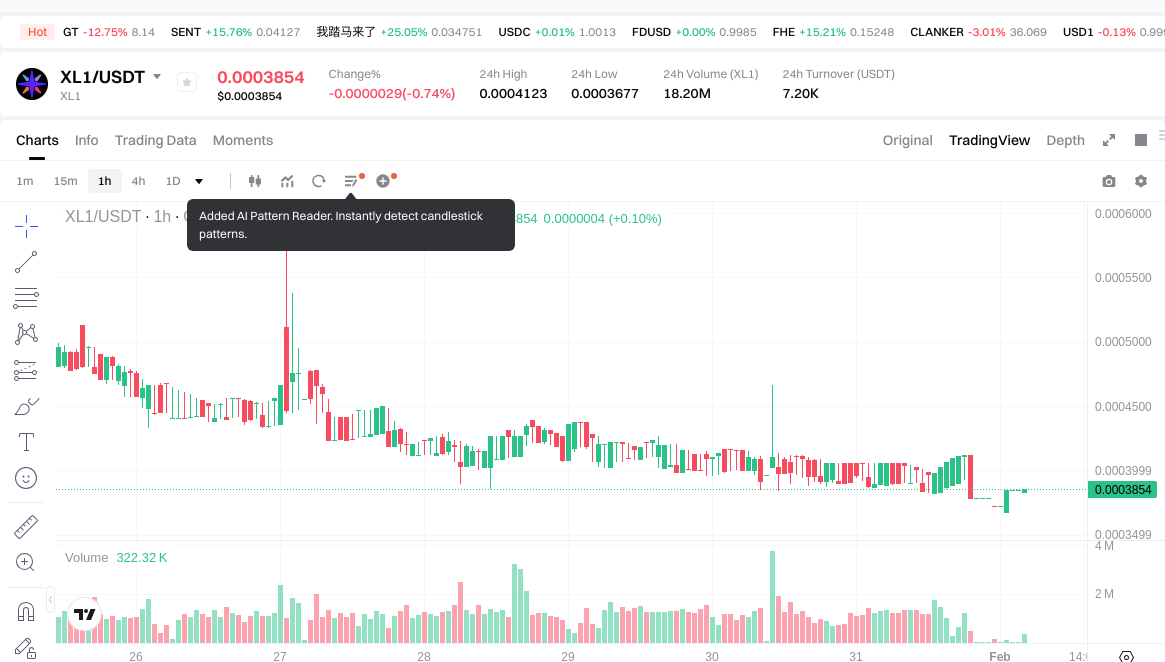
Recent price performance shows notable volatility, with declines of 5% over 24 hours, 19.73% over 7 days, 41.26% over 30 days, and 69.61% year-over-year. The token previously traded at $0.0027985 in September 2025, while touching a low of $0.0003677 on January 31, 2026. With 1,284 holders and trading activity across 4 exchanges, XL1 represents 0.00053% of the overall crypto market.
This analysis examines XL1's market positioning, historical price movements, technical characteristics, and associated considerations for those evaluating "Is XL1 a good investment?" The following sections provide data-driven perspectives on the token's value proposition, price dynamics, and risk factors relevant to investment decisions.
I. XL1 (XL1) Price History Review and Current Investment Value
- 2025: Initial launch with significant price volatility → Price exhibited notable fluctuations during early trading
- September 2025: Price reached $0.0027985 during a market surge → XL1 experienced upward momentum in Q3
- Late 2025 to early 2026: Market correction phase → Price declined from September levels to $0.0003677 by late January 2026
Current XL1 Investment Market Status (February 2026)
- XL1 current price: $0.0003854
- 24-hour price change: -5.0%
- 24-hour trading volume: $7,276.68
- Market capitalization: $2,196,780
- Circulating supply: 5.7 billion XL1 (15.0% of total supply)
Click to view real-time XL1 market price
II. Core Factors Influencing Whether XL1 is a Good Investment
Supply Mechanism and Scarcity (XL1 Investment Scarcity)
- XL1 operates with a defined supply structure: maximum supply of 48 billion tokens, total supply of 38 billion tokens, and current circulating supply of 5.7 billion tokens, representing 15% of the maximum supply
- The token economics include a burn mechanism where a portion of gas fees and transaction fees are destroyed through activity-based operations, potentially reducing circulating supply over time
- The relatively low circulation ratio compared to maximum supply may create potential scarcity dynamics as network adoption increases
- Investment consideration: The gap between circulating supply and maximum supply indicates substantial unlocked tokens that could impact future market dynamics
Institutional Investment and Mainstream Adoption (Institutional Investment in XL1)
- XL1 is listed on 4 exchanges with a holder base of 1,284 addresses as of February 2026
- The token serves as the utility layer for XYO Layer One, the network's first scalable data blockchain designed to bring verifiable information on-chain
- XL1 powers smart contracts, decentralized applications, and validator rewards within the XYO ecosystem
- The ecosystem operates on a dual-token model: XL1 drives on-chain operations while XYO supports the contributor network covering rewards, staking governance, and security mechanisms
Macroeconomic Environment Impact on XL1 Investment
- As a utility token within a specialized data blockchain ecosystem, XL1's investment dynamics may be influenced by broader cryptocurrency market conditions and regulatory developments
- The token's primary function centers on network operations rather than serving as a store of value or inflation hedge
- Market performance shows significant volatility with price changes of -5% over 24 hours, -19.73% over 7 days, -41.26% over 30 days, and -69.61% over 1 year as of February 1, 2026
Technology and Ecosystem Development (Technology & Ecosystem for XL1 Investment)
- XYO's decentralized physical infrastructure network (DePIN) comprises over 10 million nodes utilizing Proof of Location and Proof of Origin technologies
- The network provides trusted data infrastructure for applications in artificial intelligence, real-world assets, geospatial intelligence, and location-based gaming
- XL1 enables cross-chain bridging and wrapping functionality, expanding interoperability potential
- The ecosystem incentivizes participation through staking mechanisms and step-based reward structures
- Smart contract functionality and decentralized application support provide technical foundation for ecosystem expansion
III. XL1 Future Investment Forecast and Price Outlook (Is XL1 worth investing in 2026-2031)
Short-term Investment Forecast (2026, short-term XL1 investment outlook)
- Conservative forecast: $0.000197 - $0.000385
- Neutral forecast: $0.000385 - $0.000466
- Optimistic forecast: $0.000466 - $0.000547
Mid-term Investment Outlook (2027-2028, mid-term XL1 investment forecast)
- Market stage expectation: XL1 may enter a gradual growth phase as the XYO Layer One network continues to develop its scalable data blockchain infrastructure and expand its decentralized oracle ecosystem.
- Investment return forecast:
- 2027: $0.000326 - $0.000602
- 2028: $0.000491 - $0.000790
- Key catalysts: Expansion of the contributor network, increased adoption of Proof of Location and Proof of Origin technologies, growth in applications across AI, real-world assets, geospatial intelligence, and location-based gaming sectors.
Long-term Investment Outlook (Is XL1 a good long-term investment?)
- Base scenario: $0.000507 - $0.000798 (assuming steady ecosystem development and moderate market conditions)
- Optimistic scenario: $0.000738 - $0.000814 (assuming accelerated adoption and favorable market environment)
- Risk scenario: Below $0.000197 (under adverse market conditions or significant competitive pressure)
Click to view XL1 long-term investment and price forecast: Price Prediction
2026-02-01 - 2031 Long-term Outlook
- Base scenario: $0.000507 - $0.000768 USD (corresponding to steady progress and gradual mainstream application growth)
- Optimistic scenario: $0.000738 - $0.000814 USD (corresponding to large-scale adoption and favorable market conditions)
- Transformative scenario: Above $0.000814 USD (if ecosystem achieves breakthrough developments and mainstream popularization)
- 2031-12-31 predicted high: $0.000798 USD (based on optimistic development assumptions)
Disclaimer: Price forecasts are based on historical data and market analysis models and do not constitute investment advice. Cryptocurrency markets are highly volatile and subject to various risks. Investors should conduct independent research and consider their risk tolerance before making investment decisions.
| Year |
Predicted High Price |
Predicted Average Price |
Predicted Low Price |
Price Change |
| 2026 |
0.000547268 |
0.0003854 |
0.000196554 |
0 |
| 2027 |
0.00060157086 |
0.000466334 |
0.0003264338 |
21 |
| 2028 |
0.0007902495964 |
0.00053395243 |
0.0004912362356 |
38 |
| 2029 |
0.000814384246236 |
0.0006621010132 |
0.000609132932144 |
71 |
| 2030 |
0.000797302040095 |
0.000738242629718 |
0.000553681972288 |
91 |
| 2031 |
0.000798483228302 |
0.000767772334906 |
0.000506729741038 |
99 |
IV. XL1 Investment Strategy and Risk Management (How to invest in XL1)
Investment Methodology (XL1 investment strategy)
-
Long-term Holding (HODL XL1): This approach may suit investors with a longer time horizon who are willing to navigate market volatility. Given XL1's role as the utility token for XYO Layer One, a scalable data blockchain, long-term holders would be banking on the growth and adoption of the XYO ecosystem, including its decentralized oracle network (DePIN) and applications in AI, real-world assets, geospatial intelligence, and location-based gaming.
-
Active Trading: Traders may leverage technical analysis and price movement patterns for shorter-term strategies. With XL1's 24-hour trading volume of approximately $7,276.68 and notable price fluctuations (ranging from $0.0003677 to $0.0004123 within 24 hours as of February 1, 2026), active traders might seek to capitalize on intraday or weekly swings. However, the token's relatively low liquidity across four exchanges could impact order execution and slippage.
Risk Management (Risk management for XL1 investment)
-
Asset Allocation Ratios:
- Conservative investors: May consider limiting XL1 exposure to a small percentage (e.g., 1-3%) of their overall portfolio, given its high volatility and early-stage market presence.
- Aggressive investors: Might allocate a higher proportion (e.g., 5-10%) if comfortable with the project's technology and growth potential.
- Professional investors: Could employ dynamic allocation strategies based on market conditions, ecosystem developments, and risk-adjusted return models.
-
Risk Hedging Strategies: Diversification across multiple asset classes (e.g., large-cap cryptocurrencies, stablecoins, traditional assets) can help mitigate specific risks associated with XL1. Additionally, some investors may explore hedging instruments such as options or futures (if available) to manage downside exposure.
-
Secure Storage:
- Hot Wallets: Suitable for frequent trading but carry higher security risks.
- Cold Wallets: Recommended for long-term storage to minimize exposure to online threats.
- Hardware Wallets: Devices such as Ledger or Trezor offer enhanced security for holding XL1 tokens, particularly given the token's ERC-20 standard on the Ethereum network.
V. Risks of Investing in XL1 (Risks of investing in XL1)
-
Market Risk: XL1 has experienced significant price volatility. Over the past year, the token has declined approximately 69.61%, and within the last 30 days, it has dropped around 41.26%. The 24-hour low of $0.0003677 (recorded on January 31, 2026) and the all-time high of $0.0027985 (reached on September 16, 2025) illustrate the wide price swings. With a relatively small circulating supply of 5.7 billion tokens (15% of the total supply) and a market capitalization of approximately $2.2 million, the token may be susceptible to large price movements driven by trading activity or market sentiment.
-
Regulatory Risk: The regulatory environment for cryptocurrencies varies across jurisdictions and remains subject to change. Potential regulatory actions affecting utility tokens, decentralized oracle networks, or blockchain platforms could impact XL1's usage, liquidity, or market access. Investors should monitor developments in key markets where XL1 and the XYO ecosystem operate.
-
Technical Risk: As XL1 is an ERC-20 token on the Ethereum network, it is subject to risks inherent in that blockchain, including network congestion, gas fee volatility, and potential smart contract vulnerabilities. Additionally, the success of XL1 depends on the continued development and adoption of the XYO Layer One network and its associated technologies (e.g., Proof of Location, Proof of Origin). Any technical issues, security breaches, or delays in planned upgrades could affect token utility and investor confidence.
VI. Conclusion: Is XL1 a Good Investment?
-
Investment Value Summary: XL1's value proposition is tied to the XYO Layer One network's goal of providing verifiable, on-chain data for applications in AI, real-world assets, geospatial intelligence, and location-based services. The dual-token ecosystem (XL1 for chain operations, XYO for contributor rewards) and the decentralized oracle network with millions of nodes represent an ambitious technological framework. However, the token's market performance has been volatile, with notable declines over various timeframes and a relatively small market capitalization. The circulating supply represents only 15% of the maximum supply, which could influence future price dynamics as more tokens enter circulation.
-
Investor Recommendations:
✅ Beginners: Consider a dollar-cost averaging (DCA) approach to mitigate the impact of volatility, and prioritize secure storage solutions such as hardware wallets to protect holdings.
✅ Experienced Investors: May explore swing trading strategies based on technical indicators and market trends, while maintaining a diversified portfolio that includes other digital assets and risk-management tools.
✅ Institutional Investors: Could evaluate XL1 as part of a strategic allocation to emerging blockchain infrastructure, contingent on thorough due diligence regarding the project's technology, team, roadmap, and competitive positioning.
⚠️ Disclaimer: Cryptocurrency investments carry substantial risk, including the potential loss of principal. This content is for informational purposes only and does not constitute investment advice. Investors should conduct their own research and consult with financial advisors before making investment decisions.
VII. FAQ
Q1: What is XL1 and how does it function within the XYO ecosystem?
XL1 is the native utility token of the XYO Layer One network, a scalable data blockchain designed to bring verifiable information on-chain. It operates within a dual-token ecosystem where XL1 powers on-chain operations including gas fees, transaction costs (with partial burning mechanisms), smart contract execution, decentralized application (dApp) functionality, and validator rewards. The broader XYO network functions as a decentralized oracle system with over 10 million nodes, utilizing Proof of Location and Proof of Origin technologies to deliver verifiable data for artificial intelligence, real-world assets, geospatial intelligence, and location-based applications.
Q2: What is the current market status and price performance of XL1?
As of February 1, 2026, XL1 is trading at $0.0003854 with a market capitalization of approximately $2.20 million, ranking #1984 in the cryptocurrency market. The token has experienced significant volatility, with declines of 5% over 24 hours, 19.73% over 7 days, 41.26% over 30 days, and 69.61% year-over-year. The circulating supply stands at 5.70 billion tokens (15% of the total supply of 38 billion), with 1,284 holders and trading activity across 4 exchanges. The token previously reached $0.0027985 in September 2025 and touched a low of $0.0003677 on January 31, 2026.
Q3: What are the main factors that could influence XL1's investment potential?
Several key factors influence XL1's investment outlook: (1) Supply mechanism featuring a burn mechanism that destroys portions of gas and transaction fees, potentially creating scarcity dynamics; (2) The dual-token ecosystem model where XL1 drives on-chain operations while XYO supports the contributor network; (3) Technology development including cross-chain bridging functionality and smart contract capabilities; (4) Ecosystem expansion through applications in AI, real-world assets, geospatial intelligence, and location-based gaming; (5) The decentralized physical infrastructure network (DePIN) comprising over 10 million nodes utilizing Proof of Location and Proof of Origin technologies.
Q4: What are the projected price forecasts for XL1 from 2026 to 2031?
Price forecasts suggest varied scenarios: For 2026, conservative estimates range from $0.000197 to $0.000385, neutral forecasts between $0.000385 and $0.000466, and optimistic projections from $0.000466 to $0.000547. Mid-term outlooks (2027-2028) project ranges of $0.000326 to $0.000602 for 2027 and $0.000491 to $0.000790 for 2028. Long-term forecasts through 2031 suggest a base scenario of $0.000507 to $0.000798, an optimistic scenario of $0.000738 to $0.000814, and a risk scenario below $0.000197. However, these projections are subject to high uncertainty given market volatility and ecosystem development variables.
Q5: What investment strategies are suitable for XL1 holders?
Two primary strategies may be considered: (1) Long-term holding (HODL) for investors with longer time horizons who believe in the XYO ecosystem's growth potential, particularly its decentralized oracle network and applications across various sectors; (2) Active trading for those seeking to capitalize on short-term price movements, though this requires careful attention to the token's relatively low liquidity across four exchanges. Asset allocation recommendations vary by investor profile: conservative investors might limit exposure to 1-3% of their portfolio, aggressive investors to 5-10%, while professional investors could employ dynamic allocation strategies based on market conditions and risk-adjusted return models.
Q6: What are the primary risks associated with investing in XL1?
XL1 investment carries three major risk categories: (1) Market risk, evidenced by significant volatility with a 69.61% annual decline and wide price swings between $0.0003677 and $0.0027985, coupled with a relatively small market capitalization of $2.2 million that may amplify price movements; (2) Regulatory risk, as the evolving regulatory landscape for cryptocurrencies and decentralized oracle networks could impact token usage, liquidity, or market access; (3) Technical risk, including exposure to Ethereum network issues such as congestion and gas fee volatility, potential smart contract vulnerabilities, and dependency on the continued development and adoption of XYO Layer One technologies including Proof of Location and Proof of Origin systems.
Q7: How should investors approach security when holding XL1 tokens?
Security considerations for XL1 storage depend on investment strategy and time horizon: Hot wallets are suitable for frequent trading but carry higher security risks due to constant internet connectivity. Cold wallets are recommended for long-term storage to minimize exposure to online threats and hacking attempts. Hardware wallets such as Ledger or Trezor offer enhanced security for holding XL1 tokens, particularly advantageous given the token's ERC-20 standard on the Ethereum network. Long-term investors should prioritize cold or hardware wallet solutions, while active traders may balance convenience with security by maintaining only necessary trading amounts in hot wallets.
Q8: What percentage of XL1's total supply is currently in circulation and what are the implications?
Currently, 5.7 billion XL1 tokens are in circulation, representing only 15% of the maximum supply of 38 billion tokens and approximately 15% of the total supply of 38 billion tokens. This relatively low circulation ratio has important implications: it indicates substantial unlocked tokens that could impact future market dynamics as they enter circulation, potentially affecting price through increased supply. The gap between circulating and maximum supply suggests that investors should consider potential dilution effects. However, the token's burn mechanism, which destroys portions of gas fees and transaction fees through network activity, may partially offset future supply increases by reducing circulating tokens over time.
* The information is not intended to be and does not constitute financial advice or any other recommendation of any sort offered or endorsed by Gate.