This comprehensive analysis examines whether XL1, the utility token of XYO Layer One decentralized oracle network, represents a viable investment opportunity. The article evaluates XL1's current market position—trading at $0.0003595 with a $2.05 million market cap—alongside its historical price performance and projected trajectories through 2031. XL1 serves critical functions including gas fees, smart contract execution, and validator rewards within a DePIN ecosystem powered by over 10 million nodes. The analysis addresses investment strategies for different investor profiles, detailed price predictions ranging from $0.00024882 to $0.00088726 by 2031, and essential risk management approaches. Key risk factors include high volatility, regulatory uncertainty, and technical vulnerabilities. Readers gain actionable insights on portfolio allocation, storage solutions, and the burning mechanism's deflationary effects on token economics, enabling informed decision-making in this emerging cryptocurrency sector.
Introduction: XL1 Token's Investment Position and Market Prospects
XL1 is a significant asset in the cryptocurrency field, serving as the utility token of XYO Layer One, the first scalable data blockchain designed to bring verifiable information on-chain. As of February 1, 2026, XL1 maintains a market capitalization of approximately $2.05 million with a circulating supply of 5.7 billion tokens, trading at around $0.0003595. The token operates within a dual-token ecosystem where XL1 powers on-chain operations including gas fees, transaction costs (with partial burning mechanisms), smart contracts, decentralized applications, and validator rewards, while XYO supports the contributor network encompassing rewards, staking, governance, and security features.
With its positioning in the decentralized physical infrastructure network (DePIN) sector, XL1 has gained attention among investors exploring "Is XL1 (XL1) a good investment?" The token's underlying infrastructure consists of over 10 million nodes utilizing Proof of Location and Proof of Origin technologies to deliver trusted data for artificial intelligence, real-world assets, geospatial intelligence, and location-based gaming applications. Currently ranked #2039 in market capitalization with a dominance of 0.00048%, XL1 demonstrates characteristics of an emerging digital asset with 1,283 token holders and availability across 5 exchanges.
This article will comprehensively analyze XL1's investment value, historical price movements, future price predictions, and associated investment risks to provide reference insights for investors. The analysis covers the token's technical infrastructure, market performance metrics, tokenomics with a maximum supply of 48 billion tokens, and the factors influencing its development within the verifiable data blockchain ecosystem.
I. XL1 Price History Review and Current Investment Value
- 2025: XL1 launched with volatile price fluctuations and limited historical data available for analysis
- September 2025: Price experienced a notable peak during this period
- Late 2025 to Early 2026: Market correction phase observed, with price movement from elevated levels to lower ranges
Current XL1 Investment Market Status (February 2026)
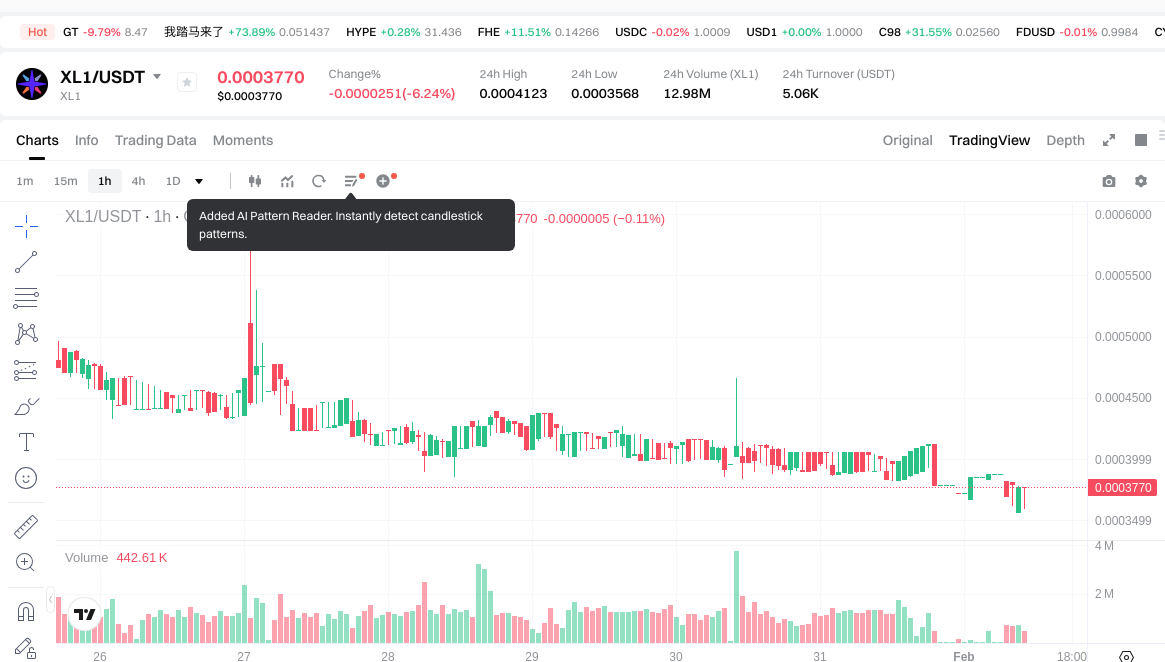
- XL1 current price: $0.0003595
- 24-hour price change: -3.32%
- 24-hour trading volume: $5,102.92
- Market capitalization: $2,049,150
- Circulating supply: 5.7 billion XL1 (15% of total supply)
- Price range (24h): High $0.0004123, Low $0.0003568
Click to view real-time XL1 market price
II. Core Factors Influencing Whether XL1 is a Good Investment
Supply Mechanism and Scarcity (XL1 Investment Scarcity)
- Structured Token Supply: XL1 operates with a clearly defined supply structure, featuring a circulating supply of 5.7 billion tokens, total supply of 38 billion tokens, and maximum supply capped at 48 billion tokens. The current circulating ratio stands at 15%, indicating significant token reserves that may enter circulation over time.
- Deflationary Features: A portion of gas fees and transaction fees paid in XL1 are subject to burning mechanisms tied to network activity levels. This activity-based burn feature introduces deflationary pressure that may potentially support price levels as network usage increases.
- Investment Consideration: The market cap to fully diluted valuation ratio of 15% suggests that the current market capitalization represents a relatively small portion of the potential total value if all tokens were in circulation. Investors should consider the gradual release schedule and its potential impact on price dynamics.
Institutional Investment and Mainstream Adoption (Institutional Investment in XL1)
- Token Holder Base: As of February 2026, XL1 has attracted 1,283 token holders, representing an early-stage user base for a project launched in September 2025.
- Exchange Presence: The token is currently listed on 5 exchanges, including Gate.com, providing multiple venues for trading and liquidity access.
- Ecosystem Integration: XL1 serves as the utility token for XYO Layer One network, which positions itself as a scalable data blockchain. The dual-token ecosystem structure—where XL1 drives on-chain operations while XYO supports the contributor network—creates interdependencies that may influence adoption patterns.
Macroeconomic Environment's Impact on XL1 Investment
- Market Positioning: With a market capitalization of approximately $2.05 million and market dominance of 0.00048%, XL1 occupies a micro-cap position within the broader cryptocurrency market, making it particularly sensitive to shifts in risk appetite and liquidity conditions.
- Volatility Profile: Recent price movements show substantial fluctuations, with 24-hour changes of -3.32%, 7-day changes of -21.6%, 30-day changes of -43.18%, and 1-year changes of -68.67%, reflecting high volatility typical of smaller-cap tokens during varying market conditions.
Technology and Ecosystem Development (Technology & Ecosystem for XL1 Investment)
- Core Functionality: XL1 serves multiple utility functions including gas fee payments, smart contract operations, decentralized application support, validator rewards distribution, and cross-chain bridging capabilities. These diverse use cases provide foundational utility for the token within its native ecosystem.
- Staking and Incentive Mechanisms: The network implements staking functionality combined with step-based reward systems designed to encourage user participation and network security contribution.
- XYO Network Integration: XL1's value proposition is closely tied to the XYO decentralized physical infrastructure network (DePIN), which comprises millions of nodes utilizing Proof of Location and Proof of Origin technologies. The network aims to provide verified data services for applications in artificial intelligence, real-world assets, geospatial intelligence, and location-based applications, potentially creating utility-driven demand for XL1 tokens.
III. XL1 Future Investment Prediction and Price Outlook (Is XL1(XL1) worth investing in 2026-2031)
Short-term Investment Prediction (2026, short-term XL1 investment outlook)
- Conservative prediction: $0.00024882 - $0.00037700
- Neutral prediction: $0.00037700 - $0.00044109
- Optimistic prediction: $0.00044109 or above
Mid-term Investment Outlook (2027-2029, mid-term XL1(XL1) investment forecast)
- Market stage expectation: The token may experience gradual growth as the XYO Layer One network expands its utility and adoption in decentralized oracle services, geospatial intelligence, and location-based applications.
- Investment return prediction:
- 2027: $0.00023316 - $0.0005563
- 2028: $0.00026547 - $0.0005599
- 2029: $0.00040660 - $0.00064118
- Key catalysts: Network adoption, validator rewards mechanism, staking incentives, cross-chain bridging expansion, and development of decentralized applications utilizing XYO's DePIN oracle network.
Long-term Investment Outlook (Is XL1 a good long-term investment?)
- Base scenario: $0.00050611 - $0.00062483 (assuming steady ecosystem development and moderate network growth)
- Optimistic scenario: $0.00062483 - $0.00088726 (assuming increased adoption in AI, RWA, and location-based gaming sectors)
- Risk scenario: Below $0.00024882 (in case of unfavorable market conditions or limited ecosystem expansion)
View XL1 long-term investment and price prediction: Price Prediction
2026-02-01 - 2031 Long-term Outlook
- Base scenario: $0.00050611 - $0.00062483 (corresponding to steady progress and stable mainstream application growth)
- Optimistic scenario: $0.00062483 - $0.00088726 (corresponding to large-scale adoption and favorable market environment)
- Transformational scenario: Above $0.00088726 (if the ecosystem achieves breakthrough progress and mainstream adoption)
- 2031-12-31 predicted high: $0.00088726 (based on optimistic development assumptions)
Disclaimer: The above predictions are based on available data and market analysis models. Cryptocurrency markets are highly volatile and subject to various unpredictable factors. These forecasts should not be considered as investment advice. Investors should conduct independent research and assess their own risk tolerance before making any investment decisions.
| Year |
Predicted High Price |
Predicted Average Price |
Predicted Low Price |
Price Change |
| 2026 |
0.00044109 |
0.000377 |
0.00024882 |
4 |
| 2027 |
0.0005563012 |
0.000409045 |
0.00023315565 |
13 |
| 2028 |
0.000559900796 |
0.0004826731 |
0.000265470205 |
34 |
| 2029 |
0.00064118294604 |
0.000521286948 |
0.00040660381944 |
45 |
| 2030 |
0.000668420189073 |
0.00058123494702 |
0.000552173199669 |
61 |
| 2031 |
0.000887255146626 |
0.000624827568046 |
0.000506110330117 |
73 |
IV. XL1 Investment Strategy and Risk Management (How to invest in XL1)
Investment Methodology (XL1 investment strategy)
-
Long-term Holding (HODL XL1): Suitable for conservative investors
Long-term holding strategies focus on XL1's fundamental value as the utility token for XYO Layer One network. Investors adopting this approach typically overlook short-term price fluctuations and concentrate on the project's technological development and ecosystem expansion. This method suits investors who believe in the long-term potential of decentralized oracle networks and location-based verification technologies.
-
Active Trading: Relies on technical analysis and swing trading
Active trading strategies require monitoring XL1's price movements and market trends. Given the token's price volatility (with 24-hour changes of -3.32% and 7-day changes of -21.6% as of February 1, 2026), traders may seek opportunities through short-term price fluctuations. This approach demands solid technical analysis skills and market timing abilities, suitable for investors with trading experience and risk tolerance.
Risk Management (Risk management for XL1 investment)
-
Asset Allocation Ratio: Conservative / Aggressive / Professional investors
- Conservative investors: Consider allocating 1-3% of total portfolio to XL1
- Aggressive investors: May allocate 5-10% depending on risk tolerance
- Professional investors: Can adjust allocation based on comprehensive market analysis and risk assessment
Given XL1's market capitalization dominance of 0.00048% and ranking of 2039, it represents a relatively smaller-cap asset requiring careful position sizing.
-
Risk Hedging Solutions: Multi-asset portfolio + hedging instruments
Diversification across multiple cryptocurrency assets can help mitigate single-token risk. Investors may consider combining XL1 with more established cryptocurrencies or assets from different sectors. Additionally, understanding the dual-token mechanism (XL1 and XYO) within the ecosystem provides insight into the broader project dynamics.
-
Secure Storage: Hot/cold wallets + hardware wallet recommendations
XL1 tokens can be stored in various wallet solutions. Hardware wallets provide enhanced security for long-term holdings, while software wallets offer convenience for active trading. Investors should ensure they understand proper wallet management practices and maintain control of private keys.
V. XL1 Investment Risks and Challenges (Risks of investing in XL1)
-
Market Risk: High volatility and price manipulation
XL1 exhibits significant price volatility, with a 30-day decline of -43.18% and a 1-year decline of -68.67% as of February 1, 2026. The token's 24-hour trading volume of approximately 5,102.92 indicates relatively limited liquidity compared to larger-cap assets, which may amplify price swings. The circulating supply represents 15% of the maximum supply, suggesting potential dilution effects as more tokens enter circulation.
-
Regulatory Risk: Policy uncertainty across different jurisdictions
Cryptocurrency regulatory frameworks continue to evolve globally, potentially impacting XL1's trading, usage, and adoption. Location-based data services and oracle networks may face specific regulatory scrutiny regarding data privacy and cross-border information flows. Investors should monitor regulatory developments in relevant jurisdictions.
-
Technical Risk: Network security vulnerabilities and upgrade failures
As a Layer One network and decentralized oracle system, XL1 faces technical challenges including smart contract vulnerabilities, network consensus issues, and integration complexities. The project's reliance on a network of nodes for Proof of Location and Proof of Origin introduces additional technical dependencies. Any security breaches or technical failures could impact token value and ecosystem functionality.
VI. Conclusion: Is XL1 a Good Investment?
-
Investment Value Summary: XL1 demonstrates long-term potential through its unique positioning as a utility token for a scalable data blockchain and decentralized oracle network, though it experiences notable short-term price volatility.
-
Investor Recommendations:
✅ Beginners: Dollar-cost averaging + secure wallet storage
New investors should consider gradual accumulation strategies while prioritizing secure storage solutions. Understanding the project's technology and use cases is essential before committing significant capital.
✅ Experienced Investors: Swing trading + portfolio diversification
Investors with market experience may explore trading opportunities while maintaining diversified positions across multiple assets. Technical analysis and risk management remain crucial.
✅ Institutional Investors: Strategic long-term allocation
Institutional participants may evaluate XL1 as part of broader exposure to oracle networks and decentralized physical infrastructure networks (DePIN), with appropriate due diligence and risk assessment.
⚠️ Notice: Cryptocurrency investment carries substantial risk. This content is for informational purposes only and does not constitute investment advice.
VII. FAQ
Q1: What is XL1 and how does it differ from XYO token?
XL1 is the utility token of XYO Layer One, serving as the primary medium for on-chain operations, while XYO supports the contributor network. Specifically, XL1 powers gas fees, transaction costs (with partial burning mechanisms), smart contract execution, decentralized applications, validator rewards, and cross-chain bridging. In contrast, XYO handles rewards distribution, staking functionality, governance participation, and network security features. This dual-token architecture separates operational functions (XL1) from network contribution incentives (XYO), creating a complementary ecosystem where both tokens serve distinct but interconnected roles within the XYO Layer One network.
Q2: What is XL1's current market performance as of February 2026?
As of February 1, 2026, XL1 trades at approximately $0.0003595 with a market capitalization of $2.05 million. The token has experienced significant volatility, showing a 24-hour decline of -3.32%, a 7-day decline of -21.6%, a 30-day decline of -43.18%, and a 1-year decline of -68.67%. With a circulating supply of 5.7 billion tokens (15% of the 48 billion maximum supply), 1,283 token holders, and availability on 5 exchanges including Gate.com, XL1 currently ranks #2039 in market capitalization with a dominance of 0.00048%. The 24-hour trading volume stands at approximately $5,102.92, indicating relatively limited liquidity compared to larger-cap cryptocurrencies.
Q3: What are the primary use cases driving XL1's utility value?
XL1's utility value derives from multiple operational functions within the XYO Layer One ecosystem. The token serves as the payment mechanism for gas fees and transaction costs, with a portion burned to create deflationary pressure. It facilitates smart contract deployment and execution, powers decentralized applications built on the network, compensates validators for network security, and enables cross-chain bridging capabilities. The underlying XYO network comprises over 10 million nodes utilizing Proof of Location and Proof of Origin technologies to deliver verifiable data for artificial intelligence applications, real-world asset tokenization, geospatial intelligence services, and location-based gaming platforms, creating utility-driven demand for XL1 tokens.
Q4: What investment allocation strategy is appropriate for XL1?
Investment allocation for XL1 should reflect individual risk tolerance and experience levels. Conservative investors may consider allocating 1-3% of their total portfolio to XL1, acknowledging its micro-cap status and high volatility characteristics. Aggressive investors with higher risk tolerance might allocate 5-10% depending on their comprehensive risk assessment. Professional investors can adjust allocation based on detailed market analysis and technical evaluation. Given XL1's market capitalization dominance of 0.00048% and ranking of 2039, position sizing should account for the token's relatively smaller market presence and liquidity constraints. Diversification across multiple cryptocurrency assets remains essential to mitigate single-token concentration risk.
Q5: What are the major risks associated with investing in XL1?
XL1 investment carries three primary risk categories. Market risk includes substantial price volatility, with historical declines of -43.18% over 30 days and -68.67% over one year, coupled with limited liquidity indicated by approximately $5,102.92 in 24-hour trading volume. Regulatory risk encompasses evolving cryptocurrency frameworks globally, particularly concerning location-based data services and oracle networks that may face scrutiny regarding data privacy and cross-border information flows. Technical risk involves potential network security vulnerabilities, smart contract flaws, consensus mechanism issues, and the complexity of maintaining a decentralized network of nodes for Proof of Location and Proof of Origin verification. Additionally, the circulating supply representing only 15% of maximum supply suggests potential dilution effects as more tokens enter circulation.
Q6: What are the predicted price ranges for XL1 from 2026 to 2031?
Short-term predictions for 2026 range from a conservative $0.00024882 to an optimistic high of $0.00044109. Mid-term forecasts show 2027 ranging between $0.00023316 and $0.0005563, 2028 between $0.00026547 and $0.0005599, and 2029 between $0.00040660 and $0.00064118. Long-term outlook for 2030-2031 projects a base scenario of $0.00050611 to $0.00062483, an optimistic scenario of $0.00062483 to $0.00088726, and a transformational scenario above $0.00088726. The predicted 2031 high reaches $0.00088726 under optimistic development assumptions. These projections are contingent upon network adoption rates, validator mechanism effectiveness, ecosystem development, and broader cryptocurrency market conditions. Investors should note these forecasts carry substantial uncertainty and should not be considered investment advice.
Q7: What storage and security practices are recommended for XL1 tokens?
XL1 tokens can be stored using multiple wallet solutions depending on investment timeframe and usage patterns. For long-term holdings, hardware wallets provide enhanced security by keeping private keys offline, protecting against online threats and exchange vulnerabilities. Software wallets offer convenience for active traders requiring frequent access, though they carry higher security risks. Hot wallets connected to the internet facilitate quick transactions but should contain only amounts needed for immediate trading. Cold storage solutions, including hardware wallets and paper wallets, suit larger holdings intended for long-term investment. Regardless of storage method, investors must maintain control of private keys, implement strong passwords, enable two-factor authentication where available, and regularly update wallet software to ensure optimal security for their XL1 holdings.
Q8: How does the XL1 burning mechanism affect token economics?
The XL1 burning mechanism creates deflationary pressure by permanently removing tokens from circulation. A portion of gas fees and transaction costs paid in XL1 undergoes burning proportional to network activity levels. As network usage increases through smart contract executions, decentralized application interactions, validator operations, and cross-chain transactions, the burn rate accelerates, reducing circulating supply. This activity-based burn feature differs from fixed-rate burning by directly tying deflation to ecosystem utility and adoption. With a circulating supply of 5.7 billion tokens representing 15% of the 48 billion maximum supply, the burning mechanism may provide long-term price support by constraining supply growth. However, the actual deflationary impact depends on burn rate exceeding new token release velocity from the remaining 85% of maximum supply.
* The information is not intended to be and does not constitute financial advice or any other recommendation of any sort offered or endorsed by Gate.