This comprehensive analysis examines XPR Network (XPR) as a potential investment, evaluating its tokenomics, use cases, and market prospects. As a blockchain payment infrastructure launched in 2020, XPR currently trades at $0.003589 with a $101.85 million market cap and demonstrates 158.23% yearly appreciation. The article dissects key investment factors including instant transactions, zero gas fees, and ISO 20022 compliance alignment, while providing detailed price forecasts ranging from $0.002980 to $0.007451 through 2031. Investors benefit from tailored strategies spanning beginners to institutional players, alongside critical risk assessments covering market volatility, regulatory uncertainty, and technical vulnerabilities. Whether on Gate or other platforms, this guide equips readers with actionable insights for evaluating XPR's investment viability within the blockchain payment sector.
Introduction: XPR Network (XPR) Investment Position and Market Prospects
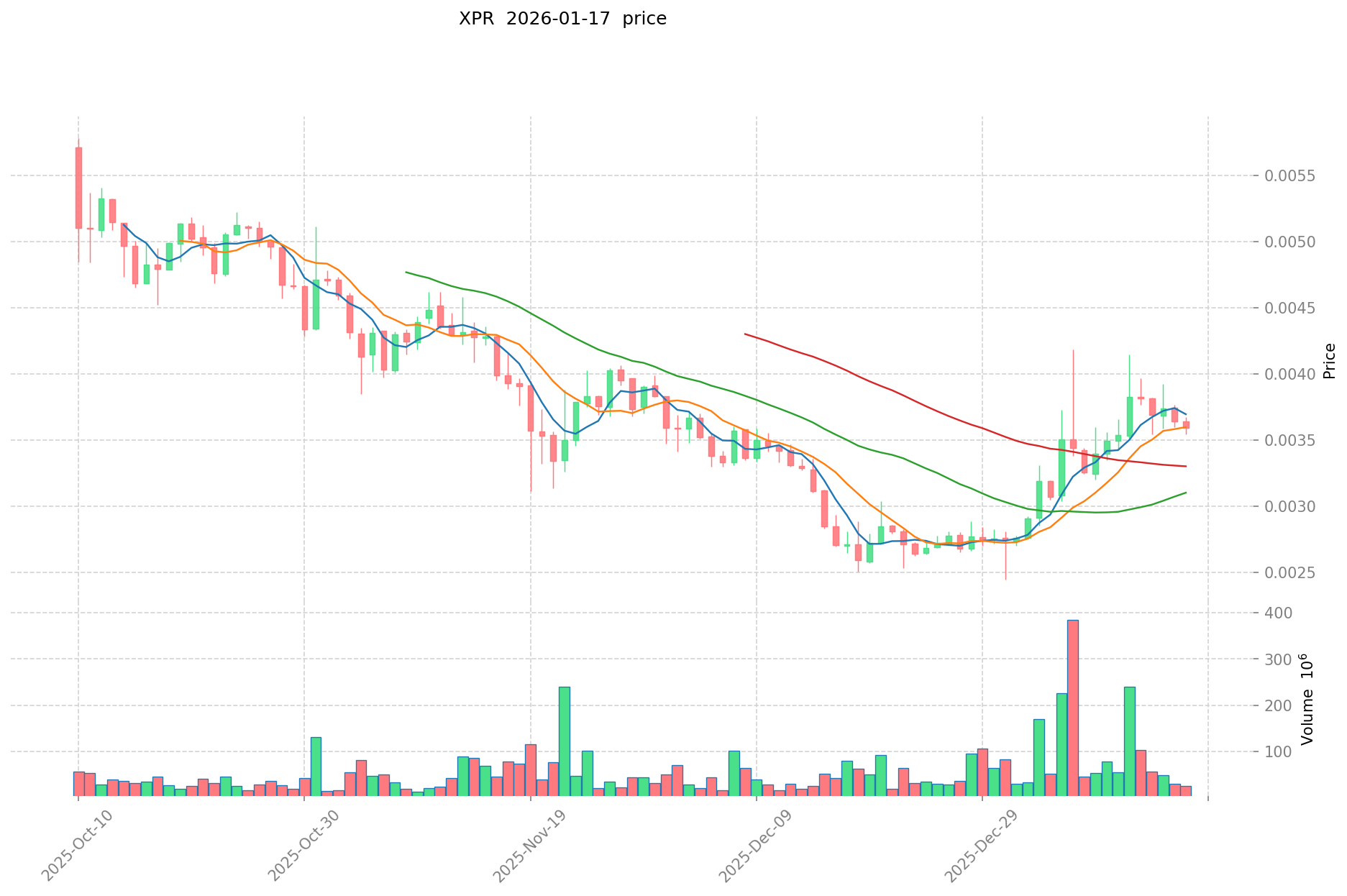
XPR Network (XPR) represents a notable asset in the cryptocurrency sector, having launched in April 2020. The project focuses on blockchain infrastructure with applications spanning cross-border payments, supply chain transparency, asset tokenization, DeFi, and digital security. As of January 17, 2026, XPR maintains a market capitalization of approximately $101.85 million, with a circulating supply of around 28.38 billion tokens. The current price stands at approximately $0.003589. With its positioning as a blockchain platform offering instant transactions, zero gas fees, and ISO 20022 alignment, XPR Network has attracted attention from investors examining "Is XPR Network (XPR) a good investment?" This article provides a comprehensive analysis of XPR's investment value, historical performance, future price projections, and associated risks to serve as a reference for investors.
The project currently ranks 351st by market capitalization, with a market dominance of 0.0033%. Over the past year, XPR has demonstrated notable price movement, with a 158.23% increase, while shorter-term performance shows a 31.73% rise over 30 days and a 3.04% gain over 7 days. The token holder base consists of approximately 27,719 addresses, and the asset is available on 8 exchanges. With a circulating supply representing 90.5% of the total supply, XPR's market cap to fully diluted valuation ratio indicates substantial token circulation. Historical data shows the token reached a previous price level of $0.100088 in April 2020, while experiencing lower price points at $0.00054716 in October 2023.
I. XPR Token Price History Review and Current Investment Value
- 2020: XPR reached a notable price level of $0.100088 on April 27, 2020 → This represented a significant early-stage valuation period for early participants
- 2023: Market conditions led to compressed valuations → XPR traded near $0.00054716 on October 19, 2023, reflecting broader crypto market adjustments
- 2024-2025: Recovery phase observed → Price gradually increased from lower ranges toward the $0.003-0.004 range
- Past year performance: XPR demonstrated appreciation of approximately 158.23% → Reflecting renewed interest and platform development progress
Current XPR Investment Market Status (January 2026)
- XPR current price: $0.0035892
- 24-hour trading volume: $79,801.78
- Market capitalization: Approximately $101.85 million
- Circulating supply: 28.38 billion XPR (representing 90.50% of total supply)
- Price fluctuation (24h): Between $0.0035427 and $0.0036736
Click to view real-time XPR market price
Recent Price Movement Patterns
- 1-hour change: -0.069%
- 7-day change: +3.04%
- 30-day change: +31.73%
- Market cap to fully diluted valuation ratio: 90.5%
- Global market cap ranking: #351
II. Core Factors Affecting Whether XPR is a Good Investment (Is XPR Network(XPR) a Good Investment)
Supply Mechanism and Scarcity (XPR investment scarcity)
- Supply Structure Impact on Value: XPR Network has a circulating supply of approximately 28.38 billion tokens out of a total supply of 31.36 billion tokens, representing a circulation ratio of approximately 90.50%. The absence of a maximum supply cap indicates an uncapped supply model.
- Investment Implications: The high circulation ratio suggests that most tokens are already in the market, potentially limiting supply-driven scarcity effects. Investors should consider how the remaining non-circulating supply may affect future market dynamics and price movements.
Institutional Investment and Mainstream Adoption (Institutional investment in XPR)
- Exchange Confidence Indicators: According to available data, Bybit's proof-of-reserves showed XPR reserves at 137% in June 2025 compared to 106% in May, suggesting increased exchange confidence in holding XPR assets.
- Market Presence: XPR Network is listed on 8 exchanges and maintains approximately 27,719 token holders, indicating a modest but established user base.
- Adoption Challenges: Community discussions suggest that XPR's limited presence on exchanges available in certain markets may affect its accessibility and adoption rate.
Macroeconomic Environment's Impact on XPR Investment
- Market Performance Context: XPR Network demonstrated a 1-year price increase of approximately 158.23% and a 30-day increase of approximately 31.73%, suggesting responsiveness to broader market conditions.
- Volatility Considerations: The 24-hour price fluctuation between $0.0035427 and $0.0036736 reflects typical cryptocurrency market volatility that investors should factor into risk assessment.
- Trading Volume: The 24-hour trading volume of approximately $79,801.78 represents relatively modest liquidity compared to major cryptocurrencies.
Technology and Ecosystem Development (Technology & Ecosystem for XPR investment)
- Core Technical Features: XPR Network focuses on instant transactions, zero gas fees, and on-chain identity verification as its primary technical differentiators.
- ISO 20022 Alignment: The platform indicates alignment with ISO 20022 standards, targeting compliance-focused applications in financial services.
- Application Areas: The network positions itself for use cases including cross-border payments, supply chain transparency, asset tokenization, DeFi, and digital security solutions.
- Developer Community: The project emphasizes support for a developer community to expand ecosystem applications across various industries.
III. XPR Future Investment Forecast and Price Outlook (Is XPR Network (XPR) worth investing in 2026-2031)
Short-term Investment Forecast (2026, short-term XPR investment outlook)
- Conservative Forecast: $0.002980 - $0.003590
- Neutral Forecast: $0.003590 - $0.004703
- Optimistic Forecast: $0.004703 - $0.006813
Mid-term Investment Outlook (2027-2029, mid-term XPR Network (XPR) investment forecast)
-
Market Stage Expectation: The mid-term period may show moderate growth patterns with potential expansion in cross-border payment applications and supply chain transparency solutions. Development activity and community engagement could influence price dynamics.
-
Investment Return Forecast:
- 2027: $0.002612 - $0.004354
- 2028: $0.003315 - $0.004717
- 2029: $0.003946 - $0.006008
-
Key Catalysts: Platform adoption rate, developer ecosystem growth, and integration of ISO 20022 compliance features may serve as potential catalysts.
Long-term Investment Outlook (Is XPR a good long-term investment?)
- Base Scenario: $0.003887 - $0.007451 (assuming steady development and moderate market conditions through 2031)
- Optimistic Scenario: $0.006479 - $0.007712 (assuming enhanced ecosystem adoption and favorable market environment)
- Risk Scenario: Below $0.003000 (under challenging market conditions or reduced platform adoption)
Click to view XPR long-term investment and price forecast: Price Prediction
2026-2031 Long-term Outlook
- Base Scenario: $0.002980 - $0.007451 (corresponding to steady progress and gradual mainstream application growth)
- Optimistic Scenario: $0.006479 - $0.007712 (corresponding to large-scale adoption and favorable market conditions)
- Transformative Scenario: Above $0.008000 (if the ecosystem achieves breakthrough progress and mainstream popularity)
- December 31, 2031 Forecast High: $0.007451 (based on optimistic development assumptions)
Disclaimer: Price forecasts are based on historical data analysis and market patterns. Actual performance may vary significantly due to market volatility, regulatory changes, technological developments, and other unpredictable factors. This information does not constitute investment advice.
| Year |
Predicted High Price |
Predicted Average Price |
Predicted Low Price |
Price Change |
| 2026 |
0.004702769 |
0.0035899 |
0.002979617 |
0 |
| 2027 |
0.004353651225 |
0.0041463345 |
0.002612190735 |
15 |
| 2028 |
0.004717492077375 |
0.0042499928625 |
0.00331499443275 |
18 |
| 2029 |
0.006008214909716 |
0.004483742469937 |
0.003945693373545 |
24 |
| 2030 |
0.007711588674045 |
0.005245978689826 |
0.004144323164963 |
46 |
| 2031 |
0.007450601234226 |
0.006478783681936 |
0.003887270209161 |
80 |
IV. XPR Network Investment Strategy and Risk Management (How to invest in blockchain payment solutions)
Investment Methodology (XPR Network investment strategy)
Long-term Holding (HODL XPR)
Long-term holding strategies may appeal to conservative investors seeking exposure to blockchain payment infrastructure. This approach involves acquiring XPR tokens and maintaining positions through market cycles, focusing on the fundamental development of the XPR Network ecosystem rather than short-term price movements. Investors considering this strategy typically evaluate factors such as network adoption rates, developer community growth, and alignment with payment standards like ISO 20022.
Active Trading
Active trading approaches rely on technical analysis and swing trading techniques to capitalize on price movements. Given XPR's historical price range between $0.00054716 and $0.100088, traders may identify entry and exit points based on support and resistance levels, volume patterns, and momentum indicators. The 24-hour trading volume of approximately $79,801 suggests moderate liquidity conditions that active traders should consider when executing positions.
Risk Management (Risk management for XPR Network investment)
Asset Allocation Ratios
Conservative Investors: May consider limiting XPR exposure to 1-3% of total cryptocurrency portfolio allocation, prioritizing established assets while maintaining minimal exposure to emerging payment-focused networks.
Aggressive Investors: Could allocate 5-10% of cryptocurrency holdings to XPR, accepting higher volatility in exchange for potential growth opportunities in blockchain payment solutions.
Professional Investors: May implement dynamic allocation strategies ranging from 3-15%, adjusting positions based on technical indicators, network development milestones, and broader market conditions.
Risk Hedging Solutions
Diversified portfolio construction combining multiple asset classes can help mitigate concentration risk. Investors might consider pairing XPR positions with established cryptocurrencies, stablecoins, or traditional financial instruments. Position sizing techniques, such as gradual accumulation through dollar-cost averaging, may reduce timing risk associated with market volatility.
Secure Storage
Cold Wallet Storage: For long-term holdings, hardware wallets provide offline storage solutions that minimize exposure to online security threats. Reputable hardware wallet manufacturers offer compatible solutions for storing XPR tokens securely.
Hot Wallet Considerations: For active traders requiring frequent access, encrypted software wallets with multi-factor authentication provide a balance between accessibility and security. Users should implement best practices including strong password protocols and regular security audits.
V. XPR Network Investment Risks and Challenges (Risks of investing in blockchain payment networks)
Market Risks
High Volatility: XPR has demonstrated significant price fluctuations, with historical data showing a low of $0.00054716 and a high of $0.100088. Recent performance indicates notable movement, with a 30-day change of 31.73% and a 1-year change of 158.23%. Such volatility patterns suggest substantial price risk for investors.
Liquidity Considerations: With a 24-hour trading volume of approximately $79,801 and availability on 8 exchanges, liquidity conditions may vary across different trading platforms. Limited liquidity can amplify price swings during periods of concentrated buying or selling activity.
Regulatory Risks
Policy Uncertainty: Blockchain payment networks operate within evolving regulatory frameworks that vary significantly across jurisdictions. Changes in cryptocurrency regulations, payment system oversight, or compliance requirements could affect XPR Network's operational environment and token value.
Compliance Standards: While the project references alignment with ISO 20022 standards, regulatory interpretations and implementation requirements may evolve, potentially impacting network operations or market access in certain regions.
Technical Risks
Network Security: Blockchain networks face ongoing security challenges including potential vulnerabilities in smart contracts, consensus mechanisms, and protocol implementations. Security incidents affecting the XPR Network or its associated infrastructure could impact token value and user confidence.
Upgrade Execution: Technical upgrades and protocol changes carry implementation risks. Unsuccessful upgrades, network forks, or compatibility issues could temporarily disrupt network operations or fragment the user base.
Developer Dependency: The network's development trajectory depends on sustained community participation and technical innovation. Changes in developer engagement or competing protocol developments may influence long-term viability.
VI. Conclusion: Is blockchain payment infrastructure a Good Investment?
Investment Value Summary
XPR Network presents characteristics associated with emerging blockchain payment infrastructure, including features such as transaction speed and compliance framework alignment. The token has shown considerable price appreciation over a one-year period (158.23%), though it remains significantly below its historical high of $0.100088 reached in April 2020. The current market capitalization of approximately $101.8 million and circulation ratio of 90.5% indicate substantial token distribution.
Long-term investment potential depends on multiple factors including network adoption, competitive positioning within the blockchain payments sector, and successful execution of technical roadmaps. Short-term price movements may continue to exhibit significant volatility, as evidenced by historical price ranges and recent percentage changes.
Investor Recommendations
✅ Beginners: Consider dollar-cost averaging strategies to gradually build positions while minimizing timing risk. Prioritize secure storage solutions using hardware wallets and limit initial exposure to a small percentage of overall portfolio allocation. Focus on understanding blockchain payment fundamentals before increasing position sizes.
✅ Experienced Investors: May employ swing trading techniques during periods of increased volatility while maintaining core long-term positions. Implement portfolio diversification across multiple blockchain sectors and asset classes. Monitor network development metrics, partnership announcements, and technical indicators to inform position adjustments.
✅ Institutional Investors: Could evaluate XPR Network as part of strategic allocation to blockchain payment infrastructure. Consider conducting comprehensive due diligence covering technical architecture, regulatory compliance frameworks, competitive landscape analysis, and liquidity profiles across multiple exchanges. Implement risk management protocols including position limits and regular portfolio rebalancing.
⚠️ Notice: Cryptocurrency investments carry substantial risk, including potential loss of principal. This content is provided for informational purposes only and does not constitute investment advice, financial guidance, or a recommendation to buy or sell any asset. Investors should conduct independent research and consult qualified financial professionals before making investment decisions.
VII. FAQ
Q1: What is XPR Network and what makes it different from other blockchain payment solutions?
XPR Network is a blockchain infrastructure platform launched in April 2020 that focuses on cross-border payments, supply chain transparency, and asset tokenization. The network distinguishes itself through instant transactions, zero gas fees, and alignment with ISO 20022 financial messaging standards. Unlike many blockchain networks that charge transaction fees, XPR Network's zero gas fee structure positions it competitively for high-volume payment applications. The platform's ISO 20022 compliance targets financial institutions seeking standardized messaging protocols, potentially facilitating integration with traditional financial systems. With approximately 27,719 token holders and availability on 8 exchanges, the network maintains a modest but established presence in the blockchain payments sector.
Q2: How has XPR performed as an investment over the past year?
XPR has demonstrated notable appreciation of approximately 158.23% over the past year as of January 2026. However, this performance should be contextualized within its broader price history: the token reached a high of $0.100088 in April 2020 shortly after launch, then experienced significant compression to $0.00054716 in October 2023. The current price of approximately $0.003589 remains substantially below its historical peak. Recent shorter-term performance shows a 31.73% increase over 30 days and 3.04% gain over 7 days, indicating continued volatility characteristic of emerging cryptocurrency assets. The 24-hour trading volume of approximately $79,801 suggests moderate liquidity conditions that investors should consider when evaluating position sizing.
Q3: What are the main risks associated with investing in XPR Network?
XPR Network investments carry several key risk categories. Market risks include high volatility, as evidenced by historical price fluctuations ranging from $0.00054716 to $0.100088, and relatively modest liquidity with a 24-hour trading volume around $79,801. Regulatory risks stem from evolving cryptocurrency regulations and payment system oversight across different jurisdictions, which could affect network operations despite ISO 20022 alignment. Technical risks encompass potential security vulnerabilities, implementation challenges during protocol upgrades, and dependency on sustained developer community engagement. The network's presence on only 8 exchanges may limit accessibility in certain markets, potentially affecting adoption rates and liquidity conditions. Investors should also consider the uncapped supply model, with 90.5% of tokens already in circulation.
Q4: What is the projected price outlook for XPR Network through 2031?
Based on current market analysis and historical patterns, XPR Network shows varied forecast scenarios. For 2026, conservative forecasts range from $0.002980 to $0.003590, neutral forecasts suggest $0.003590 to $0.004703, and optimistic scenarios project $0.004703 to $0.006813. Mid-term projections through 2029 estimate ranges from $0.002612 to $0.006008, depending on network adoption and market conditions. Long-term forecasts through December 31, 2031, indicate a base scenario of $0.003887 to $0.007451, with optimistic scenarios reaching $0.006479 to $0.007712. These projections assume continued ecosystem development, growing adoption of blockchain payment solutions, and favorable market conditions. However, actual performance may vary significantly due to market volatility, regulatory changes, competitive dynamics, and technological developments.
Q5: How should different types of investors approach XPR Network investment?
Investment approaches should align with risk tolerance and experience levels. Beginners are advised to employ dollar-cost averaging strategies, limiting initial exposure to 1-3% of cryptocurrency portfolio allocation while prioritizing secure hardware wallet storage. Experienced investors may implement swing trading techniques during volatility periods while maintaining 5-10% core positions, utilizing technical analysis for entry and exit points. Institutional investors could consider strategic allocation to blockchain payment infrastructure with 3-15% dynamic positioning, conducting comprehensive due diligence on technical architecture, regulatory compliance, and competitive landscape. All investor categories should implement risk management protocols including portfolio diversification across multiple asset classes, position sizing techniques, and regular security audits of storage solutions.
Q6: What factors could drive future growth for XPR Network?
Several catalysts could influence XPR Network's future trajectory. Network adoption rates in target applications including cross-border payments, supply chain transparency, and DeFi solutions represent primary growth drivers. Successful implementation of ISO 20022 compliance features may facilitate integration with traditional financial institutions seeking standardized messaging protocols. Developer ecosystem expansion and community engagement levels could accelerate application development across various industries. Partnership announcements with payment processors, financial institutions, or enterprise clients may validate the platform's value proposition. Additionally, favorable cryptocurrency market conditions and increased liquidity through additional exchange listings could support price appreciation. However, growth depends on successful execution of technical roadmaps and competitive positioning against established blockchain payment networks.
Q7: How does XPR Network's supply structure affect its investment potential?
XPR Network's supply dynamics present specific considerations for investors. With approximately 28.38 billion tokens in circulation from a total supply of 31.36 billion tokens, the network maintains a high circulation ratio of 90.5%. The absence of a maximum supply cap indicates an uncapped supply model, distinguishing it from fixed-supply cryptocurrencies like Bitcoin. This high circulation ratio suggests that most tokens are already in the market, potentially limiting supply-driven scarcity effects that contribute to price appreciation in some cryptocurrency assets. Investors should evaluate how the remaining approximately 2.98 billion non-circulating tokens may be released and their potential impact on market dynamics. The supply structure favors current liquidity but may moderate long-term scarcity-based valuation arguments compared to cryptocurrencies with more restrictive supply mechanisms.
* The information is not intended to be and does not constitute financial advice or any other recommendation of any sort offered or endorsed by Gate.