This comprehensive investment analysis examines whether XRP represents a viable investment opportunity by evaluating its market position, historical performance, and future potential. As the 4th largest cryptocurrency with $124.8 billion market capitalization, XRP offers institutional-grade infrastructure for cross-border payments, recently bolstered by $1.3 billion in ETF inflows following regulatory clarity from the August 2025 SEC case resolution. The article evaluates XRP price trajectories from 2014 through 2031 forecasts, analyzing supply dynamics, ecosystem development including RLUSD stablecoin growth, and institutional adoption trends. Investment strategies range from dollar-cost averaging for conservative investors to active trading approaches for experienced participants, complemented by comprehensive risk management frameworks addressing market volatility, regulatory uncertainties, and technical considerations. The analysis provides tiered recommendations for new investors, experienced traders, an
Introduction: XRP's Investment Position and Market Outlook
XRP is a significant asset in the cryptocurrency sector. Since its launch in 2010, it has achieved notable progress in cross-border payments and financial settlements. As of 2026, XRP maintains a market capitalization of approximately $124.80 billion, with a circulating supply of around 60.70 billion tokens, and a current price hovering around $2.056. Ranked 4th by market capitalization and holding a 6.32% market dominance, XRP has gradually become a focal point for investors discussing "Is XRP a good investment?" Built on the XRP Ledger, an open-source public decentralized blockchain designed specifically for payments, XRP offers fast transaction speeds (approximately 3 seconds per transaction), low costs ($0.0002 per transaction), scalability (1,500+ tps), and carbon neutrality. This article provides a comprehensive analysis of XRP's investment value, historical trends, future price predictions, and investment risks to serve as a reference for investors.
I. XRP Price History Review and Current Investment Value Status
- 2014: XRP recorded one of its early low points, trading at $0.00268621, representing the formative stage of the digital asset with limited market recognition.
- 2017: During the broader cryptocurrency market expansion, XRP experienced substantial growth, rising from $0.006 at the beginning of the year to $3.84 by year-end, driven by partnerships with financial institutions and increased Asian market participation. This period demonstrated significant volatility characteristic of emerging digital assets.
- 2018: Following the 2017 peak, XRP underwent a market correction, with prices declining to approximately $0.35, reflecting broader market adjustments in the cryptocurrency sector.
- 2020-2023: Regulatory developments, particularly legal proceedings involving the SEC, influenced XRP's price trajectory. In 2021, positive legal developments contributed to a price movement toward $1.96, though sustained momentum remained challenging during this period.
- 2023: A favorable legal outcome in July 2023, where XRP was determined not to be classified as a security in certain contexts, contributed to renewed market interest and price appreciation.
- 2024: XRP showed recovery patterns, with prices moving from the $0.50 range to approximately $1.50 by year-end, reflecting improved market sentiment and the broader cryptocurrency market cycle.
- 2025: XRP reached $3.65 in July 2025, representing a notable price level. The introduction of XRP spot ETF products in September 2025 marked institutional recognition, with initial trading volumes reaching $37.7 million.
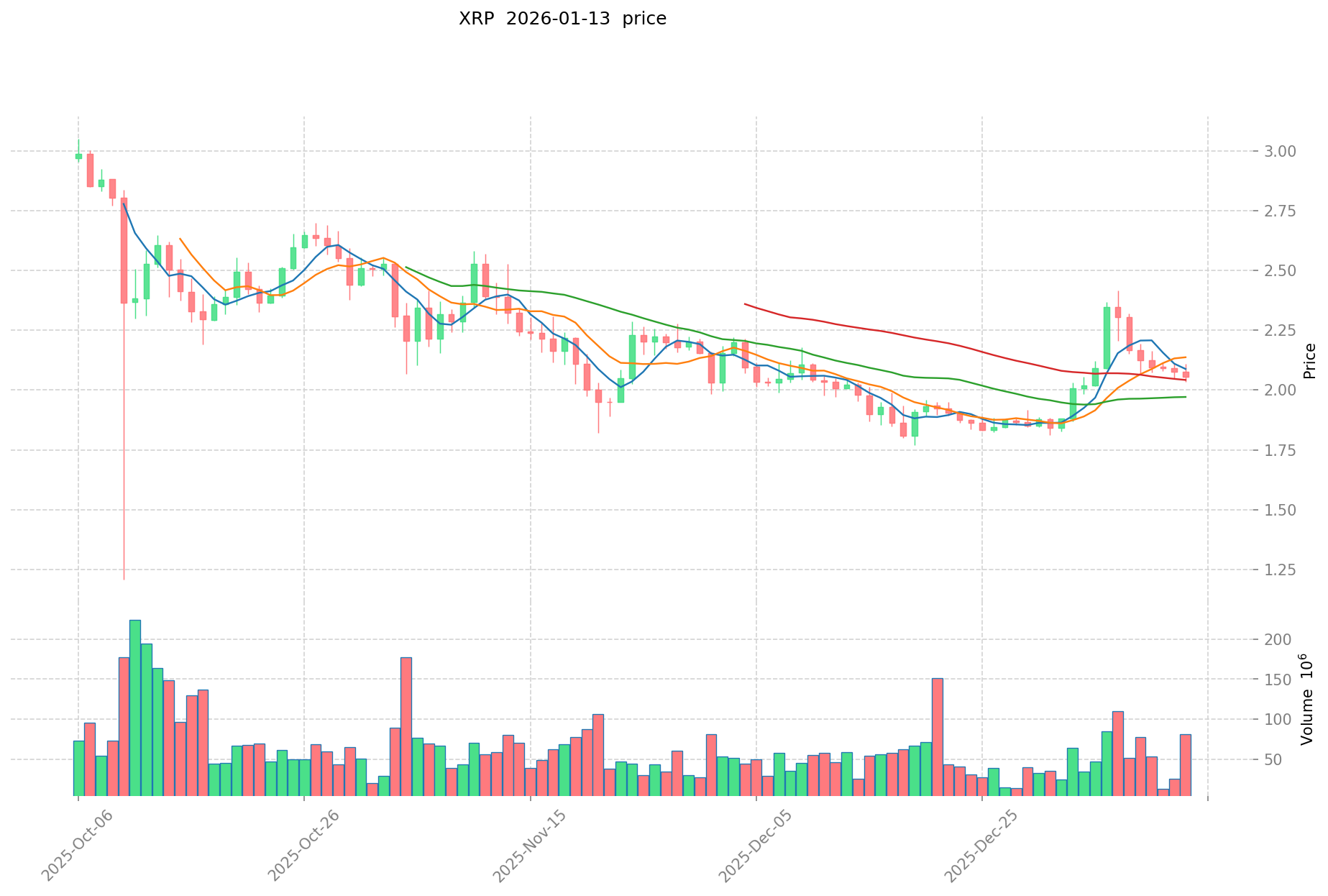
Current XRP Investment Market Status (January 2026)
- XRP current price: $2.056 (as of January 13, 2026)
- 24-hour trading volume: $153,163,412.08
- Market capitalization: $124.8 billion
- Circulating supply: 60.70 billion XRP
- Fully diluted valuation: $205.57 billion
- Market dominance: 6.32%
- 24-hour price range: $2.035 - $2.109
- Recent price movements: -0.19% (1H), -1.01% (24H), -13.4% (7D)
- Address holders: 7,507,537
- Trading pairs available on 82 exchanges
View real-time XRP market price
II. Core Factors Influencing Whether XRP is a Good Investment
Supply Mechanism and Scarcity (XRP investment scarcity)
- XRP has a fixed maximum supply of 100 billion tokens, with approximately 60.7 billion tokens currently in circulation. The circulating supply represents about 60.7% of the total supply, while the remaining tokens are held in escrow or by Ripple Labs.
- Supply dynamics: XRP exchange balances have declined to 1.6 billion tokens as of late 2025, representing a seven-year low and a 57% decrease from 3.76 billion tokens in October 2025. This supply compression on exchanges indicates reduced selling pressure.
- Investment significance: The controlled supply mechanism and decreasing exchange balances contribute to XRP's scarcity profile, which may support long-term investment value as demand increases.
Institutional Investment and Mainstream Adoption (Institutional investment in XRP)
- Institutional holding trends: Since the launch of spot XRP ETFs in November 2025, inflows have reached $1.3 billion, with seven XRP ETF issuers entering the market. Each $1 billion in ETF inflows locks approximately 500 million XRP tokens, representing 0.76% of the circulating supply.
- Enterprise adoption: XRP's integration into Ripple's fintech ecosystem and its role in cross-border payment solutions have contributed to increased institutional interest. RLUSD, Ripple's stablecoin built on the XRP Ledger, has grown to a market cap of $1.33 billion, becoming the third-largest US-regulated stablecoin.
- Regulatory clarity: The conclusion of Ripple's legal case with the SEC in August 2025 allowed compliance teams to evaluate XRP based on utility and liquidity rather than regulatory uncertainty, contributing to increased institutional adoption.
Macroeconomic Environment's Impact on XRP Investment
- Market conditions: XRP's investment appeal may be influenced by broader monetary policy shifts, interest rate changes, and global economic conditions that affect risk appetite in cryptocurrency markets.
- Portfolio diversification: As a digital asset with specific use cases in payment infrastructure, XRP may serve different portfolio functions compared to other cryptocurrencies during varying economic conditions.
Technology and Ecosystem Development (Technology & Ecosystem for XRP investment)
- Technical infrastructure: The XRP Ledger operates as an open-source public decentralized blockchain designed specifically for payments, offering transaction speeds of approximately 3 seconds, transaction costs of $0.0002, throughput capacity exceeding 1,500 transactions per second, and carbon-neutral operations.
- Ecosystem expansion: The development of RLUSD stablecoin on the XRP Ledger and growing ETF infrastructure represent ecosystem developments that may enhance XRP's utility and long-term investment value.
- Payment applications: XRP's integration into Ripple's cross-border payment solutions and enterprise blockchain applications continues to support its use case as a bridge currency in international transactions.
III. XRP Future Investment Predictions and Price Outlook (Is XRP Worth Investing in 2026-2031)
Short-term XRP Investment Outlook (2026)
- Conservative Forecast: $1.93 - $2.06
- Neutral Forecast: $2.06 - $2.20
- Optimistic Forecast: $2.20 - $2.35
Mid-term XRP Investment Forecast (2027-2029)
-
Market Stage Expectations: XRP is expected to enter a phase of gradual appreciation, supported by potential regulatory clarity and expanding financial institution partnerships. The token may experience moderate volatility as the broader crypto market adjusts to macroeconomic conditions.
-
Investment Return Predictions:
- 2027: $1.70 - $2.55 (approximately 7% average growth from 2026)
- 2028: $1.95 - $2.47 (approximately 15% average growth from 2027)
- 2029: $1.38 - $2.69 (approximately 17% average growth from 2028, with wider range reflecting increased uncertainty)
-
Key Catalysts: Potential approval and expansion of XRP spot ETFs, resolution of ongoing regulatory matters, adoption of cross-border payment solutions by major financial institutions, and broader institutional capital inflows.
Long-term Investment Outlook (Is XRP a Good Long-term Investment?)
- Base Scenario: $2.30 - $3.81 (assuming steady adoption and favorable regulatory environment through 2030-2031)
- Optimistic Scenario: $3.76 - $6.57 (assuming accelerated institutional adoption, positive regulatory outcomes, and strong market sentiment)
- Risk Scenario: $1.38 - $1.95 (under conditions of prolonged regulatory uncertainty, market contraction, or diminished institutional interest)
For detailed XRP long-term investment analysis and price predictions, visit: Price Prediction
2026-2031 Long-term Outlook
- Base Scenario: $2.30 - $3.81 (reflecting steady progress and gradual mainstream application growth)
- Optimistic Scenario: $3.76 - $6.57 (reflecting large-scale adoption and favorable market conditions)
- Transformative Scenario: Above $6.57 (contingent on breakthrough ecosystem developments and mainstream adoption)
- Projected High by December 31, 2031: $3.76 (based on optimistic development assumptions)
Disclaimer: These predictions are based on historical data, technical analysis, and market research. Cryptocurrency investments carry significant risk, and actual prices may differ materially from forecasts due to market volatility, regulatory changes, technological developments, and macroeconomic factors. This content does not constitute investment advice, and investors should conduct independent research and consult financial advisors before making investment decisions.
| Year |
Predicted High Price |
Predicted Average Price |
Predicted Low Price |
Price Change |
| 2026 |
2.34612 |
2.058 |
1.93452 |
0 |
| 2027 |
2.5543896 |
2.20206 |
1.6955862 |
7 |
| 2028 |
2.473353792 |
2.3782248 |
1.950144336 |
15 |
| 2029 |
2.69262611856 |
2.425789296 |
1.38269989872 |
17 |
| 2030 |
3.8132194838472 |
2.55920770728 |
2.303286936552 |
24 |
| 2031 |
3.759732042765048 |
3.1862135955636 |
2.644557284317788 |
54 |
IV. XRP Investment Strategy and Risk Management (How to invest in XRP)
Investment Strategy (XRP investment strategy)
Long-term Holding (HODL XRP)
Long-term holding represents a strategy suited for conservative investors who seek exposure to XRP's potential value appreciation over extended periods. This approach typically involves:
- Dollar-Cost Averaging (DCA): Regular purchases of XRP at predetermined intervals to mitigate timing risk and smooth out price volatility
- Strategic Accumulation: Building positions during market corrections or periods of relative price stability
- Patience-Oriented Mindset: Maintaining holdings through market cycles without reacting to short-term price fluctuations
This strategy may appeal to investors who view XRP's role in cross-border payments and its established position (ranked #4 by market capitalization at approximately $124.8 billion as of January 13, 2026) as indicators of long-term viability.
Active Trading
Active trading strategies involve more frequent position adjustments based on:
- Technical Analysis: Utilizing chart patterns, support/resistance levels, and technical indicators to identify entry and exit points
- Swing Trading: Capturing price movements within identified trends, potentially capitalizing on XRP's historical volatility
- Market Momentum: Responding to short-term price movements (XRP showed -0.19% change over 1 hour and -1.01% over 24 hours as of the latest data)
Traders should note XRP's 24-hour trading range ($2.035 - $2.109) and consider transaction costs, which may impact shorter-term trading profitability.
Risk Management (Risk management for XRP investment)
Asset Allocation
Different investor profiles may consider varying allocation approaches:
- Conservative Investors: Limited allocation (typically 1-5% of investment portfolio) to manage exposure to cryptocurrency volatility
- Moderate Investors: Moderate allocation (5-15% of crypto-specific portfolio) balanced with traditional assets
- Experienced Crypto Investors: Higher allocation may be considered, but diversification across multiple digital assets remains advisable
Given XRP's 30-day performance showing +1.53% change but 1-year performance indicating -17.83%, allocation decisions should account for both medium-term resilience and longer-term volatility.
Risk Hedging Strategies
Portfolio Diversification
- Combining XRP with other cryptocurrency assets across different categories (Layer 1 protocols, DeFi tokens, stablecoins)
- Including traditional financial instruments to reduce correlation risk
- Geographic and sector diversification within crypto holdings
Risk Mitigation Tools
- Position sizing based on individual risk tolerance
- Stop-loss orders to limit downside exposure
- Regular portfolio rebalancing to maintain target allocations
Secure Storage Solutions
Cold Storage Options
- Hardware wallets (offline devices providing enhanced security)
- Paper wallets (physical records of private keys, suitable for long-term storage)
- Multi-signature wallets (requiring multiple approvals for transactions)
Hot Wallet Considerations
- Exchange wallets for active trading (convenient but higher security risk)
- Mobile or desktop wallets for moderate accessibility and security balance
- Implementing two-factor authentication (2FA) and strong password protocols
Storage recommendations:
- Majority of long-term holdings in cold storage
- Only trading amounts kept in hot wallets
- Regular security audits of wallet solutions
- Backup and recovery phrase protection
V. XRP Investment Risks and Challenges (Risks of investing in XRP)
Market Risk
Price Volatility
XRP exhibits substantial price fluctuations characteristic of cryptocurrency markets:
- 7-day performance showing -13.4% decline demonstrates short-term volatility
- Historical price range from $0.00268621 (recorded May 22, 2014) to $3.65 (recorded July 18, 2025) illustrates extreme price movements
- Current price ($2.056 as of January 13, 2026) represents approximately 43.7% below recent peak levels
Market Manipulation Concerns
- Cryptocurrency markets may be susceptible to coordinated trading activities
- Lower liquidity periods can amplify price swings
- Whale holdings (large concentrated positions) may influence price dynamics
Liquidity Considerations
With 24-hour trading volume of approximately $153.16 million and presence on 82 exchanges, XRP maintains reasonable liquidity, though this can vary across different trading platforms and market conditions.
Regulatory Risk
Jurisdictional Variations
Cryptocurrency regulatory frameworks vary substantially across regions:
- Different countries maintain distinct classification systems for digital assets
- Regulatory clarity remains evolving in many jurisdictions
- Cross-border payment use cases may face additional regulatory scrutiny
Compliance Uncertainty
- Changing regulatory standards may impact operational aspects
- Tax treatment varies by jurisdiction and may be subject to revision
- Reporting requirements continue to develop across different markets
Policy Evolution
- Government stances toward cryptocurrency continue to develop
- International coordination on digital asset regulation remains incomplete
- Future policy changes may affect market dynamics
Technical Risk
Network Security
- Blockchain systems face ongoing security considerations
- Smart contract vulnerabilities (where applicable) may present risk vectors
- Network attacks, though uncommon on established systems, remain a theoretical concern
Protocol Upgrades
- Network upgrades and protocol changes carry implementation risks
- Community consensus on technical changes may face challenges
- Backward compatibility considerations during updates
Infrastructure Dependencies
- Exchange platform security and operational stability
- Wallet software vulnerabilities
- Internet connectivity and hardware failure risks for individual users
Counterparty Risk
- Exchange insolvency or security breaches
- Custodial service reliability
- Smart contract bugs in integrated applications
VI. Conclusion: Is XRP a Good Investment?
Investment Value Assessment
XRP presents a complex investment profile characterized by both established market position and inherent volatility. With a market capitalization of approximately $124.8 billion and ranking as the 4th largest cryptocurrency by market cap (representing 6.32% market dominance), XRP maintains substantial presence in the digital asset ecosystem.
The circulating supply of 60,699,967,552 tokens represents approximately 60.7% of the maximum supply of 100 billion, indicating a known supply schedule. The fully diluted market cap of approximately $205.57 billion provides context for potential future valuation scenarios.
Performance characteristics suggest:
- Short-term volatility: Recent 7-day decline of -13.4% demonstrates significant price fluctuation potential
- Medium-term resilience: 30-day performance showing +1.53% indicates some price recovery capability
- Long-term uncertainty: 1-year performance of -17.83% highlights extended periods of price challenge
The distance from all-time high ($3.65 recorded July 18, 2025) to current price ($2.056) represents approximately 43.7% decline, suggesting both the magnitude of past volatility and potential for future price movements in either direction.
Investor Recommendations
✅ New Investors
Recommended Approach:
- Begin with small allocations to understand market dynamics
- Implement dollar-cost averaging (DCA) strategy to reduce timing risk
- Prioritize security through hardware wallet or reputable cold storage solutions
- Invest only amounts affordable to lose given cryptocurrency volatility
- Dedicate time to understanding XRP's technology, use cases, and market position
Key Considerations:
- Start with educational resources before committing capital
- Avoid emotional decision-making during price fluctuations
- Maintain realistic expectations about returns and risks
✅ Experienced Investors
Recommended Approach:
- Consider swing trading strategies based on technical analysis frameworks
- Implement disciplined position sizing and risk management protocols
- Diversify across multiple cryptocurrency categories to reduce correlation risk
- Utilize both cold storage for long-term holdings and hot wallets for active positions
- Monitor regulatory developments that may impact XRP specifically
Strategic Considerations:
- Balance XRP exposure with other digital assets
- Employ stop-loss orders and profit-taking strategies
- Regular portfolio rebalancing based on risk tolerance and market conditions
✅ Institutional Investors
Recommended Approach:
- Evaluate XRP as potential component of diversified digital asset allocation
- Implement institutional-grade custody solutions
- Consider long-term strategic positioning rather than short-term trading
- Conduct thorough due diligence on regulatory compliance requirements
- Develop comprehensive risk management frameworks
Institutional Considerations:
- Governance and compliance protocols for cryptocurrency holdings
- Liquidity management given position sizes
- Reporting and accounting standards for digital assets
⚠️ Important Disclaimer
Cryptocurrency investments carry substantial risk, including potential complete loss of capital. Price volatility in digital asset markets can be extreme and unpredictable. This analysis is provided for informational purposes only and does not constitute financial, investment, legal, or tax advice.
Prospective investors should:
- Conduct independent research and due diligence
- Consult qualified financial advisors familiar with their specific circumstances
- Understand their own risk tolerance and investment objectives
- Stay informed about regulatory developments in relevant jurisdictions
- Never invest more than they can afford to lose
Past performance does not indicate future results. Market conditions, regulatory environments, and technological factors can change rapidly, potentially affecting investment outcomes significantly.
VII. FAQ
Q1: What is the minimum amount needed to start investing in XRP?
There is no universal minimum investment amount for XRP, as it depends on the exchange or platform used. Most cryptocurrency exchanges allow purchases starting from as little as $10-$25 USD worth of XRP. Given XRP's current price of approximately $2.056 (as of January 13, 2026), investors can acquire fractional amounts of tokens. For new investors, financial advisors typically recommend starting with small allocations (1-5% of investment portfolio) to understand market dynamics before increasing exposure. The key consideration is investing only amounts you can afford to lose entirely, given cryptocurrency market volatility.
Q2: How does XRP differ from Bitcoin as an investment?
XRP and Bitcoin serve fundamentally different purposes and exhibit distinct investment characteristics. Bitcoin operates primarily as a store of value and decentralized digital currency with a maximum supply of 21 million coins, while XRP functions specifically as a payment settlement asset with a fixed supply of 100 billion tokens. XRP offers significantly faster transaction speeds (approximately 3 seconds versus Bitcoin's 10+ minutes), lower transaction costs ($0.0002 versus Bitcoin's variable fees), and higher throughput (1,500+ tps versus Bitcoin's 7 tps). From an investment perspective, Bitcoin maintains the largest market capitalization and longest track record, whereas XRP's value proposition centers on enterprise adoption in cross-border payments and financial institution partnerships. Both assets face different regulatory considerations and market dynamics.
Q3: What are the tax implications of investing in XRP?
Tax treatment of XRP investments varies significantly by jurisdiction and individual circumstances. In most countries, cryptocurrency transactions are subject to capital gains taxation, meaning profits from selling XRP at a higher price than purchase cost may be taxable. Tax events typically occur when converting XRP to fiat currency, trading it for other cryptocurrencies, or using it for purchases. Holding periods may affect tax rates (short-term versus long-term capital gains). Some jurisdictions treat cryptocurrency mining, staking, or airdrops as taxable income events. Record-keeping is essential, including documentation of purchase prices, sale prices, dates, and transaction purposes. Given the complexity and evolving nature of cryptocurrency taxation, investors should consult qualified tax professionals familiar with digital asset regulations in their specific jurisdiction before making investment decisions.
Q4: Is XRP safer to invest in now after the SEC case resolution?
The resolution of Ripple's legal case with the SEC in August 2025 has provided increased regulatory clarity, which contributed to renewed institutional interest and the subsequent launch of XRP spot ETFs in November 2025. The legal outcome determined that XRP is not classified as a security in certain contexts, allowing compliance teams to evaluate the asset based on utility and liquidity factors. However, "safer" is relative in cryptocurrency markets. While regulatory clarity reduces one risk factor, XRP remains subject to significant market volatility (recent 7-day decline of -13.4%), technological risks, and evolving regulatory frameworks across different jurisdictions. The post-case period has seen positive developments including $1.3 billion in ETF inflows and declining exchange balances (indicating reduced selling pressure), but price performance shows -17.83% over the past year. Investors should consider that reduced regulatory uncertainty does not eliminate market risk, and comprehensive due diligence remains essential before any investment decision.
Q5: How should I store my XRP investment securely?
XRP storage security depends on investment timeframe and trading frequency. For long-term holdings, cold storage solutions offer the highest security: hardware wallets (offline devices like Ledger or Trezor), paper wallets (physical records of private keys), or multi-signature wallets (requiring multiple approvals for transactions). These methods protect against online hacking attempts. For active traders, hot wallets provide convenience but carry higher security risks: exchange wallets (accessible but rely on platform security), mobile wallets (moderate accessibility and security balance), or desktop wallets (computer-based with varying security levels). Best practices include implementing two-factor authentication (2FA), using strong unique passwords, maintaining secure backups of recovery phrases in multiple physical locations, and never sharing private keys. Security experts recommend storing the majority of holdings (70-90%) in cold storage while keeping only trading amounts in hot wallets. Regular security audits of wallet solutions and staying informed about emerging security threats are also advisable.
Q6: What factors should I monitor to evaluate my XRP investment performance?
Effective XRP investment monitoring requires tracking multiple indicators across different timeframes. Price metrics include current price relative to purchase cost, distance from all-time high and recent peaks, and volatility patterns across 24-hour, 7-day, 30-day, and annual periods. Market structure indicators encompass trading volume trends (current 24-hour volume: $153.16 million), exchange balance changes (recently at seven-year lows of 1.6 billion tokens), and market dominance (currently 6.32%). Fundamental developments include regulatory updates across jurisdictions, institutional adoption metrics (ETF inflows reached $1.3 billion), ecosystem expansion (RLUSD stablecoin growth to $1.33 billion market cap), and partnerships with financial institutions. Technical indicators for active traders include support/resistance levels, moving averages, and momentum indicators. Investors should also monitor broader cryptocurrency market conditions, Bitcoin's performance (as market leader), macroeconomic factors affecting risk appetite, and personal portfolio allocation relative to risk tolerance. Regular rebalancing based on these factors helps maintain appropriate risk exposure.
Q7: Can XRP reach its previous all-time high of $3.65 again?
Whether XRP can return to its July 2025 all-time high of $3.65 depends on multiple factors with varying probabilities. The current price of $2.056 represents approximately 43.7% below that peak, requiring roughly 77% appreciation to reach prior highs. Potential catalysts supporting price recovery include: continued institutional adoption through ETF expansion ($1.3 billion inflows to date), further regulatory clarity in major markets, increased enterprise adoption of Ripple's payment solutions, broader cryptocurrency market appreciation, and decreasing exchange supply (currently at seven-year lows suggesting reduced selling pressure). Prediction models suggest optimistic scenarios ranging from $2.20-$2.35 in 2026 to potentially $3.76-$6.57 by 2031, with base scenarios showing more conservative ranges. However, these projections carry significant uncertainty given market volatility, macroeconomic conditions, regulatory changes, and technological developments. Historical performance shows XRP has demonstrated capacity for substantial price movements in both directions. Investors should recognize that while price recovery is possible under favorable conditions, it is not guaranteed, and any investment decision should account for both upside potential and downside risk.
Q8: What is the relationship between XRP and Ripple, and why does it matter for investors?
XRP and Ripple Labs are related but distinct entities, a relationship with important investment implications. XRP is the native cryptocurrency of the XRP Ledger, an open-source public blockchain designed for payment settlements. Ripple Labs is a private fintech company that develops enterprise blockchain solutions, including RippleNet for cross-border payments. While Ripple uses XRP in some of its products as a bridge currency, the XRP Ledger operates independently of Ripple's control. This distinction matters for investors because: (1) Ripple's business success may positively influence XRP adoption but doesn't guarantee token price appreciation; (2) Regulatory actions against Ripple (like the concluded SEC case) can affect market sentiment toward XRP; (3) Ripple holds significant XRP tokens in escrow, with controlled release schedules that affect circulating supply; (4) Enterprise partnerships secured by Ripple may drive XRP utility but operate on different economic models. Understanding this relationship helps investors evaluate how Ripple's corporate developments, partnerships, and regulatory status may impact XRP's investment value while recognizing that XRP's decentralized network operates beyond any single company's control.
* The information is not intended to be and does not constitute financial advice or any other recommendation of any sort offered or endorsed by Gate.