This comprehensive article analyzes whether YearnFinance (YFI) constitutes a sound investment in 2026 and beyond. It examines YFI's market position (trading at $3,458.3 with $121.36M market cap), historical performance trends since its 2020 launch, and core investment factors including limited token supply of 36,666 units and DeFi ecosystem utility. The article provides detailed price forecasts ranging from conservative ($3,106-$3,451) to optimistic ($3,727-$4,500) scenarios for 2026, alongside long-term outlooks through 2031. It outlines investment strategies for beginners through institutional investors, emphasizing risk management and portfolio allocation guidelines. Critical analysis covers substantial risks including 59% one-year decline, extreme volatility, regulatory uncertainty, and technical vulnerabilities. Suitable resources link to real-time pricing on Gate exchange for informed decision-making.
Introduction: YearnFinance (YFI)'s Investment Position and Market Outlook
YFI represents a notable asset within the cryptocurrency sector, having been launched in 2020 and establishing itself as a significant player in the decentralized finance (DeFi) yield aggregation space. As of January 17, 2026, YearnFinance holds a market capitalization of approximately $121.36 million, with a circulating supply of around 35,092 tokens and a current trading price near $3,458. The asset ranks 329th by market capitalization and maintains a circulating supply ratio of 95.71% relative to its maximum supply of 36,666 tokens.
YearnFinance functions as an aggregation platform designed to optimize profit output data across various lending platforms, utilizing rebalancing mechanisms to identify optimal yield opportunities within DeFi protocols. With 44 exchange listings and approximately 51,930 holders, YFI has demonstrated sustained market presence since its initial deployment at $34. Recent price movements show a 10.47% increase over the past 30 days, though the asset has experienced a decline of 59.07% over the one-year period.
This article examines YFI's investment characteristics, historical performance trends, future price outlook considerations, and associated risk factors to provide analytical perspective for those evaluating "Is YearnFinance (YFI) a good investment?" within their portfolio assessment process.
I. YFI Price History Review and Investment Value Status
- 2020: YFI launched in July with an initial price of $34, experiencing rapid growth in the DeFi summer
- 2021: In May, YFI's price reached a significant milestone → price fluctuated around higher levels during the market cycle
- Historical price range: YFI has traded between $31.65 and $90,787 since its launch in July 2020
Current YFI Investment Market Status (January 2026)
- YFI current price: $3,458.3
- 24-hour trading volume: $18,279.81
- Market capitalization: $121.36 million
- Circulating supply: 35,091.99 YFI (95.71% of total supply)
- Fully diluted valuation: $126.80 million
- Market dominance: 0.0037%
Click to view real-time YFI market price
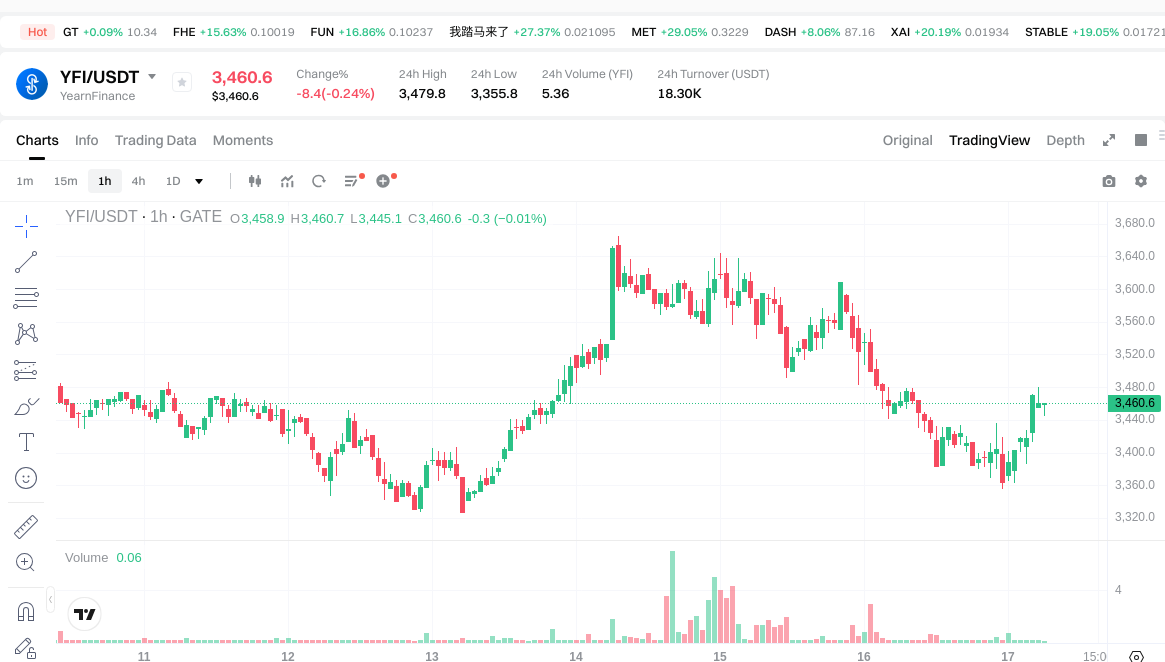
II. Core Factors Influencing Whether YFI is a Good Investment
Supply Mechanism and Scarcity (YFI Investment Scarcity)
- YFI operates with a capped maximum supply of 36,666 tokens, with approximately 35,091.99 tokens currently in circulation, representing a circulation ratio of 95.71%.
- The limited token supply creates scarcity dynamics that may influence price behavior. YFI's historical price range has varied significantly, from $31.65 to $90,787.
- Investment perspective: The near-complete token circulation and fixed maximum supply contribute to the scarcity framework that some market participants consider when evaluating long-term holding strategies.
Institutional Investment and Mainstream Adoption (Institutional Investment in YFI)
- YFI is listed on 44 exchanges, indicating a degree of market accessibility and liquidity across multiple trading platforms.
- The token has approximately 51,930 holders, reflecting a distributed ownership base within the DeFi community.
- Market capitalization stands at approximately $121.36 million, with YFI accounting for 0.0037% of the broader digital asset market share.
Technology and Ecosystem Development (Technology & Ecosystem for YFI Investment)
- Yearn.finance functions as an aggregation platform designed to optimize yield strategies across various DeFi lending protocols by analyzing profit output data and rebalancing to identify opportunities for returns.
- The platform operates on the Ethereum blockchain, with YFI serving as a governance token used to incentivize liquidity across different pools within the ecosystem.
- The YFI token contract address on Ethereum is 0x0bc529c00C6401aEF6D220BE8C6Ea1667F6Ad93e, and the protocol maintains active development repositories on GitHub, including projects related to governance and swap finance infrastructure.
- Yearn.finance's role within the DeFi landscape centers on yield optimization and automated strategy execution, positioning it within the broader decentralized finance application category.
III. YFI Future Investment Forecast and Price Outlook (Is YearnFinance(YFI) worth investing in 2026-2031)
Short-term Investment Forecast (2026, short-term YFI investment outlook)
- Conservative forecast: $3,106.53 - $3,451.7
- Neutral forecast: $3,451.7 - $3,727.84
- Optimistic forecast: $3,727.84 - $4,500
Mid-term Investment Outlook (2027-2029, mid-term YearnFinance(YFI) investment forecast)
-
Market phase expectation: YFI may experience moderate fluctuations during this period, with potential recovery from recent downturns as the DeFi sector evolves and adapts to market conditions.
-
Investment return forecast:
- 2027: $1,938.47 - $3,769.26
- 2028: $2,170.91 - $5,335.29
- 2029: $2,479.07 - $5,048.29
-
Key catalysts: Continued development of the DeFi ecosystem, favorable regulatory environment, improvements in protocol security, and broader adoption of yield optimization strategies.
Long-term Investment Outlook (Is YFI a good long-term investment?)
- Base scenario: $2,580 - $4,778 (assuming steady DeFi sector growth and moderate market conditions)
- Optimistic scenario: $5,343 - $7,236 (assuming accelerated DeFi adoption, favorable regulations, and enhanced protocol features)
- Risk scenario: $1,500 - $2,500 (under adverse market conditions, regulatory challenges, or security concerns)
Click to view YFI long-term investment and price prediction: Price Prediction
2026-01-17 - 2031 Long-term Outlook
- Base scenario: $2,580.04 - $4,777.85 (corresponding to steady progress and gradual mainstream application enhancement)
- Optimistic scenario: $5,343.54 - $7,236.05 (corresponding to large-scale adoption and favorable market environment)
- Transformative scenario: Above $10,000 (if the ecosystem achieves breakthrough developments and mainstream popularization)
- 2031-12-31 predicted high: $7,236.05 (based on optimistic development assumptions)
Disclaimer: The price predictions presented are based on statistical models and historical patterns. Cryptocurrency markets are highly volatile and influenced by numerous unpredictable factors. These forecasts should not be considered as investment advice. Past performance does not guarantee future results. Investors should conduct their own research and consider their risk tolerance before making investment decisions.
| Year |
Predicted High Price |
Predicted Average Price |
Predicted Low Price |
Price Change |
| 2026 |
3727.836 |
3451.7 |
3106.53 |
0 |
| 2027 |
3769.2564 |
3589.768 |
1938.47472 |
3 |
| 2028 |
5335.29269 |
3679.5122 |
2170.912198 |
6 |
| 2029 |
5048.2907384 |
4507.402445 |
2479.07134475 |
30 |
| 2030 |
6354.535966961 |
4777.8465917 |
2580.037159518 |
38 |
| 2031 |
7236.04866312965 |
5566.1912793305 |
5343.54362815728 |
60 |
IV. YFI Investment Strategy and Risk Management (How to invest in DeFi tokens)
Investment Methodology (YFI investment strategy)
Long-term Holding (HODL YFI): This approach may suit conservative investors who believe in the long-term development of the yearn.finance protocol. Given YFI's limited maximum supply of 36,666 tokens and its role as a governance token in a yield optimization platform, some investors view it as a potential store of value within the DeFi ecosystem. However, the token has experienced significant volatility, with a historical high of $90,787 (May 2021) and a current price of $3,458.3 (as of January 17, 2026), representing a substantial decline from its peak.
Active Trading: This strategy relies on technical analysis and swing trading opportunities. YFI's 24-hour trading volume of approximately $18,279.81 suggests moderate liquidity across 44 exchanges. Recent price movements show:
- 1-hour change: -0.53%
- 24-hour change: -0.24%
- 7-day change: -0.83%
- 30-day change: +10.47%
- 1-year change: -59.07%
The 30-day positive performance contrasts with the longer-term decline, potentially offering trading opportunities for those who can navigate short-term price fluctuations.
Risk Management (Risk management for YFI investment)
Asset Allocation Ratios:
- Conservative investors: Consider limiting DeFi token exposure to 1-3% of total portfolio
- Moderate investors: May allocate 3-8% to DeFi governance tokens like YFI
- Aggressive/Professional investors: Could allocate 8-15% or more, depending on risk tolerance and market expertise
Risk Hedging Solutions:
- Multi-asset portfolio: Diversify across different cryptocurrency categories (Bitcoin, Ethereum, stablecoins, DeFi tokens)
- Hedging instruments: Consider stablecoin positions or derivatives if available
- Position sizing: Never invest more than you can afford to lose completely
Secure Storage:
- Hot wallets: Suitable for active trading amounts only
- Cold wallets: Recommended for long-term holdings
- Hardware wallets: Devices like Ledger or Trezor provide enhanced security for significant YFI holdings
- Contract verification: YFI's primary contract address on Ethereum is 0x0bc529c00C6401aEF6D220BE8C6Ea1667F6Ad93e (always verify through official sources)
V. YFI Investment Risks and Challenges (Risks of investing in DeFi tokens)
Market Risks:
- High volatility: YFI has demonstrated extreme price swings, declining approximately 96% from its all-time high
- Price manipulation concerns: With a circulating supply of 35,091.98 tokens (95.71% of max supply) and market capitalization of approximately $121.36 million, the relatively small market size may be susceptible to large holder influence
- Liquidity risks: While listed on 44 exchanges, daily trading volume represents a small fraction of market cap
Regulatory Risks:
- Different jurisdictions maintain varying approaches to DeFi protocols and governance tokens
- Evolving regulatory frameworks may impact yearn.finance operations or token utility
- Tax treatment uncertainty in multiple countries
Technical Risks:
- Network security vulnerabilities: Smart contract risks inherent to DeFi protocols
- Protocol dependency: YFI value is tied to yearn.finance platform performance and user adoption
- Ethereum network risks: As an ERC-20 token, YFI is subject to Ethereum network congestion and gas fee fluctuations
- Competition: Numerous yield aggregation platforms compete in the DeFi space
VI. Conclusion: Is DeFi governance token a Good Investment?
Investment Value Summary: YFI represents a governance token for a yield optimization protocol in the DeFi sector. While the token has shown significant price appreciation potential historically, it has also experienced substantial decline, with a one-year decrease of approximately 59%. The limited token supply and established protocol history may appeal to certain investors, but the extreme volatility and technical complexity present considerable challenges.
Investor Recommendations:
✅ Beginners:
- Consider dollar-cost averaging with small amounts if interested in DeFi exposure
- Use secure wallet storage (hardware wallets recommended)
- Thoroughly research yearn.finance protocol mechanics before investing
- Start with more established cryptocurrencies before exploring governance tokens
✅ Experienced Investors:
- Employ swing trading strategies based on technical analysis
- Maintain diversified portfolio allocation
- Monitor DeFi sector developments and yearn.finance protocol updates
- Set clear stop-loss and take-profit levels
✅ Institutional Investors:
- Conduct comprehensive due diligence on protocol security and governance
- Consider strategic long-term allocation as part of broader DeFi exposure
- Implement robust risk management frameworks
- Monitor regulatory developments affecting DeFi tokens
⚠️ Notice: Cryptocurrency investment carries substantial risk. YFI has demonstrated extreme volatility, declining significantly from historical peaks. This content is for informational purposes only and does not constitute investment advice. Always conduct independent research and consult financial professionals before making investment decisions.
VII. FAQ
Q1: Is YearnFinance (YFI) a good investment for beginners in 2026?
YFI may not be the most suitable choice for cryptocurrency beginners due to its high volatility and technical complexity. The token has experienced significant price fluctuations, declining approximately 59% over the past year and roughly 96% from its all-time high of $90,787. For beginners interested in DeFi exposure, it would be advisable to first gain experience with more established cryptocurrencies like Bitcoin or Ethereum before exploring governance tokens. If choosing to invest in YFI, beginners should start with small amounts using dollar-cost averaging, utilize secure wallet storage (hardware wallets recommended), and thoroughly research the yearn.finance protocol mechanics. The limited maximum supply of 36,666 tokens and YFI's role in yield optimization may present long-term potential, but the substantial risks require careful consideration and proper risk management.
Q2: What is the projected price range for YFI by the end of 2026?
Based on current market analysis and statistical models, YFI's price projections for 2026 present three scenarios: Conservative forecast ranges from $3,106.53 to $3,451.7, neutral forecast spans $3,451.7 to $3,727.84, and optimistic forecast extends from $3,727.84 to $4,500. The predicted high for 2026 is approximately $3,727.84, with an average price around $3,451.7. These projections consider YFI's current trading price of $3,458.3 (as of January 17, 2026), recent 30-day performance showing a 10.47% increase, and the token's market capitalization of approximately $121.36 million. However, investors should note that cryptocurrency markets are highly volatile and influenced by numerous unpredictable factors including DeFi sector developments, regulatory changes, and broader market conditions. These forecasts should not be considered as investment advice, and past performance does not guarantee future results.
Q3: How does YFI's limited supply affect its investment potential?
YFI's capped maximum supply of 36,666 tokens creates a scarcity framework that influences its investment characteristics. Currently, approximately 35,091.99 tokens are in circulation, representing a 95.71% circulation ratio, meaning nearly all tokens have already entered the market. This near-complete token circulation combined with the fixed maximum supply establishes scarcity dynamics that some market participants consider when evaluating long-term holding strategies. Unlike cryptocurrencies with inflationary supply mechanisms, YFI's limited issuance theoretically supports price stability through supply constraint. However, scarcity alone does not guarantee investment success, as the token has still experienced significant price decline from historical peaks. The limited supply should be considered alongside other factors including protocol adoption, DeFi sector growth, market sentiment, and competitive landscape. With approximately 51,930 holders currently, the distribution of this limited supply among market participants also influences price behavior and liquidity patterns.
Q4: What are the main risks associated with investing in YFI?
Investing in YFI carries multiple significant risks that require careful consideration. Market risks include extreme volatility, as evidenced by the token declining approximately 96% from its all-time high, and potential price manipulation concerns given the relatively small market capitalization of $121.36 million and limited circulating supply. Liquidity risks exist despite listings on 44 exchanges, as daily trading volume of approximately $18,279.81 represents a small fraction of market cap. Technical risks include smart contract vulnerabilities inherent to DeFi protocols, protocol dependency where YFI value is directly tied to yearn.finance platform performance, and Ethereum network risks such as congestion and gas fee fluctuations since YFI operates as an ERC-20 token. Regulatory risks encompass varying jurisdictional approaches to DeFi protocols, evolving regulatory frameworks that may impact operations, and tax treatment uncertainty. Additionally, competition from numerous yield aggregation platforms in the DeFi space poses ongoing challenges to yearn.finance's market position and YFI's value proposition.
Q5: What investment strategy is recommended for YFI holders?
Investment strategies for YFI should align with individual risk tolerance and experience levels. For long-term holding (HODL), conservative investors who believe in yearn.finance's protocol development may consider this approach, though they must accept significant volatility given YFI's historical price fluctuations. This strategy may suit those viewing YFI as a governance token with potential long-term value within the DeFi ecosystem. For active trading, investors can employ swing trading strategies based on technical analysis, taking advantage of short-term price movements. Recent performance shows mixed signals with a 30-day gain of 10.47% contrasted against a one-year decline of 59.07%. Regardless of strategy, proper risk management is essential: conservative investors should limit DeFi token exposure to 1-3% of total portfolio, moderate investors may allocate 3-8%, while aggressive investors could consider 8-15% or more depending on expertise. Diversification across different cryptocurrency categories, secure storage using hardware wallets, and never investing more than one can afford to lose completely are fundamental principles for YFI investment.
Q6: How does YFI compare to other DeFi governance tokens as an investment?
YFI occupies a distinctive position within the DeFi governance token landscape as one of the earlier yield optimization protocols launched during the 2020 DeFi summer. With a market capitalization of approximately $121.36 million and ranking 329th by market cap, YFI represents a mid-sized DeFi asset. The token's extreme scarcity with only 36,666 maximum supply distinguishes it from many competitors with larger token supplies, potentially offering different supply-demand dynamics. However, YFI has experienced more severe price decline than some competing DeFi protocols, dropping approximately 59% over the past year. The platform's focus on yield aggregation and optimization across various DeFi lending protocols provides specific utility, though numerous competitors offer similar services. With 44 exchange listings and approximately 51,930 holders, YFI maintains reasonable accessibility and community distribution. When comparing investment potential, investors should evaluate YFI's protocol innovation, development activity (visible through GitHub repositories), governance mechanisms, and competitive advantages against other DeFi governance tokens while considering that the DeFi sector faces collective challenges including regulatory uncertainty and market volatility.
Q7: What factors could drive YFI price appreciation in the future?
Several factors could potentially influence YFI price appreciation over the coming years. Protocol development and enhancement of yearn.finance's yield optimization capabilities could attract more users and increase token utility, particularly if the platform successfully implements innovative features or improves returns compared to competitors. Broader DeFi sector growth and mainstream adoption of decentralized finance applications would likely benefit established protocols like yearn.finance. A favorable regulatory environment that provides clarity for DeFi governance tokens while avoiding overly restrictive measures could reduce uncertainty and attract institutional participation. Enhanced protocol security and successful audits addressing smart contract risks may increase user confidence. The near-complete token circulation (95.71%) combined with the fixed maximum supply of 36,666 tokens creates scarcity that could support price appreciation if demand increases. Macroeconomic factors including cryptocurrency market cycles, Ethereum network developments, and traditional finance integration with DeFi could also influence YFI valuation. However, these potential catalysts must be weighed against significant challenges including intense competition, historical price volatility, and the token's substantial decline from previous peaks.
* The information is not intended to be and does not constitute financial advice or any other recommendation of any sort offered or endorsed by Gate.