This comprehensive analysis examines whether DFI.Money (YFII) represents a viable investment opportunity. The article evaluates YFII's market position as a DeFi yield aggregation platform with a capped supply of 40,000 tokens, currently trading at $43.62 with $1.73M market capitalization. It presents short-term price ranges of $22.68-$46.24 and long-term projections through 2031, while addressing key risks including extreme volatility (86.68% annual decline), regulatory uncertainty, and technical vulnerabilities. Investment strategies are tailored for conservative, aggressive, and professional investors, with recommended allocations of 1-3%, 5-10%, and specialized portfolio approaches respectively. The analysis emphasizes YFII's Bitcoin-like halving mechanism and integration of Compound, dYdX, and Aave protocols, balanced against liquidity constraints and governance challenges. Suitable for cryptocurrency investors seeking DeFi exposure via Gate exchange.
Introduction: DFI.Money (YFII) Investment Position and Market Prospects
YFII is a notable asset in the cryptocurrency space, having been launched in 2020 as a fork of the YFI project. As of February 2026, YFII maintains a market capitalization of approximately $1.73 million, with a circulating supply of around 39,732 tokens and a current price hovering near $43.62. Positioned as a DeFi yield aggregation platform token, YFII has gradually become a focal point for investors discussing "Is DFI.Money (YFII) a good investment?" This article will comprehensively analyze YFII's investment characteristics, historical price movements, future price projections, and associated risks to provide reference for investors.
YFII emerged from community governance discussions within the Yearn Finance ecosystem, adopting a Bitcoin-like halving mechanism for token distribution. The platform aggregates multiple DeFi protocols including Compound, dYdX, Aave, and DDEX, automatically allocating user deposits to protocols offering optimal yields. With a maximum supply capped at 40,000 tokens and approximately 99.33% already in circulation, YFII represents a relatively mature token distribution model. The project holds a market ranking of 2,131 and accounts for 0.000064% of the total cryptocurrency market dominance as of early 2026.
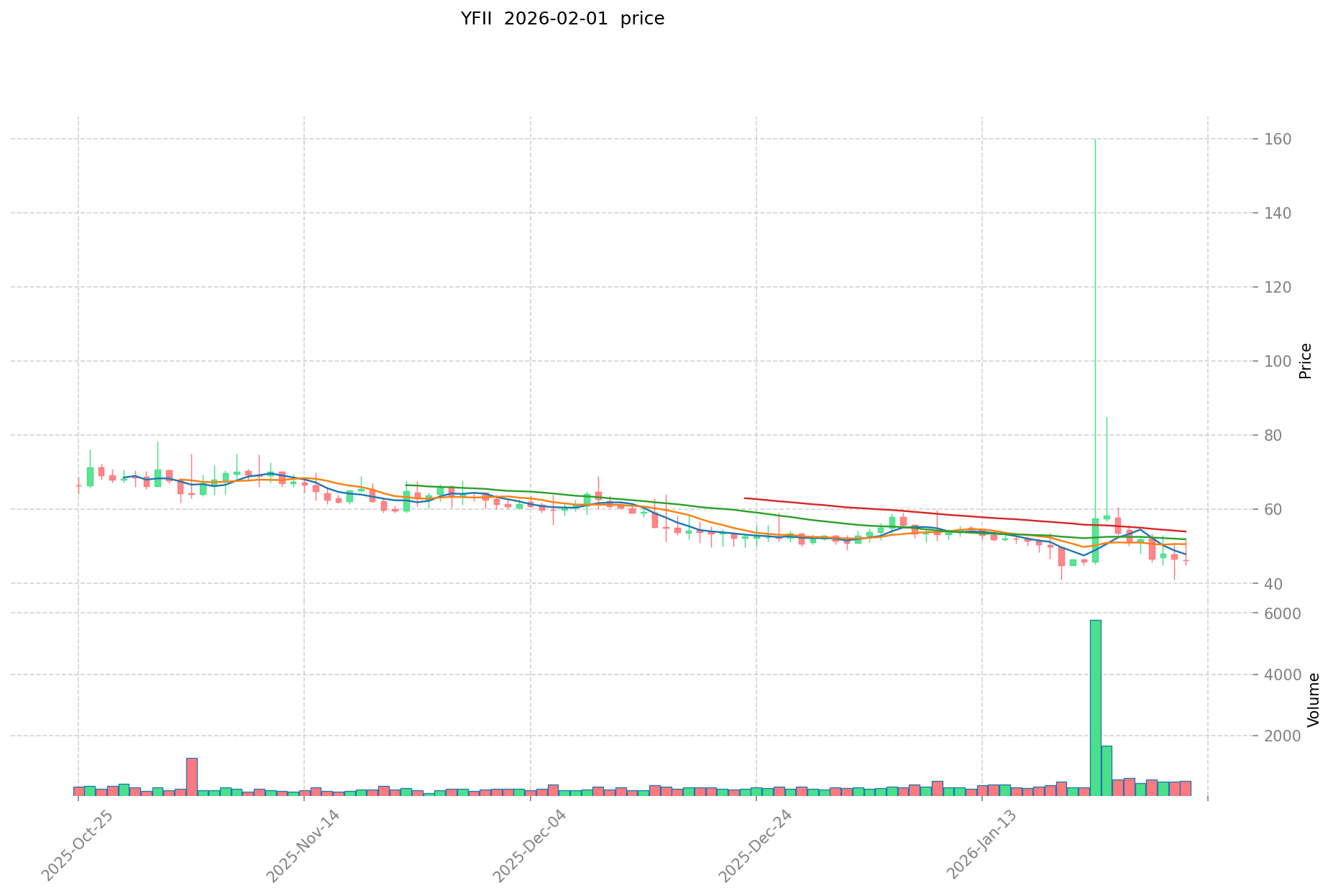
The token's price performance has shown significant volatility, with recent data indicating a 5.51% decline over 24 hours, a 19.1% decrease over seven days, and an 86.68% drop over the past year. YFII's all-time high of $9,251.7 was recorded on September 2, 2020, while its recent low of $43.79 occurred in January 2026. Currently, the token is traded on two exchanges and is held by approximately 14,375 addresses. Understanding these metrics is essential for evaluating YFII's current market position and potential investment implications.
I. YFII Price History Review and Current Investment Landscape
- 2020: YFII launched in July 2020 as a fork of YFI project, adopting a halving mechanism similar to Bitcoin to ensure fairer token distribution → During August 4-18, 2020, the Chinese blockchain community maintained the price at 120, achieving what was called the "120 defense victory," after which YFII's value gradually gained recognition in the community
- 2020: YFII reached a peak price level of 9,251.7 in September 2020 → The token experienced significant price appreciation during the early DeFi Summer period
- 2026: Market conditions evolved significantly → Price declined to 43.62 as of February 2, 2026
Current YFII Investment Market Status (February 2026)
- YFII current price: $43.62
- Market sentiment (Fear & Greed Index): Data indicates bearish market conditions
- 24-hour trading volume: $18,558.48
- Total market capitalization: $1,733,114.67
- Circulating supply: 39,732.11 YFII (99.33% of maximum supply of 40,000 tokens)
- Price changes: -0.82% (1H), -5.51% (24H), -19.1% (7D), -15.87% (30D), -86.68% (1Y)
- Token holder count: 14,375 addresses
Click to view real-time YFII market price
II. Core Factors Affecting Whether YFII is a Good Investment
Supply Mechanism and Scarcity (YFII Investment Scarcity)
- Halving issuance mechanism → Impacts price and investment value
- Historical pattern: YFII adopted a Bitcoin-like halving mechanism with total supply capped at 40,000 tokens, distributed across three pools with weekly halving over 10 weeks
- Investment significance: With circulating supply at 39,732.11 tokens (99.33% of maximum supply), near-complete distribution creates a scarcity-driven value proposition
Institutional Investment and Mainstream Adoption (Institutional Investment in YFII)
- Market positioning: YFII operates as a DeFi aggregator platform integrating Compound, dYdX, Aave, and DDEX protocols
- Community governance structure: The project originated from a community fork of YFI following the failed YIP-8 proposal, establishing decentralized control mechanisms
- Market presence: Currently listed on 2 exchanges with 14,375 token holders as of February 2026
Macroeconomic Environment's Impact on YFII Investment
- Market volatility: YFII experienced significant price fluctuations with 24-hour change of -5.51%, 7-day change of -19.1%, and 1-year change of -86.68%
- Current valuation context: Trading at $43.62 as of February 2, 2026, compared to historical price range between $43.79 and $9,251.7
- Market capitalization standing: Total market cap of approximately $1.74 million with 0.000064% market dominance
Technology and Ecosystem Development (Technology & Ecosystem for YFII Investment)
- Automated yield optimization: Platform automatically reallocates funds between protocols to maximize returns for depositors
- yToken mechanism: Users receive yToken as proof of deposit, enabling withdrawal of original tokens plus accumulated yield
- DeFi integration: Aggregates multiple lending protocols to provide optimized yield generation strategies for liquidity providers
III. YFII Future Investment Prediction and Price Outlook (Is 二姨夫(YFII) worth investing in 2026-2031)
Short-term Investment Prediction (2026, short-term YFII investment outlook)
- Conservative estimate: $22.68 - $43.62
- Neutral estimate: $43.62 - $46.24
- Optimistic estimate: $46.24 and above
Mid-term Investment Outlook (2027-2029, mid-term 二姨夫(YFII) investment forecast)
-
Market stage expectation: YFII is expected to experience gradual development with price fluctuations across multiple scenarios. The token's performance may reflect broader DeFi sector trends and project-specific developments.
-
Investment return prediction:
- 2027: $39.09 - $61.10
- 2028: $42.41 - $62.56
- 2029: $45.07 - $75.70
-
Key catalysts: Market adoption trends, DeFi sector performance, protocol developments, and overall crypto market conditions may influence price movements.
Long-term Investment Outlook (Is YFII a good long-term investment?)
- Base scenario: $54.06 - $85.43 (assuming steady protocol development and sustained DeFi ecosystem engagement through 2030-2031)
- Optimistic scenario: $66.74 - $82.18 (assuming favorable market conditions and increased protocol adoption)
- Risk scenario: Below $54.06 (under challenging market conditions or reduced ecosystem activity)
Click to view YFII long-term investment and price prediction: Price Prediction
2026-02-02 - 2031 Long-term Outlook
- Base scenario: $54.06 - $66.74 USD (corresponding to steady progress and stable mainstream application growth)
- Optimistic scenario: $76.09 - $85.43 USD (corresponding to large-scale adoption and favorable market environment)
- Transformative scenario: Above $85.43 USD (such as ecosystem breakthrough progress and mainstream popularization)
- 2031-12-31 predicted high point: $82.18 USD (based on optimistic development assumptions)
Disclaimer: Price predictions are based on historical data analysis and market trend projections. Cryptocurrency markets are highly volatile and unpredictable. The information provided is for reference purposes only and should not be considered as financial advice. Investors should conduct their own research and consider their risk tolerance before making any investment decisions.
| Year |
Predicted High Price |
Predicted Average Price |
Predicted Low Price |
Price Change |
| 2026 |
46.2372 |
43.62 |
22.6824 |
0 |
| 2027 |
61.102896 |
44.9286 |
39.087882 |
3 |
| 2028 |
62.55858264 |
53.015748 |
42.4125984 |
21 |
| 2029 |
75.7011865692 |
57.78716532 |
45.0739889496 |
32 |
| 2030 |
85.432545209088 |
66.7441759446 |
54.062782515126 |
53 |
| 2031 |
82.17542942299152 |
76.088360576844 |
60.10980485570676 |
74 |
IV. YFII Investment Strategy and Risk Management (How to invest in DeFi tokens)
Investment Methodology (YFII investment strategy)
Risk Management (Risk management for YFII investment)
-
Asset Allocation Ratio: Conservative / Aggressive / Professional investors
- Conservative investors: Allocate no more than 1-3% of total portfolio to YFII due to its high volatility and relatively small market capitalization ($1.73 million as of February 2, 2026).
- Aggressive investors: May allocate 5-10% for potential high returns, while accepting increased exposure to price fluctuations.
- Professional investors: Should conduct thorough due diligence on the project's governance, smart contract security, and competitive positioning within the DeFi yield aggregation sector.
-
Risk Hedging Solutions: Multi-asset portfolio + hedging tools
- Diversify across multiple DeFi tokens and traditional assets to reduce correlation risk.
- Consider using derivatives or stablecoins to hedge against downside risk during periods of heightened volatility.
- Monitor macroeconomic factors and DeFi sector trends that may impact YFII's performance.
-
Secure Storage: Hot/cold wallets + hardware wallet recommendations
- YFII is an ERC-20 token on the Ethereum blockchain (contract address: 0xa1d0E215a23d7030842FC67cE582a6aFa3CCaB83).
- For long-term storage, use hardware wallets such as Ledger or Trezor to minimize exposure to online threats.
- For active trading, maintain only necessary funds in exchange wallets, and enable two-factor authentication (2FA) and withdrawal whitelists.
- Regularly verify wallet addresses and contract details via Etherscan to avoid phishing attacks.
V. YFII Investment Risks and Challenges (Risks of investing in DeFi tokens)
-
Market Risk: High volatility and potential price manipulation
- YFII has experienced substantial price swings, with a decline of over 86% from its peak. Such volatility can lead to significant losses in short timeframes.
- The relatively low market capitalization and trading volume ($18,558.48 in 24 hours) may expose YFII to liquidity risks and susceptibility to large buy or sell orders.
- Market dominance is minimal (0.000064%), indicating limited influence within the broader cryptocurrency ecosystem.
-
Regulatory Risk: Policy uncertainty across jurisdictions
- DeFi projects, including YFII, operate in a regulatory gray area in many countries. Future regulatory actions could impact platform operations, token liquidity, or user access.
- Investors should stay informed about evolving regulations in their jurisdiction and assess compliance measures adopted by the YFII project.
-
Technical Risk: Network security vulnerabilities and upgrade failures
- As an ERC-20 token, YFII is subject to risks associated with the Ethereum network, including congestion, high gas fees, and potential vulnerabilities in smart contracts.
- The project originated as a fork of YFI due to governance disputes. Future governance decisions or technical upgrades could introduce unforeseen risks.
- Smart contract audits and community governance transparency are critical factors for assessing technical risk. Investors should review publicly available audit reports and monitor GitHub activity (https://github.com/yfii).
VI. Conclusion: Is DeFi tokens a Good Investment?
-
Investment Value Summary: YFII presents potential long-term value as part of the DeFi yield aggregation sector, but its price has exhibited extreme volatility. The project's halving mechanism and capped supply may appeal to investors seeking deflationary tokenomics. However, the token's performance has been weak over the past year, and market conditions remain uncertain.
-
Investor Recommendations:
- ✅ Beginners: Consider dollar-cost averaging (DCA) and secure wallet storage. Start with small allocations to manage risk while gaining exposure to the DeFi ecosystem.
- ✅ Experienced Investors: Utilize swing trading strategies combined with diversified portfolio allocation. Monitor technical indicators and DeFi market trends closely.
- ✅ Institutional Investors: Conduct comprehensive due diligence, including governance analysis, smart contract audits, and competitive landscape assessment. Strategic long-term allocation may be appropriate for portfolios with high-risk tolerance.
⚠️ Disclaimer: Cryptocurrency investment carries high risk. This content is for informational purposes only and does not constitute investment advice. Investors should conduct their own research and consult with financial professionals before making investment decisions.
VII. FAQ
Q1: Is DFI.Money (YFII) a good investment in 2026?
YFII presents a high-risk investment opportunity with uncertain returns. The token has declined 86.68% over the past year, trading at $43.62 as of February 2026 compared to its all-time high of $9,251.7 in September 2020. While the project features deflationary tokenomics with a capped supply of 40,000 tokens (99.33% already circulating), its small market capitalization of $1.73 million and low trading volume of $18,558.48 create significant liquidity risks. Conservative investors should allocate no more than 1-3% of their portfolio to YFII, while more aggressive investors may consider 5-10% allocations if they can tolerate extreme volatility.
Q2: What makes YFII different from other DeFi yield aggregators?
YFII originated as a community-driven fork of YFI following the failed YIP-8 proposal, implementing a Bitcoin-like halving mechanism for token distribution. The platform automatically aggregates yields from multiple protocols including Compound, dYdX, Aave, and DDEX, reallocating user deposits to maximize returns. Users receive yTokens as proof of deposit, which can be redeemed for their original assets plus accumulated yields. Unlike many DeFi projects with ongoing inflation, YFII's fixed maximum supply creates potential scarcity value. However, the project's relatively small ecosystem (14,375 token holders) and limited exchange listings (2 exchanges) may constrain its competitive position against larger yield aggregators.
Q3: What are the price predictions for YFII through 2031?
Short-term forecasts (2026) suggest a range of $22.68 to $46.24 depending on market conditions. Mid-term projections indicate potential growth to $39.09-$61.10 by 2027, $42.41-$62.56 by 2028, and $45.07-$75.70 by 2029. Long-term predictions through 2031 range from a base scenario of $54.06-$66.74 to an optimistic scenario reaching $82.18. These projections assume sustained DeFi ecosystem engagement and favorable market conditions. However, cryptocurrency markets are highly unpredictable, and YFII's recent 86.68% annual decline demonstrates the substantial downside risks. Investors should view these predictions as speculative scenarios rather than guaranteed outcomes.
Q4: What are the main risks of investing in YFII?
YFII faces multiple significant risks. Market risk includes extreme volatility, with recent declines of 19.1% over seven days and 86.68% annually, plus potential price manipulation due to low liquidity. Regulatory risk stems from uncertain DeFi regulations across jurisdictions that could impact platform operations. Technical risks include Ethereum network vulnerabilities, high gas fees, potential smart contract exploits, and governance uncertainties arising from the project's fork origin. The token's minimal market dominance (0.000064%) and small trading volume create concentration risks. Additionally, the project's GitHub activity and ongoing development momentum should be monitored, as reduced developer engagement could signal declining project viability.
Q5: How should investors store YFII tokens securely?
YFII is an ERC-20 token on Ethereum (contract address: 0xa1d0E215a23d7030842FC67cE582a6aFa3CCaB83), requiring appropriate storage solutions. For long-term holdings, hardware wallets like Ledger or Trezor provide maximum security against online threats. Active traders should maintain only necessary funds on exchange wallets, enabling two-factor authentication and withdrawal whitelists. Always verify wallet addresses and contract details via Etherscan to avoid phishing attacks. Never share private keys or seed phrases, and consider using multi-signature wallets for larger holdings. Regular security audits of your storage setup and staying informed about potential vulnerabilities in the Ethereum ecosystem are essential practices.
Q6: Is YFII suitable for beginners or experienced investors?
YFII is generally more appropriate for experienced investors who understand DeFi mechanics, can tolerate extreme volatility, and have diversified portfolios. Beginners interested in YFII exposure should start with dollar-cost averaging strategies, allocating only 1-3% of their portfolio, and prioritizing secure storage education. The token's 86.68% annual decline and complex yield aggregation mechanism require substantial research before investing. Experienced investors may employ swing trading strategies, monitor technical indicators, and leverage their understanding of DeFi market cycles. Institutional investors should conduct comprehensive due diligence including governance analysis, smart contract audits, and competitive positioning assessment before considering strategic allocations for high-risk portfolios.
Q7: How does YFII's halving mechanism affect its investment value?
YFII's Bitcoin-like halving mechanism distributed tokens across three pools over 10 weeks with weekly halvings, creating a deflationary supply model. With 39,732.11 tokens circulating (99.33% of the 40,000 maximum supply), near-complete distribution eliminates future inflationary pressure. This scarcity-driven approach theoretically supports long-term value appreciation, similar to Bitcoin's supply dynamics. However, scarcity alone does not guarantee price appreciation—demand must accompany limited supply. The project's small user base (14,375 holders), declining price trends, and limited mainstream adoption suggest that scarcity has not yet translated into sustained demand. Investors should evaluate whether the halving mechanism provides genuine value differentiation or primarily serves as a marketing narrative.
Q8: What role does community governance play in YFII's investment prospects?
YFII emerged from community disagreement with YFI's governance direction, establishing decentralized control as a core principle. This community-driven approach allows token holders to participate in protocol decisions, potentially aligning incentives between users and developers. However, governance disputes that led to YFII's creation also highlight coordination challenges in decentralized systems. The project's relatively small community (14,375 holders) may struggle to achieve consensus on critical decisions or compete with larger DeFi protocols for developer talent and resources. Investors should monitor governance activity, proposal implementation rates, and community engagement levels as indicators of project health. Active governance participation can signal community commitment, while declining engagement may foreshadow reduced development momentum and investment risk.
* The information is not intended to be and does not constitute financial advice or any other recommendation of any sort offered or endorsed by Gate.