Yield Guild Games (YGG) operates as a decentralized autonomous organization investing in blockchain gaming NFTs and virtual world assets, offering exposure to the gaming and metaverse economy. As of January 2026, YGG trades at $0.06431 with a $45.65 million market cap, representing a significant decline from its 2021 peak of $11.17, reflecting broader cryptocurrency market corrections and reduced play-to-earn enthusiasm. This comprehensive analysis examines YGG's historical price performance, current market position with 23,212 holders across 36 exchanges including Gate, and multiple investment scenarios predicting potential price ranges from $0.04 to $0.40 through 2031. Key investment considerations include supply mechanics (70.99% circulating), tokenomic utility through staking and governance, and substantial risks including market volatility, regulatory uncertainty, and technical vulnerabilities. Investors face multiple strategies from long-term holding for believers in gaming adoption to active trading le
Introduction: Yield Guild Games (YGG) Investment Position and Market Outlook
YGG is a notable asset in the cryptocurrency field. As a decentralized autonomous organization (DAO) focused on investing in NFTs from virtual worlds and blockchain games, it has established a presence in the gaming and metaverse sectors. As of January 19, 2026, YGG holds a market capitalization of approximately $45.65 million, with a circulating supply of about 709.92 million tokens, and the current price is around $0.06431. Ranked 554th in the market, YGG represents approximately 0.0019% of the total crypto market dominance. With its unique positioning combining NFT and DeFi characteristics in the gaming economy, YGG has become a subject of interest when investors discuss "Is Yield Guild Games (YGG) a good investment?" This article provides a comprehensive analysis of YGG's investment characteristics, historical performance, future price considerations, and associated risks to serve as a reference for investors.
I. Price History Review and Current Investment Value of YieldGuildGames (YGG)
- 2021: Token launch and initial market entry → YGG was issued at a price of $1.7333, attracting early investor attention in the blockchain gaming sector
- 2021 (November): Market peak during NFT and metaverse boom → YGG price reached $11.17, reflecting strong market enthusiasm for play-to-earn gaming models
- 2022-2024: Market correction and consolidation phase → Price experienced significant decline alongside broader crypto market downturn
- 2025 (December): Price reached lower levels → YGG traded at $0.056812, showing substantial volatility from previous peaks
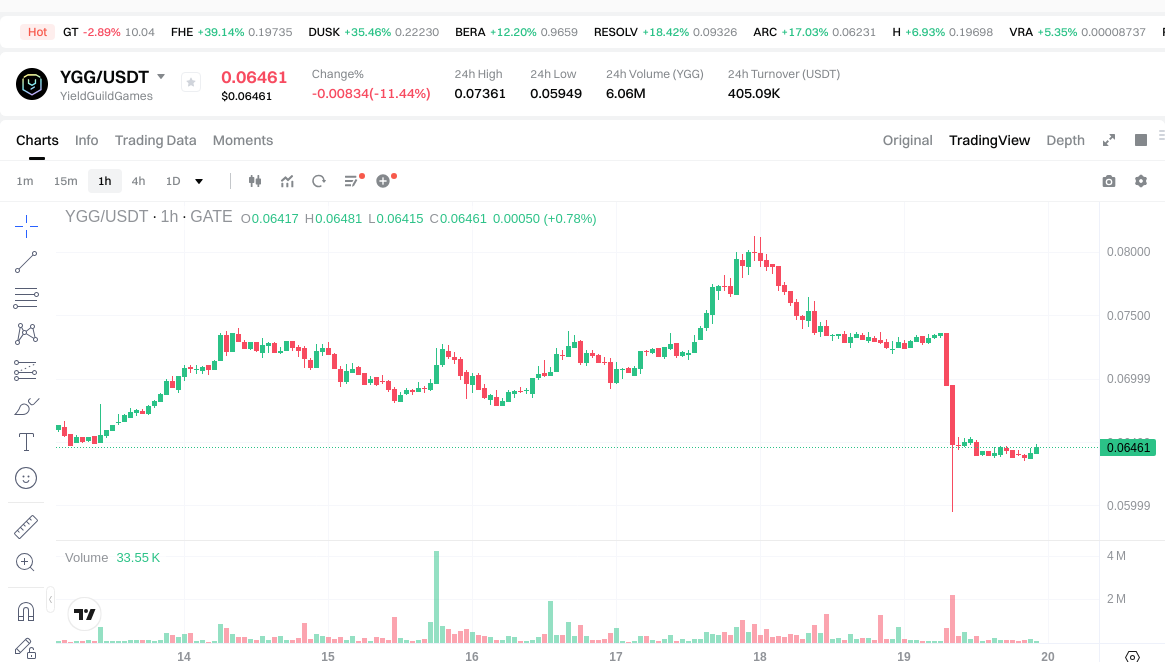
- 2026 (January): Current trading phase → Price stands at $0.06431, with 24-hour decline of 11.25%
Current YGG Investment Market Status (January 2026)
- Current YGG price: $0.06431
- 24-hour trading volume: $405,627.35
- Circulating supply: 709,919,946.66 YGG (70.99% of total supply)
- Total supply: 999,716,389.32 YGG, with maximum supply capped at 1,000,000,000 YGG
- Market capitalization: $45,654,951.77
- Fully diluted valuation: $64,291,760.99
- Price performance: 1-hour +0.26%, 7-day -0.32%, 30-day +0.97%, 1-year -85.1%
- Total holder addresses: 23,212
- Listed on 36 exchanges
Visit real-time YGG market price
II. Core Factors Influencing Whether YGG is a Good Investment
Supply Mechanism and Scarcity (YGG investment scarcity)
- Supply structure → The token features a maximum supply of 1,000,000,000 YGG, with approximately 709,919,946.66 tokens currently in circulation (around 70.99% of total supply). The circulating supply ratio suggests a relatively mature token distribution phase, which may influence price dynamics and investment considerations.
- Historical price movement → YGG has experienced notable price volatility, with its current price at $0.06431 showing a decline of 11.25% over the past 24 hours. The token's circulating market cap stands at approximately $45.65 million, reflecting current market valuation levels.
- Investment implications → The defined maximum supply ceiling establishes a framework for potential scarcity dynamics. The market cap to fully diluted valuation ratio of 70.99% indicates that a significant portion of tokens are already in circulation, which may affect future supply-side pressure considerations.
Institutional Investment and Mainstream Adoption (Institutional investment in YGG)
- Holder distribution → Available data indicates approximately 23,212 token holders, suggesting a distributed holder base across the network.
- Ecosystem development → YGG allocated 50 million tokens to an on-chain guild for yield farming and liquidity activities in August 2025, demonstrating active treasury management and ecosystem expansion efforts.
- Treasury operations → In August 2025, YGG executed a treasury buyback program funded by operational profits, representing an attempt to strengthen token economics through supply management mechanisms.
Macroeconomic Environment's Impact on YGG Investment
- Market sentiment indicators → The broader cryptocurrency market shows a Fear & Greed Index reading of 49 (Neutral), with Bitcoin dominance at 59.32% and 24-hour trading volume of $211.77 billion (down 36.22%), reflecting current market conditions that may influence altcoin performance including YGG.
- Performance metrics → YGG has shown mixed short-term performance with a 0.26% increase over 1 hour, but declined 11.25% over 24 hours and 0.32% over 7 days. The 1-year performance shows a decline of 85.1%, indicating significant price compression from previous levels.
- Technical indicators → The 14-day RSI stands at 45.57, while the Momentum (10) indicator shows a sell signal at -0.00, suggesting neutral to bearish short-term technical positioning.
Technology and Ecosystem Development (Technology & Ecosystem for YGG investment)
- Platform foundation → YGG operates as a decentralized autonomous organization (DAO) focused on investing in NFTs related to virtual worlds and blockchain gaming. The platform combines NFT and DeFi characteristics, integrating liquidity mining models into gaming economies.
- Token utility framework → YGG tokens serve multiple functions within the ecosystem, including staking for activity-related rewards, voting and DAO governance participation, accessing exclusive content, ordering merchandise, and paying for network services.
- Ecosystem pool initiative → The $7.5 million ecosystem pool launched on August 4, 2025, allocated 50 million tokens to support active yield farming and liquidity provision, representing infrastructure development aimed at expanding platform utility.
- Gaming and metaverse positioning → YGG focuses on developing value through game players, artists, and creators within virtual world and blockchain gaming environments, positioning itself within the gaming and metaverse sectors of the digital asset space.
III. YGG Future Investment Prediction and Price Outlook (Is YieldGuildGames(YGG) worth investing in 2026-2031)
Short-term Investment Prediction (2026, short-term YGG investment outlook)
Based on available market analysis, YGG demonstrates varied price projections for 2026. Conservative estimates suggest a range of $0.04 to $0.06, reflecting cautious market sentiment amid ongoing blockchain gaming sector consolidation. Neutral forecasts indicate potential movement between $0.06 and $0.10, supported by stable Web3 gaming community engagement. Optimistic scenarios project prices reaching $0.34, contingent upon expanded guild partnerships and increased NFT gaming adoption.
Technical indicators show the 200-day moving average in a downward trend since early January 2026, suggesting near-term resistance levels. The 50-day moving average positioning indicates potential consolidation phases during 2026.
Mid-term Investment Outlook (2027-2028, mid-term YieldGuildGames(YGG) investment forecast)
-
Market Stage Expectation: The mid-term period may witness gradual stabilization as the Web3 gaming sector matures. Guild-based gaming models could experience refinement phases, with community-driven growth potentially offsetting broader market volatility.
-
Investment Return Prediction:
- 2027: $0.04 to $0.37, with average projections around $0.07. The range reflects uncertainty regarding regulatory developments and blockchain gaming adoption rates.
- 2028: $0.05 to $0.38, showing modest potential appreciation compared to 2027 baseline figures.
-
Key Catalysts: Partnership expansions with major gaming platforms, enhanced guild utility mechanisms, regulatory clarity in digital asset classifications, and broader NFT market recovery could serve as significant price drivers during this period.
Long-term Investment Outlook (Is YGG a good long-term investment?)
-
Baseline Scenario: $0.07 to $0.13 (assuming steady Web3 gaming adoption and maintained community engagement through 2031)
-
Optimistic Scenario: $0.38 to $0.40 (contingent upon substantial guild network expansion, major platform integrations, and favorable cryptocurrency market conditions)
-
Risk Scenario: Below $0.04 (under circumstances of prolonged market downturns, regulatory constraints on blockchain gaming, or decreased guild participation rates)
For detailed YGG long-term investment and price predictions: Price Prediction
2026-2031 Long-term Outlook
-
Base Scenario: $0.06 - $0.13 (corresponding to steady progress and gradual mainstream application improvement)
-
Optimistic Scenario: $0.34 - $0.40 (corresponding to large-scale adoption and favorable market environment)
-
Transformative Scenario: Above $3.40 (contingent upon breakthrough ecosystem developments and mainstream popularization)
-
December 31, 2031 Predicted High: $0.13 (based on optimistic development assumptions)
Disclaimer: Price predictions involve substantial uncertainty and should not constitute financial advice. Cryptocurrency investments carry inherent risks including price volatility, regulatory changes, and market sentiment fluctuations. Historical performance does not guarantee future results. Investors should conduct independent research and consider risk tolerance before making investment decisions.
| Year |
Predicted High Price |
Predicted Average Price |
Predicted Low Price |
Price Change |
| 2026 |
0.0807625 |
0.06461 |
0.0620256 |
0 |
| 2027 |
0.07850115 |
0.07268625 |
0.0443386125 |
13 |
| 2028 |
0.08315307 |
0.0755937 |
0.048379968 |
17 |
| 2029 |
0.10080419895 |
0.079373385 |
0.0682611111 |
23 |
| 2030 |
0.129727860444 |
0.090088791975 |
0.079278136938 |
40 |
| 2031 |
0.12309732535464 |
0.1099083262095 |
0.10551199316112 |
70 |
IV. YGG Investment Strategy and Risk Management (How to invest in YGG)
Investment Methodology (YGG investment strategy)
Long-term Holding (HODL YGG): Suitable for Conservative Investors
For investors seeking exposure to the blockchain gaming and metaverse sector, long-term holding of YGG tokens may align with a belief in the growth potential of play-to-earn economies and NFT-based virtual worlds. This approach typically involves purchasing YGG tokens and holding them through market cycles, focusing on the project's fundamental development rather than short-term price movements.
Given YGG's position as a decentralized autonomous organization investing in virtual world and blockchain game-based NFTs, long-term holders would be betting on the expansion of the guild model and broader adoption of blockchain gaming. The token's utility includes staking for rewards, governance participation, and access to exclusive content, which may provide additional value beyond price appreciation.
Active Trading: Technical Analysis and Swing Trading
Active traders may approach YGG through technical analysis, monitoring price action, volume patterns, and market sentiment. With a 24-hour trading volume of approximately $405,627 and notable price volatility (24-hour range between $0.05949 and $0.07361), YGG presents opportunities for swing trading strategies.
Traders should note that YGG has experienced significant price movements historically, with performance metrics showing -11.25% over 24 hours, -0.32% over 7 days, and +0.97% over 30 days as of the reference date. The token's historical volatility, including an 85.1% decline over one year from previous levels, indicates substantial price swings that active traders may seek to capitalize on.
Risk Management (Risk management for YGG investment)
Asset Allocation Ratios: Conservative / Aggressive / Professional Investors
-
Conservative Investors: May consider allocating 1-3% of their cryptocurrency portfolio to YGG, treating it as a speculative position within a broader diversified portfolio that includes more established digital assets.
-
Aggressive Investors: Could allocate 5-10% to YGG as part of a gaming and metaverse-focused strategy, accepting higher volatility in exchange for potential upside from sector growth.
-
Professional Investors: Might implement dynamic allocation strategies, adjusting YGG exposure based on market conditions, technical indicators, and fundamental developments in the blockchain gaming ecosystem.
Investors can implement several risk management approaches:
-
Portfolio Diversification: Combining YGG with other blockchain gaming tokens, established cryptocurrencies, and traditional assets to reduce concentration risk.
-
Position Sizing: Using predetermined position sizes based on risk tolerance and portfolio volatility targets.
-
Stop-Loss Mechanisms: Setting predetermined exit points to limit potential losses during adverse market movements.
-
Correlation Analysis: Understanding YGG's correlation with broader cryptocurrency markets and gaming sector tokens to optimize portfolio construction.
Secure Storage: Hot and Cold Wallets + Hardware Wallet Recommendations
YGG is an ERC-20 token on the Ethereum blockchain (contract address: 0x25f8087EAD173b73D6e8B84329989A8eEA16CF73), requiring appropriate Ethereum-compatible storage solutions:
-
Cold Wallets: Hardware wallets such as Ledger and Trezor provide offline storage for long-term holdings, protecting assets from online threats.
-
Hot Wallets: Software wallets like MetaMask or Trust Wallet offer convenience for active trading and staking activities, though they carry higher security risks.
-
Best Practices: Investors should never store recovery phrases digitally, enable two-factor authentication where available, and consider multi-signature wallets for larger holdings.
V. YGG Investment Risks and Challenges (Risks of investing in YGG)
Market Risks: High Volatility and Price Manipulation
YGG exhibits considerable price volatility characteristic of smaller-cap cryptocurrency projects. With a market capitalization of approximately $45.65 million and relatively limited trading volume, the token is susceptible to significant price swings. The historical data shows YGG reached a peak of $11.17 in November 2021 but declined to $0.056812 in December 2025, demonstrating the potential for substantial drawdowns.
The token's relatively lower liquidity compared to major cryptocurrencies may result in wider bid-ask spreads and increased susceptibility to large trades impacting price. With only 36 exchanges listing YGG and approximately 23,212 holders, the market depth may be limited during periods of high volatility.
Regulatory Risks: Policy Uncertainty Across Different Countries
As a token associated with blockchain gaming, NFTs, and decentralized autonomous organizations, YGG faces evolving regulatory landscapes across multiple jurisdictions. Key regulatory considerations include:
-
Securities Classification: Regulatory authorities in various countries may classify YGG differently, potentially affecting its legal status and trading availability.
-
Gaming and Gambling Regulations: The play-to-earn model may face scrutiny under gaming or gambling regulations in certain jurisdictions.
-
NFT Regulatory Framework: As YGG invests in and operates with NFTs, evolving regulations around digital collectibles and virtual assets may impact the project's operations.
-
DAO Legal Status: The legal recognition and treatment of decentralized autonomous organizations remains uncertain in many jurisdictions, potentially affecting governance and operational aspects.
Technical Risks: Network Security Vulnerabilities and Upgrade Failures
Several technical considerations present risks to YGG investors:
-
Smart Contract Risks: As an ERC-20 token, YGG relies on smart contract code that could contain vulnerabilities or bugs, potentially leading to security breaches or operational issues.
-
Ethereum Network Dependencies: YGG's functionality depends on the Ethereum network's performance, including transaction fees, network congestion, and potential technical issues.
-
Platform Integration Risks: YGG's value proposition depends on successful integration with various blockchain games and virtual worlds, where technical compatibility issues or platform failures could impact utility.
-
Governance Risks: As a DAO, decision-making processes depend on token holder participation and consensus, which may lead to delayed responses to urgent issues or contentious upgrades.
VI. Conclusion: Is YGG a Good Investment?
Investment Value Summary
YGG represents exposure to the blockchain gaming and metaverse sector through a guild-based investment model. With a circulating supply of approximately 709.92 million tokens (70.99% of maximum supply) and a fully diluted market cap of approximately $64.29 million, the project occupies a niche position within the cryptocurrency ecosystem.
The token's utility encompasses staking rewards, governance participation, and access to exclusive content, providing multiple value accrual mechanisms beyond simple price appreciation. However, significant price volatility and the token's performance relative to its historical peak indicate substantial risks alongside potential opportunities.
Investor Recommendations
✅ Beginners: Dollar-Cost Averaging + Secure Wallet Storage
New investors considering YGG should:
- Implement dollar-cost averaging strategies to mitigate timing risk
- Allocate only capital they can afford to lose completely
- Prioritize secure storage using hardware wallets
- Research the blockchain gaming sector thoroughly before investing
- Start with small positions to gain familiarity with the asset's behavior
✅ Experienced Investors: Swing Trading + Portfolio Allocation
Investors with cryptocurrency experience might:
- Employ technical analysis for entry and exit timing
- Consider YGG as part of a diversified gaming sector allocation
- Monitor developments in blockchain gaming and metaverse trends
- Use risk management tools including stop-losses and position sizing
- Evaluate correlation with broader market movements
✅ Institutional Investors: Strategic Long-term Allocation
Institutional participants may:
- Conduct thorough due diligence on the project's fundamentals and team
- Consider YGG as part of a thematic allocation to gaming and metaverse exposure
- Implement structured risk management frameworks
- Monitor regulatory developments affecting the gaming token sector
- Evaluate liquidity constraints for larger position sizes
⚠️ Disclaimer
Cryptocurrency investments carry substantial risks, including the potential for complete loss of capital. YGG's price volatility, regulatory uncertainties, and technical risks require careful consideration. This content is provided for informational purposes only and does not constitute investment, financial, or legal advice. Prospective investors should conduct their own research and consult with qualified professionals before making investment decisions.
VII. FAQ
Q1: What is Yield Guild Games (YGG) and how does it generate value?
YGG is a decentralized autonomous organization (DAO) that invests in NFTs related to virtual worlds and blockchain gaming, functioning as a gaming guild that combines NFT and DeFi characteristics. The platform generates value through multiple mechanisms: investing in play-to-earn game assets, managing a portfolio of virtual world properties, enabling guild members to access gaming opportunities through NFT scholarships, and providing liquidity mining opportunities within gaming economies. The YGG token serves as both a governance instrument for the DAO and a utility token for staking, accessing exclusive content, and participating in the platform's economic activities. With approximately 23,212 token holders and a market capitalization of $45.65 million as of January 2026, YGG represents exposure to the blockchain gaming sector through a community-driven investment model.
Q2: Why has YGG's price declined significantly from its all-time high?
YGG has experienced a substantial decline from its November 2021 peak of $11.17 to its current price of $0.06431, representing approximately a 99.4% drawdown. This decline reflects several converging factors: the broader cryptocurrency market correction that began in late 2021, reduced enthusiasm for NFT and metaverse projects following the initial hype cycle, decreased participation in play-to-earn gaming models as token rewards diminished, and overall risk-off sentiment affecting smaller-cap altcoins. The 85.1% decline over the past year specifically indicates continued pressure from reduced trading activity (24-hour volume of approximately $405,627), limited exchange listings (36 exchanges), and challenges in the blockchain gaming sector adapting to sustainable economic models beyond initial speculative interest.
Q3: What are the primary risks of investing in YGG?
Investing in YGG carries several significant risks that potential investors should understand. Market volatility risk is substantial, with the token demonstrating price swings of -11.25% in 24 hours and limited liquidity that can amplify price movements. Regulatory uncertainty poses ongoing challenges, as blockchain gaming tokens face evolving legal frameworks regarding securities classification, gaming regulations, and DAO legal status across different jurisdictions. Technical risks include smart contract vulnerabilities on the Ethereum network, dependency on external gaming platforms for utility, and governance challenges inherent in DAO structures. Additionally, sector-specific risks exist, including declining interest in play-to-earn models, competition from newer gaming tokens, and the potential for virtual world platforms that YGG invests in to lose relevance or shut down operations.
Q4: How should different investor types approach YGG allocation?
Investment approaches to YGG should vary based on investor experience and risk tolerance. Conservative investors should consider limiting YGG exposure to 1-3% of their cryptocurrency portfolio, treating it as a speculative position within a diversified strategy, and using dollar-cost averaging to reduce timing risk. Aggressive investors might allocate 5-10% as part of a gaming and metaverse-focused strategy, accepting higher volatility while implementing technical analysis for entry and exit timing. Professional investors could employ dynamic allocation strategies, adjusting exposure based on market conditions, using correlation analysis with broader gaming sector tokens, and implementing structured risk management frameworks including stop-losses and position sizing protocols. Regardless of approach, all investors should prioritize secure storage using hardware wallets and never allocate capital they cannot afford to lose completely.
Q5: What factors could drive YGG's price appreciation in the future?
Several potential catalysts could positively impact YGG's valuation trajectory. Ecosystem expansion through partnerships with major gaming platforms would increase token utility and demand. The successful implementation of the $7.5 million ecosystem pool (50 million tokens allocated in August 2025) could enhance liquidity and attract active participants. Broader adoption of blockchain gaming and metaverse applications beyond current levels would benefit YGG's fundamental value proposition. Technical developments such as successful treasury buyback programs funded by operational profits could reduce circulating supply pressure. Additionally, favorable regulatory clarity for blockchain gaming tokens, recovery in NFT market sentiment, and increased institutional interest in gaming sector exposure could serve as positive price drivers. However, these scenarios remain speculative and contingent upon numerous external factors beyond the project's direct control.
Q6: How does YGG's tokenomics structure affect its investment potential?
YGG's tokenomics feature a maximum supply cap of 1,000,000,000 tokens, with approximately 709,919,946.66 tokens currently in circulation (70.99% of total supply). This relatively high circulation ratio indicates a mature distribution phase with limited remaining supply overhang compared to projects with lower circulation percentages. The defined maximum supply creates a scarcity framework, though with 29.01% of tokens still to enter circulation, future supply pressure remains a consideration. The token serves multiple utility functions including staking for activity-related rewards, DAO governance voting, accessing exclusive content, and paying for network services, which creates demand mechanisms beyond speculative trading. The project's treasury management activities, including the August 2025 buyback program funded by operational profits, demonstrate active supply management efforts. However, the current fully diluted valuation of $64.29 million versus circulating market cap of $45.65 million suggests moderate dilution risk as remaining tokens enter circulation.
Q7: What technical indicators suggest about YGG's current investment positioning?
Technical analysis of YGG reveals mixed signals for potential investors. The 14-day RSI stands at 45.57, indicating neither overbought nor oversold conditions, suggesting neutral momentum in the medium term. The Momentum (10) indicator shows a sell signal at -0.00, reflecting short-term bearish pressure. The 200-day moving average has been trending downward since early January 2026, indicating longer-term resistance levels and potential overhead supply. Short-term performance metrics show +0.26% over 1 hour but -11.25% over 24 hours and -0.32% over 7 days, demonstrating recent volatility and downward pressure. The 30-day performance of +0.97% suggests some stabilization at current price levels. The broader cryptocurrency market Fear & Greed Index reading of 49 (Neutral) and Bitcoin dominance at 59.32% indicate that general market sentiment is neither particularly bullish nor bearish, which may limit significant directional movement for altcoins like YGG without project-specific catalysts.
Q8: Is YGG suitable for long-term holding compared to short-term trading?
The suitability of YGG for long-term holding versus short-term trading depends on individual investment objectives and risk tolerance. Long-term holding strategies suit investors who believe in the fundamental growth potential of blockchain gaming and the guild model, are willing to endure significant volatility (as evidenced by the 85.1% decline over one year), and can allocate capital they won't need to access during market downturns. This approach benefits from potential ecosystem development, partnership expansion, and broader Web3 gaming adoption over time, with price predictions suggesting possible ranges of $0.07-$0.13 by 2031 in baseline scenarios. Short-term trading strategies may be appropriate for experienced traders who can capitalize on YGG's notable price volatility (24-hour ranges between $0.05949 and $0.07361) and relatively lower liquidity that creates swing trading opportunities. However, the limited trading volume ($405,627 over 24 hours) may result in slippage for larger positions, and technical indicators showing mixed signals require careful analysis. Both approaches require robust risk management, secure storage solutions, and awareness that historical performance does not guarantee future results.
* The information is not intended to be and does not constitute financial advice or any other recommendation of any sort offered or endorsed by Gate.