Zebec Protocol (ZBCN) is a decentralized payment streaming infrastructure built on Solana, enabling real-time value transfers for payroll, subscriptions, and treasury management. This comprehensive analysis examines ZBCN's investment fundamentals, revealing a token with 225.09% annual growth, ranked 201st by market capitalization at $273.77 million, and trading on 20 exchanges including Gate. The article evaluates core investment factors including token supply mechanics (96.91% circulation), institutional partnerships with Ondo Finance and Nacha, and technological capabilities supporting enterprise adoption. Price forecasts span conservative ($0.00199-$0.00235), neutral ($0.00284-$0.00321), and optimistic ($0.00358-$0.00409) 2026 scenarios, with long-term projections to 2031 ranging from $0.00343-$0.00708. Critical investment considerations include price volatility risks, regulatory uncertainties surrounding decentralized payments, and Solana network dependencies, balanced against growing institutional adopti
Introduction: Zebec Protocol (ZBCN) Investment Position and Market Prospects
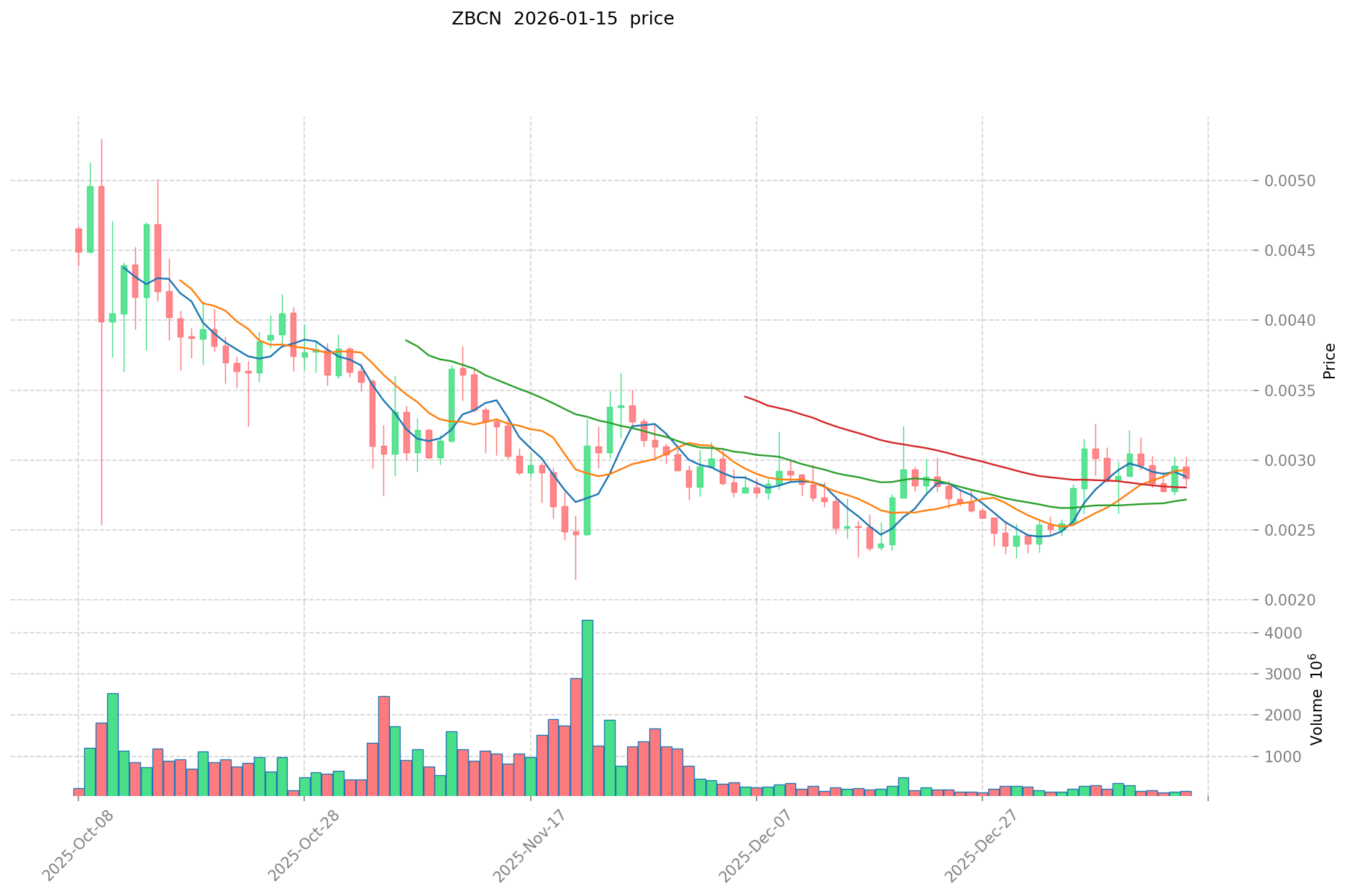
ZBCN is a notable asset in the cryptocurrency sector, having been launched in April 2024 with a focus on decentralized financial infrastructure. The project aims to enable seamless and immediate value transfer for individuals, businesses, investors, and teams through its decentralized infrastructure network. As of January 15, 2026, ZBCN holds a market capitalization of approximately $273.77 million, with a circulating supply of around 96.91 billion tokens, and the current price stands at approximately $0.002825. With its positioning in the decentralized payments and financial control space, ZBCN has gradually become a focal point for investors discussing "Is Zebec Protocol (ZBCN) a good investment?" This article comprehensively analyzes ZBCN's investment value, historical trends, future price predictions, and investment risks to provide reference for investors.
Currently ranked 201st by market capitalization, ZBCN demonstrates notable price dynamics with a 5.02% increase over the past 7 days and a 13.88% gain over the past 30 days. The token's annual performance shows substantial growth of 225.09% since launch. With a circulating supply ratio of approximately 96.91% of the maximum supply of 100 billion tokens, ZBCN maintains relatively high liquidity in the market. The token is traded on 20 exchanges and has attracted a holder base of over 91,000 addresses, indicating growing community engagement.
The project's infrastructure operates with a contract address on the Solana blockchain, positioning it within the high-performance blockchain ecosystem. ZBCN's market share stands at 0.0082% of the total cryptocurrency market, with a fully diluted valuation closely aligned with its current market cap at 96.91% ratio. Historical price data shows the token reached a notable price level of $0.007193 on May 30, 2025, while experiencing a lower price point of $0.000686 on August 5, 2024, reflecting the volatility characteristic of emerging crypto assets.
I. Zebec Protocol (ZBCN) Price History Review and Investment Value Status
- April 2024: Token launched on major exchanges at $0.001 → Early participants observed price appreciation in subsequent months
- May 2025: ZBCN reached $0.007193 during market expansion phase → Price level represented notable growth from initial listing
- August 2024: Market correction period → Price adjusted to $0.000686 during broader crypto market volatility
- January 2026: One-year performance showed 225.09% change → Price recovered to $0.002825 range with improved trading activity
Current ZBCN Investment Market Status (January 2026)
- ZBCN current price: $0.002825
- 24-hour trading volume: $402,404.61
- Circulating supply: 96.91 billion ZBCN (96.91% of max supply)
- Market capitalization: $273.77 million
- Holder count: 91,194 addresses
- Exchange availability: Listed on 20 trading platforms
Visit the real-time ZBCN market price page for updated data.
II. Core Factors Influencing Whether ZBCN is a Good Investment
Supply Mechanism and Scarcity (ZBCN Investment Scarcity)
- Fixed maximum supply of 100 billion ZBCN tokens establishes a defined scarcity framework
- Current circulating supply stands at approximately 96.91 billion tokens (96.91% of maximum supply), with limited remaining token issuance
- Token distribution dynamics: circulating supply approaching maximum supply may reduce future dilution concerns for investors
- Investment significance: the near-complete circulation of ZBCN's total supply creates a transparent supply environment, though scarcity impact may be limited given the large absolute token quantity
Institutional Investment and Mainstream Adoption (Institutional Investment in ZBCN)
- Institutional partnerships: Zebec Network has established collaborations with Ondo Finance for real-world asset (RWA) payments and secured custody services through Uphold
- Enterprise adoption trajectory: the protocol focuses on compliance-ready tokenized payroll and treasury services, with integrations across wallet platforms, payroll systems, and DAO tooling suites
- Technology adoption indicators: the project acquired Science Card for educational technology use cases and integrated with XDB CHAIN, while maintaining active participation in Solana hackathons and Web3 events
- Ecosystem positioning: as of available data, ZBCN maintains approximately 91,194 holders and listings on 20 exchanges, reflecting measurable network distribution
Macroeconomic Environment's Impact on ZBCN Investment
- Market positioning within broader crypto ecosystem: ZBCN ranked 201st by market capitalization as of January 15, 2026, with a market cap of approximately $273.77 million
- Performance context: the token demonstrated year-over-year growth trends, though investment value remains subject to overall cryptocurrency market cycles and regulatory developments
- Value proposition alignment: Zebec's focus on real-time payment infrastructure positions it within the evolving digital financial services sector, with exposure to institutional blockchain adoption trends
Technology and Ecosystem Development (Technology & Ecosystem for ZBCN Investment)
- Core technology infrastructure: Zebec Network operates as a decentralized infrastructure built on Solana, enabling programmable continuous cash flows for payroll, subscriptions, and treasury streaming
- Technical capabilities: the platform facilitates real-time value transfers using both cryptocurrency and fiat-backed stablecoins, addressing enterprise payment use cases
- Ecosystem applications: primary focus areas include Decentralized Physical Infrastructure Networks (DePIN), real-world payment applications such as the Zebec Card, and enterprise solutions for payroll and treasury management
- Utility framework: ZBCN token serves as the operational asset within the network, designed to support transaction processing and platform functionality rather than speculative positioning
- Development trajectory: the project's participation in Solana ecosystem events and strategic acquisitions suggest ongoing technical and business development efforts
III. ZBCN Future Investment Forecast and Price Outlook (Is Zebec Protocol(ZBCN) worth investing in 2026-2031)
Short-term Investment Outlook (2026, short-term ZBCN investment outlook)
Based on current market data and technical analysis, ZBCN presents varied scenarios for 2026. As of January 15, 2026, the token trades at $0.002825, showing recent volatility with a 24-hour decline of 2.26% alongside a 7-day gain of 5.02%.
- Conservative forecast: $0.00199 - $0.00235
- Neutral forecast: $0.00284 - $0.00321
- Optimistic forecast: $0.00358 - $0.00409
The conservative range reflects potential market corrections following recent price movements. Market participants should note that RSI indicators have shown overbought conditions in recent periods, suggesting possible consolidation phases. The neutral scenario assumes steady adoption of Zebec's payment infrastructure, while the optimistic projection factors in successful implementation of recent partnerships and ISO 20022 integration.
Mid-term Investment Outlook (2027-2028, mid-term Zebec Protocol(ZBCN) investment forecast)
The mid-term outlook for ZBCN reflects both opportunities and uncertainties in the broader cryptocurrency payment sector.
- Market phase expectation: Consolidation and ecosystem expansion phase, characterized by integration of traditional finance partnerships and potential regulatory developments
- Investment return forecast:
- 2027: $0.00292 - $0.00437 (representing potential growth of 14% from 2026 baseline)
- 2028: $0.00311 - $0.00489 (indicating cumulative growth of approximately 34% from 2026)
- Key catalysts: Partnership expansion with traditional payment networks such as Nacha, broader implementation of ISO 20022 standards in payment systems, development progress in Southeast Asian markets through collaborations, and overall cryptocurrency market sentiment
Analysts suggest mixed perspectives for this period, with some forecasting ranges between $0.00230 and $0.00390, while others project potential ranges of $0.00286 to $0.00419, depending on market adoption rates and regulatory environments.
Long-term Investment Outlook (Is ZBCN a good long-term investment?)
Long-term projections for ZBCN through 2031 present multiple scenarios based on varying adoption trajectories and market conditions.
- Base scenario: $0.00343 - $0.00527 (assuming steady ecosystem development and gradual mainstream adoption of decentralized payment infrastructure)
- Optimistic scenario: $0.00494 - $0.00708 (contingent upon accelerated adoption, successful scaling of partnerships, and favorable regulatory developments)
- Risk scenario: $0.00214 - $0.00275 (under conditions of heightened market volatility, regulatory challenges, or technical setbacks)
Click to view ZBCN long-term investment and price forecast: Price Prediction
2026-2031 Long-term Outlook
- Base scenario: $0.00343 - $0.00527 (corresponding to steady progress and gradual mainstream application adoption)
- Optimistic scenario: $0.00494 - $0.00708 (corresponding to large-scale adoption and favorable market conditions)
- Transformative scenario: Above $0.00708 (in cases of breakthrough ecosystem developments and mainstream penetration)
- December 31, 2031 forecast high: $0.00708 (based on optimistic development assumptions)
Disclaimer: Price forecasts are inherently speculative and subject to significant uncertainty. Cryptocurrency markets exhibit high volatility influenced by numerous factors including regulatory changes, technological developments, market sentiment, and macroeconomic conditions. Historical performance does not guarantee future results. These projections should not be construed as financial advice. Investors should conduct independent research, assess their risk tolerance, and consider consulting financial advisors before making investment decisions. The actual price trajectory may differ substantially from forecasted ranges.
| Year |
Predicted High Price |
Predicted Average Price |
Predicted Low Price |
Price Change |
| 2026 |
0.00358218 |
0.002843 |
0.0019901 |
0 |
| 2027 |
0.0043691224 |
0.00321259 |
0.0029234569 |
14 |
| 2028 |
0.004890204498 |
0.0037908562 |
0.003108502084 |
34 |
| 2029 |
0.00620695839907 |
0.004340530349 |
0.00234388638846 |
54 |
| 2030 |
0.005695643923957 |
0.005273744374035 |
0.003427933843122 |
87 |
| 2031 |
0.007075255452205 |
0.005484694148996 |
0.004936224734096 |
94 |
IV. Zebec Protocol Investment Strategy and Risk Management (How to invest in Zebec Protocol)
Investment Methodology (Zebec Protocol investment strategy)
Investors considering ZBCN may adopt different approaches based on their risk tolerance and investment objectives:
-
Long-term Holding (HODL ZBCN): Suitable for conservative investors who believe in the protocol's decentralized infrastructure vision. Given ZBCN's performance of 225.09% over the past year, long-term holders may benefit from the protocol's adoption trajectory while weathering short-term volatility.
-
Active Trading: Traders may leverage technical analysis and swing trading strategies, particularly given ZBCN's 24-hour price range between $0.002792 and $0.003022. The token's circulating supply of 96.91 billion (96.91% of max supply) and daily trading volume of approximately $402,405 provide liquidity for active trading strategies.
Risk Management (Risk management for Zebec Protocol investment)
V. Zebec Protocol Investment Risks and Challenges (Risks of investing in Zebec Protocol)
-
Market Risks: ZBCN exhibits notable price volatility, with a 24-hour change of -2.26% and 30-day fluctuation of 13.88%. The token has experienced price movements between a low of $0.000686 and a high of $0.007193 in its trading history. Market manipulation risks exist, particularly for tokens outside the top 100 by market capitalization.
-
Regulatory Risks: Decentralized payment protocols face evolving regulatory frameworks across jurisdictions. Policy uncertainties regarding payment streaming infrastructure and decentralized finance applications may impact ZBCN's utility and adoption.
-
Technical Risks:
- Network security vulnerabilities in the underlying Solana infrastructure
- Smart contract risks associated with the protocol's payment streaming mechanisms
- Upgrade implementation challenges that could affect protocol functionality
- Dependency on Solana network performance and stability
VI. Conclusion: Is Zebec Protocol a Good Investment?
Investment Value Summary: ZBCN presents potential opportunities within the decentralized payment streaming sector, with year-over-year growth of 225.09% indicating market interest. However, the token experiences substantial short-term price fluctuations, as evidenced by recent 24-hour volatility. The protocol's focus on real-world value transfer and financial accessibility positions it within an evolving infrastructure category.
Investor Recommendations:
✅ Beginners: Implement dollar-cost averaging (DCA) strategies with secure wallet storage. Start with small allocations to understand price dynamics before increasing exposure.
✅ Experienced Investors: Consider swing trading opportunities leveraging technical indicators, while maintaining diversified portfolio allocation across multiple crypto assets.
✅ Institutional Investors: Evaluate strategic long-term positioning based on comprehensive analysis of protocol adoption metrics, holder growth (currently 91,194 holders), and decentralized payment streaming market development.
⚠️ Disclaimer: Cryptocurrency investments carry substantial risks. This analysis serves informational purposes only and does not constitute investment advice. Conduct thorough independent research and consider your financial situation before making investment decisions.
VII. FAQ
Q1: What makes Zebec Protocol (ZBCN) different from other payment cryptocurrencies?
ZBCN operates as a decentralized payment streaming protocol built on Solana, enabling continuous real-time value transfers rather than batch transactions. Unlike traditional payment cryptocurrencies that process discrete transactions, Zebec's infrastructure allows programmable cash flows for payroll, subscriptions, and treasury management. The protocol supports both cryptocurrency and fiat-backed stablecoins, with enterprise-focused applications including ISO 20022 integration and partnerships with traditional payment networks like Nacha. Its strategic positioning addresses institutional use cases through compliance-ready tokenized payroll systems and real-world asset (RWA) payment capabilities via collaborations with entities such as Ondo Finance.
Q2: How does ZBCN's supply mechanism affect its investment potential?
ZBCN has a fixed maximum supply of 100 billion tokens, with approximately 96.91 billion (96.91%) already in circulation as of January 15, 2026. This near-complete circulation creates a transparent supply environment with limited future dilution risk, as only 3.09% of tokens remain for potential release. However, the large absolute token quantity (100 billion total) moderates the scarcity effect compared to cryptocurrencies with smaller maximum supplies. For investors, this supply structure means price appreciation depends primarily on demand drivers such as protocol adoption and utility expansion rather than supply constraints.
Q3: What are the primary risks associated with investing in ZBCN?
ZBCN investment risks include significant price volatility, with historical fluctuations ranging from $0.000686 to $0.007193 and recent 24-hour changes of -2.26%. As a token ranked 201st by market capitalization, ZBCN faces liquidity risks and potential market manipulation concerns. Technical risks include dependencies on Solana network stability, smart contract vulnerabilities in payment streaming mechanisms, and upgrade implementation challenges. Regulatory uncertainties surrounding decentralized payment protocols across jurisdictions present additional risks, as evolving frameworks may impact ZBCN's utility and adoption trajectory. Investors should implement appropriate risk management strategies including diversified asset allocation and secure storage practices.
Q4: Is ZBCN suitable for long-term holding or short-term trading?
ZBCN accommodates both strategies depending on investor objectives and risk tolerance. Long-term holding (HODL) suits investors believing in decentralized payment infrastructure adoption, with ZBCN demonstrating 225.09% year-over-year growth. Conservative investors may allocate 1-3% of their crypto portfolio to ZBCN for long-term positions. Active traders can leverage technical analysis strategies given ZBCN's daily price ranges and $402,405 trading volume, though this requires monitoring volatility patterns. The token's 96.91% circulating supply ratio provides reasonable liquidity for both approaches. Investors should match their strategy to their risk profile, with beginners implementing dollar-cost averaging (DCA) while experienced traders may pursue swing trading opportunities.
Q5: What factors could drive ZBCN price appreciation through 2031?
Key catalysts for ZBCN price growth include expanded adoption of Zebec's payment streaming infrastructure by enterprises and financial institutions, successful implementation of partnerships with traditional payment networks like Nacha, and broader integration of ISO 20022 standards in payment systems. Ecosystem development in Southeast Asian markets through strategic collaborations represents geographic expansion potential. Technical developments such as enhanced DePIN applications, real-world payment solutions like Zebec Card, and improvements in payroll and treasury management services could increase utility value. Overall cryptocurrency market sentiment, favorable regulatory developments for decentralized payment protocols, and growing institutional blockchain adoption trends also influence ZBCN's long-term trajectory. Base scenario forecasts suggest prices between $0.00343-$0.00527 by 2031, while optimistic scenarios project $0.00494-$0.00708 depending on adoption acceleration.
Q6: How does Zebec Protocol's technology infrastructure impact investment value?
Zebec's infrastructure operates on Solana blockchain, leveraging high-performance capabilities for real-time payment processing. The protocol enables programmable continuous cash flows through smart contracts, addressing enterprise requirements for payroll automation, subscription management, and treasury streaming. Technical advantages include support for both cryptocurrency and fiat-backed stablecoins, providing flexibility for institutional adoption. Strategic acquisitions like Science Card for educational technology use cases and integrations with XDB CHAIN demonstrate ecosystem expansion efforts. The protocol's participation in Solana hackathons and Web3 events indicates ongoing development activity. However, technical dependencies on Solana network performance and smart contract security create infrastructure risks that investors should evaluate when assessing ZBCN's value proposition.
Q7: What portfolio allocation strategy is recommended for ZBCN investment?
Recommended ZBCN allocation varies by investor risk profile: conservative investors should limit exposure to 1-3% of their cryptocurrency portfolio, while aggressive investors may allocate 5-10% based on higher risk tolerance. Professional investors conducting comprehensive due diligence might consider larger allocations. Implement diversified portfolio strategies combining ZBCN with other digital assets and risk mitigation instruments. Consider pairing ZBCN holdings with stablecoin positions to manage volatility exposure. For secure storage, utilize cold wallets (hardware wallet solutions) for long-term holdings and maintain minimal amounts in hot wallets for trading purposes. Given ZBCN operates on Solana, ensure hardware wallets support SOL chain compatibility. Beginners should start with dollar-cost averaging to understand price dynamics before increasing exposure.
Q8: What are the key indicators to monitor when investing in ZBCN?
Essential metrics for ZBCN investment monitoring include holder count growth (currently 91,194 addresses), trading volume trends (recent 24-hour volume: $402,404.61), and exchange listing expansion (currently 20 platforms). Track technical indicators such as RSI for overbought/oversold conditions and price ranges to identify entry/exit points. Monitor partnership announcements with traditional finance entities and protocol adoption metrics for enterprise use cases. Evaluate Solana network performance metrics given ZBCN's infrastructure dependency. Observe broader cryptocurrency market sentiment and regulatory developments affecting decentralized payment protocols. Compare ZBCN's market capitalization ranking (#201 as of January 15, 2026) and market share (0.0082%) against competing payment streaming projects to assess competitive positioning and relative value.
* The information is not intended to be and does not constitute financial advice or any other recommendation of any sort offered or endorsed by Gate.