ZEEBU (ZBU) is a Web3 Neobank solution for telecommunications, combining a loyalty token with on-chain invoice settlement. This comprehensive investment analysis examines whether ZEEBU represents a viable opportunity in 2024-2026. The article evaluates ZBU's price performance, noting an 87.56% annual decline to $0.5245 despite reaching $6.6 in December 2024, alongside current market fundamentals including $216.95M market cap and 0.077% dominance. Core investment factors analyzed include token supply mechanics (8.27% circulation rate), institutional adoption trends, and technology ecosystem positioning within the telecom sector. Price forecasts project conservative ranges of $0.39-$0.70 through 2026, with longer-term scenarios reaching $0.95-$1.09 by 2031. The analysis provides actionable investment strategies for different investor profiles, comprehensive risk management frameworks addressing volatility and regulatory concerns, and detailed identification of market risks. Strategic recommendations balance opp
Introduction: ZEEBU (ZBU)'s Investment Position and Market Outlook
ZBU represents an emerging asset in the cryptocurrency space, positioned within the telecommunications payment ecosystem since its launch in July 2023. As of January 16, 2026, ZEEBU maintains a market capitalization of approximately $216.95 million USD, with a circulating supply of around 413.63 million tokens, and a current price of approximately $0.5245 USD. Positioned as a Web3 Neobank solution for the telecommunications industry, ZBU combines loyalty token functionality with an on-chain invoice settlement platform, aiming to provide telecom carriers and businesses with a unified payment ecosystem. The token ranks 226th by market capitalization, holding approximately 0.077% market dominance. With a fully diluted valuation of $2.62 billion USD based on a maximum supply of 5 billion tokens, ZBU has experienced notable price fluctuations, including a decline of approximately 87.56% over the past year. This article examines ZBU's investment characteristics, historical price movements, future price outlook, and associated investment risks to provide analytical perspective for market participants considering "Is ZEEBU (ZBU) a good investment?"
I. ZEEBU (ZBU) Price History Review and Current Investment Value
- 2023: Token launch at $1.6 (July 2023) → Early investors experienced initial market volatility as the token established its presence in the telecommunications payment ecosystem
- 2023-2024: Market adjustment period → ZBU price fluctuated between regional lows and developing market conditions as the project built its Web3 Neobank infrastructure
- 2024: Notable price movement in December → The token reached a peak price level of $6.6 on December 17, 2024, reflecting increased market interest in the telecommunications settlement platform
- 2025-2026: Market correction phase → Price adjusted from previous higher levels to the current range around $0.52, representing a shift in market dynamics and investor sentiment
Current ZBU Investment Market Status (January 2026)
- ZBU current price: $0.5245
- 24-hour trading volume: $20,697.23
- Market capitalization: $216.95 million
- Circulating supply: 413.63 million ZBU (approximately 8.27% of total supply)
- Fully diluted market cap: $2.62 billion
- Price performance: -0.54% (24h), -8.55% (7d), -21.95% (30d)
Click to view real-time ZBU market price
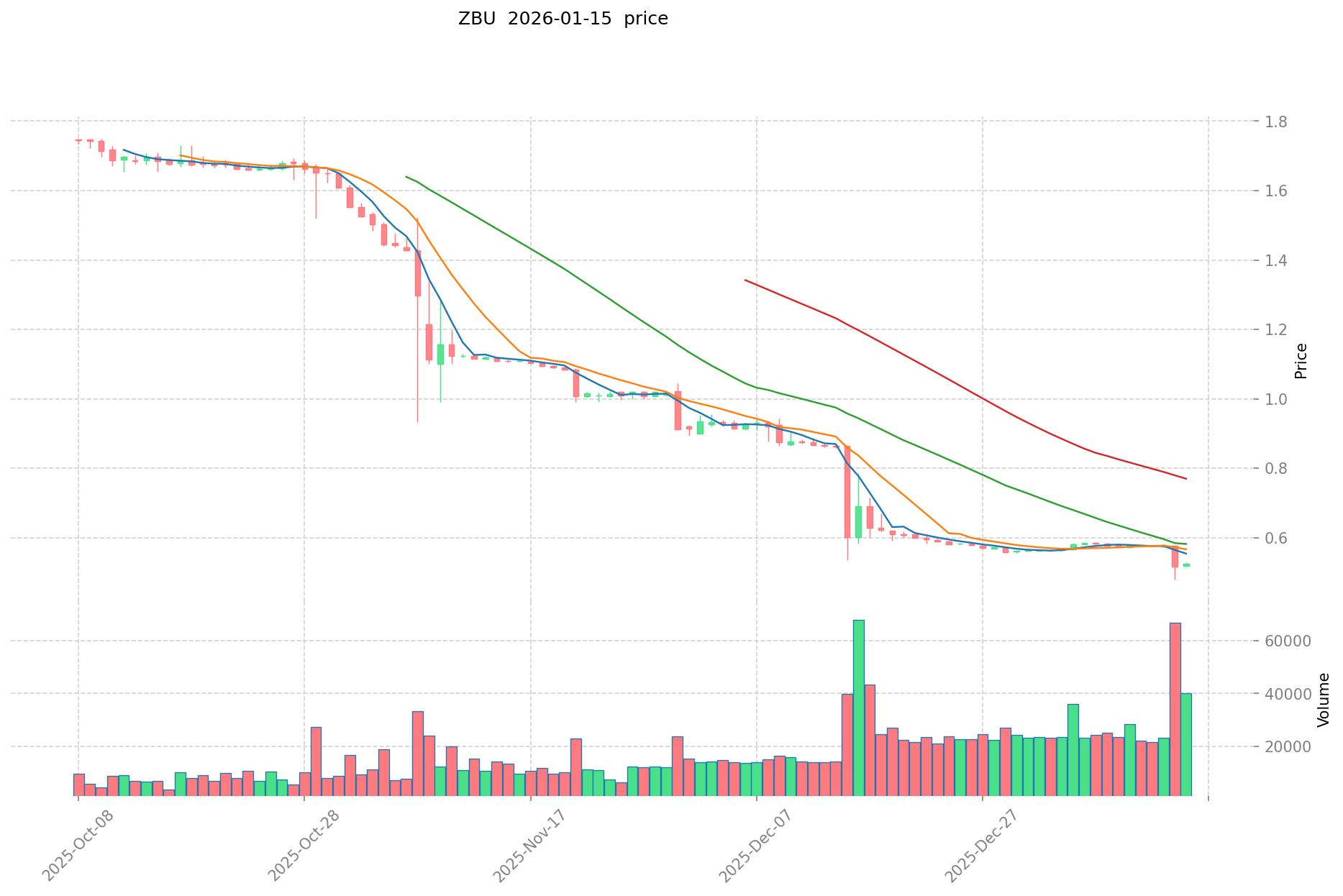
II. Core Factors Influencing Whether ZBU is a Good Investment
Supply Mechanism and Scarcity (ZBU investment scarcity)
- Total Supply: ZBU has a maximum supply of 5,000,000,000 tokens, with a current circulating supply of 413,627,996 tokens, representing approximately 8.27% of the total supply.
- Circulating Supply Impact: The limited circulating supply relative to the total supply may contribute to price dynamics, though the substantial remaining supply could influence long-term scarcity considerations.
- Investment Significance: The controlled release of tokens into circulation may be a factor in evaluating long-term investment potential, though the large total supply should be considered in scarcity assessments.
Institutional Investment and Mainstream Adoption (Institutional investment in ZBU)
- Holder Distribution: As of the reference date, ZBU has 14 recorded holders, indicating a relatively concentrated holder base.
- Exchange Listings: ZBU is listed on 5 exchanges, including Gate.com, which may affect liquidity and accessibility for investors.
- Enterprise Focus: ZEEBU is positioning itself as a Web3 Neobank for the telecommunications sector, combining the ZBU loyalty token with an on-chain invoice settlement platform to serve telecom carriers and businesses.
Macroeconomic Environment Impact on ZBU Investment
- Market Capitalization: As of January 16, 2026, ZBU has a market capitalization of approximately $216.95 million, representing 0.077% market dominance in the crypto asset space.
- Price Performance: ZBU has experienced notable volatility, with a 1-year decline of 87.56% and a 30-day decline of 21.95%, reflecting sensitivity to broader market conditions.
- Investment Context: The token's price movements may be influenced by macroeconomic factors affecting risk appetite in digital asset markets, though specific correlations require further analysis.
Technology and Ecosystem Development (Technology & Ecosystem for ZBU investment)
- Core Technology: ZEEBU integrates blockchain technology with telecommunications payment infrastructure, offering an on-chain invoice settlement platform combined with a loyalty token system.
- Sector-Specific Application: The project targets the telecommunications industry, providing carriers and businesses with a unified payment ecosystem designed for telecom-specific use cases.
- Development Resources: The project maintains public repositories on GitHub and documentation through GitBook, indicating ongoing technical development efforts.
- Ecosystem Positioning: By focusing on B2B telecommunications payments and settlements, ZBU operates in a niche sector within the broader Web3 infrastructure landscape.
III. ZBU Future Investment Forecast and Price Outlook (Is ZEEBU(ZBU) worth investing in 2026-2031)
Short-term Investment Forecast (2026, short-term ZBU investment outlook)
- Conservative forecast: $0.3945 - $0.526
- Neutral forecast: $0.526
- Optimistic forecast: $0.526 - $0.70484
Mid-term Investment Outlook (2027-2029, mid-term ZEEBU(ZBU) investment forecast)
- Market stage expectation: Statistical models suggest ZBU may experience moderate growth through the mid-term period, with price trajectories influenced by historical patterns and market dynamics.
- Investment return forecast:
- 2027: $0.369252 - $0.7938918
- 2028: $0.450979776 - $0.810354285
- 2029: $0.401477699025 - $0.855980754525
- Key catalysts: Market adoption trends, ecosystem development progress, and broader crypto market conditions.
Long-term Investment Outlook (Is ZEEBU a good long-term investment?)
- Base scenario: $0.621192051104625 - $1.1939795267985 (assuming steady ecosystem expansion and sustained market interest through 2030)
- Optimistic scenario: $0.950343163897725 - $1.090393735419495 (assuming accelerated adoption and favorable market environments through 2031)
- Risk scenario: Below $0.3945 (under adverse market conditions or significant ecosystem setbacks)
Click to view ZBU long-term investment and price forecast: Price Prediction
2026-01-16 - 2031 Long-term Outlook
- Base scenario: $0.526 - $0.8067429235125 (corresponding to steady progress and gradual mainstream application growth)
- Optimistic scenario: $0.7046559 - $1.1939795267985 (corresponding to large-scale adoption and favorable market environments)
- Transformative scenario: Above $1.090393735419495 (if ecosystem achieves breakthrough progress and mainstream penetration)
- 2031-12-31 forecast high: $1.090393735419495 (based on optimistic development assumptions)
Disclaimer: These forecasts are derived from statistical models based on historical patterns and should be considered as reference information only. Actual market performance may differ significantly due to various factors including market volatility, regulatory changes, technological developments, and macroeconomic conditions. These projections do not constitute investment advice.
| Year |
Predicted High Price |
Predicted Average Price |
Predicted Low Price |
Price Change |
| 2026 |
0.70484 |
0.526 |
0.3945 |
0 |
| 2027 |
0.7938918 |
0.61542 |
0.369252 |
17 |
| 2028 |
0.810354285 |
0.7046559 |
0.450979776 |
34 |
| 2029 |
0.855980754525 |
0.7575050925 |
0.401477699025 |
44 |
| 2030 |
1.1939795267985 |
0.8067429235125 |
0.621192051104625 |
53 |
| 2031 |
1.090393735419495 |
1.0003612251555 |
0.950343163897725 |
90 |
Investment Methodology (ZEEBU investment strategy)
-
Long-term Holding (HODL ZEEBU): Suitable for conservative investors
For investors seeking exposure to the telecom payment infrastructure sector, a long-term holding strategy may be considered. This approach focuses on the potential growth of ZEEBU's unified telecom payment ecosystem and its adoption among telecom carriers and enterprises.
-
Active Trading: Relies on technical analysis and swing trading
Active traders may utilize technical indicators to capture price movements. Given ZEEBU's 24-hour trading volume and price fluctuations, swing trading opportunities may exist for experienced traders who can manage volatility.
Risk Management (Risk management for ZEEBU investment)
-
Asset Allocation Ratio: Conservative / Aggressive / Professional investors
- Conservative investors: Consider allocating a small percentage (1-3%) of portfolio to high-volatility assets like ZEEBU
- Aggressive investors: May allocate 5-10% depending on risk tolerance
- Professional investors: Should conduct thorough due diligence and consider strategic positioning based on telecom sector analysis
-
Risk Hedging Solutions: Multi-asset portfolio + hedging instruments
Diversification across different cryptocurrency categories and traditional assets can help mitigate concentration risk. Consider balancing ZEEBU exposure with more established digital assets and traditional portfolio components.
-
Secure Storage: Hot/cold wallets + hardware wallet recommendations
Given that ZEEBU operates on the BSC (Binance Smart Chain), investors should use compatible wallets. Hardware wallets supporting BSC tokens are recommended for long-term storage, while keeping only necessary amounts in hot wallets for trading purposes.
-
Market Risk: High volatility and price manipulation concerns
ZEEBU has demonstrated significant price volatility, with a 7-day change of -8.55% and a 30-day change of -21.95%. The circulating supply represents approximately 8.27% of the total supply, which may contribute to price sensitivity. The token has experienced substantial price movements from its all-time low of $0.162 to a peak of $6.6.
-
Regulatory Risk: Policy uncertainty across different jurisdictions
As a Web3 payment solution targeting the telecom industry, ZEEBU may face regulatory scrutiny in various jurisdictions. The evolving regulatory landscape for cryptocurrency payment systems and loyalty tokens could impact the project's operations and token utility.
-
Technical Risk: Network security vulnerabilities and upgrade failures
As a BSC-based token, ZEEBU inherits both the benefits and risks of the underlying blockchain infrastructure. Smart contract vulnerabilities, network congestion, or platform-specific issues could affect token functionality and user confidence.
-
Investment Value Summary: ZEEBU presents a specialized use case in the telecom payment infrastructure sector, though it has experienced substantial price volatility in recent periods.
-
Investor Recommendations:
✅ Beginners: Consider dollar-cost averaging + secure wallet storage. Start with small allocations to understand market dynamics before increasing exposure.
✅ Experienced Investors: May explore swing trading opportunities + portfolio diversification. Monitor telecom industry adoption trends and ecosystem development.
✅ Institutional Investors: Conduct comprehensive due diligence on the telecom payment market opportunity and strategic long-term positioning considerations.
⚠️ Disclaimer: Cryptocurrency investments carry high risk. This content is for informational purposes only and does not constitute investment advice. Investors should conduct their own research and consult with financial advisors before making investment decisions.
VII. FAQ
Q1: What is ZEEBU (ZBU) and what problem does it solve?
ZEEBU is a Web3 Neobank solution designed for the telecommunications industry, combining a loyalty token (ZBU) with an on-chain invoice settlement platform. It addresses the challenge of fragmented payment systems in the telecom sector by providing carriers and businesses with a unified payment ecosystem for B2B transactions and settlements. Launched in July 2023 on the BSC (Binance Smart Chain), ZEEBU aims to streamline cross-border telecom payments and settlements while offering loyalty rewards through its native token.
Q2: Why has ZEEBU's price declined significantly over the past year?
ZEEBU has experienced an 87.56% decline over the past year, dropping from a peak of $6.6 in December 2024 to approximately $0.5245 as of January 16, 2026. This substantial correction reflects several factors including market-wide cryptocurrency volatility, profit-taking after the December 2024 peak, and the token's early-stage development phase. Additionally, with only 8.27% of the total supply currently in circulation, price movements may be influenced by liquidity constraints and concentrated holder dynamics. The broader crypto market correction and uncertainty in Web3 adoption rates have also contributed to the price adjustment.
Q3: What is the difference between ZEEBU's market cap and fully diluted valuation?
ZEEBU's current market capitalization is approximately $216.95 million USD, calculated based on the circulating supply of 413.63 million tokens. However, its fully diluted valuation (FDV) is significantly higher at $2.62 billion USD, calculated using the maximum supply of 5 billion tokens. This substantial difference indicates that approximately 91.73% of tokens have yet to be released into circulation. This disparity is an important consideration for investors, as future token unlocks could potentially create selling pressure and affect price dynamics over time.
Q4: How does ZEEBU generate value for token holders?
ZEEBU generates value through its dual functionality as both a payment utility token and a loyalty rewards mechanism within the telecommunications ecosystem. The token facilitates on-chain invoice settlements between telecom carriers and businesses, potentially reducing transaction costs and settlement times. As a loyalty token, ZBU rewards participants in the ecosystem for conducting transactions through the platform. The value proposition depends on adoption rates among telecom carriers, transaction volume growth, and the expansion of the ZEEBU payment network. However, investors should note that token utility does not guarantee price appreciation.
Q5: What are the main risks associated with investing in ZEEBU?
ZEEBU carries multiple investment risks including high price volatility (with recent declines of -8.55% over 7 days and -21.95% over 30 days), concentrated holder base (only 14 recorded holders), and limited liquidity (24-hour trading volume of approximately $20,697). Regulatory uncertainty surrounding cryptocurrency payment systems presents another significant risk, as evolving regulations could impact the project's operations. Technical risks include smart contract vulnerabilities and BSC network dependencies. Additionally, the success of ZEEBU depends heavily on adoption within the telecommunications industry, which remains uncertain. The large percentage of tokens yet to be released (91.73%) poses potential dilution concerns for current investors.
Q6: Is ZEEBU suitable for beginner cryptocurrency investors?
ZEEBU is generally not recommended as a primary investment for beginner cryptocurrency investors due to its high volatility, specialized use case, and early development stage. The token has demonstrated extreme price fluctuations, including an 87.56% annual decline, which requires significant risk tolerance. Beginners considering exposure to ZEEBU should start with minimal allocations (1-3% of their crypto portfolio), employ dollar-cost averaging strategies, and ensure proper security measures through compatible BSC wallets. It is advisable for newcomers to first establish positions in more established cryptocurrencies before exploring specialized sector tokens like ZEEBU.
Q7: How can investors access and securely store ZEEBU tokens?
ZEEBU tokens are available for trading on 5 cryptocurrency exchanges, including Gate.com, which provides liquidity and accessibility for investors. As a BSC-based token, ZEEBU requires BSC-compatible wallets for storage. For long-term holders, hardware wallets supporting Binance Smart Chain tokens are recommended to maximize security. Examples include Ledger and Trezor devices with BSC compatibility. For active traders, maintaining small amounts in exchange hot wallets or software wallets like MetaMask (configured for BSC) may be practical, while transferring the majority of holdings to cold storage solutions reduces exposure to exchange-related risks.
Q8: What are the realistic price expectations for ZEEBU through 2031?
Based on statistical modeling of historical patterns, ZEEBU's price projections vary significantly across scenarios. For 2026, conservative forecasts suggest a range of $0.39-$0.53, while optimistic scenarios project $0.53-$0.70. By 2031, base case projections estimate $0.95-$1.09, with optimistic scenarios reaching approximately $1.09. However, these forecasts carry substantial uncertainty and should not be interpreted as guaranteed outcomes. Actual performance depends on multiple variables including telecom industry adoption rates, broader crypto market conditions, regulatory developments, and ecosystem execution. Investors should recognize that ZEEBU could underperform these projections or experience extended periods below current price levels in adverse scenarios.
* The information is not intended to be and does not constitute financial advice or any other recommendation of any sort offered or endorsed by Gate.