This comprehensive guide evaluates whether Zenchain (ZTC) represents a viable investment opportunity by analyzing its technical architecture, market dynamics, and risk profile. ZTC distinguishes itself as a Layer 1 blockchain combining Bitcoin-level security with Ethereum programmability and a native protocol-level AI layer for fraud detection and network optimization. Trading at $0.002116 with a $10.35 million market cap, ZTC has demonstrated significant volatility since January 2026 launch, experiencing both recovery momentum and substantial drawdowns. The analysis covers price forecasts through 2031, investment strategies for different risk profiles, and critical risk considerations including market volatility, regulatory uncertainty, and early-stage adoption metrics. Suitable for investors seeking exposure to emerging Layer 1 infrastructure with strong emphasis on risk management and diversification. Available on Gate and 9 other exchanges with developing liquidity infrastructure.
Introduction: Zenchain (ZTC)'s Investment Position and Market Outlook
ZTC is an emerging digital asset in the cryptocurrency sector. Since its launch on January 6, 2026, this Layer 1 blockchain project has demonstrated notable development in combining Bitcoin-level security with Ethereum programmability. As of January 26, 2026, Zenchain holds a market capitalization of approximately $10.35 million, with a circulating supply of around 4.89 billion tokens, and the current price maintains around $0.002116. With its positioning as a hybrid consensus blockchain featuring EVM compatibility and a native protocol-level AI layer, ZTC has gradually become a focal point when investors discuss "Is Zenchain (ZTC) a good investment?" This article comprehensively analyzes ZTC's investment value, historical trends, future price forecasts, and investment risks to provide reference for investors.
I. ZTC Price History Review and Current Investment Value Status
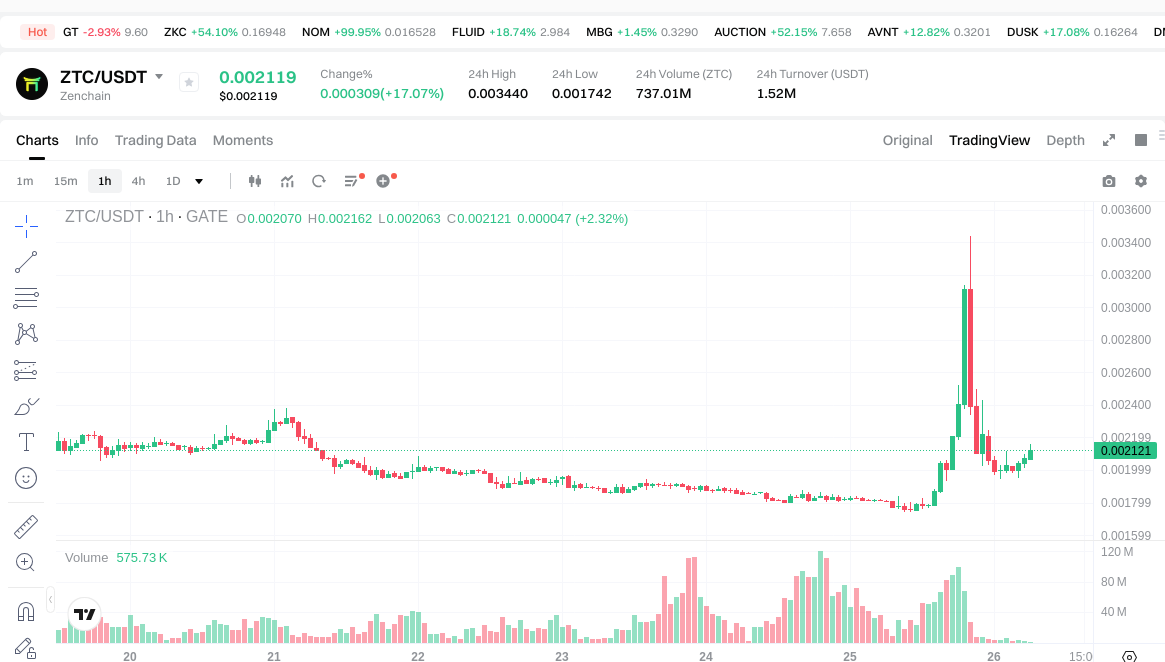
- 2026 Q1: ZTC reached a price peak of $0.012675 on January 7, 2026 → Subsequently experienced significant volatility with prices declining to $0.001742 by January 25, 2026
- Recent Price Movement: Following the low point in late January 2026, ZTC demonstrated recovery momentum with a 24-hour increase of 18.12%, reaching $0.002116
- Market Cycle Context: Price fluctuated between $0.001742 and $0.00344 within the past 24 hours, reflecting heightened trading activity
Current ZTC Investment Market Status (January 2026)
- ZTC Current Price: $0.002116
- 24-Hour Trading Volume: $1,531,939.46
- Market Capitalization: $10.35 million (circulating supply: 4.89 billion ZTC)
- Fully Diluted Valuation: $44.44 million
- Market Dominance: 0.0014%
- Price Performance: +4.29% (1H), +18.12% (24H), -3.04% (7D), -70.48% (30D)
- Token Holders: 682
- Listed Exchanges: 10
Click to view real-time ZTC market price
II. Core Factors Affecting Whether ZTC is a Good Investment (Is Zenchain(ZTC) a Good Investment)
Supply Mechanism and Scarcity (ZTC investment scarcity)
- Maximum supply capped at 21,000,000,000 ZTC with current circulating supply of 4,893,000,000 ZTC (23.3% of max supply) → influences price dynamics and investment value
- Market capitalization to fully diluted valuation ratio of 23.3% indicates substantial future token releases may affect supply-side dynamics
- Investment significance: controlled supply expansion and progressive token distribution represent key considerations for long-term investment evaluation
Institutional Investment and Mainstream Adoption (Institutional investment in ZTC)
- Current holder base comprises 682 addresses, indicating early-stage adoption metrics
- Token listed on 10 exchanges with trading volume of $1,531,939.46 over 24 hours, suggesting developing liquidity infrastructure
- Market share represents 0.0014% of total cryptocurrency market capitalization, positioning ZTC as an emerging asset class
Macroeconomic Environment's Impact on ZTC Investment
- Broader cryptocurrency market conditions influence investor sentiment toward Layer 1 blockchain projects
- Regulatory frameworks for EVM-compatible chains affect institutional participation and capital allocation decisions
- Market volatility considerations: 24-hour price range between $0.001742 and $0.00344 reflects emerging market characteristics
Technology and Ecosystem Development (Technology & Ecosystem for ZTC investment)
- Hybrid consensus mechanism combining Bitcoin-level security with Ethereum programmability → differentiates technical architecture from traditional Layer 1 solutions
- Native protocol-level AI layer for fraud detection, execution optimization, and adaptive network management → represents technical innovation in autonomous decentralized applications
- EVM compatibility enables deployment of smart contracts with reported low fees and fast transaction finality → supports potential DeFi and dApp ecosystem expansion
III. ZTC Future Investment Forecast and Price Outlook (Is Zenchain(ZTC) worth investing in 2026-2031)
Short-term Investment Forecast (2026, short-term ZTC investment outlook)
- Conservative Forecast: $0.0020235 - $0.00213
- Neutral Forecast: $0.00213 - $0.0022
- Optimistic Forecast: $0.0022 - $0.0024495
Mid-term Investment Outlook (2027-2029, mid-term Zenchain(ZTC) investment forecast)
-
Market Stage Expectation: ZTC may enter a gradual development phase as the project continues to expand its EVM-compatible Layer 1 ecosystem and AI-driven protocol features. The hybrid consensus mechanism and low-fee structure could attract more developers seeking Bitcoin-level security with Ethereum programmability.
-
Investment Return Forecast:
- 2027: $0.0016257225 - $0.002701905
- 2028: $0.0020964951 - $0.003119784375
- 2029: $0.002330478928125 - $0.002892040115625
-
Key Catalysts: Expansion of dApp ecosystem, adoption of AI-layer features for fraud detection and execution optimization, increased developer activity on the platform, and potential partnerships within the blockchain infrastructure space.
Long-term Investment Outlook (Is Zenchain a good long-term investment?)
- Base Scenario: $0.001909448427796 - $0.003541314352806 (assuming steady ecosystem growth and moderate market conditions through 2031)
- Optimistic Scenario: $0.003106416098953 - $0.003541314352806 (assuming accelerated adoption of AI-driven smart contract platforms and favorable regulatory environment)
- Risk Scenario: Below $0.001909448427796 (in case of prolonged market downturn, limited developer adoption, or competitive pressures from other Layer 1 solutions)
View ZTC long-term investment and price forecast: Price Prediction
2026-01-26 - 2031 Long-term Outlook
- Base Scenario: $0.001909448427796 - $0.003106416098953 (corresponding to steady progress and gradual mainstream application growth)
- Optimistic Scenario: $0.003106416098953 - $0.003541314352806 (corresponding to large-scale adoption and favorable market environment)
- Transformative Scenario: Above $0.003541314352806 (in case of breakthrough ecosystem developments and mainstream adoption)
- 2031-12-31 Forecast High: $0.003541314352806 (based on optimistic development assumptions)
Disclaimer: The forecasts provided are based on available data and market analysis models. Cryptocurrency investments carry significant risks, and actual prices may differ materially from predictions due to market volatility, regulatory changes, technological developments, and other unforeseen factors. This information should not be considered financial advice.
| Year |
Predicted High Price |
Predicted Average Price |
Predicted Low Price |
Price Change |
| 2026 |
0.0024495 |
0.00213 |
0.0020235 |
0 |
| 2027 |
0.002701905 |
0.00228975 |
0.0016257225 |
8 |
| 2028 |
0.003119784375 |
0.0024958275 |
0.0020964951 |
17 |
| 2029 |
0.002892040115625 |
0.0028078059375 |
0.002330478928125 |
32 |
| 2030 |
0.003362909171343 |
0.002849923026562 |
0.001909448427796 |
34 |
| 2031 |
0.003541314352806 |
0.003106416098953 |
0.002360876235204 |
46 |
IV. Zenchain Investment Strategy and Risk Management (How to invest in Layer 1 blockchain)
Investment Methodology (Zenchain investment strategy)
Long-term Holding (HODL Zenchain): This approach may be suitable for conservative investors who believe in the project's long-term vision of combining Bitcoin-level security with Ethereum's programmability. Given ZTC's positioning as a Layer 1 blockchain with EVM compatibility and an AI-powered protocol layer, investors following this strategy would focus on the project's technological development and ecosystem expansion rather than short-term price movements.
Active Trading: For traders employing technical analysis and swing trading strategies, ZTC has demonstrated notable price volatility. Recent data shows 24-hour price fluctuations ranging from $0.001742 to $0.00344, with a 24-hour change of +18.12% and a 1-hour change of +4.29%. However, the 30-day performance shows a decline of -70.48%, indicating significant price swings that may present both opportunities and risks for active traders.
Risk Management (Risk management for Zenchain investment)
Asset Allocation Ratios:
- Conservative investors: Consider limiting exposure to 1-3% of total portfolio
- Aggressive investors: May allocate 5-10% depending on risk tolerance
- Professional investors: Could incorporate as part of a diversified Layer 1 blockchain allocation
Risk Hedging Solutions: Investors may consider implementing multi-asset portfolio strategies that include established cryptocurrencies alongside emerging Layer 1 projects like Zenchain. Diversification across different blockchain ecosystems and market cap segments can help manage exposure.
Secure Storage:
- Cold wallets: Recommended for long-term holdings to minimize online exposure
- Hot wallets: Suitable for smaller amounts needed for active trading
- Hardware wallets: Provide enhanced security for significant holdings
Given that ZTC is an ERC-20 token (contract address: 0xa6773c4f26c80c86bc04aa6506533693a39d1195 on Ethereum), investors should ensure their chosen wallet supports Ethereum-based tokens.
V. Zenchain Investment Risks and Challenges (Risks of investing in Layer 1 blockchain)
Market Risks: ZTC exhibits high volatility characteristics common in emerging cryptocurrency projects. The token experienced a significant price decline of -70.48% over 30 days, dropping from an all-time high of $0.012675 (recorded on January 7, 2026) to an all-time low of $0.001742 (January 25, 2026). With a relatively modest market capitalization of approximately $10.35 million and 24-hour trading volume of around $1.53 million, the token may be susceptible to price fluctuations influenced by limited liquidity.
Regulatory Risks: As with all cryptocurrency investments, ZTC faces potential regulatory uncertainties across different jurisdictions. The evolving regulatory landscape for Layer 1 blockchains, smart contract platforms, and AI-integrated protocols may impact the project's development and adoption trajectory.
Technical Risks: While Zenchain positions itself as combining Bitcoin-level security with Ethereum programmability and an AI layer for fraud detection and network optimization, the project is relatively new (launched January 6, 2026). The platform's hybrid consensus mechanism and native AI protocol layer represent complex technical implementations that require ongoing testing and refinement. With only 682 holders as of the latest data, the project is in early stages of adoption.
Additionally, the current circulating supply represents only 23.3% of the maximum supply (4.893 billion out of 21 billion tokens), indicating potential future token releases that could impact price dynamics.
VI. Conclusion: Is Layer 1 blockchain a Good Investment?
Investment Value Summary: Zenchain presents an interesting proposition in the Layer 1 blockchain space through its approach of combining Bitcoin security, Ethereum compatibility, and AI-powered protocol optimization. The project's EVM compatibility and focus on enabling smart contracts with enhanced security may attract developer interest. However, the token has experienced substantial price volatility since launch, declining significantly from its all-time high while showing periods of recovery.
Investor Recommendations:
✅ Beginners: Consider dollar-cost averaging (DCA) to mitigate timing risk, combined with secure wallet storage. Given the project's early stage and price volatility, new investors should start with minimal allocations and prioritize understanding the technology and ecosystem development.
✅ Experienced Investors: May explore swing trading opportunities given the observed price volatility, while maintaining a diversified portfolio that includes established Layer 1 projects alongside emerging platforms. Monitor technological milestones, partnership announcements, and ecosystem growth metrics.
✅ Institutional Investors: Could consider strategic positioning as part of a broader Layer 1 blockchain allocation, with careful attention to token unlock schedules and project development progress. The relatively low market dominance (0.0014%) suggests early-stage positioning.
⚠️ Important Notice: Cryptocurrency investments carry high risk and significant price volatility. This content is for informational purposes only and does not constitute investment advice. Investors should conduct thorough research, assess their risk tolerance, and consider consulting financial advisors before making investment decisions.
VII. FAQ
Q1: What is the current price and market performance of Zenchain (ZTC)?
As of January 26, 2026, ZTC is trading at $0.002116 with a market capitalization of approximately $10.35 million. The token has shown recent volatility with a 24-hour increase of 18.12% and a 1-hour gain of 4.29%. However, the 30-day performance indicates a decline of -70.48% from earlier highs. The 24-hour trading volume stands at $1,531,939.46, with prices fluctuating between $0.001742 and $0.00344 during this period. The circulating supply represents 4.89 billion tokens out of a maximum supply of 21 billion ZTC.
Q2: What makes Zenchain's technology different from other Layer 1 blockchains?
Zenchain distinguishes itself through a hybrid consensus mechanism that combines Bitcoin-level security with Ethereum programmability. The platform features EVM compatibility, enabling developers to deploy smart contracts with reportedly low fees and fast transaction finality. Additionally, ZTC incorporates a native protocol-level AI layer designed for fraud detection, execution optimization, and adaptive network management. This combination of security, programmability, and AI-driven features positions Zenchain as an infrastructure platform for autonomous decentralized applications while maintaining compatibility with existing Ethereum-based tools and contracts.
Q3: What are the price predictions for ZTC through 2031?
Price forecasts vary by timeframe and scenario. For 2026, conservative estimates range from $0.0020235 to $0.00213, while optimistic projections reach $0.0022 to $0.0024495. Mid-term forecasts for 2027-2029 suggest gradual growth as the ecosystem develops, with 2029 predictions ranging from $0.002330478928125 to $0.002892040115625. Long-term projections through 2031 show a base scenario of $0.001909448427796 to $0.003106416098953, with optimistic scenarios reaching $0.003541314352806. These forecasts assume continued technological development, ecosystem expansion, and favorable market conditions, though actual prices may differ significantly due to market volatility and unforeseen factors.
Q4: What are the main risks associated with investing in ZTC?
ZTC investment carries several significant risks. Market risk is evident from the -70.48% decline over 30 days and high price volatility, with the token experiencing swings from an all-time high of $0.012675 to an all-time low of $0.001742 within a short period. The modest market capitalization of $10.35 million and limited liquidity may amplify price fluctuations. Technical risks stem from the project's early stage—launched January 6, 2026, with only 682 holders—and the complexity of implementing hybrid consensus and AI protocol features. Additionally, only 23.3% of maximum token supply is currently circulating, suggesting potential future releases that could impact price dynamics. Regulatory uncertainties affecting Layer 1 blockchains and AI-integrated protocols present additional considerations.
Q5: How should different types of investors approach ZTC investment?
Investment strategies should align with experience level and risk tolerance. Beginners are advised to employ dollar-cost averaging (DCA) with minimal portfolio allocation (1-3%), focusing on secure wallet storage and understanding the technology before increasing exposure. Experienced investors may explore swing trading opportunities given observed volatility while maintaining diversification across established and emerging Layer 1 projects, allocating 5-10% based on risk appetite. Institutional investors could consider strategic positioning as part of a broader Layer 1 blockchain allocation, carefully monitoring token unlock schedules and development milestones. All investors should prioritize risk management through appropriate asset allocation, diversification strategies, and secure storage solutions such as hardware wallets for significant holdings.
Q6: What factors could drive ZTC's future value appreciation?
Several catalysts may influence ZTC's long-term value trajectory. Technological factors include ecosystem expansion through increased dApp development on the platform, adoption of the AI-layer features for enhanced security and optimization, and successful implementation of the hybrid consensus mechanism. Market factors encompass growing developer activity attracted by EVM compatibility and low transaction fees, strategic partnerships within blockchain infrastructure sectors, and increased token holder base beyond the current 682 addresses. Additionally, favorable regulatory frameworks for EVM-compatible chains, expansion to additional trading platforms beyond the current 10 exchanges, and broader mainstream acceptance of AI-integrated blockchain solutions could contribute to value appreciation. However, investors should note that these remain speculative factors subject to market conditions and execution capabilities.
Q7: What is the token supply structure and how might it affect investment decisions?
ZTC has a maximum supply capped at 21 billion tokens, with current circulating supply of approximately 4.89 billion tokens, representing 23.3% of total supply. This controlled supply expansion suggests that approximately 16.11 billion tokens remain to be released over time, which represents a significant consideration for investment evaluation. The market capitalization to fully diluted valuation ratio of 23.3% indicates substantial future token releases that may affect supply-side dynamics and price pressure. The fully diluted valuation stands at $44.44 million compared to the current market cap of $10.35 million. Investors should factor in potential dilution from future token distributions when assessing long-term holding strategies and price expectations, as progressive token releases could impact supply-demand equilibrium.
Q8: Where can investors trade ZTC and what security measures should they implement?
ZTC is currently listed on 10 cryptocurrency exchanges with 24-hour trading volume of approximately $1.53 million, indicating developing liquidity infrastructure. As an ERC-20 token with contract address 0xa6773c4f26c80c86bc04aa6506533693a39d1195 on Ethereum, investors must ensure their chosen platforms and wallets support Ethereum-based tokens. Security best practices include using cold wallets for long-term holdings to minimize online exposure, hot wallets for smaller amounts needed for active trading, and hardware wallets for significant holdings requiring enhanced security. Investors should verify wallet compatibility with ERC-20 tokens, implement strong authentication measures, and never share private keys or seed phrases. Given the relatively low trading volume compared to established cryptocurrencies, investors should also consider liquidity constraints when planning larger trades.
* The information is not intended to be and does not constitute financial advice or any other recommendation of any sort offered or endorsed by Gate.