This comprehensive analysis examines whether Zeta Markets (ZEX) represents a sound investment opportunity. The article evaluates ZEX's market position with current pricing at $0.05506 and market cap of approximately $9.99 million, tracing its trajectory from June 2024 launch through January 2026. Core investment factors include tokenomics analysis with 18.14% circulating supply, institutional adoption indicators, and technological infrastructure built on Solana's blockchain. Price forecasts range from $0.040737 to $0.093397861178943 through 2031 across conservative to optimistic scenarios. The analysis provides investment strategies for different investor profiles, risk management approaches, and identifies key challenges including high volatility, liquidity constraints, regulatory uncertainty, and competitive pressures. Suitable for cryptocurrency investors seeking detailed ZEX valuation insights, fundamental analysis, and strategic investment guidance on this emerging decentralized perpetual exchange protoc
Introduction: Zeta Markets (ZEX) Investment Status and Market Outlook
ZEX is an important asset in the cryptocurrency field. Since its launch in 2024, it has made notable progress in the decentralized perpetual derivatives exchange sector. As of January 2026, Zeta Markets has a market capitalization of approximately $9.99 million, with a circulating supply of about 181.44 million tokens, and the current price is around $0.05506. With its positioning focused on building a high-speed, user-friendly, and secure perpetuals DEX leveraging Solana's scalability, ZEX has gradually become a focal point for investors discussing "Is Zeta Markets (ZEX) a good investment?" This article will comprehensively analyze the investment value, historical trends, future price predictions, and investment risks of ZEX to provide reference for investors.
I. Historical Price Review and Current Investment Value Status of ZEX
- 2024: Token launch in June → Initial trading price at $0.1769, followed by notable volatility
- 2024: Market fluctuation cycle → Price experienced movements between different ranges throughout the year
- 2024-2025: Market adjustment period → Price declined from June 2024 levels to lower trading ranges observed in subsequent months
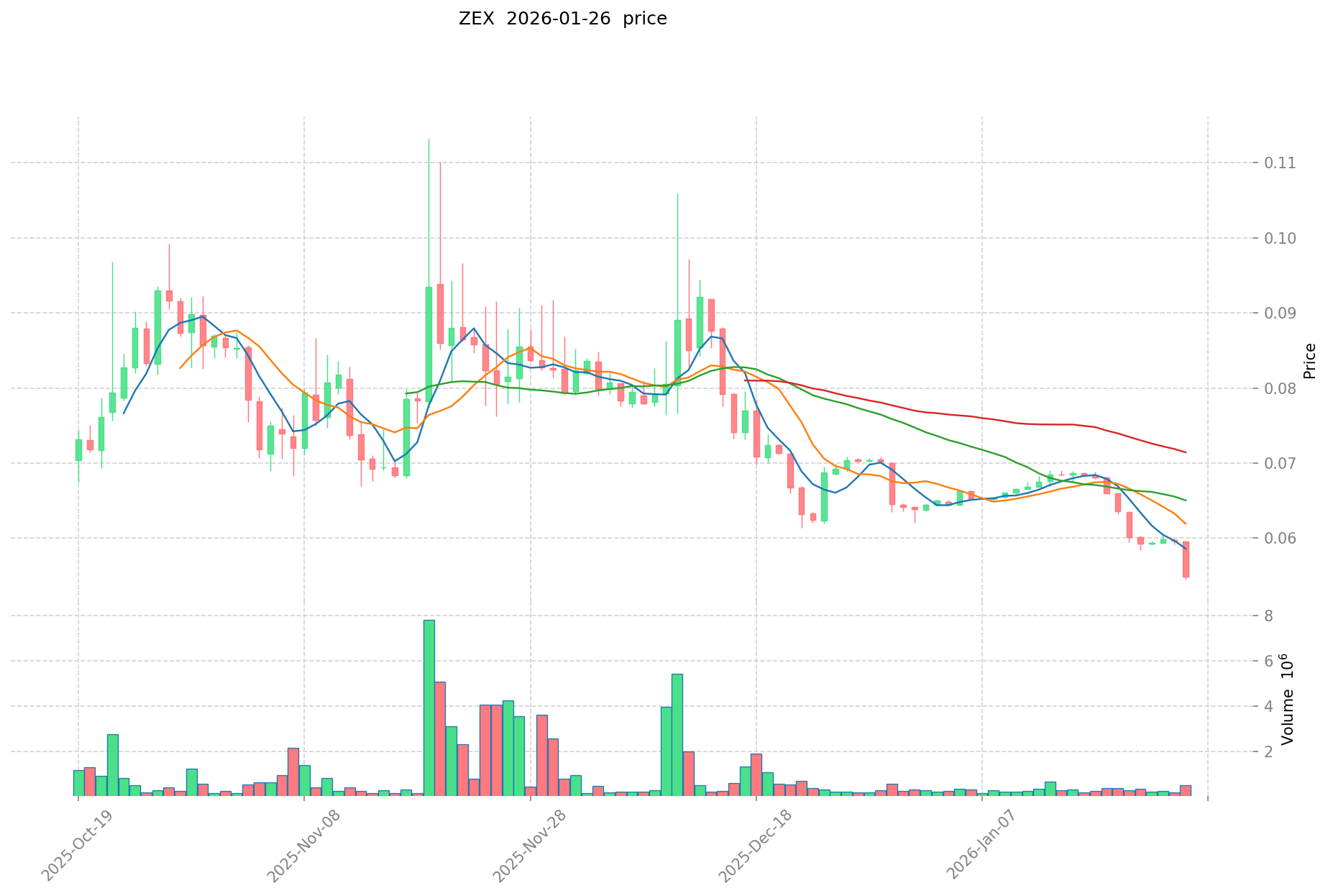
Current ZEX Investment Market Status (January 2026)
- ZEX current price: $0.05506
- 24-hour trading volume: $34,668.80
- Circulating supply: 181,438,032 ZEX tokens
- Market capitalization: $9,989,978.04
- Fully diluted valuation: $55,060,000
- Market dominance: 0.0017%
- Circulating supply ratio: 18.14%
Click to view real-time ZEX market price
II. Core Factors Affecting Whether ZEX is a Good Investment (Is Zeta Markets(ZEX) a Good Investment)
Supply Mechanism and Scarcity (ZEX investment scarcity)
- Supply Structure: ZEX has a maximum supply of 1,000,000,000 tokens, with a current circulating supply of 181,438,032 tokens, representing an 18.14% circulation ratio. The defined supply cap provides a framework for potential scarcity dynamics as adoption progresses.
- Historical Price Context: ZEX reached a notable price level of $0.3184 on June 27, 2024, and experienced a lower price point of $0.0218 on August 5, 2024. These historical price movements reflect market volatility and varying investor sentiment during different market conditions.
- Investment Consideration: The relationship between circulating supply (18.14%) and maximum supply suggests that a significant portion of tokens remains to enter circulation, which may influence future supply dynamics and market valuation as the project develops.
Institutional Investment and Mainstream Adoption (Institutional investment in ZEX)
- Holder Base: As of the latest data, ZEX has 29,854 token holders, indicating a developing community of participants engaged with the project.
- Exchange Accessibility: ZEX is currently listed on 8 exchanges, providing multiple access points for investors and contributing to market liquidity.
- Market Position: With a market capitalization of approximately $9.99 million and a fully diluted market cap of $55.06 million, ZEX represents a relatively smaller market cap project in the decentralized exchange sector, which may present both opportunity and risk considerations for investors.
Macroeconomic Environment's Impact on ZEX Investment
- Market Volatility Sensitivity: ZEX has demonstrated price sensitivity to broader market conditions, with a 24-hour price change of -6.8%, a 7-day change of -15.2%, and a 30-day change of -21.73%, reflecting responsiveness to market sentiment shifts.
- Sector Performance: As a decentralized perpetual exchange protocol built on Solana, ZEX's performance may be influenced by trends in the DeFi sector, Solana ecosystem health, and overall cryptocurrency market conditions.
- Risk Considerations: The token's trading volume of $34,668.80 over 24 hours and its market dominance of 0.0017% suggest that liquidity and market depth are factors investors should evaluate when considering position sizing.
Technology and Ecosystem Development (Technology & Ecosystem for ZEX investment)
- Platform Foundation: Zeta Markets is developing a decentralized perpetual exchange on Solana, aiming to combine centralized exchange-level features and performance with the self-custodial nature and transparency characteristics of decentralized platforms.
- Technical Infrastructure: The project leverages Solana's blockchain infrastructure to pursue speed and scalability objectives for its perpetual trading platform.
- Ecosystem Integration: The deployment on Solana positions ZEX within a broader ecosystem of decentralized finance applications, potentially enabling network effects and cross-protocol interactions as the DeFi sector evolves.
III. ZEX Future Investment Forecast and Price Outlook (Is Zeta Markets (ZEX) Worth Investing in 2026-2031)
Short-term Investment Forecast (2026, Short-term ZEX Investment Outlook)
- Conservative forecast: $0.040737 - $0.05505
- Neutral forecast: $0.05505
- Optimistic forecast: $0.05505 - $0.059454
Mid-term Investment Outlook (2027-2029, Mid-term Zeta Markets (ZEX) Investment Forecast)
-
Market stage expectation: During 2027-2029, ZEX may experience moderate growth as the DeFi derivatives market continues to evolve. The platform's focus on speed and security on Solana could attract more users seeking CEX-comparable performance with DEX transparency.
-
Investment return forecast:
- 2027: $0.03778632 - $0.0658398
- 2028: $0.034465704 - $0.086779719
- 2029: $0.06822978474 - $0.083803974735
-
Key catalysts: Expansion of Solana ecosystem adoption, increased trading volume on perpetual DEX platforms, potential protocol upgrades, and broader institutional interest in decentralized derivatives trading.
Long-term Investment Outlook (Is ZEX a Good Long-term Investment?)
- Base scenario: $0.069623860151576 - $0.093397861178943 (assuming steady development and moderate market growth)
- Optimistic scenario: $0.084907146526312 - $0.093397861178943 (assuming accelerated adoption and favorable market conditions)
- Risk scenario: Below $0.069623860151576 (under adverse market conditions or intensified competition)
Click to view ZEX long-term investment and price forecast: Price Prediction
2026-2031 Long-term Outlook
- Base scenario: $0.040737 - $0.093397861178943 (corresponding to steady progress and gradual mainstream application growth)
- Optimistic scenario: $0.084907146526312 - $0.093397861178943 (corresponding to large-scale adoption and favorable market environment)
- Transformative scenario: Above $0.093397861178943 (if the ecosystem achieves breakthrough developments and mainstream popularization)
- 2031-12-31 projected high: $0.093397861178943 (based on optimistic development assumptions)
Disclaimer: Price predictions are based on historical data and market analysis models. Cryptocurrency markets are highly volatile and subject to various risks including regulatory changes, technological developments, and market sentiment shifts. These forecasts should not be considered as investment advice. Investors should conduct their own research and consider their risk tolerance before making investment decisions.
| Year |
Predicted High Price |
Predicted Average Price |
Predicted Low Price |
Price Change |
| 2026 |
0.059454 |
0.05505 |
0.040737 |
0 |
| 2027 |
0.0658398 |
0.057252 |
0.03778632 |
3 |
| 2028 |
0.086779719 |
0.0615459 |
0.034465704 |
11 |
| 2029 |
0.083803974735 |
0.0741628095 |
0.06822978474 |
34 |
| 2030 |
0.090830900935125 |
0.0789833921175 |
0.07108505290575 |
43 |
| 2031 |
0.093397861178943 |
0.084907146526312 |
0.069623860151576 |
54 |
IV. ZEX Investment Strategy and Risk Management (How to invest in Zeta Markets)
Investment Methodology (ZEX investment strategy)
Long-term Holding (HODL ZEX)
For conservative investors seeking exposure to decentralized perpetual trading infrastructure, a long-term holding strategy may be considered. This approach involves acquiring ZEX tokens and maintaining positions through market cycles, focusing on the protocol's fundamental development rather than short-term price movements. Given ZEX's current circulating supply of 181,438,032 tokens (18.14% of total supply) and market capitalization of approximately $9.99 million, investors should consider the project's relatively early stage and limited liquidity when planning position sizes.
Active Trading
Traders employing technical analysis may focus on ZEX's price action within established ranges. Recent data shows 24-hour volatility with a high of $0.05921 and low of $0.05432. The token has experienced notable price fluctuations since its June 2024 launch, with all-time high of $0.3184 and all-time low of $0.0218. Active traders should monitor support and resistance levels while considering the token's 24-hour trading volume of approximately $34,669, which may impact execution and slippage.
Risk Management (Risk management for ZEX investment)
Asset Allocation Framework
- Conservative investors: Consider limiting ZEX exposure to 1-3% of total cryptocurrency portfolio, given the project's early stage and market cap ranking around #1200
- Aggressive investors: May allocate 5-10% while maintaining diversification across established Layer 1 platforms and DeFi protocols
- Professional investors: Should evaluate protocol metrics, on-chain activity, and competitive positioning within the Solana DeFi ecosystem before determining allocation
Risk Hedging Approaches
Investors may consider diversifying across multiple perpetual DEX protocols and Solana-based DeFi projects to mitigate protocol-specific risks. Position sizing should account for ZEX's correlation with broader Solana ecosystem performance and general cryptocurrency market conditions. Utilizing stablecoin reserves for opportunistic rebalancing during periods of heightened volatility may help manage downside exposure.
Secure Storage Solutions
- Hot wallets: For active trading, consider using reputable Solana-compatible wallets with multi-signature capabilities
- Cold storage: For long-term holdings, hardware wallets supporting Solana SPL tokens (such as Ledger or Trezor with Solana integration) provide enhanced security
- Custody considerations: Verify contract address (ZEXy1pqteRu3n13kdyh4LwPQknkFk3GzmMYMuNadWPo) before any transactions to avoid phishing attempts
V. ZEX Investment Risks and Challenges (Risks of investing in Zeta Markets)
Market Risk
High Volatility
ZEX has demonstrated significant price volatility since launch. The token's price has declined 21.73% over 30 days and 15.2% over 7 days as of January 26, 2026. The current price of $0.05506 represents an approximate 83% decline from the all-time high of $0.3184 recorded in June 2024. This volatility pattern is characteristic of smaller-cap tokens and may present both opportunities and risks for investors.
Liquidity Constraints
With 24-hour trading volume of approximately $34,669 and availability on 8 exchanges, ZEX exhibits relatively limited liquidity compared to established cryptocurrencies. This may result in wider bid-ask spreads, increased slippage for larger orders, and potential difficulty exiting positions during market stress periods.
Regulatory Risk
Decentralized derivatives platforms face evolving regulatory scrutiny across jurisdictions. While Zeta Markets operates as a self-custodial DEX on Solana, regulatory frameworks for perpetual swaps and leveraged trading products continue to develop globally. Changes in regulatory approaches toward DeFi protocols, particularly those offering derivatives products, could impact protocol usage and token utility.
Technical Risk
Network Dependencies
As a Solana-based protocol, Zeta Markets inherits both benefits and risks associated with the underlying blockchain. Network congestion, potential outages, or security vulnerabilities affecting Solana could impact protocol functionality and user experience.
Smart Contract Risk
Despite the protocol's focus on security, smart contract vulnerabilities remain an inherent risk in DeFi protocols. Investors should monitor protocol audit reports and consider that the relatively recent launch (June 2024) means the protocol has limited operational history compared to established competitors.
Competitive Pressure
The perpetual DEX sector includes numerous competitors across multiple blockchains. Zeta Markets faces competition from established players with larger user bases, deeper liquidity, and more extensive track records, which may impact long-term market share and token value proposition.
VI. Conclusion: Is Zeta Markets a Good Investment?
Investment Value Summary
ZEX represents exposure to the decentralized perpetual trading infrastructure built on Solana. The protocol aims to provide CEX-like performance while maintaining self-custodial characteristics. However, investors should note the token's early stage, with only 18.14% of supply currently circulating and a fully diluted valuation of approximately $55 million. The significant price decline from all-time highs and recent negative price trends across multiple timeframes suggest caution is warranted.
Investor Recommendations
✅ Beginners: Consider starting with educational research on perpetual DEXs and Solana ecosystem before committing capital. If investing, use dollar-cost averaging with small position sizes and prioritize secure storage solutions. Ensure understanding of token utility and protocol mechanics before purchase.
✅ Experienced Investors: May consider tactical positions based on technical analysis and protocol development milestones. Monitor on-chain metrics, trading volume trends, and competitive positioning within the Solana DeFi landscape. Maintain diversification across multiple DeFi protocols and avoid overconcentration.
✅ Institutional Investors: Conduct thorough due diligence on protocol architecture, team background, tokenomics structure, and long-term sustainability. Evaluate liquidity constraints and consider position sizing limitations given current market depth. Assess strategic alignment with broader DeFi derivatives thesis.
⚠️ Disclaimer: Cryptocurrency investments carry substantial risk, including potential loss of principal. This analysis is provided for informational purposes only and does not constitute investment advice, financial advice, trading advice, or any other type of advice. Investors should conduct independent research and consult with qualified financial advisors before making investment decisions.
VII. FAQ
Q1: What is the current market valuation of Zeta Markets (ZEX) and how does it compare to its historical performance?
As of January 2026, ZEX has a market capitalization of approximately $9.99 million with a current price around $0.05506. The token has experienced significant volatility since its launch in June 2024, when it initially traded at $0.1769. It reached an all-time high of $0.3184 on June 27, 2024, and a low of $0.0218 on August 5, 2024. The current price represents approximately a 83% decline from its peak, reflecting broader market adjustments and the challenges faced by emerging DeFi protocols. With only 18.14% of its maximum supply of 1 billion tokens currently in circulation (181,438,032 tokens), the fully diluted valuation stands at approximately $55.06 million.
Q2: What are the primary risks associated with investing in ZEX?
Investing in ZEX carries several notable risks. Market risk is significant, with the token showing 21.73% decline over 30 days and high price volatility characteristic of smaller-cap tokens. Liquidity constraints present challenges, with 24-hour trading volume of only $34,669 and availability on 8 exchanges, potentially resulting in wider spreads and execution difficulties. Technical risks include dependency on Solana's network performance and smart contract vulnerabilities inherent in DeFi protocols. Additionally, regulatory uncertainty surrounding decentralized derivatives platforms may impact protocol operations and token utility as global frameworks for DeFi continue to evolve.
Q3: How does ZEX's supply structure impact its investment potential?
ZEX has a maximum supply of 1,000,000,000 tokens, with currently only 181,438,032 tokens (18.14%) in circulation. This relatively low circulation ratio means that approximately 81.86% of tokens remain to enter the market, which could exert downward pressure on price through future supply increases. The defined supply cap provides potential scarcity dynamics as adoption progresses, but investors should carefully consider how additional token releases might impact valuation. The relationship between current market cap ($9.99 million) and fully diluted valuation ($55.06 million) suggests significant dilution potential that could affect long-term price appreciation.
Q4: What trading strategies are recommended for different investor profiles considering ZEX?
For conservative investors, a long-term holding strategy with 1-3% portfolio allocation is recommended, focusing on protocol fundamentals rather than short-term price movements. Active traders may leverage technical analysis within established price ranges, noting recent volatility between $0.05432 and $0.05921, though they should account for limited liquidity impacting execution. Aggressive investors might consider 5-10% allocation while maintaining diversification across established Layer 1 platforms and DeFi protocols. All strategies should incorporate proper risk management, including secure storage solutions such as hardware wallets supporting Solana SPL tokens, and verification of the contract address (ZEXy1pqteRu3n13kdyh4LwPQknkFk3GzmMYMuNadWPo) before transactions.
Q5: What factors could positively influence ZEX's price in the mid to long-term?
Several catalysts could support ZEX price appreciation through 2026-2031. Expansion of Solana ecosystem adoption and increased trading volume on perpetual DEX platforms represent primary growth drivers. Protocol upgrades that enhance speed, security, and user experience could attract more traders seeking CEX-comparable performance with DEX transparency. Broader institutional interest in decentralized derivatives trading may increase demand for protocols like Zeta Markets. Price forecasts suggest potential ranges of $0.040737 - $0.059454 for 2026, potentially reaching $0.069623860151576 - $0.093397861178943 by 2031 under optimistic scenarios, though these projections depend on successful execution and favorable market conditions.
Q6: How does Zeta Markets differentiate itself in the competitive perpetual DEX landscape?
Zeta Markets positions itself as a high-speed, user-friendly, and secure perpetuals DEX leveraging Solana's scalability advantages. The protocol aims to combine centralized exchange-level features and performance with self-custodial nature and transparency characteristics of decentralized platforms. Built on Solana's infrastructure, it pursues speed and scalability objectives that may appeal to traders requiring fast execution without sacrificing custody control. However, with a market dominance of only 0.0017% and 29,854 token holders, the platform faces significant competition from established players with larger user bases and deeper liquidity, making competitive differentiation crucial for long-term success.
Q7: What price predictions exist for ZEX through 2031 and what assumptions underlie them?
Price forecasts for ZEX suggest a range of scenarios based on different market conditions and adoption rates. For 2026, predictions range from $0.040737 (conservative) to $0.059454 (optimistic). Mid-term forecasts for 2027-2029 project ranges from $0.03778632 to $0.083803974735, assuming moderate growth in DeFi derivatives markets. Long-term 2031 projections extend from $0.069623860151576 (base scenario) to $0.093397861178943 (optimistic scenario), representing approximately 54% potential increase from current levels under favorable conditions. These predictions assume continued protocol development, increased Solana ecosystem adoption, and favorable regulatory environment, but investors should recognize that cryptocurrency markets are highly volatile and these forecasts carry substantial uncertainty.
Q8: What due diligence should investors conduct before investing in ZEX?
Investors should conduct comprehensive research across multiple dimensions before committing capital to ZEX. This includes verifying the protocol's smart contract audits and security measures, analyzing on-chain metrics such as trading volume trends and active user growth, and evaluating the team's background and development roadmap. Understanding the token's utility within the Zeta Markets ecosystem and its role in governance or fee structures is essential. Investors should assess competitive positioning within the Solana DeFi landscape, monitor liquidity constraints given the $34,669 daily trading volume, and evaluate how the low circulating supply ratio (18.14%) might impact future price dynamics. Additionally, staying informed about regulatory developments affecting decentralized derivatives platforms and ensuring proper security measures for token storage are critical components of responsible investment due diligence.
* The information is not intended to be and does not constitute financial advice or any other recommendation of any sort offered or endorsed by Gate.