ZetaChain (ZETA) is a foundational blockchain enabling omnichain smart contracts and cross-chain messaging, addressing multi-chain interoperability challenges. As of January 2026, ZETA trades at $0.08266 with a $100.68 million market cap, ranking 354th globally with 1.218 billion circulating tokens. This comprehensive analysis examines whether ZETA represents a sound investment by evaluating its innovative omnichain technology, current market position across 33 exchanges including Gate, and long-term growth potential. The article reviews ZETA's historical performance, including an 84.28% one-year decline and recent positive momentum, while analyzing key investment factors such as tokenomics, institutional adoption, and macroeconomic influences. Investment forecasts through 2031 range from $0.0759 to $0.1849 under various scenarios. The guide provides tailored strategies for conservative, aggressive, and professional investors, emphasizing risk management and secure storage solutions. Investors should recogniz
Introduction: ZetaChain (ZETA) Investment Position and Market Outlook
ZETA is a significant asset in the cryptocurrency field. As a foundational public blockchain, ZetaChain enables omnichain smart contracts and messaging between blockchains, addressing cross-chain and multi-chain challenges. As of January 17, 2026, ZETA's market capitalization stands at approximately $100.68 million, with a circulating supply of 1.218 billion tokens and a current price around $0.08266. With a market ranking of 354 and a market dominance of 0.0051%, ZetaChain has positioned itself as a notable player in blockchain interoperability infrastructure. The project supports a fluid multi-chain ecosystem, enabling users and developers to leverage benefits across different blockchains, including payments, DeFi, liquidity, games, and more. As investors explore "Is ZetaChain (ZETA) a good investment?", this article provides a comprehensive analysis of ZETA's investment value, historical performance, future price outlook, and associated risks to serve as a reference for potential investors.
I. ZetaChain (ZETA) Historical Price Review and Current Investment Value
- 2024: ZETA reached a notable price level of $2.87 on February 15 → Early investors experienced significant gains during this period
- 2025: Market correction phase → Price declined from previous highs to $0.05735 on October 10
- 2026: Recovery trajectory observed → Current trading price stands at $0.08266 as of January 17
Current ZETA Investment Market Status (January 2026)
- Current ZETA price: $0.08266
- Market capitalization: $100.68 million
- 24-hour trading volume: $274,477.12
- Circulating supply: 1.218 billion ZETA (58% of total supply)
- Listed on 33 exchanges including major platforms
- Holder count: 78,875 addresses
Click to view real-time ZETA market price
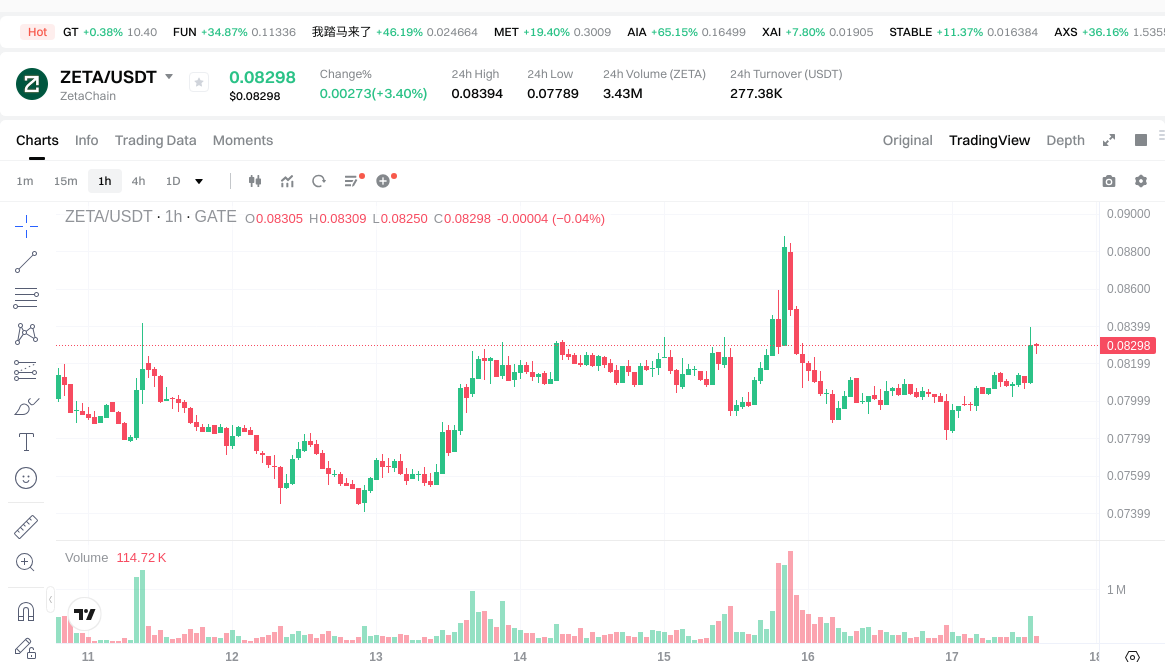
II. Core Factors Influencing Whether ZETA is a Good Investment (Is ZetaChain (ZETA) a Good Investment)
Supply Mechanism and Scarcity (ZETA Investment Scarcity)
-
Supply Dynamics → Influences Price and Investment Value
ZetaChain has a maximum supply of 2,100,000,000 ZETA tokens, with approximately 1,218,000,000 tokens currently in circulation, representing a circulating ratio of approximately 58%. The token's supply structure includes scheduled unlock events that may introduce additional selling pressure into the market. As of January 17, 2026, ZETA trades at $0.08266, showing a price decline trend over the past year.
-
Historical Supply Impact
Historical data indicates that token unlock schedules and changes in circulating supply have influenced ZETA's price movements. The token experienced price volatility following unlock events, with observable pullbacks during periods of increased supply distribution. Such patterns have been documented across high-utility altcoins with similar tokenomics structures.
-
Investment Significance
The relationship between circulating supply (58% of max supply) and fully diluted valuation suggests that future token unlocks remain a consideration for investment evaluation. The gradual release of the remaining 42% of tokens may affect long-term scarcity perception and market dynamics.
Institutional Investment and Mainstream Adoption (Institutional Investment in ZETA)
-
Adoption Landscape
ZetaChain's cross-chain infrastructure enables interaction with native assets across multiple blockchain networks including Ethereum, Bitcoin, and Solana without requiring bridges or wrapped tokens. This technical positioning targets developers and users seeking multi-chain interoperability solutions.
-
Market Presence
As of January 2026, ZETA is listed on 33 cryptocurrency exchanges and holds approximately 78,875 token holders. The token represents 0.0051% of the total cryptocurrency market capitalization, indicating a relatively modest market position within the broader digital asset ecosystem.
Macroeconomic Environment Impact on ZETA Investment
-
Market Conditions and Investment Context
The broader cryptocurrency market environment and macroeconomic conditions influence altcoin investment dynamics. ZETA's price movements reflect sensitivity to overall crypto market sentiment, with correlation to macro risk events and liquidity conditions affecting investor positioning.
-
Volatility Profile
ZETA demonstrates significant price volatility, with 24-hour trading ranges and annual price changes indicating exposure to both short-term trading patterns and longer-term market cycles. The token's performance over the past year shows a decline of 84.28%, reflecting challenges in maintaining price levels during shifting market conditions.
Technology and Ecosystem Development (Technology & Ecosystem for ZETA Investment)
-
Cross-Chain Infrastructure
ZetaChain's technical architecture focuses on enabling omnichain smart contracts and messaging functionality. The protocol is designed to facilitate interaction with native assets across different blockchains without relying on traditional bridge mechanisms, addressing cross-chain and multi-chain interoperability challenges.
-
Developer and User Ecosystem
The platform aims to support a multi-chain crypto ecosystem where users and developers can access various blockchain functionalities including payments, DeFi, gaming, and other decentralized applications. Sustained developer activity and cross-chain transaction volume represent key metrics for evaluating the protocol's practical utility and adoption trajectory.
-
Technical Development Factors
Protocol improvements related to throughput, finality, and transaction processing capabilities may influence the platform's competitiveness within the cross-chain infrastructure sector. The execution of technical roadmap milestones and network performance metrics constitute ongoing considerations for assessing investment fundamentals.
III. ZETA Future Investment Forecast and Price Outlook (Is ZetaChain(ZETA) worth investing in 2026-2031)
Short-term Investment Forecast (2026, short-term ZETA investment outlook)
- Conservative forecast: $0.0432 - $0.0831
- Neutral forecast: $0.0766 - $0.1003
- Optimistic forecast: $0.1003 - $0.1203
Mid-term Investment Outlook (2027-2029, mid-term ZetaChain(ZETA) investment forecast)
-
Market stage expectation: According to the provided data, ZETA may experience gradual growth during this period, with the price potentially ranging between $0.0773 and $0.1314, reflecting approximately 22% to 41% year-over-year changes. The development trajectory suggests a phase of steady market positioning with moderate volatility.
-
Investment return forecast:
- 2027: $0.0773 - $0.1240
- 2028: $0.1083 - $0.1219
- 2029: $0.0810 - $0.1314
-
Key catalysts: Factors influencing mid-term price movements may include developments in cross-chain interoperability technology, adoption rates of omnichain smart contract solutions, broader cryptocurrency regulatory dynamics, and ecosystem expansion activities.
Long-term Investment Outlook (Is ZETA a good long-term investment?)
- Base scenario: $0.0759 - $0.1249 (assuming sustained development of cross-chain infrastructure and moderate market conditions)
- Optimistic scenario: $0.1249 - $0.1849 (contingent upon accelerated adoption of multi-chain solutions and favorable regulatory environment)
- Risk scenario: Below $0.0759 (under conditions of significant market downturns or competitive challenges)
View ZETA long-term investment and price forecast: Price Prediction
2026-01-17 - 2031 Long-term Outlook
- Base scenario: $0.0759 - $0.1350 (corresponding to steady progress and gradual mainstream application enhancement)
- Optimistic scenario: $0.1350 - $0.1849 (corresponding to large-scale adoption and favorable market environment)
- Transformative scenario: Above $0.1849 (contingent upon breakthrough ecosystem developments and mainstream popularization)
- 2031-12-31 forecast high: $0.1849 (based on optimistic development assumptions)
Disclaimer: The above forecasts are derived from analytical models and historical data patterns. Cryptocurrency markets involve substantial risk and volatility. Past performance does not guarantee future results. These projections should not be construed as investment advice, and investors should conduct independent research and consider their risk tolerance before making investment decisions.
| Year |
Predicted High Price |
Predicted Average Price |
Predicted Low Price |
Price Change |
| 2026 |
0.120321 |
0.08298 |
0.0431496 |
0 |
| 2027 |
0.12401361 |
0.1016505 |
0.07725438 |
22 |
| 2028 |
0.1218586194 |
0.112832055 |
0.1083187728 |
36 |
| 2029 |
0.131426777664 |
0.1173453372 |
0.080968282668 |
41 |
| 2030 |
0.14553168719544 |
0.124386057432 |
0.07587549503352 |
50 |
| 2031 |
0.184893655069796 |
0.13495887231372 |
0.109316686574113 |
63 |
IV. ZETA Investment Strategy and Risk Management (How to invest in ZETA)
Investment Strategy (ZETA investment strategy)
Long-term Holding (HODL ZETA): Suitable for Conservative Investors
Long-term holding represents a strategy where investors acquire ZETA tokens and maintain their positions over extended periods, typically measured in years rather than months. This approach aligns with the fundamental belief in ZetaChain's omnichain technology and its potential role in connecting disparate blockchain ecosystems. According to available data, ZETA has experienced significant price fluctuations since its launch in February 2024, with historical prices ranging from $0.05735 to $2.87. For conservative investors, a long-term holding strategy may help mitigate the impact of short-term volatility while potentially benefiting from the project's development trajectory.
This strategy requires patience and conviction in ZetaChain's value proposition as a foundational public blockchain enabling cross-chain smart contracts and messaging. Investors adopting this approach typically focus on the project's technological milestones, ecosystem growth, and adoption metrics rather than daily price movements. The current circulating supply of 1,218,000,000 ZETA tokens out of a maximum supply of 2,100,000,000 indicates approximately 58% of tokens are in circulation, which investors should consider when evaluating long-term supply dynamics.
Active Trading: Technical Analysis and Swing Trading
Active trading strategies for ZETA involve capitalizing on price fluctuations through technical analysis and swing trading techniques. Recent data shows ZETA has demonstrated notable volatility, with 24-hour price changes of 2.62%, 7-day changes of 10.38%, and 30-day changes of 18.91%. Such price movements create opportunities for traders who can effectively analyze market trends and execute timely transactions.
Traders employing this strategy typically monitor key technical indicators, trading volume patterns, and market sentiment across the 33 exchanges where ZETA is listed. The 24-hour trading volume of approximately $274,477 provides liquidity for active trading activities. However, this approach requires significant time commitment, market knowledge, and risk tolerance, as it exposes traders to both potential gains and losses from frequent market movements.
Risk Management (Risk management for ZETA investment)
Asset Allocation Ratios: Conservative / Aggressive / Professional Investors
Conservative Investors: Conservative investors should consider limiting ZETA exposure to 1-5% of their total cryptocurrency portfolio, with cryptocurrency itself representing a small portion of overall investment assets. This approach acknowledges ZETA's innovative technology while managing exposure to its volatility and relatively early stage of development.
Aggressive Investors: Aggressive investors with higher risk tolerance might allocate 10-20% of their cryptocurrency portfolio to ZETA, particularly if they have conviction in omnichain infrastructure and cross-chain interoperability solutions. This allocation should still be balanced with established cryptocurrencies and traditional assets.
Professional Investors: Professional and institutional investors may take strategic positions based on comprehensive due diligence, potentially allocating larger percentages while implementing sophisticated hedging strategies. These investors typically have access to advanced risk management tools and deeper market analysis capabilities.
Effective risk management for ZETA investments involves diversification across multiple dimensions. Investors should consider holding a mix of established cryptocurrencies, emerging projects with different use cases, and potentially traditional financial instruments. For ZETA specifically, hedging strategies might include:
- Portfolio diversification across different blockchain infrastructure projects
- Allocation to stablecoins to maintain liquidity and reduce overall portfolio volatility
- Consideration of correlated and uncorrelated assets to balance risk exposure
Given ZETA's market capitalization of approximately $100.68 million and its ranking at position 354, investors should recognize its position as a mid-tier cryptocurrency project with corresponding liquidity considerations.
Secure Storage: Hot and Cold Wallets + Hardware Wallet Recommendations
Secure storage of ZETA tokens is essential for protecting investments from theft or loss. ZETA is an ERC-20 token deployed on the Ethereum network (contract address: 0xf091867ec603a6628ed83d274e835539d82e9cc8), which provides multiple storage options:
Cold Wallet Storage: For long-term holdings, hardware wallets such as Ledger or Trezor provide secure offline storage. These devices protect private keys from internet-connected devices, significantly reducing exposure to hacking attempts.
Hot Wallet Storage: For active trading or regular transactions, software wallets connected to the internet offer convenience. However, investors should only maintain amounts intended for near-term use in hot wallets, as they present higher security risks.
Best Practices: Regardless of wallet type, investors should implement security measures including strong passwords, two-factor authentication, regular software updates, and secure backup of recovery phrases in multiple physical locations.
V. ZETA Investment Risks and Challenges (Risks of investing in ZETA)
Market Risk: High Volatility and Price Manipulation Concerns
ZETA exhibits substantial price volatility characteristic of cryptocurrency markets. The token has experienced a one-year price decline of 84.28%, indicating significant downward pressure from its previous levels. The 24-hour price range between $0.07789 and $0.08394 demonstrates ongoing volatility even in shorter timeframes.
Market capitalization of approximately $100.68 million and 24-hour trading volume of around $274,477 suggest moderate liquidity conditions. While ZETA is listed on 33 exchanges, the relatively modest trading volume compared to market cap may create conditions where large trades could impact prices. Investors should be aware that sudden price movements can occur, particularly during periods of low liquidity or significant market events.
The token's fully diluted valuation of approximately $173.59 million, compared to its current market cap, indicates potential future supply increases as the remaining 42% of tokens enter circulation. This supply dynamic represents a consideration for price appreciation potential.
Regulatory Risk: Policy Uncertainty Across Different Jurisdictions
Cryptocurrency regulatory frameworks vary significantly across jurisdictions and continue to evolve. ZetaChain's focus on cross-chain interoperability and omnichain functionality may face regulatory scrutiny as authorities develop policies for blockchain infrastructure projects.
Investors should recognize that regulatory developments can impact ZETA's accessibility, trading options, and utility. Changes in securities classification, tax treatment, or operational requirements in major markets could affect the project's development trajectory and token value. The global nature of blockchain technology creates complexity as projects must navigate multiple regulatory environments simultaneously.
Regulatory uncertainty extends to the broader cryptocurrency market, where policy changes affecting the ecosystem as a whole can indirectly impact individual projects like ZetaChain. Investors should stay informed about regulatory developments in their jurisdictions and in regions where ZetaChain operates.
Technical Risk: Network Security Vulnerabilities and Upgrade Failures
As a blockchain infrastructure project focused on enabling cross-chain smart contracts and messaging, ZetaChain faces technical risks inherent to complex distributed systems. The project's functionality depends on maintaining security across multiple blockchain interactions, which increases the potential attack surface compared to single-chain systems.
Potential technical risks include:
Network Security: Smart contract vulnerabilities, consensus mechanism issues, or cross-chain bridge exploits could compromise user funds or network functionality. The cryptocurrency industry has witnessed numerous security incidents affecting similar infrastructure projects.
Protocol Upgrades: Blockchain protocol upgrades carry risks of implementation errors, network splits, or unexpected behavior. While upgrades are necessary for improvement and security, they introduce periods of elevated technical risk.
Integration Complexity: ZetaChain's omnichain approach requires integration with multiple blockchain networks, each with its own technical characteristics and potential vulnerabilities. Technical issues on connected chains could impact ZetaChain's functionality.
Investors should monitor the project's technical development, security audit results, and community feedback regarding network performance and security practices.
VI. Conclusion: Is ZETA a Good Investment?
Investment Value Summary
ZETA represents an investment in omnichain blockchain infrastructure, addressing cross-chain and multi-chain challenges in the cryptocurrency ecosystem. The project's focus on enabling universal smart contracts and messaging between different blockchains positions it within the blockchain interoperability sector.
From a price perspective, ZETA has experienced significant volatility, with a one-year decline of 84.28% while showing recent positive momentum with 7-day gains of 10.38% and 30-day gains of 18.91%. The token's market capitalization of approximately $100.68 million places it in the mid-tier category of cryptocurrency projects.
The project's circulating supply of 1,218,000,000 tokens represents approximately 58% of the maximum supply of 2,100,000,000, with the remaining tokens potentially entering circulation over time. This supply dynamic, combined with the project's technological development and ecosystem growth, will influence long-term value potential.
Investors should recognize that ZETA's investment case depends on multiple factors including technological execution, adoption of omnichain solutions, competition from alternative cross-chain projects, and overall cryptocurrency market conditions.
Investor Recommendations
✅ Beginners:
- Consider dollar-cost averaging (DCA) to mitigate timing risk and reduce the impact of volatility
- Prioritize secure storage using hardware wallets or reputable software wallets with strong security features
- Limit ZETA allocation to a small percentage of overall investment portfolio
- Focus on understanding the project's fundamentals before investing
- Avoid investing more than you can afford to lose
✅ Experienced Investors:
- Implement swing trading strategies based on technical analysis if actively managing positions
- Maintain diversified portfolio allocation across different cryptocurrency sectors
- Monitor project developments, partnerships, and ecosystem growth indicators
- Consider both market trends and project-specific factors when making trading decisions
- Use appropriate risk management tools including stop-losses and position sizing
✅ Institutional Investors:
- Conduct comprehensive due diligence on technology, team, tokenomics, and competitive positioning
- Consider strategic long-term allocation as part of blockchain infrastructure investment thesis
- Implement sophisticated hedging strategies to manage risk exposure
- Monitor regulatory developments affecting cross-chain infrastructure projects
- Evaluate liquidity conditions and trading venues for optimal execution
⚠️ Important Notice: Cryptocurrency investments carry substantial risk due to high volatility, regulatory uncertainty, and technical complexities. The information provided in this analysis is for reference purposes only and does not constitute investment advice. Past performance does not guarantee future results. Investors should conduct their own research, consider their financial situation and risk tolerance, and consult with qualified financial advisors before making investment decisions. Only invest amounts you are prepared to lose.
VII. FAQ
Q1: What is ZetaChain (ZETA) and what makes it unique in the blockchain space?
ZetaChain is a foundational public blockchain that enables omnichain smart contracts and messaging between different blockchains. Unlike traditional bridge-based solutions, ZetaChain allows interaction with native assets across multiple blockchain networks including Ethereum, Bitcoin, and Solana without requiring bridges or wrapped tokens. This technical architecture addresses cross-chain and multi-chain interoperability challenges by facilitating universal smart contract functionality across disparate blockchain ecosystems. The platform aims to support a fluid multi-chain crypto ecosystem where users and developers can access various blockchain functionalities including payments, DeFi, gaming, and other decentralized applications.
Q2: What is the current market position of ZETA as of January 2026?
As of January 17, 2026, ZETA trades at approximately $0.08266 with a market capitalization of $100.68 million, ranking at position 354 with a market dominance of 0.0051%. The token has a circulating supply of 1.218 billion tokens (58% of the maximum supply of 2.1 billion), is listed on 33 cryptocurrency exchanges, and has approximately 78,875 token holders. The 24-hour trading volume stands at $274,477.12. However, ZETA has experienced significant price volatility, with a one-year decline of 84.28% from previous highs, though showing recent positive momentum with 7-day gains of 10.38% and 30-day gains of 18.91%.
Q3: What are the main risks associated with investing in ZETA?
ZETA investments carry several significant risks. Market risk includes high volatility, as evidenced by the 84.28% one-year price decline and ongoing price fluctuations. Regulatory risk stems from evolving cryptocurrency policies across different jurisdictions that could impact cross-chain infrastructure projects. Technical risks include potential network security vulnerabilities, smart contract exploits, protocol upgrade failures, and integration complexity across multiple blockchain networks. Additionally, the token's supply dynamics, with 42% of maximum supply yet to enter circulation, could create future selling pressure. The relatively modest trading volume compared to market capitalization may also create liquidity challenges during large transactions.
Q4: What investment strategies are suitable for different types of ZETA investors?
For conservative investors, a long-term holding (HODL) strategy with 1-5% portfolio allocation is recommended, focusing on ZetaChain's technological development and ecosystem growth rather than short-term price movements. Aggressive investors with higher risk tolerance might allocate 10-20% of their cryptocurrency portfolio to ZETA, potentially employing swing trading strategies based on technical analysis to capitalize on price volatility. Professional and institutional investors may take strategic positions based on comprehensive due diligence, implementing sophisticated hedging strategies and advanced risk management tools. All investors should prioritize secure storage using hardware wallets for long-term holdings and maintain diversified portfolios across multiple asset classes.
Q5: What is the price forecast for ZETA from 2026 to 2031?
Short-term forecasts for 2026 range from $0.0432 to $0.1203 depending on market conditions. Mid-term projections suggest gradual growth, with prices potentially ranging between $0.0773 and $0.1314 through 2029, reflecting approximately 22% to 41% year-over-year changes. Long-term outlook for 2031 shows a base scenario of $0.0759 to $0.1350, an optimistic scenario of $0.1350 to $0.1849 contingent upon large-scale adoption, and a transformative scenario above $0.1849 based on breakthrough ecosystem developments. The predicted high price for 2031 is $0.1849. These forecasts are derived from analytical models and should not be construed as guaranteed outcomes, as cryptocurrency markets involve substantial risk and volatility.
Q6: How does ZetaChain's token supply structure affect its investment potential?
ZetaChain has a maximum supply of 2.1 billion ZETA tokens, with approximately 1.218 billion tokens currently in circulation, representing a 58% circulating ratio. The remaining 42% of tokens are scheduled for future unlock events, which may introduce additional selling pressure into the market and affect long-term scarcity perception. Historical data indicates that token unlock schedules have influenced ZETA's price movements, with observable pullbacks during periods of increased supply distribution. The fully diluted valuation of approximately $173.59 million compared to the current market cap of $100.68 million reflects this future supply consideration. Investors should monitor unlock schedules and supply dynamics as part of their fundamental analysis when evaluating investment decisions.
Q7: What factors could drive ZETA's price appreciation in the future?
Several key catalysts could potentially influence ZETA's price trajectory positively. Technological developments in cross-chain interoperability solutions and successful implementation of omnichain smart contract functionality represent fundamental drivers. Increased adoption rates by developers and users seeking multi-chain ecosystem access could expand network utility. Strategic partnerships with established blockchain projects and integration with additional blockchain networks would enhance the platform's value proposition. Broader cryptocurrency market conditions, including regulatory clarity favorable to blockchain infrastructure projects and overall market liquidity improvements, could provide supportive environments. Additionally, sustained developer activity, growing cross-chain transaction volume, and protocol improvements related to throughput and transaction processing capabilities may strengthen competitive positioning within the cross-chain infrastructure sector.
Q8: What security measures should investors take when holding ZETA tokens?
ZETA is an ERC-20 token on the Ethereum network, providing multiple secure storage options. For long-term holdings, hardware wallets such as Ledger or Trezor offer secure offline storage, protecting private keys from internet-connected devices and significantly reducing hacking exposure. For active trading, software wallets provide convenience, though investors should maintain only amounts intended for near-term use in hot wallets due to higher security risks. Essential security practices include implementing strong passwords, enabling two-factor authentication, performing regular software updates, and securing backup recovery phrases in multiple physical locations. Investors should verify wallet compatibility with ERC-20 tokens and use official wallet applications from reputable sources to avoid phishing attempts or malicious software.
* The information is not intended to be and does not constitute financial advice or any other recommendation of any sort offered or endorsed by Gate.