This comprehensive analysis evaluates whether Zeus Network (ZEUS) represents a sound investment opportunity in 2024-2026. Trading at $0.01206 with a $10.05 million market cap, ZEUS operates as a cross-chain communication layer on Solana Virtual Machine, focusing on bridging Bitcoin liquidity through its APOLLO DApp. The article examines historical price performance, revealing significant volatility and 97.86% decline over one year, alongside current market positioning with 79,882 holders across 22 exchanges including Gate. Core investment considerations include tokenomics analysis with 83.37% supply circulation, technology fundamentals, and ecosystem development. Price forecasts span conservative to optimistic scenarios through 2031, with detailed investment strategies for different investor profiles and comprehensive risk management frameworks. Key risks encompass market volatility, regulatory uncertainties, technical execution challenges, and competitive pressures. Suitable for investors evaluating early-st
Introduction: Zeus Network (ZEUS) Investment Position and Market Prospects
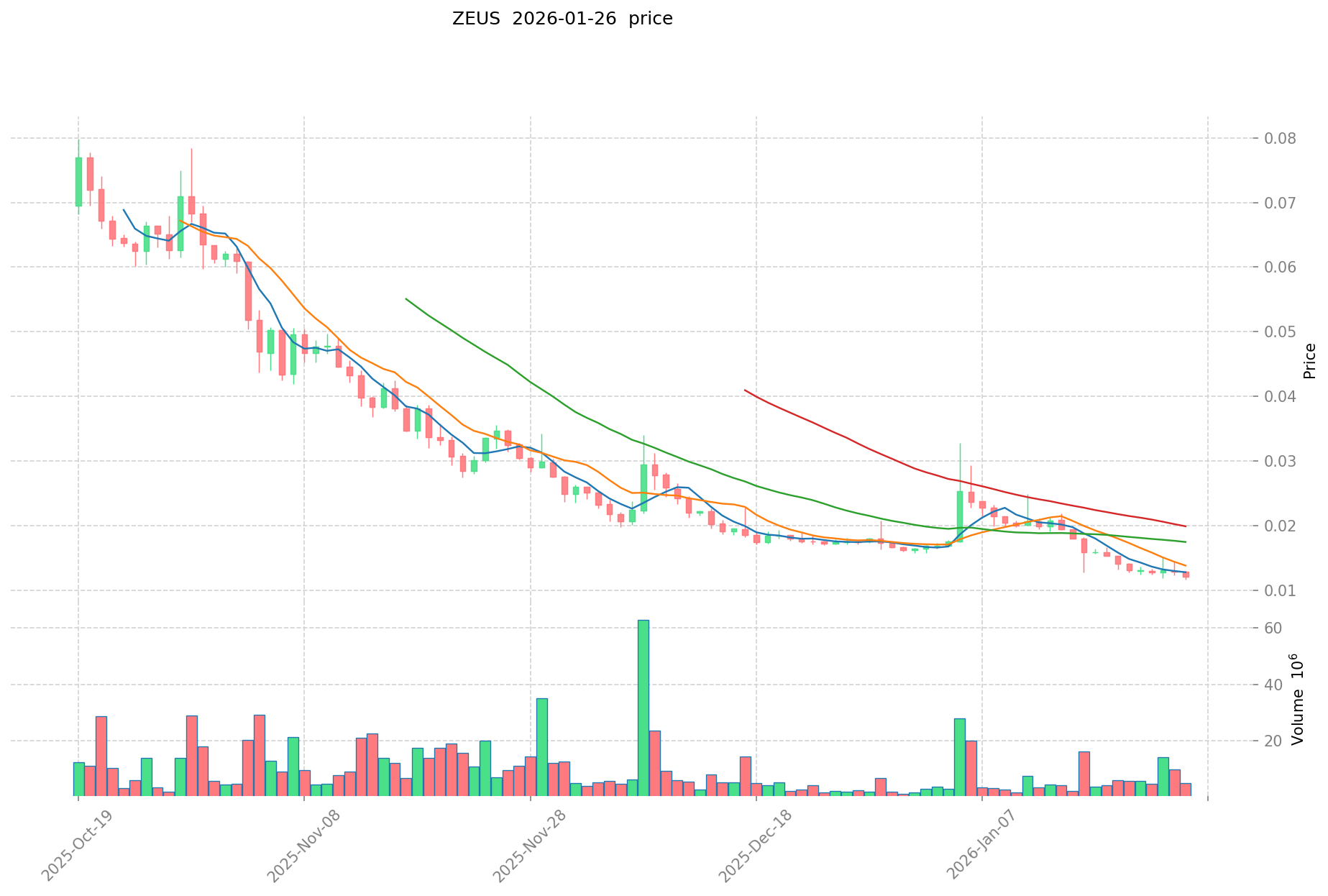
ZEUS is a notable asset in the cryptocurrency field. As of January 26, 2026, Zeus Network has a market capitalization of approximately $10.05 million, with a circulating supply of around 833.67 million tokens, and the current price is maintained at around $0.01206. Positioned as a cross-chain communication layer on SVM focused on bridging Bitcoin liquidity to Solana through its DApp APOLLO, ZEUS has attracted attention from investors discussing "Is Zeus Network (ZEUS) a good investment?" This article will comprehensively analyze the investment value, historical trends, future price forecasts, and investment risks of ZEUS to provide reference for investors.
I. Cryptocurrency (ZEUS) Historical Price Review and Current Investment Value Status
- 2024: Zeus Network launched on mainnet in April → Token experienced significant volatility with initial price discovery phase
- 2024: Token reached peak valuation in early April → ZEUS price achieved notable levels before entering consolidation phase
- 2024-2026: Market cycle transition → Price declined from elevated levels to current range
Current ZEUS Investment Market Status (January 2026)
- ZEUS current price: $0.01206
- 24-hour trading volume: $58,521.92
- Circulating supply: 833,666,194.62 ZEUS
- Market capitalization: $10,054,014.31
- Total supply: 999,995,473.41 ZEUS
- Circulating ratio: 83.37%
- Token holders: 79,882
- Listed on 22 exchanges
Click to view real-time ZEUS market price
II. Core Factors Affecting Whether ZEUS is a Good Investment (Is Zeus Network(ZEUS) a Good Investment)
Supply Mechanism and Scarcity (ZEUS investment scarcity)
- Maximum Supply: Zeus Network has a maximum supply of 1,000,000,000 ZEUS tokens, with approximately 833,666,195 tokens currently in circulation, representing about 83.37% of the total supply.
- Supply Dynamics: The relatively high circulating supply ratio suggests that the majority of tokens are already in the market, which may limit the potential impact of future token releases on price volatility.
- Investment Consideration: The defined maximum supply cap establishes a clear scarcity model, which could serve as a fundamental element for long-term investment analysis, though market performance depends on multiple factors beyond supply mechanics.
Technology and Ecosystem Development (Technology & Ecosystem for ZEUS investment)
- Cross-Chain Communication Layer: Zeus Network operates as a cross-chain communication layer implemented on the Solana Virtual Machine (SVM), focusing on facilitating interoperability between blockchain networks.
- Bitcoin-Solana Bridge Initiative: The network's primary mission involves bringing Bitcoin liquidity to the Solana ecosystem through its first decentralized application, APOLLO, which aims to expand cross-chain asset accessibility.
- SPL Token Standard: ZEUS is deployed as an SPL token on the Solana blockchain, benefiting from Solana's high-throughput infrastructure and lower transaction costs.
- Ecosystem Positioning: As a cross-chain infrastructure project, Zeus Network's investment value is tied to the adoption of cross-chain solutions and the growth of Bitcoin-Solana interoperability use cases.
Market Performance Context
- Price Trends: As of January 26, 2026, ZEUS is trading at approximately $0.01206, showing declines of 0.41% over 1 hour, 5.03% over 24 hours, 16.54% over 7 days, 30.45% over 30 days, and 97.86% over 1 year.
- Market Capitalization: The token maintains a market capitalization of approximately $10.05 million, with a fully diluted valuation of around $12.06 million, representing 0.00039% of the total cryptocurrency market.
- Holder Distribution: The token has approximately 79,882 holders, indicating a relatively distributed ownership structure across the network.
- Exchange Availability: ZEUS is listed on 22 exchanges, providing multiple access points for trading and liquidity.
III. ZEUS Future Investment Forecast and Price Outlook (Is Zeus Network(ZEUS) worth investing in 2026-2031)
Short-term Investment Forecast (2026, short-term ZEUS investment outlook)
- Conservative forecast: $0.0069 - $0.0122
- Neutral forecast: $0.0122 - $0.0152
- Optimistic forecast: $0.0152 and above
Mid-term Investment Outlook (2027-2029, mid-term Zeus Network(ZEUS) investment forecast)
- Market stage expectation: The mid-term outlook for ZEUS reflects a gradual recovery phase, with anticipated development in cross-chain communication infrastructure and potential expansion of Bitcoin liquidity integration with Solana ecosystem.
- Investment return forecast:
- 2027: $0.0082 - $0.0174
- 2028: $0.0082 - $0.0180
- 2029: $0.0109 - $0.0191
- Key catalysts: Progress in cross-chain technology implementation, expansion of APOLLO DApp functionality, broader adoption of SVM-based solutions, and overall market conditions for cross-chain communication protocols.
Long-term Investment Outlook (Is ZEUS a good long-term investment?)
- Baseline scenario: $0.0106 - $0.0257 (assuming steady development of cross-chain infrastructure and moderate market adoption)
- Optimistic scenario: $0.0142 - $0.0257 (assuming accelerated adoption of cross-chain solutions and favorable market conditions)
- Risk scenario: Below $0.0106 (under conditions of limited adoption or adverse market environment)
For more details on ZEUS long-term investment and price predictions: Price Prediction
2026-2031 Long-term Outlook
- Base scenario: $0.0106 - $0.0218 (corresponding to steady progress and gradual mainstream application improvement)
- Optimistic scenario: $0.0142 - $0.0257 (corresponding to large-scale adoption and favorable market environment)
- Transformative scenario: Above $0.0257 (if ecosystem achieves breakthrough progress and mainstream adoption)
- 2031-12-31 predicted high: $0.0257 (based on optimistic development assumptions)
Disclaimer: Price predictions are based on historical data analysis and market trend assessments. Actual performance may vary significantly due to market volatility, regulatory changes, technological developments, and other unpredictable factors. This information does not constitute investment advice.
| Year |
Predicted High Price |
Predicted Average Price |
Predicted Low Price |
Price Change |
| 2026 |
0.0152125 |
0.01217 |
0.0069369 |
0 |
| 2027 |
0.0173878875 |
0.01369125 |
0.00821475 |
13 |
| 2028 |
0.01802589975 |
0.01553956875 |
0.0082359714375 |
28 |
| 2029 |
0.019132317045 |
0.01678273425 |
0.0109087772625 |
39 |
| 2030 |
0.025679261675925 |
0.0179575256475 |
0.010594940132025 |
48 |
| 2031 |
0.02574570452082 |
0.021818393661712 |
0.014181955880113 |
80 |
IV. ZEUS Investment Strategy and Risk Management (How to invest in ZEUS Network)
Investment Strategy (ZEUS investment strategy)
-
Long-term Holding (HODL ZEUS): This approach may suit conservative investors who believe in the long-term potential of cross-chain communication technology and Bitcoin-Solana liquidity bridging. Investors adopting this strategy typically focus on the fundamental value proposition rather than short-term price fluctuations.
-
Active Trading: Traders may utilize technical analysis and swing trading strategies based on price patterns. Given the 24-hour trading volume of approximately $58,521 and recent price movements ranging between $0.01163 and $0.01285, active traders should monitor volatility patterns and key support/resistance levels.
Risk Management (Risk management for ZEUS investment)
V. ZEUS Investment Risks and Challenges (Risks of investing in ZEUS Network)
-
Market Risks: ZEUS exhibits substantial volatility, with a 24-hour price change of -5.03%, 7-day decline of -16.54%, and 30-day drop of -30.45%. The current price of $0.01206 represents a significant decrease from its previous levels, indicating heightened price fluctuation risks. The relatively modest 24-hour trading volume may present liquidity challenges during market stress.
-
Regulatory Risks: As a cross-chain communication protocol connecting Bitcoin and Solana ecosystems, ZEUS may face evolving regulatory frameworks across different jurisdictions. Policy uncertainties regarding cross-chain protocols and DeFi applications could impact project operations and token utility.
-
Technical Risks: Cross-chain communication layers face inherent security complexities, including potential smart contract vulnerabilities, bridge security concerns, and protocol upgrade challenges. The success of the APOLLO DApp and its ability to effectively facilitate Bitcoin liquidity to Solana remains subject to technical execution risks.
-
Market Positioning Risks: With a market cap ranking of 1195 and market dominance of 0.00039%, ZEUS operates in a highly competitive segment with numerous established cross-chain solutions. The circulating supply represents 83.37% of maximum supply, suggesting limited token release pressure but also concentration risks among current holders.
VI. Conclusion: Is ZEUS Network a Good Investment?
-
Investment Value Summary: ZEUS Network addresses the technical challenge of cross-chain communication, specifically targeting Bitcoin-Solana liquidity bridging. However, recent price performance reflects substantial volatility and market uncertainty. The project's long-term viability depends on successful execution of its cross-chain infrastructure and adoption of the APOLLO DApp.
-
Investor Recommendations:
✅ Beginners: Consider dollar-cost averaging (DCA) strategy with small position sizes, and prioritize secure storage using SPL-compatible hardware wallets. Focus on understanding the cross-chain technology fundamentals before investing.
✅ Experienced Investors: May explore swing trading opportunities based on technical patterns, while maintaining strict risk management protocols. Consider ZEUS as a small portfolio allocation within a broader cross-chain infrastructure thesis.
✅ Institutional Investors: Conduct thorough due diligence on protocol security, team background, and competitive positioning. Any allocation should align with strategic exposure to cross-chain communication infrastructure, with appropriate risk controls for early-stage protocols.
⚠️ Disclaimer: Cryptocurrency investments involve substantial risks, including complete loss of capital. This content is provided for informational purposes only and does not constitute investment advice. Conduct independent research and consider your risk tolerance before making investment decisions.
VII. FAQ
Q1: What is Zeus Network (ZEUS) and what makes it unique as an investment?
Zeus Network is a cross-chain communication layer built on the Solana Virtual Machine (SVM) that focuses on bridging Bitcoin liquidity to the Solana ecosystem through its DApp APOLLO. As of January 26, 2026, ZEUS trades at approximately $0.01206 with a market capitalization of $10.05 million. The project's uniqueness lies in its specialized focus on connecting Bitcoin—the largest cryptocurrency by market cap—with Solana's high-throughput blockchain infrastructure, addressing a specific market need for cross-chain liquidity solutions. However, investors should note the token has experienced significant volatility, with a 97.86% decline over one year, reflecting the early-stage risks associated with cross-chain infrastructure projects.
Q2: How has ZEUS performed historically and what is its current market position?
ZEUS launched on mainnet in April 2024 and experienced initial price discovery volatility, reaching peak valuations in early 2024 before entering a consolidation and decline phase. Currently, the token maintains approximately 833.67 million tokens in circulation (83.37% of maximum supply) with 79,882 holders across 22 exchanges. Recent performance shows declines of 5.03% over 24 hours, 16.54% over 7 days, and 30.45% over 30 days. With a market cap ranking of 1195 and market dominance of 0.00039%, ZEUS represents a small-cap cryptocurrency with limited liquidity, as evidenced by its 24-hour trading volume of approximately $58,521.
Q3: What are the key price predictions for ZEUS from 2026 to 2031?
Short-term forecasts for 2026 range from conservative estimates of $0.0069-$0.0122 to optimistic projections of $0.0152 and above. Mid-term outlook (2027-2029) suggests gradual recovery with 2027 predictions of $0.0082-$0.0174, expanding to $0.0109-$0.0191 by 2029. Long-term projections through 2031 present a baseline scenario of $0.0106-$0.0257, with the optimistic scenario reaching up to $0.0257 by December 2031. These predictions assume steady development of cross-chain infrastructure and increasing adoption of Bitcoin-Solana interoperability solutions. However, actual performance may vary significantly due to market volatility, regulatory changes, technological developments, and competitive dynamics in the cross-chain communication sector.
Q4: What investment strategies are appropriate for ZEUS?
For conservative investors, a long-term holding (HODL) strategy allocating 1-3% of crypto portfolio may be suitable, focusing on the fundamental value of cross-chain technology rather than short-term fluctuations. Moderate investors might allocate 3-7% while employing dollar-cost averaging to manage volatility risk. Active traders can explore swing trading strategies based on technical analysis, monitoring key support and resistance levels within the recent range of $0.01163-$0.01285. Risk management should include diversification with more established cryptocurrencies and stablecoins, secure storage using SPL-compatible hardware wallets for long-term holdings, and position sizing appropriate to the token's relatively modest liquidity and market capitalization of $10.05 million.
Q5: What are the major risks associated with investing in ZEUS?
ZEUS investment carries substantial risks across multiple dimensions. Market risk is evident through extreme volatility, with recent declines of 30.45% over 30 days and 97.86% over one year, combined with limited liquidity as indicated by modest trading volumes. Technical risks include potential smart contract vulnerabilities, cross-chain bridge security concerns, and execution challenges for the APOLLO DApp's Bitcoin-Solana liquidity bridging functionality. Regulatory uncertainty surrounding cross-chain protocols and DeFi applications across different jurisdictions presents compliance risks. Additionally, competitive positioning risks exist given ZEUS's small market dominance (0.00039%) in a crowded cross-chain infrastructure sector with numerous established competitors, potentially limiting the project's ability to capture significant market share.
Q6: How does ZEUS's tokenomics affect its investment potential?
ZEUS has a maximum supply of 1 billion tokens, with approximately 833.67 million (83.37%) already in circulation, suggesting limited future token release pressure but also concentration risks among current holders. The defined supply cap establishes a clear scarcity model that could support long-term value appreciation if demand increases. As an SPL token on Solana, ZEUS benefits from the network's high-throughput infrastructure and lower transaction costs. However, the relatively high circulating ratio means most tokens are already in the market, potentially limiting supply-side price catalysts. The token's distribution across 79,882 holders indicates moderate decentralization, though the project's long-term success depends more critically on adoption of its cross-chain infrastructure and the utility value of its APOLLO DApp than on tokenomics alone.
Q7: What key developments could influence ZEUS's future investment value?
Several catalysts could significantly impact ZEUS's investment trajectory. Technical milestones include successful implementation and scaling of the cross-chain communication protocol, security audits and upgrades to the APOLLO DApp, and expansion of Bitcoin-Solana liquidity bridging capabilities. Ecosystem growth factors encompass increased adoption of SVM-based solutions, partnerships with major DeFi protocols or institutional players, and integration with additional blockchain networks beyond Bitcoin and Solana. Market conditions such as broader cryptocurrency market trends, regulatory clarity for cross-chain protocols, and competitive dynamics within the cross-chain infrastructure sector will also play crucial roles. Given the project's current early-stage status and recent price performance, potential investors should closely monitor development updates, on-chain activity metrics, and total value locked (TVL) in the APOLLO bridge as indicators of fundamental progress.
Q8: Is ZEUS suitable for beginner cryptocurrency investors?
ZEUS presents significant challenges for beginner investors due to its high volatility, limited liquidity, early-stage development status, and complex cross-chain technology fundamentals. The token's 97.86% decline over one year and recent 30-day drop of 30.45% demonstrate the substantial downside risks inherent in small-cap cryptocurrency projects. Beginners considering ZEUS should first gain foundational knowledge of cryptocurrency markets, blockchain technology, and cross-chain communication protocols before investing. If proceeding, they should employ strict risk management through dollar-cost averaging with very small position sizes (maximum 1-3% of crypto portfolio), secure storage using SPL-compatible hardware wallets, and recognition that total capital loss is possible. More established cryptocurrencies with greater liquidity, longer track records, and clearer use cases may be more appropriate starting points for those new to cryptocurrency investing.
* The information is not intended to be and does not constitute financial advice or any other recommendation of any sort offered or endorsed by Gate.