Zeus Network (ZEUS) operates as a cross-chain communication layer on Solana Virtual Machine, bridging Bitcoin liquidity through its APOLLO DApp. Currently trading at $0.0123 with a $10.25 million market cap, ZEUS has declined significantly from its $1.1485 peak in April 2024. The analysis examines investment viability across multiple timeframes: short-term ($0.0076-$0.0172), mid-term growth potential through 2028, and long-term scenarios reaching $0.0402 by 2031 under optimistic conditions. Key investment factors include 833.67 million circulating tokens (83.37% of supply), 79,882 holders across 22 exchanges, and relatively limited $58,457 daily volume. Primary risks encompass high volatility, technical vulnerabilities in cross-chain bridges, regulatory uncertainty, and competitive pressures. Suitable allocation ranges from 1-3% for conservative investors to 10% for experienced traders employing active strategies on Gate and other platforms.
Introduction: Zeus Network (ZEUS) Investment Position and Market Outlook
ZEUS represents a notable digital asset in the cryptocurrency sector, launched in April 2024 as a cross-chain communication layer implemented on SVM. As of January 26, 2026, ZEUS maintains a market capitalization of approximately $10.25 million with a circulating supply of around 833.67 million tokens, currently priced at $0.0123. With its positioning as a bridge for introducing Bitcoin liquidity to Solana through its first DApp APOLLO, ZEUS has attracted attention from investors examining whether Zeus Network (ZEUS) presents a viable investment opportunity. This analysis provides a comprehensive examination of ZEUS's investment characteristics, historical price movements, future price considerations, and associated investment risks to offer reference points for potential investors.
The token currently ranks #1186 by market capitalization and is available on 22 exchanges, with approximately 79,882 holders. Over the past year, ZEUS has experienced significant price fluctuations, with recent periods showing downward pressure across multiple timeframes. Understanding the fundamentals, technical dynamics, and risk factors of this cross-chain communication token remains essential for informed investment decisions in the evolving cryptocurrency landscape.
I. Token (ZEUS) Historical Price Review and Current Investment Value
- 2024: Initial token launch and market debut → Early investors experienced significant volatility with prices reaching elevated levels during the initial listing phase
- 2024 (April): Price reached a peak of $1.1485 during the early market cycle → ZEUS demonstrated notable price appreciation in the weeks following its deployment
- 2025-2026: Market adjustment period → Price declined from higher levels to current trading range, reflecting broader market conditions and project development phases
Current ZEUS Investment Market Status (January 2026)
- ZEUS current price: $0.0123
- Market sentiment (Fear & Greed Index): Data not available in provided materials
- 24-hour trading volume: $58,457.53
- Institutional investor holdings: Data not available in provided materials
Click to view real-time ZEUS market price
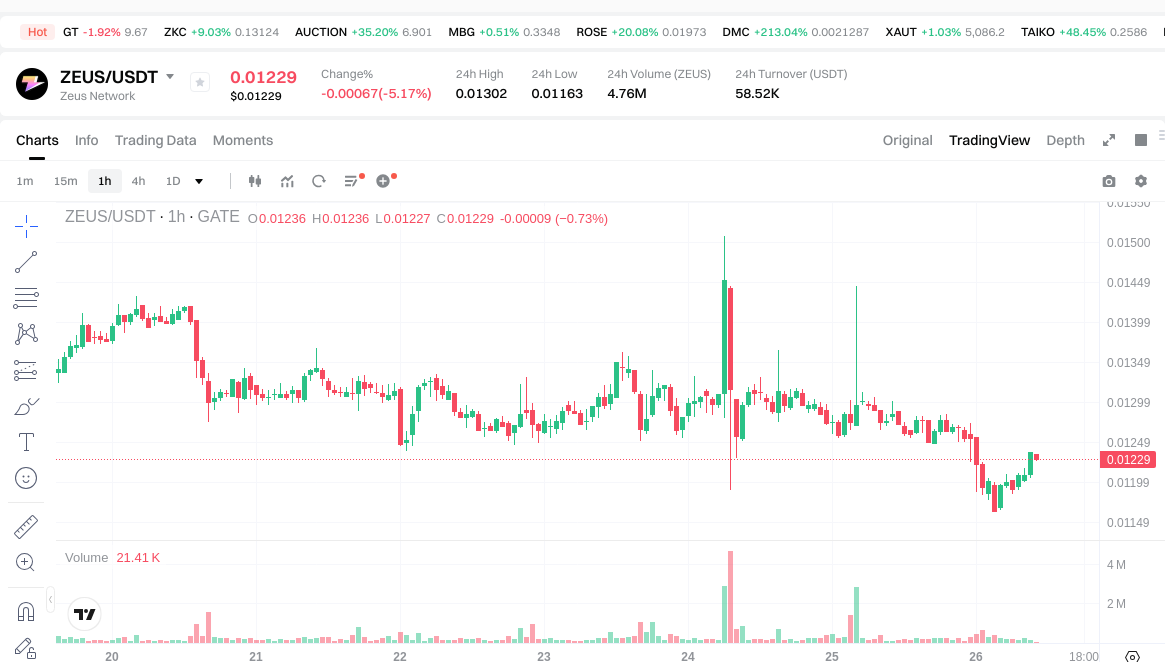
II. Core Factors Affecting Whether ZEUS Is a Good Investment
Supply Mechanism and Scarcity (ZEUS Investment Scarcity)
- Supply Mechanism → According to the data, Zeus Network (ZEUS) has a maximum supply of 1,000,000,000 tokens, with a current circulating supply of 833,666,194.623621 tokens (approximately 83.37% of the total supply). The relatively high circulating ratio suggests that a significant portion of the token supply is already in the market, which may influence the token's scarcity dynamics and potential price volatility.
- Historical Price Context → ZEUS has experienced considerable price fluctuations since its launch. The token reached a notable price level of $1.1485 on April 8, 2024, but has since declined significantly, with the price falling to approximately $0.01163 on January 25, 2026. This substantial price movement reflects the token's sensitivity to market conditions and supply-demand dynamics.
- Investment Implications → The supply mechanism and scarcity profile are important considerations for investors. With a large portion of the supply already circulating and a fully diluted market cap closely aligned with the current market cap (83.37% ratio), the potential impact of future token releases on price may be relatively limited. However, the token's historical volatility suggests that investors should carefully assess market conditions and project developments when evaluating long-term investment potential.
Institutional Investment and Mainstream Adoption (Institutional Investment in ZEUS)
- Holder Distribution → As of the latest data, Zeus Network (ZEUS) has approximately 79,882 token holders, indicating a relatively broad distribution of ownership. This suggests a growing community of participants, though the level of institutional involvement remains an important factor to monitor for assessing mainstream adoption trends.
- Exchange Presence → ZEUS is listed on 22 cryptocurrency exchanges, providing investors with multiple access points for trading. The availability of the token across various platforms may contribute to liquidity and visibility within the broader crypto market, though this does not necessarily indicate institutional adoption or endorsement.
Macroeconomic Environment's Impact on ZEUS Investment
- Market Context → The broader cryptocurrency market environment can significantly influence the investment attractiveness of tokens like ZEUS. Factors such as monetary policy changes, interest rate adjustments, and macroeconomic conditions can affect investor risk appetite and capital flows into digital assets. During periods of economic uncertainty or shifts in monetary policy, investors may reassess their allocation strategies across various asset classes, including cryptocurrencies.
- Market Position → With a market dominance of 0.00039% and a ranking of 1186, ZEUS represents a relatively small position within the overall cryptocurrency market. This positioning suggests that the token's price movements may be more susceptible to broader market trends and shifts in investor sentiment toward smaller-cap digital assets.
Technology and Ecosystem Development (Technology & Ecosystem for ZEUS Investment)
- Core Technology → Zeus Network serves as a cross-chain communication layer implemented on the Solana Virtual Machine (SVM). The project's primary mission focuses on introducing Bitcoin liquidity to the Solana ecosystem through its first decentralized application (DApp), APOLLO. This cross-chain functionality aims to address interoperability challenges and expand liquidity options within the Solana ecosystem.
- Technical Infrastructure → ZEUS operates using the SPL (Solana Program Library) standard on the Solana blockchain. This technical foundation provides the token with access to Solana's high-performance infrastructure, which is designed to support fast transaction processing and lower fees compared to some other blockchain networks.
- Ecosystem Considerations → The development and adoption of Zeus Network's cross-chain communication capabilities and its applications, such as APOLLO, are important factors in evaluating the project's long-term value proposition. The success of these initiatives in attracting users, facilitating Bitcoin-Solana liquidity bridging, and expanding the ecosystem's utility could influence the token's investment profile over time. Investors should monitor the progress of technical development, ecosystem growth, and the competitive landscape in cross-chain solutions when assessing ZEUS's potential.
III. ZEUS Future Investment Forecast and Price Outlook (Is Zeus Network(ZEUS) worth investing in 2026-2031)
Short-term Investment Forecast (2026, short-term ZEUS investment outlook)
- Conservative forecast: $0.007626 - $0.0123
- Neutral forecast: $0.0123 - $0.01476
- Optimistic forecast: $0.01476 - $0.01722
Mid-term Investment Outlook (2027-2028, mid-term Zeus Network(ZEUS) investment forecast)
- Market stage expectation: During this period, ZEUS may experience gradual recovery and stabilization as the project continues to develop its cross-chain communication infrastructure between Bitcoin and Solana ecosystems.
- Investment return forecast:
- 2027: $0.0112176 - $0.0193356
- 2028: $0.016024932 - $0.02386692
- Key catalysts: Expansion of APOLLO DApp adoption, growth in Bitcoin liquidity bridging to Solana, and broader SVM ecosystem development.
Long-term Investment Outlook (Is ZEUS a good long-term investment?)
- Base scenario: $0.01761378696 - $0.027930433608 (assuming steady development of cross-chain infrastructure and moderate market conditions)
- Optimistic scenario: $0.027930433608 - $0.04021982439552 (assuming accelerated adoption of Zeus Network's cross-chain solutions and favorable market sentiment)
- Risk scenario: Below $0.01163 (under adverse market conditions or significant competition in cross-chain communication space)
Click to view ZEUS long-term investment and price prediction: Price Prediction
2026-01-26 - 2031 Long-term Outlook
- Base scenario: $0.01761378696 - $0.027930433608 (corresponding to steady progress and gradual mainstream application growth)
- Optimistic scenario: $0.027930433608 - $0.04021982439552 (corresponding to large-scale adoption and favorable market environment)
- Transformative scenario: Above $0.04021982439552 (if ecosystem achieves breakthrough developments and mainstream popularization)
- 2031-12-31 predicted high: $0.04021982439552 (based on optimistic development assumptions)
Disclaimer
| Year |
Predicted High Price |
Predicted Average Price |
Predicted Low Price |
Price Change |
| 2026 |
0.01722 |
0.0123 |
0.007626 |
0 |
| 2027 |
0.0193356 |
0.01476 |
0.0112176 |
20 |
| 2028 |
0.02386692 |
0.0170478 |
0.016024932 |
38 |
| 2029 |
0.0298677456 |
0.02045736 |
0.0128881368 |
66 |
| 2030 |
0.030698314416 |
0.0251625528 |
0.01761378696 |
104 |
| 2031 |
0.04021982439552 |
0.027930433608 |
0.02178573821424 |
127 |
IV. ZEUS Investment Strategy and Risk Management (How to invest in ZEUS Network)
Investment Methodology (ZEUS investment strategy)
Long-term Holding (HODL ZEUS): This approach may be suitable for conservative investors who believe in the long-term potential of cross-chain communication infrastructure. Given ZEUS Network's focus on bridging Bitcoin liquidity to Solana through its APOLLO DApp, investors adopting this strategy would maintain their positions through market fluctuations, betting on the growing demand for cross-chain solutions.
Active Trading: This strategy relies on technical analysis and swing trading opportunities. With ZEUS experiencing notable price volatility (7-day change of -15.79% and 30-day change of -29.81% as of January 26, 2026), active traders may identify entry and exit points based on price movements between support levels around $0.01163 and resistance levels near $0.01302.
Risk Management (Risk management for ZEUS investment)
Asset Allocation Ratios:
- Conservative investors: Consider limiting ZEUS exposure to 1-3% of crypto portfolio
- Moderate investors: May allocate 3-7% depending on risk tolerance
- Experienced investors: Could consider up to 10% allocation with appropriate hedging strategies
Risk Hedging Solutions: Implementing multi-asset portfolio strategies that include established cryptocurrencies alongside smaller-cap tokens like ZEUS can help mitigate concentration risk. Investors may also consider using stop-loss orders to limit downside exposure.
Secure Storage:
- Cold wallets: Hardware wallets provide offline storage for long-term holdings
- Hot wallets: Convenient for active trading but require robust security practices
- Multi-signature wallets: Additional security layer for larger holdings
V. ZEUS Investment Risks and Challenges (Risks of investing in ZEUS Network)
Market Risks: ZEUS demonstrates significant price volatility, with the token experiencing a decline from its all-time high of $1.1485 (April 8, 2024) to $0.01163 (January 25, 2026), representing substantial drawdown. The 24-hour trading volume of $58,457.53 suggests relatively limited liquidity compared to major cryptocurrencies, which may contribute to price fluctuations.
Regulatory Risks: Cross-chain communication protocols and DeFi applications face evolving regulatory frameworks across different jurisdictions. Changes in cryptocurrency regulations, particularly concerning cross-chain bridges and liquidity protocols, could impact ZEUS Network's operations and token value.
Technical Risks: As a cross-chain communication layer, ZEUS Network's infrastructure depends on the security and stability of multiple blockchain networks. Potential vulnerabilities in smart contracts, bridge protocols, or the underlying SVM implementation could pose risks. Network upgrades or protocol changes may introduce technical challenges that could temporarily affect functionality.
Project-Specific Risks: With a market capitalization of approximately $10.25 million and ranking at #1186, ZEUS represents a smaller-cap cryptocurrency project. The circulating supply ratio of 83.37% indicates that additional token releases could occur, potentially affecting price dynamics.
VI. Conclusion: Is ZEUS Network a Good Investment?
Investment Value Summary: ZEUS Network addresses the technical challenge of cross-chain communication, specifically focusing on connecting Bitcoin liquidity with the Solana ecosystem. The project's infrastructure approach targets a genuine market need as blockchain interoperability continues to develop. However, the token has experienced considerable price decline over the past year, and the project operates in a competitive landscape with other cross-chain solutions.
Investor Recommendations:
✅ Beginners: Consider dollar-cost averaging (DCA) strategies with small position sizes, ensuring tokens are stored in secure, self-custody wallets. Thorough research into cross-chain technology and ZEUS Network's specific use case is essential before investing.
✅ Experienced Investors: May explore swing trading opportunities based on technical analysis, while maintaining diversified portfolio allocation. Understanding the competitive dynamics of cross-chain protocols and monitoring development progress can inform investment decisions.
✅ Institutional Investors: Could evaluate ZEUS as part of a broader thesis on blockchain interoperability infrastructure, with appropriate due diligence on technical architecture, team credentials, and market positioning.
⚠️ Disclaimer: Cryptocurrency investments carry substantial risks, including potential loss of capital. This content is provided for informational purposes only and does not constitute investment advice. Market conditions, regulatory environments, and project developments can change rapidly. Investors should conduct independent research and consider their individual risk tolerance and financial circumstances before making investment decisions.
VII. FAQ
Q1: What is Zeus Network (ZEUS) and what problem does it solve?
Zeus Network (ZEUS) is a cross-chain communication layer built on the Solana Virtual Machine (SVM) that bridges Bitcoin liquidity to the Solana ecosystem through its first DApp, APOLLO. The project addresses the interoperability challenge between Bitcoin and Solana blockchains, enabling Bitcoin holders to access Solana's high-performance infrastructure and DeFi opportunities while maintaining exposure to Bitcoin liquidity.
Q2: Why has ZEUS price declined significantly from its all-time high?
ZEUS has declined from $1.1485 (April 8, 2024) to approximately $0.0123 (January 26, 2026), representing a substantial drawdown. This price movement reflects several factors including broader cryptocurrency market conditions, the early-stage nature of the project, relatively limited trading volume ($58,457.53 daily), and the competitive landscape in cross-chain communication protocols. The token's smaller market capitalization ($10.25 million) and ranking (#1186) also contribute to higher price volatility compared to established cryptocurrencies.
Q3: Is ZEUS suitable for long-term investment?
ZEUS may appeal to investors who believe in the long-term potential of blockchain interoperability infrastructure, particularly Bitcoin-Solana bridging solutions. The project addresses a genuine market need as cross-chain communication continues to develop. However, investors should consider the significant risks including high volatility, limited liquidity, competitive market dynamics, and the early-stage nature of the project. Conservative investors might allocate 1-3% of their crypto portfolio, while more experienced investors could consider up to 10% with appropriate risk management strategies including portfolio diversification and stop-loss orders.
Q4: What are the primary risks associated with investing in ZEUS?
Key risks include: (I) Market volatility and liquidity constraints, with limited daily trading volume increasing susceptibility to price fluctuations; (II) Technical risks inherent in cross-chain bridge protocols and smart contract vulnerabilities; (III) Regulatory uncertainty surrounding cross-chain communication and DeFi applications; (IV) Competitive pressure from other cross-chain solutions targeting similar use cases; (V) Token supply dynamics, with 83.37% of total supply already circulating and potential for additional releases affecting price.
Q5: How does ZEUS's circulating supply affect its investment profile?
ZEUS has a maximum supply of 1 billion tokens with approximately 833.67 million tokens currently circulating (83.37% of total supply). This relatively high circulating ratio indicates that a significant portion of the token supply is already in the market, which may limit the impact of future token releases on price dilution. However, the remaining 16.63% could still enter circulation, potentially affecting supply-demand dynamics. The high circulating ratio suggests reduced scarcity compared to tokens with lower circulation percentages, which investors should factor into their valuation considerations.
Q6: What trading strategies are appropriate for ZEUS given its volatility?
Two primary approaches exist: (I) Long-term holding (HODL) for conservative investors who believe in the cross-chain infrastructure thesis, maintaining positions through market fluctuations while focusing on fundamental development milestones; (II) Active trading for experienced investors, leveraging technical analysis to identify entry points near support levels ($0.01163) and exit points near resistance levels ($0.01302), particularly given recent volatility (-15.79% over 7 days, -29.81% over 30 days). Active traders should implement strict risk management including stop-loss orders and position sizing appropriate to their risk tolerance.
Q7: What factors could drive ZEUS price appreciation in the future?
Potential catalysts include: (I) Increased adoption of the APOLLO DApp and expansion of Bitcoin liquidity bridging functionality; (II) Growth in the broader Solana ecosystem and increased demand for cross-chain solutions; (III) Successful technical development milestones and protocol upgrades enhancing security and functionality; (IV) Strategic partnerships expanding ZEUS Network's reach and utility; (V) Favorable shifts in the macroeconomic environment increasing investor appetite for smaller-cap cryptocurrencies. However, these potential drivers carry no guarantees and are subject to market conditions, competitive dynamics, and execution risk.
Q8: Where can investors purchase and store ZEUS tokens securely?
ZEUS is available on 22 cryptocurrency exchanges, providing multiple access points for trading. For secure storage, investors should consider: (I) Cold wallets (hardware wallets) for long-term holdings, offering offline storage protection against online threats; (II) Hot wallets for active trading, requiring robust security practices including two-factor authentication and regular security audits; (III) Multi-signature wallets for larger holdings, adding an extra security layer through required multiple approvals for transactions. Investors should never leave significant holdings on exchanges and should maintain control of their private keys through self-custody solutions.
* The information is not intended to be and does not constitute financial advice or any other recommendation of any sort offered or endorsed by Gate.