This comprehensive analysis evaluates whether ZIGChain (ZIG) represents a viable investment opportunity in 2026. ZIG, an EVM-compatible Layer 1 blockchain launched in 2021, currently trades at $0.05965 with a market cap of $84.04 million and 600,000 registered users. The article examines historical price performance, identifies core investment factors including supply mechanisms and ecosystem development, and provides detailed price forecasts through 2031 across conservative, neutral, and optimistic scenarios. It outlines tailored investment strategies for beginners, experienced traders, and institutional investors, while comprehensively addressing market risks, regulatory challenges, and technical vulnerabilities. The analysis concludes that ZIG presents substantial volatility and potential, requiring careful risk management and portfolio diversification for interested investors.
Introduction: ZIGChain (ZIG) Investment Position and Market Outlook
ZIG is a notable asset in the cryptocurrency space, having been launched in 2021 and building a substantial presence in the social investment and blockchain infrastructure sectors. As of January 2026, ZIG maintains a market capitalization of approximately $84.04 million, with a circulating supply of around 1.41 billion tokens and a current price hovering near $0.05965. Positioned as an EVM-compatible Layer 1 blockchain designed to democratize wealth generation, ZIG has evolved from its roots as the native token of Zignaly, an FSCA-licensed social investment platform and top Binance Link Partner. The project's ecosystem encompasses over 600,000 registered users, 30,000 unique token holders, and a following of 100,000 on X (formerly Twitter), alongside active communities on Telegram and Discord. With a circulating supply ratio of approximately 70.45% and availability on 17 exchanges, ZIG has established itself as a mid-cap cryptocurrency project. This analysis examines ZIG's investment value, historical performance, future price projections, and associated risks to provide readers with comprehensive reference material for evaluating "Is ZIGChain (ZIG) a good investment?"
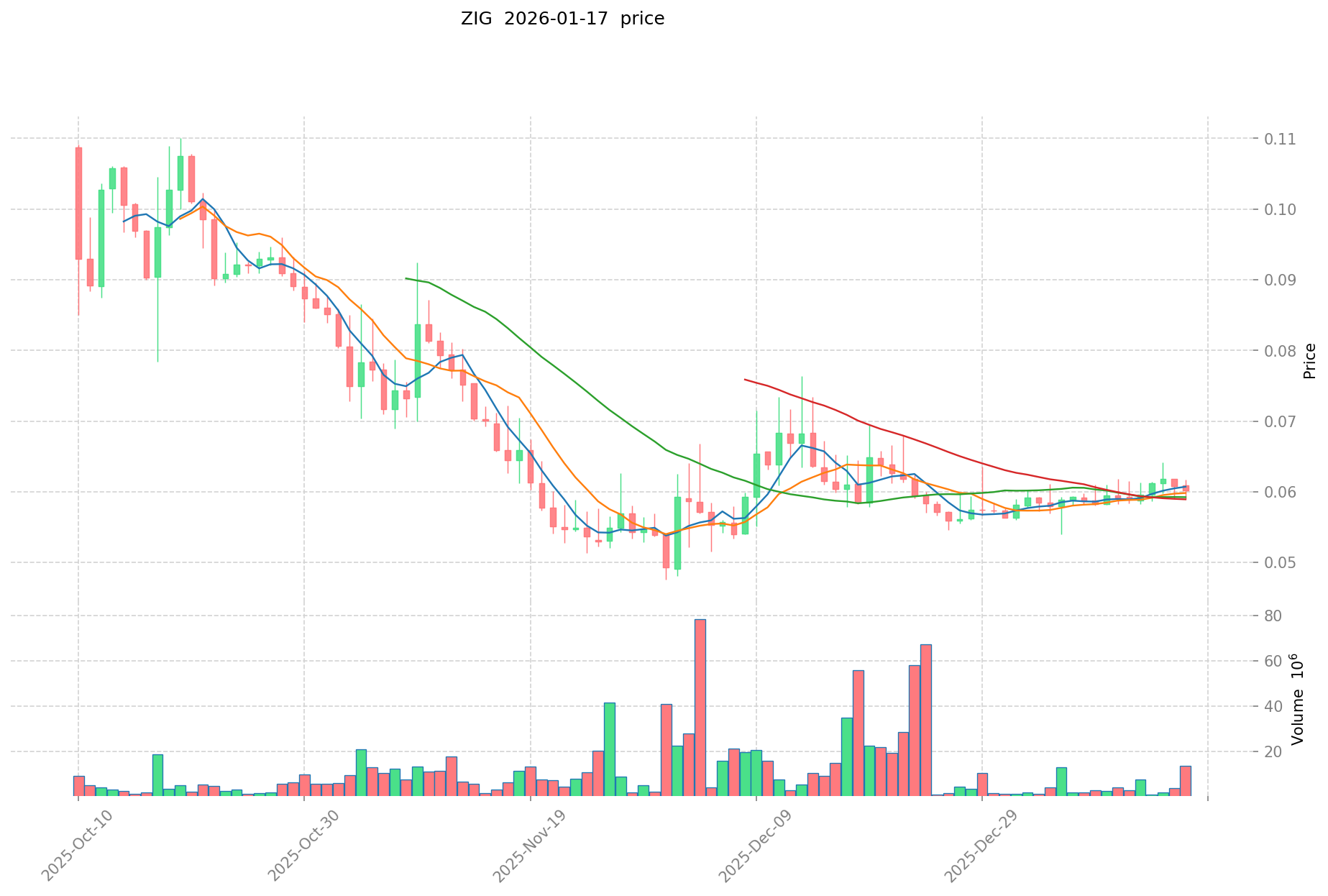
I. ZIG Price History Review and Current Investment Status
- 2018: Zignaly launched as an FSCA-licensed social investment platform and top Binance Link Partner, establishing its foundation in the wealth generation sector with an initial offering price of $0.10.
- 2021: During the cryptocurrency market expansion period, ZIG experienced notable price movements, reaching a peak level of $0.224179 on April 15, 2021.
- 2023: Amid broader market adjustments, the token price declined to $0.00428716 on July 15, 2023, reflecting the cyclical nature of digital asset markets.
- 2025-2026: The project evolved into ZIGChain, transitioning to an EVM-compatible Layer 1 blockchain focused on democratizing wealth generation protocols.
Current Market Status (January 2026)
- Current ZIG Price: $0.05965
- 24-Hour Trading Volume: $30,275.24
- Market Capitalization: $84,043,318.44
- Circulating Supply: 1,408,940,795 ZIG (70.45% of total supply)
- Total Supply: 1,953,940,795 ZIG
- Maximum Supply: 2,000,000,000 ZIG
- Token Holders: 17,728 addresses
- Number of Exchanges: 17 trading platforms
- Market Dominance: 0.0034%
View real-time ZIG market price
Recent Price Trends
- 1-Hour Change: -0.22%
- 24-Hour Change: -0.73%
- 7-Day Change: +0.61%
- 30-Day Change: -0.35%
- 1-Year Change: -51.16%
Community and Ecosystem Status
Zignaly has built a substantial user base with over 600,000 registered users, 30,000 unique $ZIG holders, 100,000 followers on X (formerly Twitter), and tens of thousands more across Telegram and Discord communities. The platform's evolution from a social investment platform to a Layer 1 blockchain demonstrates its ongoing development in the wealth generation sector.
II. Core Factors Influencing Whether ZIG is a Good Investment
Supply Mechanism and Scarcity (ZIG Investment Scarcity)
- ZIG operates with a maximum supply of 2,000,000,000 tokens, with approximately 1,408,940,795 tokens currently in circulation, representing about 70.45% of the total supply. This controlled supply mechanism may influence price dynamics and investment considerations.
- The token's price has experienced substantial fluctuation since its launch, with historical data showing variations between $0.00428716 and $0.224179. Such price movements reflect the evolving market perception of the token's value proposition.
- Investment consideration: The remaining uncirculated supply of approximately 29.55% represents potential future supply that could impact scarcity dynamics over time.
Institutional Investment and Mainstream Adoption (Institutional Investment in ZIG)
- The platform has attracted over 600,000 registered users and maintains approximately 17,728 token holders as of January 2026, indicating growing user adoption within its ecosystem.
- Zignaly operates as an FSCA-licensed social investment platform and maintains partnership status as a top Binance Link Partner, which may contribute to its regulatory positioning and market accessibility.
- The platform's evolution from a trading platform to ZIGChain, an EVM-compatible Layer 1 blockchain, represents a strategic expansion aimed at broadening its technological infrastructure and potential use cases.
Macroeconomic Environment's Impact on ZIG Investment
- Cryptocurrency markets generally respond to shifts in monetary policy and interest rate changes, which can affect investor preferences between traditional and digital assets.
- During periods of economic uncertainty, digital assets may experience varying levels of investor interest, though individual token performance depends on multiple project-specific factors.
- Broader market conditions and regulatory developments continue to shape the investment landscape for blockchain-based projects like ZIGChain.
Technology and Ecosystem Development (Technology & Ecosystem for ZIG Investment)
- ZIGChain's transition to an EVM-compatible Layer 1 blockchain represents a technical evolution designed to support wealth generation protocols and investment strategies within its ecosystem.
- The platform's architecture enables wealth managers to deploy investment protocols, potentially expanding the utility and application scope of the ZIG token.
- The project's social investment platform combines copy trading functionality with profit-sharing mechanisms, creating an ecosystem where users can engage with experienced traders and investment strategies.
III. ZIG Future Investment Forecast and Price Outlook (Is ZIGChain(ZIG) worth investing in 2026-2031)
Short-term Investment Forecast (2026, short-term ZIG investment outlook)
- Conservative forecast: $0.050106 - $0.05965
- Neutral forecast: $0.05965 - $0.06608
- Optimistic forecast: $0.06608 - $0.079931
Mid-term Investment Outlook (2027-2029, mid-term ZIGChain(ZIG) investment forecast)
- Market stage expectation: ZIGChain may experience gradual expansion as its EVM-compatible Layer 1 blockchain infrastructure continues to evolve within the wealth management ecosystem.
- Investment return forecast:
- 2027: $0.048155445 - $0.080259075
- 2028: $0.0570188385 - $0.09153024075
- 2029: $0.05995981017 - $0.10243134237375
- Key catalysts: Platform development progress, ecosystem protocol deployment, user base expansion among registered investors and wealth managers.
Long-term Investment Outlook (Is ZIG a good long-term investment?)
- Base scenario: $0.052927024102143 - $0.1039969596393 (assuming steady ecosystem development and maintained market position)
- Optimistic scenario: $0.098425693944337 - $0.136811714582629 (assuming expanded adoption of wealth generation protocols and increased platform engagement)
- Risk scenario: below $0.050106 (under adverse market conditions or significant competitive pressures)
Click to view ZIG long-term investment and price forecast: Price Prediction
2026-01-18 - 2031 Long-term Outlook
- Base scenario: $0.052927024102143 - $0.092854428249375 (corresponding to steady progress and gradual mainstream application growth)
- Optimistic scenario: $0.098425693944337 - $0.136811714582629 (corresponding to large-scale adoption and favorable market environment)
- Transformational scenario: above $0.136811714582629 (if ecosystem achieves breakthrough developments and mainstream popularization)
- 2031-12-31 forecast high: $0.136811714582629 (based on optimistic development assumptions)
Disclaimer: Price forecasts are based on historical data analysis and market projections. Actual results may vary significantly due to market volatility, regulatory changes, technological developments, and other unforeseen factors. These forecasts should not be considered as investment advice.
| Year |
Predicted High Price |
Predicted Average Price |
Predicted Low Price |
Price Change |
| 2026 |
0.079931 |
0.05965 |
0.050106 |
0 |
| 2027 |
0.080259075 |
0.0697905 |
0.048155445 |
17 |
| 2028 |
0.09153024075 |
0.0750247875 |
0.0570188385 |
25 |
| 2029 |
0.10243134237375 |
0.083277514125 |
0.05995981017 |
39 |
| 2030 |
0.1039969596393 |
0.092854428249375 |
0.052927024102143 |
55 |
| 2031 |
0.136811714582629 |
0.098425693944337 |
0.058071159427159 |
65 |
IV. ZIG Investment Strategy and Risk Management (How to invest in ZIG)
Investment Strategy (ZIG investment strategy)
Long-term Holding (HODL ZIG): Suitable for Conservative Investors
Long-term holding represents a passive investment approach that may suit investors with lower risk tolerance. This strategy involves acquiring ZIG tokens and maintaining positions over extended periods, potentially reducing exposure to short-term price fluctuations. Investors following this approach typically focus on the fundamental development of the ZIGChain ecosystem and its long-term adoption potential.
Active Trading: Technical Analysis and Swing Trading
Active trading strategies involve frequent position adjustments based on technical analysis and market trends. Given ZIG's 24-hour price range between $0.05937 and $0.06022 as of January 18, 2026, traders may identify entry and exit points using various technical indicators. This approach requires continuous market monitoring and understanding of cryptocurrency market dynamics.
Risk Management (Risk management for ZIG investment)
Asset Allocation Ratios: Conservative / Aggressive / Professional Investors
- Conservative investors may consider limiting ZIG exposure to 1-3% of their total portfolio, given the asset's volatility characteristics
- Aggressive investors might allocate 5-10% of their portfolio, accepting higher risk for potential returns
- Professional investors with extensive market experience may adjust allocations based on market conditions and risk assessment frameworks
Risk Hedging Solutions: Multi-Asset Portfolio + Risk Management Tools
Diversification across multiple digital assets and traditional financial instruments can help mitigate concentration risk. Investors may consider combining ZIG holdings with other cryptocurrencies, stablecoins, or traditional assets. Additionally, utilizing stop-loss orders and position sizing strategies can help manage downside exposure.
Secure Storage: Hot and Cold Wallets + Hardware Wallet Recommendations
ZIG tokens are available on multiple blockchain networks including Ethereum (ETH), Binance Smart Chain (BSC), and Polygon (MATIC). Security practices include:
- Cold storage solutions (hardware wallets) for long-term holdings
- Hot wallets for active trading with limited fund allocation
- Multi-signature wallets for institutional or large holdings
- Regular security audits of storage solutions
V. ZIG Investment Risks and Challenges (Risks of investing in ZIG)
Market Risk: High Volatility and Price Manipulation
ZIG has demonstrated significant price volatility, with a 1-year decline of approximately 51.16% as of January 18, 2026. The token's historical price range spans from $0.00428716 (July 15, 2023) to $0.224179 (April 15, 2021), indicating substantial price fluctuations. Market participants should be aware that cryptocurrency markets can experience rapid price movements influenced by various factors including trading volume, market sentiment, and macroeconomic conditions.
Regulatory Risk: Policy Uncertainty Across Different Jurisdictions
Regulatory frameworks for cryptocurrencies continue to evolve globally. While Zignaly operates as an FSCA-licensed social investment platform, regulatory changes in different jurisdictions could impact the project's operations and token utility. Investors should monitor regulatory developments in their respective countries and assess potential compliance requirements.
Technical Risk: Network Security Vulnerabilities and Upgrade Challenges
As an EVM-compatible Layer 1 blockchain, ZIGChain faces technical considerations including:
- Smart contract vulnerabilities that could affect ecosystem applications
- Network congestion during periods of high activity
- Successful execution of protocol upgrades and maintenance
- Security of cross-chain bridge implementations across Ethereum, BSC, and Polygon networks
The multi-chain deployment strategy introduces additional complexity in maintaining security across different blockchain environments.
VI. Conclusion: Is ZIG a Good Investment?
Investment Value Summary: ZIG presents a multifaceted investment proposition within the social investment and wealth generation sector. The project's evolution from a social trading platform to a Layer 1 blockchain represents an ambitious expansion of its original vision. However, price performance data indicates significant volatility and a substantial decline over the past year.
Investor Recommendations:
✅ Beginners: Dollar-cost averaging (DCA) strategy combined with secure wallet storage may help mitigate timing risk and ensure asset protection. New investors should prioritize understanding the project fundamentals and blockchain technology before committing significant capital.
✅ Experienced Investors: Swing trading strategies combined with portfolio diversification could be appropriate for those with technical analysis skills and market experience. This approach requires active monitoring of price movements and market conditions.
✅ Institutional Investors: Strategic long-term allocation decisions should be based on comprehensive due diligence, including assessment of the ZIGChain ecosystem development, adoption metrics, and competitive positioning within the Layer 1 blockchain landscape.
⚠️ Disclaimer: Cryptocurrency investments carry substantial risk, including the potential loss of principal. This content is provided for informational purposes only and does not constitute investment advice, financial advice, trading advice, or any other type of advice. Investors should conduct independent research and consult with qualified financial advisors before making investment decisions.
VII. FAQ
Q1: What is ZIGChain and how does it differ from traditional cryptocurrencies?
ZIGChain is an EVM-compatible Layer 1 blockchain launched in 2021, initially operating as the native token of Zignaly, an FSCA-licensed social investment platform and top Binance Link Partner. Unlike traditional cryptocurrencies focused solely on payment or store of value, ZIGChain is specifically designed to democratize wealth generation by enabling wealth managers to deploy investment protocols on its blockchain infrastructure. The platform combines copy trading functionality with profit-sharing mechanisms, creating an ecosystem where users can engage with experienced traders and investment strategies. With over 600,000 registered users and deployment across multiple blockchain networks including Ethereum, BSC, and Polygon, ZIGChain represents a convergence of social investment technology and blockchain infrastructure.
Q2: How has ZIG's price performed historically, and what is its current market position?
ZIG has experienced significant price volatility since its launch. The token reached its all-time high of $0.224179 on April 15, 2021, during the broader cryptocurrency market expansion. However, it subsequently declined to $0.00428716 on July 15, 2023, representing a substantial correction. As of January 2026, ZIG trades at approximately $0.05965 with a market capitalization of $84.04 million and a 24-hour trading volume of $30,275.24. The token has shown a 51.16% decline over the past year, though recent short-term performance indicates a 0.61% increase over 7 days. With 17,728 token holders and availability on 17 exchanges, ZIG maintains a mid-cap position with approximately 70.45% of its maximum supply in circulation.
Q3: What are the main factors that could influence ZIG's future investment value?
Several key factors may impact ZIG's investment value: (1) Supply Dynamics - With approximately 29.55% of tokens still uncirculated, future token releases could affect scarcity and price dynamics; (2) Ecosystem Development - The successful deployment of wealth generation protocols and expansion of the Layer 1 blockchain infrastructure could drive utility and adoption; (3) User Growth - Continued expansion beyond the current 600,000 registered users and 30,000 unique token holders may positively influence network effects; (4) Regulatory Environment - As an FSCA-licensed platform, regulatory developments across different jurisdictions could impact operations and token utility; (5) Technical Evolution - The effectiveness of ZIGChain's EVM-compatible infrastructure and multi-chain deployment across Ethereum, BSC, and Polygon networks will be crucial for long-term competitiveness.
Q4: What investment strategies are suitable for different types of ZIG investors?
Investment approaches vary by investor profile: Conservative Investors may consider a long-term holding (HODL) strategy with 1-3% portfolio allocation, utilizing dollar-cost averaging (DCA) to mitigate timing risk and storing assets in secure cold wallets. Aggressive Investors with higher risk tolerance might allocate 5-10% of their portfolio and employ active trading strategies using technical analysis, taking advantage of ZIG's price volatility within its 24-hour trading range. Professional Investors may adjust allocations dynamically based on market conditions while implementing comprehensive risk management frameworks including multi-asset diversification, stop-loss mechanisms, and position sizing strategies. All investors should prioritize secure storage solutions appropriate to their holdings, ranging from hardware wallets for long-term positions to segregated hot wallets for active trading.
Q5: What are the primary risks associated with investing in ZIG?
ZIG investment carries several significant risks: Market Risk - The token has demonstrated extreme volatility, with a historical price range from $0.00428716 to $0.224179, and a 51.16% decline over the past year, indicating substantial price fluctuation potential. Regulatory Risk - While operating as an FSCA-licensed platform, evolving cryptocurrency regulations across different jurisdictions could impact operations, token utility, and market accessibility. Technical Risk - As an EVM-compatible Layer 1 blockchain deployed across multiple networks (Ethereum, BSC, Polygon), ZIGChain faces challenges including smart contract vulnerabilities, network congestion, protocol upgrade execution, and cross-chain bridge security. Liquidity Risk - With a 24-hour trading volume of approximately $30,275, relatively low liquidity compared to larger cryptocurrencies may result in higher price slippage during large transactions. Investors should conduct thorough due diligence and only invest capital they can afford to lose.
Q6: What are the price forecasts for ZIG from 2026 to 2031?
Price projections for ZIG vary significantly based on different scenarios. For 2026 (short-term), conservative forecasts range from $0.050106 to $0.05965, while optimistic scenarios project $0.06608 to $0.079931. Mid-term forecasts (2027-2029) anticipate gradual expansion, with 2029 estimates ranging from $0.05995981017 (low) to $0.10243134237375 (high). Long-term projections through 2031 suggest a base scenario of $0.052927024102143 to $0.1039969596393, assuming steady ecosystem development. Optimistic scenarios project $0.098425693944337 to $0.136811714582629, contingent on widespread adoption of wealth generation protocols and favorable market conditions. However, these forecasts should be interpreted as reference points rather than guarantees, as actual performance may vary significantly due to market volatility, regulatory changes, technological developments, and competitive dynamics in the blockchain ecosystem.
Q7: How does ZIGChain's multi-chain deployment strategy affect its investment proposition?
ZIGChain's deployment across Ethereum (ETH), Binance Smart Chain (BSC), and Polygon (MATIC) networks represents both opportunities and challenges for investors. This multi-chain strategy potentially enhances accessibility by allowing users to interact with the platform on their preferred blockchain, potentially reducing transaction costs and increasing network flexibility. The approach may also facilitate broader adoption by tapping into different blockchain ecosystems and user bases. However, this strategy introduces additional complexity, including the need to maintain security across multiple networks, manage cross-chain bridge implementations, and ensure consistent protocol functionality across different blockchain environments. Investors should consider that multi-chain deployments require robust technical infrastructure and security measures, and any vulnerabilities in cross-chain mechanisms could pose risks to the ecosystem's overall security and token value.
Q8: Is ZIG suitable for long-term investment, and what should investors monitor?
Whether ZIG is suitable for long-term investment depends on individual risk tolerance and investment objectives. The token's significant volatility (51.16% decline over one year) and mid-cap market position ($84.04 million market cap) suggest higher risk compared to established cryptocurrencies. Long-term investors should monitor several key metrics: (1) Ecosystem Growth - Expansion beyond the current 600,000 registered users and protocol deployment progress on the Layer 1 blockchain; (2) Token Distribution - The release schedule and impact of the remaining 29.55% uncirculated supply; (3) Technological Milestones - Successful implementation of wealth generation protocols and maintenance of cross-chain infrastructure; (4) Competitive Position - ZIGChain's differentiation within the crowded Layer 1 blockchain landscape; (5) Regulatory Developments - Changes in cryptocurrency regulations that may affect platform operations. Investors should maintain diversified portfolios, use secure storage solutions, and regularly reassess their investment thesis based on project developments and market conditions.
* The information is not intended to be and does not constitute financial advice or any other recommendation of any sort offered or endorsed by Gate.