This comprehensive analysis evaluates whether Zircuit (ZRC), a fully EVM-compatible zero-knowledge rollup Layer 2 solution, constitutes a sound investment opportunity. As of January 2026, ZRC trades at $0.002004 with a $4.55 million market cap, having experienced a 96.71% decline from its November 2024 peak of $0.14844. The article examines ZRC's core technology, market performance metrics, and tokenomics while addressing critical investment considerations including supply mechanisms showing only 22.73% circulating supply, technical architecture advantages, and significant price volatility. Multiple investment forecasts project 2026 price ranges of $0.00184-$0.00355, with long-term scenarios varying substantially based on adoption outcomes. Key risk factors include market volatility, regulatory uncertainty, and technical vulnerabilities inherent to emerging Layer 2 protocols. The analysis provides tailored investment strategies for beginners, experienced traders, and institutional investors, emphasizing disci
Introduction: Zircuit (ZRC) Investment Position and Market Outlook
Zircuit (ZRC) represents a notable asset within the cryptocurrency sector as a fully EVM-compatible, zero-knowledge rollup powered by recent advances in Layer 2 technology. As of January 29, 2026, ZRC maintains a market capitalization of approximately $4.55 million, with a circulating supply of about 2.27 billion tokens and a current trading price around $0.002004. The token operates across 23 exchanges and has attracted 2,424 holders. Ranked at position 1590 in the broader crypto market, ZRC occupies a 0.00064% market dominance. This analysis examines Zircuit's investment characteristics, historical price performance, future price considerations, and associated risk factors to provide reference information for those evaluating "Is Zircuit (ZRC) a good investment?" The following sections explore the token's technical foundation, market dynamics, and analytical perspectives relevant to informed decision-making.
I. Zircuit (ZRC) Price History Review and Current Investment Status
ZRC Historical Price Trends and Investment Returns
- 2024: ZRC reached a notable price level of $0.14844 in November 2024, representing a significant milestone for the project since its token launch.
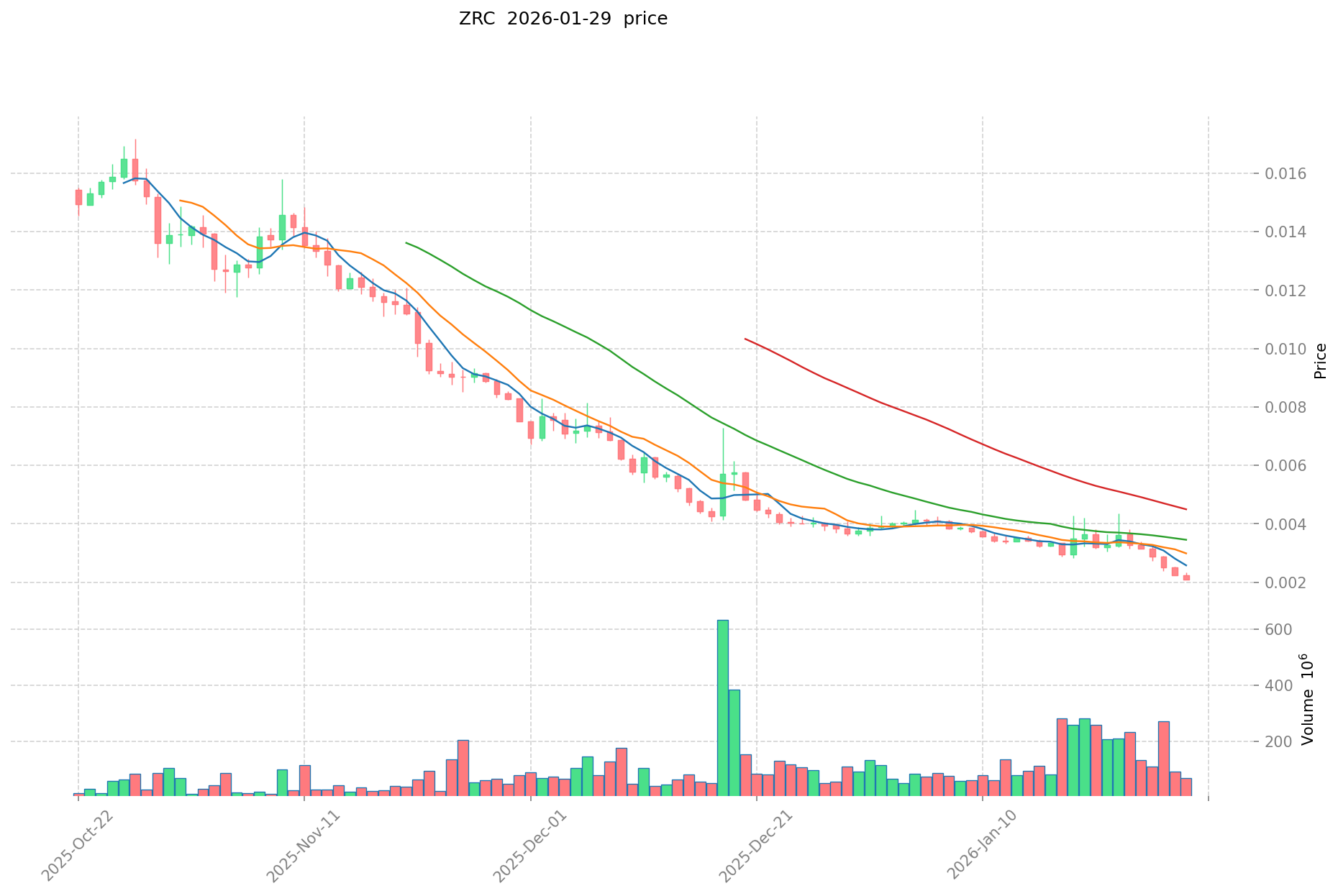
- 2026: From the November 2024 price level to January 29, 2026, ZRC experienced substantial price movement, declining to $0.002004, reflecting broader market dynamics and project-specific developments.
Current ZRC Investment Market Status (January 2026)
- ZRC Current Price: $0.002004
- 24-hour Trading Volume: $194,428.01
- Market Capitalization: $4,554,974.80
- Circulating Supply: 2,272,941,519.43 ZRC (approximately 22.73% of total supply)
- Total Supply: 10,000,000,000 ZRC
Click to view real-time ZRC market price
II. Core Factors Influencing Whether ZRC Is a Good Investment
Supply Mechanism and Scarcity (ZRC Investment Scarcity)
- Supply Structure: ZRC has a maximum supply of 10 billion tokens, with approximately 2.27 billion tokens currently in circulation, representing a circulating ratio of 22.73%
- Market Cap to FDV Ratio: The current market cap to fully diluted valuation ratio stands at 22.73%, suggesting significant token unlocks may occur in the future, which could impact price dynamics
- Investment Consideration: The large portion of uncirculated tokens (approximately 77.27%) represents a potential supply overhang that investors should factor into long-term valuation assessments
Technology and Ecosystem Development (Technology & Ecosystem for ZRC Investment)
- Core Technology: Zircuit is a fully EVM-compatible zero-knowledge rollup powered by Layer 2 technology research advancements
- Technical Architecture: The platform utilizes AI-powered sequencer-level security combined with zero-knowledge rollups and full EVM compatibility
- Ecosystem Positioning: Zircuit aims to enhance Ethereum's scalability while improving user-friendliness through its hybrid architecture
- Development Impact: The technical foundation provides potential for ecosystem expansion, though actual adoption and implementation remain key factors for investment value
- Recent Performance: ZRC has experienced considerable volatility, with a 24-hour decline of 12.97% and a 7-day decline of 37.66%
- Longer-Term Trends: The token shows a 30-day decline of 45.44% and a 1-year decline of 96.71%, indicating sustained downward pressure
- Price Range: ZRC reached a high of $0.14844 on November 16, 2024, and recorded a low of $0.001998 on January 29, 2026
- Market Sentiment: Current technical indicators suggest a bearish outlook, with various forecasts projecting subdued price performance
Price Forecast Analysis
- 2026 Projections: Multiple forecasting models suggest ZRC prices may remain constrained, with some estimates indicating potential minimum values around $0.00260 and average values near $0.00272
- Varied Predictions: Some analyses project quarterly fluctuations throughout 2026, while others suggest potential gains of approximately 7.33% compared to current levels
- Investment Perspective: Market forecasts generally indicate a cautious outlook for ZRC in 2026, with price predictions ranging considerably across different analytical models
- Risk Consideration: The divergence in price predictions reflects uncertainty in the market's assessment of ZRC's near-term trajectory
III. ZRC Future Investment Forecast and Price Outlook (Is Zircuit(ZRC) Worth Investing in 2026-2030)
Short-Term Investment Forecast (2026, Short-Term ZRC Investment Outlook)
- Conservative Forecast: $0.00184 - $0.00244
- Neutral Forecast: $0.00200 - $0.00288
- Optimistic Forecast: $0.00244 - $0.00355
Mid-Term Investment Outlook (2027-2028, Mid-Term Zircuit(ZRC) Investment Forecast)
-
Market Stage Expectation: The mid-term outlook for ZRC suggests a potential gradual recovery phase as the project continues to develop its EVM-compatible zero-knowledge rollup infrastructure. Market performance may remain influenced by broader Layer-2 solution adoption trends and competitive dynamics within the scaling ecosystem.
-
Investment Return Forecast:
- 2027: $0.00176 - $0.00355
- 2028: $0.00153 - $0.00350
-
Key Catalysts: Factors that may influence mid-term performance include technological development progress in AI-powered security features, expansion of the Zircuit ecosystem, partnerships with decentralized applications, and overall market sentiment toward Layer-2 scaling solutions.
Long-Term Investment Outlook (Is ZRC a Good Long-Term Investment?)
-
Baseline Scenario: $0.00181 - $0.00473 (assuming steady development of the ecosystem and gradual adoption of the platform's Layer-2 solutions)
-
Optimistic Scenario: $0.00347 - $0.00599 (assuming successful mainstream adoption of Zircuit's AI-enhanced security infrastructure and significant growth in decentralized finance applications)
-
Risk Scenario: $0.00153 - $0.00244 (under conditions of intensified competition from alternative Layer-2 protocols, regulatory headwinds, or technological challenges)
View ZRC long-term investment and price forecasts: Price Prediction
2026-2030 Long-Term Outlook
-
Baseline Scenario: $0.00181 - $0.00410 (corresponding to steady progress and gradual mainstream application adoption)
-
Optimistic Scenario: $0.00347 - $0.00599 (corresponding to large-scale adoption and favorable market conditions)
-
Transformative Scenario: Above $0.00599 (if the ecosystem achieves breakthrough developments and mainstream penetration)
-
December 31, 2030 Predicted High: $0.00473 (based on optimistic development assumptions)
Disclaimer: Price forecasts are derived from historical data analysis and current market trends. Cryptocurrency investments carry substantial risk, and actual market performance may differ materially from projections. This analysis does not constitute investment advice, and readers should conduct independent research and consult financial professionals before making investment decisions.
| Year |
Predicted High Price |
Predicted Average Price |
Predicted Low Price |
Price Change |
| 2026 |
0.00288576 |
0.002004 |
0.00184368 |
0 |
| 2027 |
0.003545076 |
0.00244488 |
0.0017603136 |
22 |
| 2028 |
0.00350412426 |
0.002994978 |
0.00152743878 |
49 |
| 2029 |
0.0037044882882 |
0.00324955113 |
0.0031520645961 |
62 |
| 2030 |
0.004728746804376 |
0.0034770197091 |
0.001808050248732 |
73 |
| 2031 |
0.005990209554837 |
0.004102883256738 |
0.003610537265929 |
104 |
IV. Zircuit Investment Strategy and Risk Management (How to invest in Layer 2 solutions)
Investment Methodology (Zircuit investment strategy)
Risk Management (Risk management for Zircuit investment)
-
Asset Allocation Ratios: Conservative / Aggressive / Professional investors
- Conservative investors: It is recommended to allocate no more than 5-10% of the total investment portfolio to Zircuit or similar high-risk digital assets.
- Aggressive investors: May increase allocation to 10-20%, but should maintain diversification across multiple quality projects.
- Professional investors: Can flexibly adjust positions based on market conditions and risk assessment, but should maintain overall portfolio risk control.
-
Risk Hedging Solutions: Multi-asset portfolio + hedging tools
- Diversify investments across different cryptocurrency categories, including established assets and emerging Layer 2 projects, to reduce single-asset risk.
- Consider using stablecoin positions as a buffer to manage market volatility.
- Professional investors may explore derivatives or other hedging instruments, though these require specialized knowledge.
-
Secure Storage: Hot/cold wallets + hardware wallet recommendations
- Cold wallet storage: Recommended for long-term holdings, using hardware wallets or offline storage solutions to minimize hacking risks.
- Hot wallet usage: Only keep necessary amounts for trading in exchange accounts or online wallets.
- Multi-signature wallets: Provide additional security layers for larger holdings.
- Regular security audits: Periodically review wallet security settings and backup recovery phrases.
V. Zircuit Investment Risks and Challenges (Risks of investing in Layer 2 solutions)
-
Market Risks: High volatility, price manipulation
- ZRC has demonstrated extreme price volatility, with data showing a decline from its historical high of $0.14844 to a current price of $0.002004, representing a significant drawdown.
- The 30-day decline of 45.44% and 1-year decline of 96.71% illustrate substantial market risks.
- With a 24-hour trading volume of approximately $194,428 and a relatively modest market capitalization, the asset may be susceptible to price manipulation or low liquidity issues.
- The circulating supply represents only 22.73% of the total supply, with potential future token releases possibly creating additional selling pressure.
-
Regulatory Risks: Policy uncertainty across different jurisdictions
- Cryptocurrency regulations vary significantly across countries and regions, with ongoing policy developments that may impact project operations and token trading.
- Layer 2 solutions and zero-knowledge technology may face evolving regulatory scrutiny as authorities develop frameworks for emerging blockchain technologies.
- Changes in regulatory environments could affect market access, trading availability, and overall project viability in certain jurisdictions.
-
Technical Risks: Network security vulnerabilities, upgrade failures
- As an EVM-compatible zero-knowledge rollup, Zircuit relies on complex technical architecture that may contain undiscovered vulnerabilities.
- Smart contract risks exist, including potential coding errors or security flaws that could be exploited.
- Network upgrades or protocol changes carry implementation risks that could temporarily or permanently affect functionality.
- The project's dependency on Layer 2 technology means it inherits both the benefits and potential weaknesses of this relatively newer infrastructure.
- Competition from other Layer 2 solutions may impact adoption rates and long-term sustainability.
VI. Conclusion: Is Layer 2 solutions a Good Investment?
-
Investment Value Summary: Zircuit represents innovative Layer 2 technology with potential for long-term development, but faces significant short-term price volatility and market challenges.
- The project's technological foundation as a fully EVM-compatible zero-knowledge rollup positions it within a growing sector of blockchain scalability solutions.
- Current market performance reflects considerable challenges, with substantial price declines across multiple timeframes indicating heightened risk.
- The relatively limited circulating supply and modest market capitalization suggest the project is in early stages, with both opportunities and uncertainties ahead.
-
Investor Recommendations:
-
✅ Beginners: Dollar-cost averaging + secure wallet storage
- Consider starting with small, regular investments to average entry prices and reduce timing risk.
- Prioritize learning about secure storage methods and only invest amounts you can afford to lose.
- Focus on understanding the technology and market dynamics before increasing exposure.
-
✅ Experienced Investors: Swing trading + portfolio diversification
- May utilize technical analysis for short-term trading opportunities while managing position sizes carefully.
- Maintain diversification across multiple quality projects and asset classes.
- Set clear entry and exit strategies with disciplined risk management parameters.
-
✅ Institutional Investors: Strategic long-term allocation
- Conduct thorough due diligence on technology, team, and competitive positioning.
- Consider allocation as part of a broader thesis on Layer 2 solutions and blockchain scalability.
- Implement sophisticated risk management frameworks appropriate for emerging technology investments.
⚠️ Disclaimer: Cryptocurrency investment carries substantial risks. This content is for informational purposes only and does not constitute investment advice. Investors should conduct independent research and consult with qualified financial advisors before making investment decisions.
VII. FAQ
Q1: What is Zircuit (ZRC) and what makes it different from other Layer 2 solutions?
Zircuit (ZRC) is a fully EVM-compatible zero-knowledge rollup powered by advanced Layer 2 technology that combines AI-powered sequencer-level security with zero-knowledge proofs. The platform distinguishes itself through its hybrid architecture that aims to enhance Ethereum's scalability while maintaining user-friendliness. Unlike traditional Layer 2 solutions, Zircuit integrates AI-enhanced security features at the sequencer level, providing an additional layer of protection for transactions and smart contracts. This combination of EVM compatibility, zero-knowledge technology, and AI-powered security positions Zircuit as an innovative approach to blockchain scaling, though the project is still in its early development stages with a current market capitalization of approximately $4.55 million.
Q2: Why has ZRC's price declined significantly from its November 2024 high?
ZRC has experienced a substantial price decline of approximately 96.71% over one year, dropping from $0.14844 in November 2024 to around $0.002004 as of January 29, 2026. This decline reflects multiple factors including broader cryptocurrency market volatility, the project's early-stage development status, and relatively low trading liquidity with a 24-hour volume of approximately $194,428. Additionally, the limited circulating supply of 22.73% of total tokens suggests that only a fraction of the total supply is currently in circulation, which may contribute to price instability. The competitive landscape of Layer 2 solutions and the ongoing maturation of the zero-knowledge rollup sector also influence market sentiment toward newer projects like Zircuit.
Q3: What are the main risks associated with investing in Zircuit?
Investing in Zircuit carries several significant risks that potential investors should carefully consider. Market risks include extreme price volatility, with historical data showing declines of 45.44% over 30 days and 96.71% over one year, as well as potential price manipulation due to relatively low trading volume and market capitalization. Technical risks involve potential smart contract vulnerabilities, network security issues, and the challenges inherent in maintaining complex zero-knowledge rollup infrastructure. Regulatory risks arise from evolving cryptocurrency regulations across different jurisdictions that may impact the project's operations and token trading. Furthermore, approximately 77.27% of tokens remain uncirculated, representing a potential supply overhang that could create additional selling pressure when unlocked.
Q4: How does Zircuit's tokenomics affect its investment potential?
Zircuit's tokenomics present both opportunities and challenges for investors. The project has a maximum supply of 10 billion ZRC tokens, with approximately 2.27 billion tokens (22.73%) currently in circulation. This relatively low circulating supply creates a market cap to fully diluted valuation ratio of 22.73%, indicating that a substantial portion of tokens will enter circulation in the future. This token distribution structure suggests potential dilution risk for current holders as additional tokens are released, which could impact long-term price performance. The gradual token release schedule may provide stability if managed strategically, but it also represents a significant consideration for investors evaluating the project's long-term value proposition and potential supply-side pressure on pricing.
Q5: What investment strategy is most appropriate for Zircuit?
The appropriate investment strategy for Zircuit depends on individual risk tolerance and investment objectives. Conservative investors should consider limiting allocation to 5-10% of their total portfolio, using dollar-cost averaging to mitigate timing risk, and prioritizing secure storage through hardware wallets or cold storage solutions. Aggressive investors may allocate 10-20% while maintaining diversification across multiple quality projects and potentially engaging in swing trading based on technical analysis. Professional investors can implement more sophisticated strategies including flexible position sizing, derivatives for hedging, and strategic long-term allocation as part of a broader thesis on Layer 2 solutions. Regardless of approach, all investors should conduct thorough independent research, maintain disciplined risk management, and only invest amounts they can afford to lose given the asset's high volatility and early-stage development status.
Q6: What are the long-term price prospects for Zircuit through 2030?
Long-term price forecasts for Zircuit through 2030 vary considerably depending on adoption scenarios and market conditions. Baseline scenarios project potential prices ranging from $0.00181 to $0.00473, assuming steady ecosystem development and gradual adoption of the platform's Layer 2 solutions. Optimistic scenarios suggest prices between $0.00347 and $0.00599, contingent upon successful mainstream adoption of Zircuit's AI-enhanced security infrastructure and significant growth in decentralized finance applications. However, risk scenarios indicate potential prices between $0.00153 and $0.00244 under conditions of intensified competition, regulatory challenges, or technological setbacks. These projections are derived from historical data and current market trends but carry substantial uncertainty, as cryptocurrency markets are highly volatile and actual performance may differ materially from forecasts.
Q7: How does Zircuit's technology compare to competing Layer 2 solutions?
Zircuit's technological approach combines several advanced features that differentiate it within the competitive Layer 2 ecosystem. The platform's full EVM compatibility ensures seamless integration with existing Ethereum-based applications and developer tools, reducing migration friction. Its zero-knowledge rollup architecture provides enhanced privacy and scalability benefits, while the integration of AI-powered sequencer-level security represents a relatively unique feature among Layer 2 solutions. However, Zircuit faces competition from established Layer 2 protocols with larger ecosystems, greater liquidity, and proven track records. The project's success depends on its ability to demonstrate tangible advantages in security, performance, and user experience while building developer and user adoption. The early-stage nature of the project means its competitive positioning remains under development, with actual implementation and adoption serving as key determinants of long-term viability.
Q8: What factors should investors monitor when evaluating Zircuit's development?
Investors evaluating Zircuit should monitor several key factors to assess the project's progress and investment potential. Technical development milestones include successful implementation of AI-powered security features, network stability and performance metrics, and smart contract audit results. Ecosystem growth indicators such as the number of decentralized applications building on the platform, total value locked (TVL), and transaction volume provide insights into adoption trends. Token distribution and unlock schedules should be tracked to anticipate potential supply-side pressure. Regulatory developments affecting Layer 2 solutions and zero-knowledge technology may impact operational viability. Additionally, competitive positioning relative to other Layer 2 protocols, partnership announcements, and team execution capability serve as important indicators of long-term sustainability and growth potential in the evolving blockchain scaling landscape.
* The information is not intended to be and does not constitute financial advice or any other recommendation of any sort offered or endorsed by Gate.