This comprehensive guide analyzes whether Zircuit (ZRC) represents a viable investment opportunity as an EVM-compatible zero-knowledge rollup Layer 2 scaling solution. Trading at $0.002028 with a market cap of $4.61 million as of January 2026, ZRC has experienced significant volatility, declining 96.67% over the past year from its November 2024 high of $0.14844. The article examines core investment factors including supply mechanics (22.73% circulation ratio), institutional adoption across 23 exchanges, technological infrastructure, and macroeconomic impacts on long-term viability. Price predictions span conservative ($0.0018-$0.0020) to optimistic scenarios ($0.0023-$0.0060) through 2031, addressing both short and long-term investor considerations. The analysis covers investment strategies for conservative, aggressive, and professional investors, emphasizing risk management through portfolio allocation of 1-15% depending on risk tolerance. Critical risks including extreme volatility, limited liquidity ($191,
Introduction: Zircuit (ZRC) Investment Position and Market Outlook
Zircuit (ZRC) represents a distinctive position within the cryptocurrency ecosystem as a fully EVM-compatible zero-knowledge rollup powered by advanced Layer 2 research. As of January 29, 2026, ZRC maintains a market capitalization of approximately $4.61 million with a circulating supply of 2.27 billion tokens, trading at $0.002028. The token is listed on 23 exchanges and held by 2,424 addresses. With a circulation ratio of 22.73% from its maximum supply of 10 billion tokens, ZRC demonstrates a structured token distribution model. The project's positioning within the Layer 2 scaling solutions sector has attracted attention from participants examining "Is Zircuit (ZRC) a good investment?" This article provides a comprehensive analysis of ZRC's investment characteristics, historical performance patterns, future outlook considerations, and associated risk factors to serve as reference material for market participants.
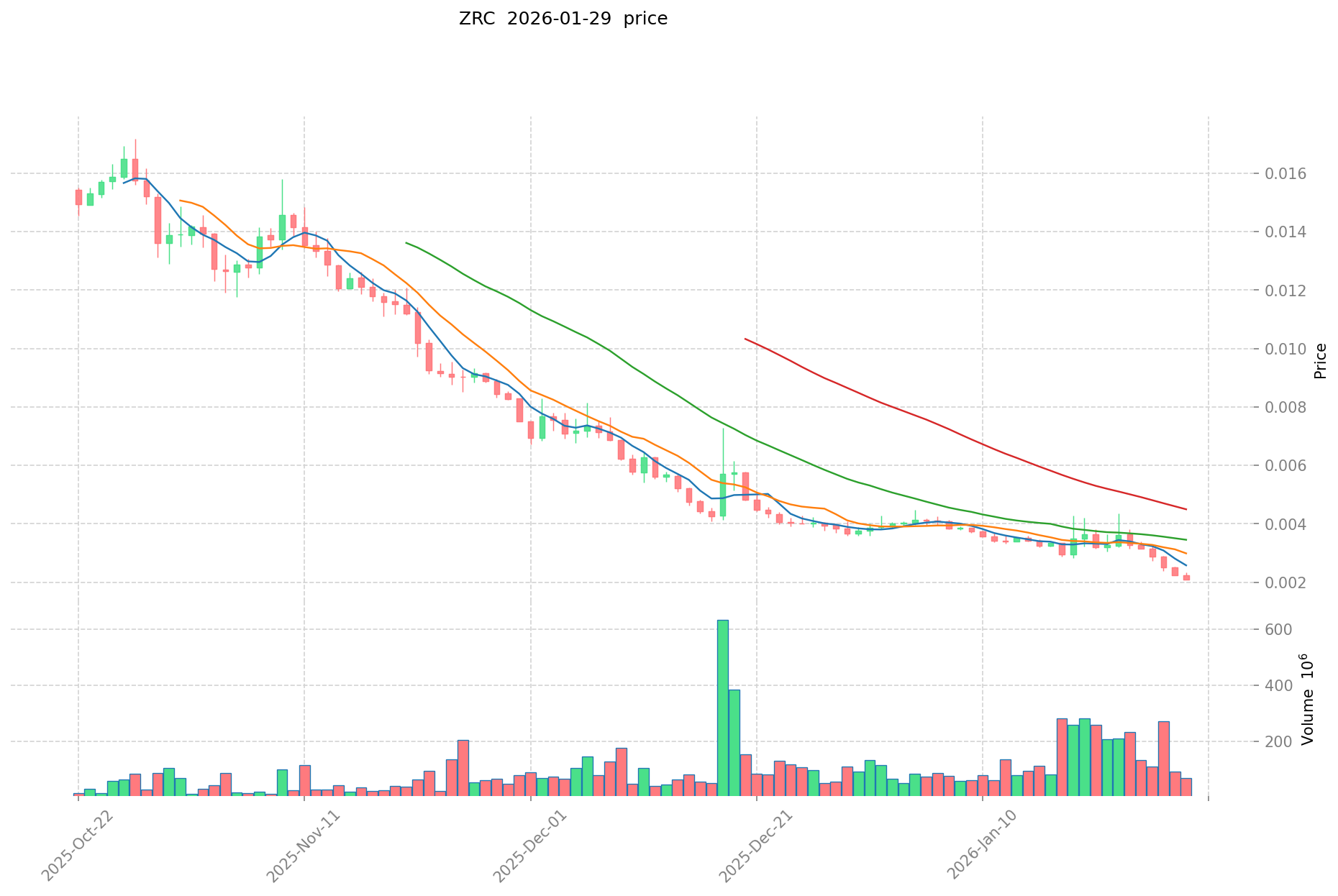
I. Zircuit (ZRC) Price History Review and Current Investment Value
- 2024: ZRC reached a notable price level of $0.14844 on November 16, 2024 → The token subsequently experienced significant price volatility in the following months.
- 2026: On January 29, 2026, ZRC recorded a price of $0.002006 → This represented a substantial decline from previous price levels, with the token trading near observed lower price ranges.
- Recent Period: Market activity showed notable fluctuations → Price movement from $0.002306 (24-hour high) to $0.002006 (24-hour low).
Current ZRC Investment Market Status (January 2026)
- ZRC Current Price: $0.002028
- 24-Hour Trading Volume: $191,445.024095
- Circulating Supply: 2,272,941,519.43 ZRC (approximately 22.73% of total supply)
- Market Capitalization: $4,609,525.40
- Fully Diluted Market Cap: $20,280,000
- Total Supply: 10,000,000,000 ZRC
- Available on 23 exchanges
- Holder Count: 2,424 addresses
Click to view real-time ZRC market price
II. Core Factors Influencing Whether ZRC is a Good Investment
Supply Mechanism and Scarcity (ZRC investment scarcity)
- Total Supply: 10,000,000,000 ZRC tokens with a circulating supply of 2,272,941,519.43 ZRC (22.73% of total supply)
- Current circulating market cap stands at $4,609,525.40, while fully diluted valuation reaches $20,280,000.00
- The relatively low circulation ratio may indicate potential future supply expansion, which could influence price dynamics
- Investment consideration: The gap between current circulation and maximum supply suggests future token releases may affect scarcity dynamics
Institutional Investment and Mainstream Adoption (Institutional investment in ZRC)
- Token holder count: 2,424 addresses currently hold ZRC tokens
- ZRC is listed on 23 cryptocurrency exchanges, providing accessibility for institutional and retail participants
- The project features ERC-20 standard implementation with contract addresses on both Ethereum and Zircuit networks
- Mainstream adoption metrics remain at early stages, with market dominance at 0.00064%
Macroeconomic Environment Impact on ZRC Investment
- As a Layer 2 scaling solution, ZRC's investment appeal may be influenced by broader Ethereum ecosystem developments
- Market volatility indicators show significant short-term fluctuations: -0.15% (1H), -11.86% (24H), -37.22% (7D), -44.62% (30D)
- 24-hour trading volume of $191,445.02 reflects moderate market liquidity
- Broader cryptocurrency market sentiment and regulatory developments may impact ZRC investment viability
Technology and Ecosystem Development (Technology & Ecosystem for ZRC investment)
- Zero-knowledge rollup technology: Zircuit operates as a fully EVM-compatible zero-knowledge rollup, leveraging advanced Layer 2 research
- AI-powered sequencer-level security: The platform incorporates artificial intelligence mechanisms for enhanced transaction security
- Ethereum scaling capability: As an L2 solution, Zircuit aims to improve Ethereum's scalability and user experience
- Technical infrastructure supports DeFi and broader blockchain applications through full EVM compatibility
- Investment consideration: The technology foundation positions ZRC within the competitive Layer 2 scaling sector, though long-term ecosystem adoption remains developing
III. ZRC Future Investment Prediction and Price Outlook (Is Zircuit(ZRC) worth investing in 2026-2030)
Short-term Investment Prediction (2026, short-term ZRC investment outlook)
- Conservative prediction: $0.0018 - $0.0020
- Neutral prediction: $0.0020 - $0.0023
- Optimistic prediction: $0.0023 - $0.0025
Mid-term Investment Outlook (2027-2028, mid-term Zircuit(ZRC) investment forecast)
-
Market stage expectation: ZRC may experience gradual recovery following the recent price decline, with potential stabilization as the project develops its EVM-compatible zero-knowledge rollup infrastructure and expands its ecosystem partnerships.
-
Investment return prediction:
- 2027: $0.0011 - $0.0031
- 2028: $0.0024 - $0.0028
-
Key catalysts: Development of AI-powered security features, expansion of Layer 2 adoption, strategic ecosystem partnerships, and broader market sentiment towards zero-knowledge rollup solutions.
Long-term Investment Outlook (Is Zircuit a good long-term investment?)
- Base scenario: $0.0015 - $0.0032 (assuming steady development of the L2 ecosystem and moderate market conditions)
- Optimistic scenario: $0.0032 - $0.0060 (assuming successful implementation of AI security features and increased adoption of zero-knowledge technology)
- Risk scenario: $0.0010 - $0.0018 (under prolonged market downturn or slower-than-expected technological adoption)
Click to view ZRC long-term investment and price prediction: Price Prediction
2026-2031 Long-term Outlook
- Base scenario: $0.0018 - $0.0031 USD (corresponding to steady progress and gradual mainstream application growth)
- Optimistic scenario: $0.0031 - $0.0060 USD (corresponding to large-scale adoption and favorable market conditions)
- Transformative scenario: Above $0.0060 USD (if the ecosystem achieves breakthrough developments and mainstream adoption)
- December 31, 2031 predicted high: $0.0033 USD (based on optimistic development assumptions)
Disclaimer: The above predictions are based on historical data analysis and market trend assessments. Cryptocurrency investments carry significant risks, and actual prices may differ substantially from predictions due to market volatility, regulatory changes, technological developments, and other unforeseen factors. This analysis does not constitute investment advice, and investors should conduct their own research and risk assessment before making investment decisions.
| Year |
Predicted High Price |
Predicted Average Price |
Predicted Low Price |
Price Change |
| 2026 |
0.00231306 |
0.002029 |
0.00180581 |
0 |
| 2027 |
0.0030828626 |
0.00217103 |
0.0011072253 |
7 |
| 2028 |
0.002810832541 |
0.0026269463 |
0.002443060059 |
29 |
| 2029 |
0.003235478410395 |
0.0027188894205 |
0.001495389181275 |
34 |
| 2030 |
0.003215358628683 |
0.002977183915447 |
0.001786310349268 |
46 |
| 2031 |
0.00334397297383 |
0.003096271272065 |
0.002322203454049 |
52 |
IV. Zircuit Investment Strategy and Risk Management (How to invest in Layer 2 solutions)
Investment Methodology (Zircuit investment strategy)
Long-term Holding (HODL Zircuit)
For conservative investors seeking exposure to Layer 2 scaling solutions, a long-term holding strategy may be considered. This approach involves:
- Accumulation during market corrections: Given ZRC's price volatility, with 24-hour fluctuations of -11.86% and 7-day changes of -37.22%, patient accumulation during downturns could potentially reduce average entry costs
- Focusing on fundamental development: Monitoring Zircuit's technological progress as an EVM-compatible zero-knowledge rollup
- Time horizon consideration: Long-term holders should be prepared for extended periods of price discovery, especially given the token's early stage with only 22.73% of total supply currently circulating
Active Trading
For traders with technical analysis expertise, active trading strategies include:
- Volatility-based trading: Utilizing the significant price swings (24-hour range: $0.002006 - $0.002306) for short-term opportunities
- Volume analysis: Current 24-hour trading volume of $191,445 suggests relatively limited liquidity, requiring careful position sizing
- Technical indicators: Employing support/resistance levels, with historical low at $0.002006 serving as a reference point
Risk Management (Risk management for Zircuit investment)
Asset Allocation Proportions
Conservative investors: Consider limiting ZRC exposure to 1-3% of cryptocurrency portfolio, given the token's high volatility and early development stage
Aggressive investors: May allocate 5-10% to Layer 2 solutions including ZRC, while maintaining diversification across multiple blockchain infrastructure projects
Professional investors: Could consider up to 15% allocation with sophisticated risk management tools, including stop-loss orders and hedging strategies
Risk Hedging Strategies
- Multi-asset portfolio construction: Combining ZRC with established cryptocurrencies and stablecoins to reduce overall portfolio volatility
- Diversification across Layer 2 solutions: Not concentrating solely on Zircuit, but spreading exposure across multiple scaling solutions
- Position sizing discipline: Limiting individual trade sizes based on portfolio risk tolerance and market liquidity constraints
Secure Storage Solutions
Cold wallet options: For long-term holdings, hardware wallets supporting ERC-20 tokens provide enhanced security against online threats
Hot wallet considerations: For active traders, reputable exchange wallets or software wallets with multi-signature capabilities offer convenience while maintaining reasonable security
Hardware wallet recommendations: Devices compatible with Ethereum and ERC-20 tokens, ensuring proper backup of recovery phrases
V. Zircuit Investment Risks and Challenges (Risks of investing in Layer 2 solutions)
Market Risks
High volatility: ZRC has experienced substantial price fluctuations, with a 30-day decline of -44.62% and 1-year decrease of -96.67%. The token's price has moved from an all-time high of $0.14844 (November 16, 2024) to a low of $0.002006, representing extreme volatility
Limited liquidity: With a 24-hour trading volume of approximately $191,445 and market capitalization of $4.61 million, the token faces liquidity constraints that could amplify price movements
Market manipulation concerns: The relatively small holder base of 2,424 addresses and limited exchange listings (23 exchanges) may create vulnerability to coordinated trading activities
Regulatory Risks
Jurisdictional uncertainty: Layer 2 solutions and zero-knowledge technology face evolving regulatory frameworks across different jurisdictions
Compliance requirements: Future regulatory developments regarding scaling solutions and privacy-enhancing technologies could impact Zircuit's operations and token utility
Cross-border considerations: The global nature of blockchain infrastructure creates complex regulatory compliance challenges
Technical Risks
Network security vulnerabilities: As with any blockchain infrastructure, zero-knowledge rollup implementations require robust security audits and continuous monitoring
Technology competition: The Layer 2 ecosystem includes numerous competing solutions, creating uncertainty about long-term market positioning
Implementation challenges: Technical complexities in maintaining EVM compatibility while implementing zero-knowledge proofs could present operational risks
Smart contract risks: The token operates on multiple chains (Zircuit native and Ethereum), with smart contracts at addresses requiring ongoing security verification
VI. Conclusion: Is Layer 2 solution a Good Investment?
Investment Value Summary
Zircuit represents participation in the Layer 2 scaling solution sector, which addresses important blockchain scalability challenges. However, the token faces considerable headwinds, including substantial price declines across multiple timeframes and limited liquidity. The early-stage nature of the project, with only 22.73% of tokens in circulation, introduces additional uncertainty regarding future token economics.
Investor Recommendations
✅ Beginners: Consider starting with small position sizes through dollar-cost averaging, storing tokens in secure hardware wallets, and thoroughly researching Layer 2 technology fundamentals before investing
✅ Experienced investors: May explore swing trading opportunities based on technical analysis, while maintaining strict risk management protocols and position sizing discipline appropriate for high-volatility assets
✅ Institutional investors: Could evaluate strategic allocations to Layer 2 infrastructure as part of broader blockchain ecosystem exposure, with comprehensive due diligence on technology, team, and competitive positioning
⚠️ Disclaimer: Cryptocurrency investments carry substantial risk, including potential total loss of capital. This content is for informational purposes only and does not constitute investment advice. Investors should conduct independent research and consult with financial professionals before making investment decisions.
VII. FAQ
Q1: What is Zircuit (ZRC) and how does it differ from other Layer 2 solutions?
Zircuit (ZRC) is a fully EVM-compatible zero-knowledge rollup powered by advanced Layer 2 research with an AI-powered sequencer-level security mechanism. Unlike standard Layer 2 solutions, Zircuit incorporates artificial intelligence features for enhanced transaction security while maintaining complete compatibility with Ethereum's Virtual Machine. The platform operates with a total supply of 10 billion tokens, currently with 22.73% in circulation, and is designed to improve Ethereum's scalability and user experience through zero-knowledge proof technology.
Q2: Is Zircuit (ZRC) a good investment for beginners in 2026?
For beginners, Zircuit presents high risk but potential learning opportunities in the Layer 2 sector. Currently trading at $0.002028 with a market cap of $4.61 million, the token has experienced significant volatility, declining -96.67% over the past year. Beginners should consider limiting exposure to 1-3% of their cryptocurrency portfolio, starting with small position sizes through dollar-cost averaging, and storing tokens in secure hardware wallets. Understanding zero-knowledge technology fundamentals and Layer 2 scaling solutions is essential before investing.
Q3: What are the primary risks associated with investing in Zircuit (ZRC)?
The primary risks include extreme price volatility (30-day decline of -44.62%, 1-year decrease of -96.67%), limited liquidity with only $191,445 in 24-hour trading volume, and a small holder base of 2,424 addresses. Additional risks encompass regulatory uncertainty surrounding Layer 2 solutions, technology competition from numerous competing scaling platforms, smart contract vulnerabilities, and the early-stage nature of the project with only 22.73% of tokens currently circulating. Market manipulation concerns also exist due to the token's limited liquidity and exchange presence.
Q4: What is the long-term price prediction for Zircuit (ZRC) through 2031?
Based on historical data analysis, the long-term outlook presents three scenarios: Base scenario projects $0.0018 - $0.0031 USD with steady development progress; Optimistic scenario estimates $0.0031 - $0.0060 USD assuming successful AI security implementation and increased zero-knowledge technology adoption; Risk scenario suggests $0.0010 - $0.0018 USD under prolonged market downturns. By December 31, 2031, the predicted high reaches $0.0033 USD under optimistic development assumptions. However, these predictions carry significant uncertainty due to market volatility, regulatory changes, and unforeseen technological developments.
Q5: How should investors approach risk management when investing in ZRC?
Conservative investors should limit ZRC exposure to 1-3% of their cryptocurrency portfolio, employing dollar-cost averaging during market corrections. Aggressive investors may allocate 5-10% while diversifying across multiple Layer 2 solutions, implementing stop-loss orders and hedging strategies. Professional investors could consider up to 15% allocation with sophisticated risk management tools. Key strategies include multi-asset portfolio construction combining ZRC with established cryptocurrencies and stablecoins, position sizing discipline based on the limited liquidity ($191,445 daily volume), and secure storage using hardware wallets compatible with ERC-20 tokens.
Q6: What factors could drive Zircuit's value in the coming years?
Key catalysts include development of AI-powered security features that differentiate Zircuit from competitors, expansion of Layer 2 adoption across the broader Ethereum ecosystem, strategic ecosystem partnerships enhancing utility, and improved market sentiment towards zero-knowledge rollup solutions. The technology foundation as an EVM-compatible zero-knowledge rollup positions ZRC within the competitive scaling sector, though long-term success depends on achieving mainstream adoption, expanding from the current 2,424 holder base, and successfully implementing its technological roadmap while maintaining security standards.
Q7: Which investment strategy is most suitable for ZRC - long-term holding or active trading?
The optimal strategy depends on investor profile and risk tolerance. Long-term holding (HODL) suits conservative investors seeking Layer 2 exposure, focusing on fundamental development while accumulating during corrections and preparing for extended price discovery periods. Active trading appeals to technically proficient traders who can capitalize on significant volatility (24-hour fluctuations of -11.86%, 7-day changes of -37.22%), though limited liquidity requires careful position sizing. Most investors should consider a balanced approach combining small long-term positions (1-3% allocation) with tactical trading opportunities based on technical analysis and market conditions.
Q8: What are the secure storage options for holding Zircuit (ZRC) tokens?
For long-term holdings, hardware wallets supporting ERC-20 tokens provide enhanced security against online threats, as ZRC operates on both Ethereum and Zircuit networks. Recommended devices include those compatible with Ethereum standards, ensuring proper backup of recovery phrases. Active traders may utilize reputable exchange wallets or software wallets with multi-signature capabilities for convenience while maintaining reasonable security. Given the token's dual-chain presence (contract addresses on both Ethereum and Zircuit), investors should verify wallet compatibility and ensure proper network configuration before transferring tokens to avoid potential loss.
* The information is not intended to be and does not constitute financial advice or any other recommendation of any sort offered or endorsed by Gate.