This comprehensive guide evaluates whether zkPass (ZKP) represents a sound investment opportunity within the cryptocurrency landscape. As of January 2026, ZKP trades at $0.1197 with a $24.14 million market capitalization, leveraging advanced zero-knowledge proof technology to bridge Web2 and Web3 data privacy verification. The analysis examines token economics, historical price volatility, and multi-scenario forecasts through 2031, projecting ranges from $0.1256 to $0.3073 under various market conditions. ZKP presents early-stage investment characteristics with significant price volatility, modest liquidity, and technical complexity requiring specialized knowledge. The article addresses investor strategies across conservative, active, and institutional profiles, emphasizing risk management through diversification and secure storage on both BSC and Ethereum networks. Essential considerations include regulatory uncertainties, cryptographic implementation risks, and gradual token circulation affecting long-term
Introduction: zkPass (ZKP) Investment Position and Market Outlook
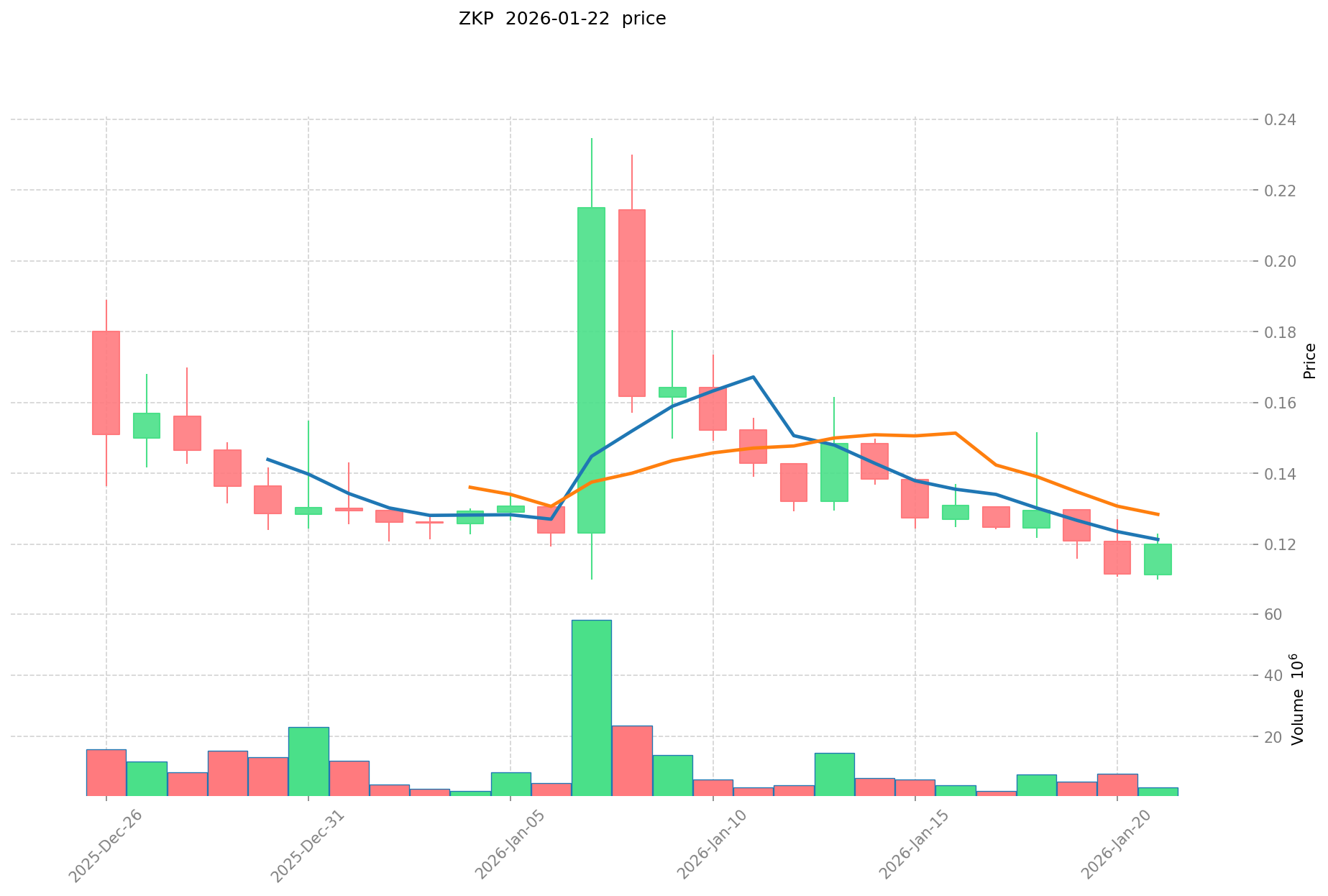
ZKP represents a notable cryptographic asset in the digital currency landscape. As of January 22, 2026, zkPass maintains a market capitalization of approximately $24.14 million with a circulating supply of 201.67 million tokens. The current trading price stands at $0.1197, reflecting recent market movements including a 3.72% increase over 24 hours and an 8.64% decline over the past week. With token contracts deployed on both BSC and ETH networks, zkPass has attracted 27,988 holders and trades across 26 exchanges.
The zkPass Protocol introduces an approach to data privacy verification by combining three-party Transport Layer Security (TLS), Multi-Party Computation (MPC), and Interactive Zero-Knowledge Proof (IZK). This cryptographic framework enables users to verify that HTTPS-accessed data originates from specific websites while maintaining zero-knowledge privacy protections. Positioned as a bridge between Web 2.0 and Web 3.0 infrastructures, the protocol addresses data sovereignty challenges inherent in centralized server architectures.
Current market metrics show ZKP holding rank #794 among digital assets, with a circulating supply representing 20.17% of the total 1 billion token maximum supply. The fully diluted market cap stands at $119.7 million. Price performance over extended periods indicates fluctuations, with a recorded range between $0.11 and $0.2346 in early 2026. This analysis examines zkPass's market positioning, historical price patterns, potential future scenarios, and associated investment considerations to provide context for those evaluating "Is zkPass (ZKP) a good investment?" within their portfolio strategies.
I. Token (ZKP) Historical Price Review and Current Investment Value
zkPass (ZKP) token has experienced notable price volatility since its launch. Based on available data, the token's price movements reflect the broader dynamics within the zero-knowledge proof and privacy-focused blockchain sector.
- 2026: Following its market debut, ZKP demonstrated early trading activity with price fluctuations between key support and resistance levels → investors experienced mixed returns during the initial trading period
- Recent period: ZKP price showed varied performance across different timeframes → short-term gains contrasted with longer-term consolidation patterns
- Current cycle: Price movements indicated shifting market sentiment → trading activity reflected ongoing adjustments in valuation
Current ZKP Investment Market Status (January 2026)
- ZKP current price: $0.1197
- 24-hour trading volume: $303,958.49
- Circulating supply: 201,666,667 ZKP (20.17% of total supply)
- Market capitalization: $24,139,500.04
- Fully diluted valuation: $119,700,000.00
- Token holders: 27,988
- Listed on 26 exchanges
Click to view real-time ZKP market price
II. Core Factors Affecting Whether ZKP is a Good Investment (Is zkPass(ZKP) a Good Investment)
Supply Mechanism and Scarcity (ZKP investment scarcity)
- Maximum supply capped at 1,000,000,000 ZKP with current circulating supply of 201,666,667 tokens (approximately 20.17% of total supply) → influences price dynamics and investment valuation
- The controlled token release mechanism and relatively low circulation ratio may contribute to supply-side constraints that could affect price movements over time
- Investment significance: scarcity dynamics and gradual token distribution remain key considerations for long-term investment evaluation
Institutional Investment and Mainstream Adoption (Institutional investment in ZKP)
- Current holder base stands at 27,988 addresses, indicating early-stage adoption levels
- Trading availability across 26 exchanges provides accessibility for diverse investor participation
- The protocol's positioning as a bridge between Web 2.0 and Web 3.0 infrastructure may influence institutional interest in privacy-preserving verification solutions
Macroeconomic Environment's Impact on ZKP Investment
- Monetary policy shifts and interest rate changes → may alter risk appetite for emerging crypto assets like ZKP
- Market conditions during periods of economic uncertainty could influence demand for privacy-focused blockchain infrastructure solutions
- Broader cryptocurrency market sentiment and regulatory developments may impact ZKP's investment dynamics
Technology and Ecosystem Development (Technology & Ecosystem for ZKP investment)
- zkPass Protocol leverages three-party Transport Layer Security (TLS), Multi-Party Computation (MPC), and Interactive Zero-Knowledge Proof (IZK) → creates technical differentiation in the privacy verification space
- The protocol enables users to prove data accessed via HTTPS originates from specific websites while maintaining zero-knowledge privacy guarantees → supports applications in identity verification, credential verification, and data attestation
- Cross-chain deployment on both Ethereum (ERC-20) and BSC (BEP-20) networks → expands potential ecosystem integration opportunities and accessibility across different blockchain environments
III. ZKP Future Investment Forecast and Price Outlook (Is zkPass(ZKP) worth investing in 2026-2031)
Short-term Investment Forecast (2026, short-term ZKP investment outlook)
- Conservative Forecast: $0.1120 - $0.1192
- Neutral Forecast: $0.1192 - $0.1450
- Optimistic Forecast: $0.1450 - $0.1739
Mid-term Investment Outlook (2027-2029, mid-term zkPass(ZKP) investment forecast)
-
Market Stage Expectation: Based on historical volatility patterns and the circulating supply ratio of 20.17%, ZKP may experience gradual price adjustments as the token distribution evolves. The project's focus on privacy-preserving data verification through zero-knowledge proofs positions it within the emerging Web3 infrastructure sector.
-
Investment Return Forecast:
- 2027: $0.0923 - $0.1655
- 2028: $0.1077 - $0.1794
- 2029: $0.1476 - $0.1962
-
Key Catalysts: Adoption of zkPass protocol in decentralized identity verification applications, expansion of privacy-preserving data bridging solutions between Web2 and Web3, and potential integration with major blockchain ecosystems.
Long-term Investment Outlook (Is ZKP a good long-term investment?)
- Base Scenario: $0.1256 - $0.2602 (assuming steady protocol adoption and moderate market conditions through 2030-2031)
- Optimistic Scenario: $0.2011 - $0.3073 (assuming accelerated adoption of privacy verification solutions and favorable regulatory environment)
- Risk Scenario: Below $0.10 (under conditions of limited protocol uptake or adverse market cycles)
View ZKP long-term investment and price forecast: Price Prediction
2026-01-22 to 2031 Long-term Outlook
- Base Scenario: $0.1256 - $0.2602 USD (corresponding to steady progress and gradual mainstream application growth)
- Optimistic Scenario: $0.2011 - $0.3073 USD (corresponding to large-scale adoption and favorable market conditions)
- Transformative Scenario: Above $0.3073 USD (subject to breakthrough ecosystem developments and mainstream proliferation)
- 2031-12-31 Projected High: $0.3073 USD (based on optimistic development assumptions)
Disclaimer: These forecasts are based on historical data analysis and market trends. Cryptocurrency investments carry substantial risk, and past performance does not guarantee future results. Investors should conduct thorough research and consider their risk tolerance before making investment decisions.
| Year |
Predicted High Price |
Predicted Average Price |
Predicted Low Price |
Price Change |
| 2026 |
0.173886 |
0.1191 |
0.111954 |
0 |
| 2027 |
0.16553709 |
0.146493 |
0.09229059 |
22 |
| 2028 |
0.17941730175 |
0.156015045 |
0.10765038105 |
30 |
| 2029 |
0.19622792284875 |
0.167716173375 |
0.14759023257 |
40 |
| 2030 |
0.260220028799981 |
0.181972048111875 |
0.125560713197193 |
52 |
| 2031 |
0.30732349345374 |
0.221096038455928 |
0.201197394994894 |
84 |
IV. zkPass Investment Strategy and Risk Management (How to invest in zkPass)
Investment Methodology (zkPass investment strategy)
-
Long-term Holding (HODL zkPass): Suitable for conservative investors seeking exposure to privacy-preserving infrastructure protocols. This approach involves accumulating zkPass tokens during market corrections and maintaining positions through market cycles, focusing on the protocol's long-term adoption potential in bridging Web 2.0 and Web 3.0 ecosystems.
-
Active Trading: Involves leveraging technical analysis and swing trading strategies. Given zkPass's relatively recent market presence (launched in 2026), traders may identify opportunities through price action analysis, volume patterns, and market sentiment indicators. This approach requires continuous monitoring of trading pairs across multiple exchanges where ZKP is listed (currently available on 26 exchanges).
Risk Management (Risk management for zkPass investment)
V. zkPass Investment Risks and Challenges (Risks of investing in zkPass)
-
Market Risks: zkPass demonstrates significant price volatility, with recent data showing fluctuations between $0.112 and $0.1238 within a 24-hour period. The token has experienced a 30.32% decline over 30 days and a 50.55% decrease over one year from its initial trading price. With a relatively low market capitalization of approximately $24.14 million and limited circulating supply (20.17% of total supply), the token may be susceptible to price volatility driven by large transactions or concentrated holder activity.
-
Regulatory Risks: Privacy-focused protocols face evolving regulatory frameworks across jurisdictions. Different national approaches to zero-knowledge proof technologies and data privacy regulations may impact zkPass protocol adoption and token utility. Investors should monitor regulatory developments in key markets where the protocol operates.
-
Technical Risks: As a protocol utilizing three-party TLS, multi-party computation, and interactive zero-knowledge proofs, zkPass faces inherent technical complexities. Potential vulnerabilities in cryptographic implementations, smart contract security on both BSC and ETH chains, and protocol upgrade execution represent ongoing technical considerations. The protocol's bridging function between Web 2.0 and Web 3.0 ecosystems introduces additional integration complexity.
VI. Conclusion: Is zkPass a Good Investment?
-
Investment Value Summary: zkPass presents a specialized investment opportunity in the privacy infrastructure sector, leveraging advanced cryptographic techniques to address data privacy challenges in blockchain ecosystems. The protocol's bridging approach between centralized and decentralized systems addresses a relevant market need. However, zkPass exhibits considerable price volatility, having experienced significant declines from recent price levels, with limited trading history since its 2026 launch. The token's relatively low circulating supply ratio (20.17%) and modest market capitalization suggest early-stage investment characteristics.
-
Investor Recommendations:
✅ Newcomers: Implement dollar-cost averaging strategies to mitigate entry timing risks. Prioritize secure storage using hardware wallets compatible with BEP-20 or ERC-20 standards. Begin with minimal allocations while developing understanding of zero-knowledge proof technologies and privacy protocol fundamentals.
✅ Experienced Investors: Consider tactical allocation strategies based on technical analysis and protocol development milestones. Maintain diversified portfolio exposure across privacy-focused and infrastructure protocols. Monitor on-chain metrics including holder distribution (currently 27,988 holders) and transaction volumes across both BSC and ETH deployments.
✅ Institutional Investors: Evaluate zkPass within broader privacy infrastructure thesis and Web3 migration trends. Conduct thorough due diligence on protocol security audits, team credentials, and competitive positioning. Consider strategic positions aligned with long-term adoption cycles while implementing appropriate risk management frameworks.
⚠️ Disclaimer: Cryptocurrency investments carry substantial risks including potential total loss of capital. This analysis is provided for informational purposes only and does not constitute financial, investment, or trading advice. Investors should conduct independent research and consult qualified financial advisors before making investment decisions.
VII. FAQ
Q1: What is zkPass (ZKP) and what makes it unique in the cryptocurrency market?
zkPass is a privacy-focused protocol token that combines three-party Transport Layer Security (TLS), Multi-Party Computation (MPC), and Interactive Zero-Knowledge Proof (IZK) technologies to enable privacy-preserving data verification. The protocol uniquely bridges Web 2.0 and Web 3.0 infrastructures by allowing users to prove that HTTPS-accessed data originates from specific websites while maintaining zero-knowledge privacy guarantees. With deployments on both BSC (BEP-20) and Ethereum (ERC-20) networks, zkPass addresses data sovereignty challenges inherent in centralized server architectures, positioning itself as infrastructure for decentralized identity verification and credential attestation applications.
Q2: Is zkPass (ZKP) currently a good investment for 2026?
zkPass presents an early-stage investment opportunity with significant considerations. As of January 22, 2026, ZKP trades at $0.1197 with a market capitalization of approximately $24.14 million and only 20.17% of tokens in circulation. The token has experienced substantial volatility, declining 50.55% from initial trading prices over one year. Conservative forecasts for 2026 suggest price ranges between $0.1120-$0.1739 depending on market conditions. Given the limited trading history, modest market cap, and substantial price volatility, zkPass may be suitable primarily for investors with high risk tolerance seeking exposure to privacy infrastructure protocols. Newcomers should consider minimal allocations using dollar-cost averaging strategies, while more experienced investors might evaluate tactical positions based on protocol development milestones.
Q3: What are the main risks associated with investing in zkPass?
zkPass carries multiple investment risks that potential investors should carefully evaluate. Market risks include significant price volatility (30.32% decline over 30 days) and low liquidity due to its modest $24.14 million market capitalization, making it susceptible to price manipulation from large transactions. Technical risks stem from the complexity of implementing three-party TLS, MPC, and IZK cryptographic systems, with potential vulnerabilities in smart contracts deployed across both BSC and ETH chains. Regulatory risks emerge from evolving legal frameworks surrounding privacy-focused protocols and zero-knowledge proof technologies across different jurisdictions. Additionally, with only 20.17% of total supply currently circulating, future token distributions could create substantial selling pressure. The project's early-stage nature (launched in 2026) means limited historical data exists to assess long-term viability.
Q4: How should I securely store zkPass tokens?
zkPass tokens can be stored using multiple security approaches depending on investment strategy and holding duration. For active trading, hot wallets on supported exchanges provide convenient access, though this method carries counterparty risk. Long-term holders should prioritize cold storage solutions using hardware wallets compatible with BEP-20 and ERC-20 standards, such as Ledger or Trezor devices, which offer enhanced security against cyber threats. Institutional investors managing larger positions should consider multi-signature wallet implementations requiring multiple authorizations for transactions. When selecting storage methods, ensure compatibility with both Binance Smart Chain and Ethereum networks, as zkPass operates on both platforms. Always verify contract addresses through official channels before executing any transfers, and maintain secure backup procedures for private keys or seed phrases.
Q5: What is zkPass's price forecast for 2027-2031?
Price forecasts for zkPass suggest potential growth trajectories under various scenarios, though significant uncertainty exists given the token's limited historical performance data. For 2027, projections range from $0.0923 (conservative) to $0.1655 (optimistic). Mid-term forecasts for 2029 indicate potential ranges between $0.1476-$0.1962. Long-term projections through 2031 suggest base scenario ranges of $0.1256-$0.2602, with optimistic scenarios reaching $0.2011-$0.3073 if the protocol achieves widespread adoption in privacy verification applications. These forecasts assume gradual protocol development, increasing integration with Web3 ecosystems, and favorable regulatory environments. However, downside scenarios exist where prices could fall below $0.10 under conditions of limited protocol uptake, adverse market cycles, or competitive displacement. These projections should be considered speculative estimates rather than guaranteed outcomes.
Q6: What investment strategy works best for zkPass tokens?
Investment strategies for zkPass should align with individual risk tolerance and market expertise. Conservative investors may adopt a long-term holding (HODL) approach, accumulating tokens during market corrections with allocations limited to 2-3% of their crypto portfolio, focusing on the protocol's infrastructure development potential. Active traders might employ swing trading strategies leveraging technical analysis, volume patterns, and market sentiment indicators across the 26 exchanges where ZKP is listed, though this requires continuous monitoring and market expertise. Dollar-cost averaging proves particularly suitable for newcomers, reducing timing risk by making regular fixed-amount purchases regardless of price fluctuations. More sophisticated investors could implement portfolio diversification combining zkPass with established cryptocurrencies and stablecoins, potentially using derivatives for hedging when available. Regardless of strategy, maintain strict position sizing discipline and avoid overexposure to this early-stage, volatile asset.
Q7: How does zkPass's circulating supply affect its investment potential?
zkPass's circulating supply structure significantly impacts its investment dynamics and price potential. Currently, only 201,666,667 tokens circulate (20.17% of the 1 billion maximum supply), creating a substantial supply overhang that could affect future price movements. This low circulation ratio presents both opportunities and risks: the limited current supply may create scarcity-driven price support during demand surges, while the large locked supply (approximately 798 million tokens) represents potential future selling pressure as tokens gradually enter circulation. The fully diluted valuation of $119.7 million compared to the current market cap of $24.14 million illustrates this discrepancy. Investors should monitor token unlock schedules and distribution mechanisms, as accelerated releases could create downward price pressure. This supply structure suggests that current price levels may not reflect long-term equilibrium values once the full supply circulates.
Q8: Who should consider investing in zkPass and who should avoid it?
zkPass investment suitability varies significantly based on investor profiles and risk tolerance. Technology-focused investors with understanding of zero-knowledge proofs, cryptographic protocols, and Web3 infrastructure development may find zkPass aligned with their thesis on privacy-preserving technologies. Experienced cryptocurrency investors comfortable with early-stage projects, high volatility (50.55% decline over one year), and conducting independent due diligence might allocate 5-8% of their crypto portfolio to zkPass as a speculative position. However, risk-averse investors, those seeking stable returns, newcomers to cryptocurrency markets without technical understanding, or individuals requiring short-term liquidity should generally avoid zkPass. The token's limited trading history (launched 2026), modest market capitalization ($24.14 million), and significant price volatility make it unsuitable for conservative portfolios or those unable to sustain potential total capital loss. Institutional investors should only consider zkPass after comprehensive due diligence on protocol security, competitive positioning, and team credentials.
* The information is not intended to be and does not constitute financial advice or any other recommendation of any sort offered or endorsed by Gate.