This comprehensive analysis examines whether zkSync (ZK) represents a viable investment opportunity within the Layer 2 scaling ecosystem. The article evaluates ZK's current market position at $0.03605 with a $308.87 million market capitalization, analyzing historical price volatility since its June 2024 launch and providing multi-year forecasts through 2031. Key investment factors include token supply mechanics, institutional adoption potential, technological developments through the ZK Stack infrastructure, and competitive positioning within the Layer 2 sector. The analysis presents short-term price forecasts for 2026, mid-term outlooks for 2027-2028, and long-term scenarios projecting potential appreciation to $0.1190 by 2031 under optimistic conditions. Investment strategies are tailored across risk profiles—conservative (1-3% allocation), moderate (3-7%), and experienced (7-15%)—while addressing critical risks including market volatility, regulatory uncertainty, technical infrastructure challenges, and co
Introduction: zkSync (ZK) Investment Position and Market Outlook
ZK is a significant asset in the cryptocurrency sector. Launched in June 2024, zkSync has positioned itself within the blockchain scalability domain as a verifiable blockchain network secured by mathematical proofs. As of January 15, 2026, ZK maintains a market capitalization of approximately $308.87 million, with a circulating supply of around 8.57 billion tokens and a current price of approximately $0.03605. With its position as a Layer 2 scaling solution, ZK has gradually become a focal point for investors examining the question "Is zkSync (ZK) a good investment?" This article provides a comprehensive analysis of ZK's investment value, historical performance, future price projections, and investment risks to serve as reference material for investors.
zkSync operates as an expanding verifiable blockchain network infrastructure, addressing scalability challenges in the blockchain ecosystem. The token currently ranks 188th by market capitalization, representing approximately 0.022% market dominance. With 338,638 holders and a circulating ratio of approximately 40.8% of its maximum supply of 21 billion tokens, ZK demonstrates measurable adoption within its target market segment. The token has exhibited notable price volatility since its launch, with short-term performance showing a 23.44% increase over the past 30 days and a 7.61% gain over the past 7 days, while experiencing a longer-term decline of 79.73% over the past year. Understanding these dynamics is essential for evaluating ZK's position within the broader cryptocurrency market landscape.
I. zkSync (ZK) Price History Review and Current Investment Value Status
- 2024: ZK token launched on major exchanges in June 2024 at an initial price of $0.282, with significant volatility throughout the year → Early investors experienced substantial price fluctuations, with the token reaching notable price levels during its first months of trading
- 2024: Market witnessed considerable price movement → ZK price fluctuated between different trading ranges, reflecting broader crypto market dynamics and sector-specific developments in Layer 2 solutions
- 2025: Ongoing market cycle → Price movements have shown continued volatility, with the token trading within established price ranges influenced by Layer 2 adoption trends and zero-knowledge technology developments
Current ZK Investment Market Status (January 2026)
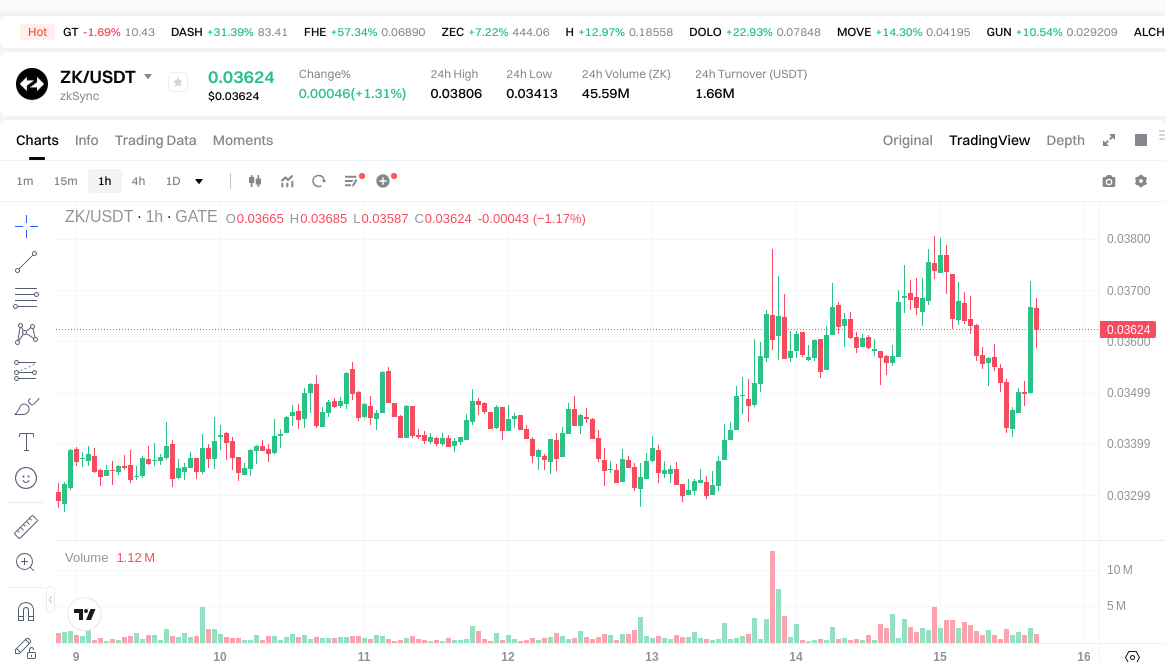
- ZK current price: $0.03605
- Market sentiment (Fear & Greed Index): Data indicates neutral market conditions with moderate trading activity
- 24-hour trading volume: $1,704,199.08
- Institutional investor holdings: With 338,638 token holders, the asset shows distributed ownership patterns across the market
Click to view real-time ZK market price
II. Core Factors Influencing Whether ZK Is a Good Investment
Supply Mechanism and Scarcity (ZK Investment Scarcity)
- Maximum Supply of 21 Billion Tokens → Defines long-term scarcity framework
- Current Circulating Supply: Approximately 8.57 billion tokens (40.8% of max supply) → Indicates substantial future supply releases may affect price dynamics
- Investment Implication: The relatively low circulation ratio suggests that token scarcity may evolve as more tokens enter circulation, which could influence long-term investment considerations
Institutional Investment and Mainstream Adoption (Institutional Investment in ZK)
- ZKsync announced plans to deepen institutional partnerships in 2026, focusing on regulated financial institutions and large enterprises
- The Atlas upgrade to ZK Stack introduced improvements in transaction speed and flexibility, targeting enterprise and institutional onchain operations
- CEO Alex Gluchowski indicated expectations for multiple regulated entities to launch production systems on ZKsync, potentially serving tens of millions of end users
- Investment Significance: Growing institutional interest and infrastructure development may enhance ZK's investment profile, though actual adoption outcomes remain to be observed
Macroeconomic Environment's Impact on ZK Investment
- Monetary Policy and Interest Rates → General crypto market sentiment and investment flows may be influenced by broader economic conditions
- Market Volatility: ZK displayed 8.40% price volatility over 30 days, with 50% green days, reflecting sensitivity to market fluctuations
- Broader Economic Uncertainty → May affect risk appetite for Layer-2 scaling solutions and their associated tokens
Technology and Ecosystem Development (Technology & Ecosystem for ZK Investment)
- ZK Stack Infrastructure: Provides modular framework for enterprises building blockchain applications, potentially expanding ecosystem utility
- Prividium and Airbender Products: ZKsync plans to focus on expanding these existing products in 2026 to drive real-world adoption
- Layer-2 Scaling Technology: ZK-rollup technology aims to improve Ethereum transaction efficiency, with investment value dependent on continued adoption and competition from alternative Layer-2 solutions
- Ecosystem Applications: The success of DeFi, NFT, and payment applications built on ZKsync infrastructure may influence long-term investment considerations
III. ZK Future Investment Forecast and Price Outlook (Is zkSync(ZK) worth investing in 2026-2031)
Short-term Investment Forecast (2026, short-term ZK investment outlook)
- Conservative forecast: $0.0297 - $0.0362
- Neutral forecast: $0.0362 - $0.0451
- Optimistic forecast: $0.0451 - $0.0506
Mid-term Investment Outlook (2027-2028, mid-term zkSync(ZK) investment forecast)
- Market stage expectation: ZKsync is anticipated to enter a gradual growth phase, with market expansion potentially driven by increased user adoption and enhanced ecosystem development.
- Investment return forecast:
- 2027: $0.0239 - $0.0581
- 2028: $0.0294 - $0.0599
- Key catalysts: User base expansion, technical upgrades within the ZK Rollup ecosystem, and broader adoption of Layer 2 scaling solutions may contribute to price movements.
Long-term Investment Outlook (Is ZK a good long-term investment?)
- Base scenario: $0.0417 - $0.0683 (assuming steady adoption and stable market conditions through 2030)
- Optimistic scenario: $0.0717 - $0.1190 (contingent on accelerated ecosystem growth and favorable regulatory developments by 2031)
- Risk scenario: Below $0.0297 (under conditions of prolonged market downturns or delayed protocol adoption)
Click to view ZK long-term investment and price forecast: Price Prediction
2026-01-15 - 2031 Long-term Outlook
- Base scenario: $0.0417 - $0.0683 (corresponding to steady progress and gradual mainstream application)
- Optimistic scenario: $0.0717 - $0.1190 (corresponding to large-scale adoption and favorable market environment)
- Transformative scenario: Above $0.1190 (contingent on breakthrough ecosystem developments and widespread mainstream adoption)
- 2031-12-31 forecasted high: $0.1190 (based on optimistic development assumptions)
Disclaimer: The above forecasts are derived from available market data and predictive models. Cryptocurrency markets are highly volatile and unpredictable. These projections do not constitute investment advice, and actual results may vary significantly. Investors should conduct their own research and consider their risk tolerance before making any investment decisions.
| Year |
Predicted High Price |
Predicted Average Price |
Predicted Low Price |
Price Change |
| 2026 |
0.050624 |
0.03616 |
0.0296512 |
0 |
| 2027 |
0.05814528 |
0.043392 |
0.0238656 |
20 |
| 2028 |
0.0599069952 |
0.05076864 |
0.0294458112 |
40 |
| 2029 |
0.081346591872 |
0.0553378176 |
0.034862825088 |
53 |
| 2030 |
0.10046304096192 |
0.068342204736 |
0.04168874488896 |
89 |
| 2031 |
0.119007698217033 |
0.08440262284896 |
0.071742229421616 |
134 |
IV. ZK Investment Strategy and Risk Management (How to invest in zkSync)
Investment Methodology (ZK investment strategy)
Long-term Holding (HODL ZK): This approach may suit investors with a moderate risk tolerance who believe in the long-term development of Layer 2 scaling solutions and zkSync's ecosystem expansion. Given ZK's significant price volatility since its launch in June 2024, with historical high of $0.367 and historical low of $0.00736, long-term holders should prepare for substantial price fluctuations.
Active Trading: Traders may consider technical analysis and swing trading strategies based on ZK's price movements. The token has shown varied performance across different timeframes, with a 7-day increase of 7.61% and 30-day gain of 23.44%, while experiencing a notable decline of 79.73% over the past year. Active traders should closely monitor support and resistance levels, with recent 24-hour ranges between $0.03413 and $0.03806.
Risk Management (Risk management for ZK investment)
Asset Allocation Ratios:
- Conservative investors: Consider limiting ZK exposure to 1-3% of total crypto portfolio
- Moderate investors: May allocate 3-7% depending on risk appetite and market outlook
- Experienced investors: Could consider 7-15% allocation with active monitoring and adjustment strategies
Risk Hedging Solutions: Investors may consider diversifying across multiple Layer 2 solutions and major cryptocurrencies to reduce concentration risk. The market cap to fully diluted valuation ratio of 40.8% indicates substantial future token supply, which should be factored into long-term positions.
Secure Storage:
- Hot wallets: Suitable for active trading amounts only
- Cold wallets: Recommended for long-term holdings
- Hardware wallets: Provide enhanced security for significant ZK holdings
- Contract address verification: Always verify the official contract address (0x5A7d6b2F92C77FAD6CCaBd7EE0624E64907Eaf3E on zkSync Era) before transactions
V. ZK Investment Risks and Challenges (Risks of investing in zkSync)
Market Risks: ZK exhibits high volatility characteristics common to cryptocurrency assets. The token's price has fluctuated significantly since its June 2024 launch, with the current price of $0.03605 representing a substantial decline from its all-time high. The relatively modest 24-hour trading volume of approximately $1.7 million suggests limited liquidity compared to major cryptocurrencies, which may amplify price movements during periods of buying or selling pressure.
Regulatory Risks: As a Layer 2 scaling solution token, ZK faces regulatory uncertainty across different jurisdictions. Changes in cryptocurrency regulations, particularly regarding token classifications, trading restrictions, or DeFi protocols, could impact ZK's adoption and market value. The project's compliance approach and regulatory developments should be monitored by investors.
Technical Risks: The zkSync network's technical infrastructure carries inherent risks including potential smart contract vulnerabilities, network upgrade challenges, and scalability limitations. With a circulating supply of approximately 8.57 billion tokens (40.8% of maximum supply) and plans for additional token releases, the emission schedule and its impact on token economics represent an ongoing consideration. Network security, cross-chain bridge safety, and the successful implementation of planned technical upgrades remain important factors affecting the project's long-term viability.
Competitive Landscape: The Layer 2 scaling solution sector includes multiple competing protocols, which may affect zkSync's market position and ZK token demand. Changes in Ethereum's base layer or the emergence of alternative scaling solutions could influence the project's competitive advantages.
VI. Conclusion: Is zkSync a Good Investment?
Investment Value Summary: ZK represents exposure to Layer 2 scaling technology within the Ethereum ecosystem. The token has experienced significant price volatility since its launch, with recent positive momentum in 7-day and 30-day periods contrasting with substantial year-over-year decline. The project's mathematical verification approach and expanding blockchain network offer technological foundations, though market conditions and competitive dynamics introduce uncertainty.
Investor Recommendations:
✅ Beginners: Consider dollar-cost averaging to mitigate timing risk, and prioritize secure wallet storage. Start with small positions to understand market dynamics before increasing exposure.
✅ Experienced Investors: May explore swing trading opportunities based on technical analysis while maintaining core long-term positions. Diversification across multiple Layer 2 solutions could reduce concentration risk.
✅ Institutional Investors: Could evaluate strategic allocation as part of broader blockchain infrastructure exposure, with careful consideration of token emission schedule and ecosystem development metrics.
⚠️ Important Notice: Cryptocurrency investments carry substantial risk and may not be suitable for all investors. This content is provided for informational purposes only and does not constitute investment advice, financial advice, trading advice, or recommendations. Investors should conduct independent research and consult qualified financial advisors before making investment decisions.
VII. FAQ
Q1: What is zkSync (ZK) and how does it work?
zkSync (ZK) is a Layer 2 scaling solution token for Ethereum that operates as a verifiable blockchain network secured by mathematical proofs. It utilizes ZK-rollup technology to improve Ethereum transaction efficiency by processing transactions off the main chain while maintaining security through zero-knowledge proofs. The ZK Stack infrastructure provides a modular framework for enterprises to build blockchain applications, with the token serving as the native asset within this ecosystem. Launched in June 2024, ZK has a maximum supply of 21 billion tokens with approximately 8.57 billion (40.8%) currently in circulation.
Q2: Is zkSync a good investment for 2026?
The investment suitability of zkSync depends on individual risk tolerance and investment objectives. For 2026, conservative forecasts suggest a price range of $0.0297-$0.0362, neutral forecasts indicate $0.0362-$0.0451, and optimistic scenarios project $0.0451-$0.0506. The token has demonstrated recent positive momentum with a 23.44% increase over 30 days, though it has declined 79.73% year-over-year since launch. Conservative investors might consider limiting ZK exposure to 1-3% of their crypto portfolio, while experienced investors could allocate 7-15% with active monitoring. Institutional partnerships and technical upgrades may support future value, but substantial volatility and regulatory uncertainty remain significant considerations.
Q3: What are the main risks of investing in zkSync (ZK)?
zkSync investment carries multiple risk categories. Market risks include high price volatility, with the token fluctuating from an all-time high of $0.367 to a low of $0.00736, and limited liquidity reflected in the modest $1.7 million 24-hour trading volume. Regulatory risks stem from uncertain cryptocurrency regulations across jurisdictions that could affect token classification and usage. Technical risks encompass potential smart contract vulnerabilities, network upgrade challenges, and the impact of gradual token emission with only 40.8% of maximum supply currently circulating. Additionally, competitive risks exist from other Layer 2 scaling solutions and potential changes in Ethereum's base layer that could affect zkSync's market position.
Q4: How does zkSync compare to other Layer 2 solutions?
zkSync operates within a competitive Layer 2 scaling sector alongside multiple alternative protocols. Its distinguishing features include ZK-rollup technology utilizing zero-knowledge proofs for transaction verification, the modular ZK Stack infrastructure for enterprise applications, and products like Prividium and Airbender planned for expansion in 2026. The project ranks 188th by market capitalization with approximately 0.022% market dominance and 338,638 token holders. While zkSync offers mathematical security proofs and focuses on institutional partnerships, its competitive position depends on continued adoption rates, technical development outcomes, and the evolving landscape of Ethereum scaling solutions.
Q5: What is the long-term price forecast for zkSync (ZK)?
Long-term price projections for zkSync through 2031 vary significantly based on adoption scenarios. Base scenario forecasts suggest a range of $0.0417-$0.0683 by 2030, assuming steady adoption and stable market conditions. Optimistic scenarios project $0.0717-$0.1190 by 2031, contingent on accelerated ecosystem growth and favorable regulatory developments, with a potential high of $0.1190 by December 31, 2031. Risk scenarios indicate prices could fall below $0.0297 under prolonged market downturns or delayed protocol adoption. These forecasts assume progressive ecosystem development, institutional adoption milestones, and continued technical improvements, though actual outcomes may vary substantially due to cryptocurrency market volatility.
Q6: How should I store my ZK tokens securely?
ZK token storage should align with intended usage patterns and security requirements. For active trading, hot wallets connected to exchanges or web interfaces provide convenience but carry higher security risks and should only hold trading amounts. For long-term holdings, cold wallets offer enhanced security by keeping private keys offline, while hardware wallets provide the highest security level for significant ZK holdings through physical devices that isolate private keys. Before any transaction, investors must verify the official zkSync contract address (0x5A7d6b2F92C77FAD6CCaBd7EE0624E64907Eaf3E on zkSync Era) to avoid fraudulent contracts. Diversifying storage across multiple wallet types can balance security and accessibility based on investment strategy.
Q7: What investment strategies work best for zkSync (ZK)?
Investment strategies for zkSync should match individual risk profiles and market expertise. Long-term holding (HODL) may suit moderate-risk investors believing in Layer 2 scaling adoption, though holders should prepare for substantial volatility given the token's historical price range from $0.00736 to $0.367. Active trading strategies can leverage technical analysis based on recent performance metrics showing 7.61% gains over 7 days and 23.44% over 30 days, with traders monitoring support and resistance levels between $0.03413 and $0.03806. Dollar-cost averaging helps beginners mitigate timing risk while building positions gradually. Portfolio allocation recommendations range from 1-3% for conservative investors, 3-7% for moderate investors, and 7-15% for experienced investors, with diversification across multiple Layer 2 solutions reducing concentration risk.
Q8: What factors could drive zkSync's future value?
Multiple factors may influence zkSync's future investment value. Institutional adoption represents a significant catalyst, with zkSync announcing plans to deepen partnerships with regulated financial institutions and CEO Alex Gluchowski expecting multiple regulated entities to launch production systems potentially serving tens of millions of users. Technical developments including the Atlas upgrade to ZK Stack, improvements in transaction speed and flexibility, and the expansion of products like Prividium and Airbender may enhance utility. Ecosystem growth through DeFi, NFT, and payment applications built on zkSync infrastructure could drive demand. Market factors include the broader adoption of Layer 2 scaling solutions, Ethereum ecosystem developments, and macroeconomic conditions affecting cryptocurrency investment flows. The token's supply dynamics, with only 40.8% of maximum supply circulating, will impact scarcity as additional tokens enter the market.
* The information is not intended to be and does not constitute financial advice or any other recommendation of any sort offered or endorsed by Gate.