This comprehensive analysis evaluates ZND as an investment asset within the zondacrypto ecosystem established since 2014. As of February 2026, ZND trades at $0.008814 with a $1.62 million market cap, having experienced significant volatility with a 98% annual decline. The article examines ZND's price history, supply mechanics, ecosystem utilities including trading, earning, borrowing, and payment processing via zondacrypto Pay, and provides price projections through 2031. It presents tailored investment strategies for conservative, aggressive, and professional investors, emphasizing risk management through portfolio diversification, position sizing, and secure storage on Gate and other platforms. Key risks include limited liquidity ($113,280 daily volume), substantial dilution potential (87.37% uncirculated supply), regulatory uncertainty, and technical dependencies. The analysis concludes ZND suits experienced investors with high risk tolerance rather than beginners, requiring thorough due diligence before c
Introduction: ZND's Investment Position and Market Prospects
ZND is a significant asset in the cryptocurrency space, launched in December 2023 as part of a fully regulated financial ecosystem. As of February 2026, ZND has a market capitalization of approximately $1.62 million, with a circulating supply of around 183.63 million tokens, and the current price stands at approximately $0.008814. With its positioning as a settlement token within the zondacrypto ecosystem, ZND has become a focal point when investors discuss "Is ZND a good investment?" Built on the foundation of zondacrypto, a Central European crypto exchange operational since 2014, the ZND platform integrates Trade, Earn, Borrow, and Explore functions to serve diverse user needs. The token's utility includes facilitating cryptocurrency payments through zondacrypto Pay and unlocking rewards across the ecosystem. This article provides a comprehensive analysis of ZND's investment value, historical performance, future price projections, and associated risks to offer reference for investors.
I. ZND Price History Review and Current Investment Value
- 2025: ZND reached a notable price level of $0.55 in March 2025 → representing a reference point for subsequent market movements
- 2026: Market correction phase → ZND experienced price adjustments from previous levels to approximately $0.008814
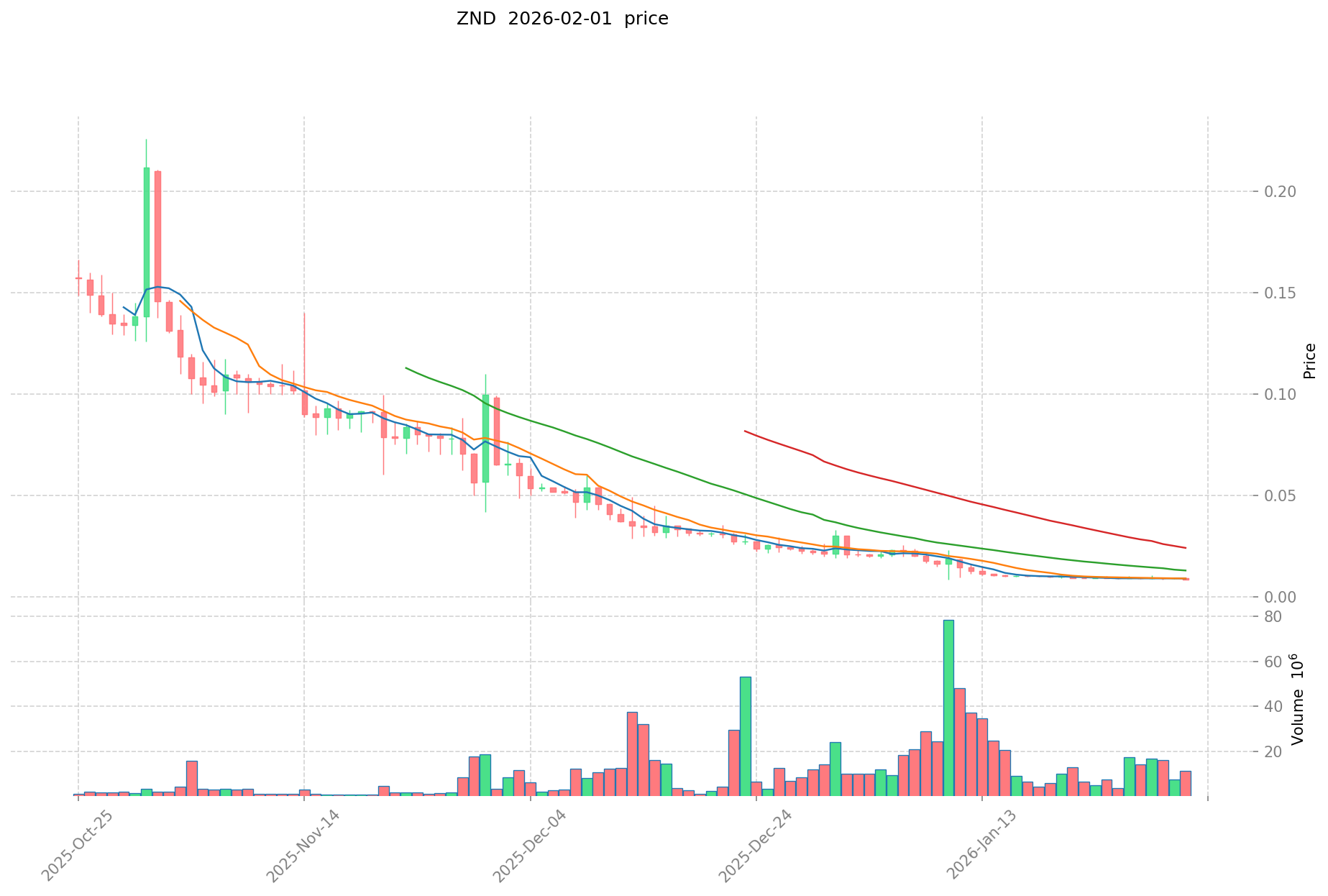
- Past 12 months: Significant volatility period → price fluctuated with a decline of approximately 98.06% from higher levels
Current ZND Investment Market Status (February 2026)
- ZND current price: $0.008814
- 24-hour trading volume: $113,280.33
- Market capitalization: $1,618,558.37
- Circulating supply: 183,634,940.72 ZND (12.63% of total supply)
Click to view real-time ZND market price
II. Core Factors Influencing Whether ZND Is a Good Investment
Supply Mechanism and Scarcity
- Maximum Supply: ZND has a capped maximum supply of 694,349,223 tokens, with approximately 183,634,940.72 tokens currently in circulation (representing around 26.45% of the total supply).
- Circulation Dynamics: The relatively low circulating supply compared to maximum supply indicates potential future token releases, which may impact scarcity considerations for investors.
- Investment Significance: Token supply mechanics play a role in shaping long-term value expectations, though multiple market factors contribute to investment outcomes.
Institutional Investment and Mainstream Adoption
- Exchange Presence: ZND is listed on 5 exchanges, providing accessibility for various investor segments.
- Holder Base: As of February 2, 2026, ZND has approximately 2,205 token holders, reflecting the current scale of community participation.
- Ecosystem Foundation: The project is built upon zondacrypto, which has operated as a Central European cryptocurrency exchange since 2014, providing operational history in the regulated exchange space.
Macroeconomic Environment Impact on Investment Considerations
- Market Conditions: The broader cryptocurrency market environment in 2026 continues to be influenced by evolving regulatory frameworks, interest rate policies, and institutional participation trends.
- Risk Factors: Geopolitical developments, monetary policy shifts, and regulatory changes across jurisdictions represent ongoing considerations for digital asset investments.
- Market Context: Investment decisions should account for the dynamic nature of cryptocurrency markets and their sensitivity to broader economic conditions.
Technology and Ecosystem Development
- Technical Standard: ZND operates as an ERC-20 token on the Ethereum network, utilizing established blockchain infrastructure.
- Platform Components: The ZND ecosystem includes multiple platforms launched since December 2023, focusing on trading, earning, borrowing, and exploration functionalities.
- Token Utility: ZND serves as a settlement unit within its ecosystem, designed to facilitate transactions, rewards, and benefits across integrated platforms including zondacrypto Pay for business cryptocurrency payments.
- Development Stage: The project continues developing its financial ecosystem, with ongoing efforts to expand utility and user accessibility for both new and experienced cryptocurrency market participants.
III. ZND Future Investment Prediction and Price Outlook (Is ZND(ZND) worth investing in 2026-2031)
Short-term Investment Prediction (2026, short-term ZND investment outlook)
- Conservative forecast: $0.00642254 - $0.008798
- Neutral forecast: $0.008798 - $0.00958982
- Optimistic forecast: $0.00958982 and above
Mid-term Investment Outlook (2027-2029, mid-term ZND(ZND) investment forecast)
- Market stage expectation: The token may enter a gradual development phase, with price movements potentially influenced by ecosystem expansion and broader market sentiment.
- Investment return prediction:
- 2027: $0.0060679806 - $0.0112165702
- 2028: $0.00918471609 - $0.013470916932
- 2029: $0.00816827417604 - $0.01527112128564
- Key catalysts: Ecosystem development progress, market adoption trends, and regulatory environment changes.
Long-term Investment Outlook (Is ZND a good long-term investment?)
- Base scenario: $0.009217127932557 - $0.014232329895861 (assuming steady ecosystem development and moderate market conditions)
- Optimistic scenario: $0.013198791653423 - $0.018756177612759 (assuming enhanced adoption and favorable market environment)
- Risk scenario: Below $0.009217127932557 (under adverse market conditions or limited ecosystem progress)
Click to view ZND long-term investment and price prediction: Price Prediction
2026-02-02 - 2031 Long-term Outlook
- Base scenario: $0.009217127932557 - $0.014232329895861 (corresponding to steady progress and gradual mainstream application growth)
- Optimistic scenario: $0.013198791653423 - $0.018756177612759 (corresponding to large-scale adoption and favorable market environment)
- Transformative scenario: Above $0.018756177612759 (such as breakthrough developments in the ecosystem and mainstream adoption)
- 2031-12-31 predicted high: $0.018756177612759 (based on optimistic development assumptions)
Disclaimer: Price predictions are based on historical data analysis and market trends. Cryptocurrency markets are highly volatile and subject to various risks. This information does not constitute investment advice. Investors should conduct independent research and consult with financial professionals before making investment decisions.
| Year |
Predicted High Price |
Predicted Average Price |
Predicted Low Price |
Price Change |
| 2026 |
0.00958982 |
0.008798 |
0.00642254 |
0 |
| 2027 |
0.0112165702 |
0.00919391 |
0.0060679806 |
4 |
| 2028 |
0.013470916932 |
0.0102052401 |
0.00918471609 |
15 |
| 2029 |
0.01527112128564 |
0.011838078516 |
0.00816827417604 |
34 |
| 2030 |
0.014232329895861 |
0.01355459990082 |
0.009217127932557 |
53 |
| 2031 |
0.018756177612759 |
0.01389346489834 |
0.013198791653423 |
57 |
IV. ZND Investment Strategy and Risk Management (How to invest in ZND)
Investment Methodology (ZND investment strategy)
Long-term Holding (HODL ZND): Suitable for Conservative Investors
Long-term holding strategies may be considered by investors who believe in the fundamental value of the ZND ecosystem. The ZND platform, launched in December 2023, integrates multiple financial services including trading, earning, borrowing, and exploration features. As of February 2, 2026, ZND is priced at $0.008814 with a circulating supply of approximately 183.63 million tokens out of a maximum supply of 694.35 million tokens.
Investors adopting a long-term approach should consider the ecosystem's development trajectory and adoption metrics. The ZND token serves as the primary settlement unit within the zondacrypto ecosystem, which has operated as a Central European crypto exchange since 2014. The platform's zondacrypto Pay functionality enables businesses to accept cryptocurrency payments, potentially expanding the token's utility over time.
Active Trading: Relying on Technical Analysis and Swing Operations
Active traders may utilize technical analysis and market timing strategies when trading ZND. Recent price trends show:
- 1-hour change: +0.06%
- 24-hour change: -0.07%
- 7-day change: -2.15%
- 30-day change: -57.49%
- 1-year change: -98.056%
The token's 24-hour trading volume stands at approximately $113,280, with a 24-hour price range between $0.007473 (low) and $0.0093 (high). The token is currently listed on 5 exchanges with Gate.com being one of the trading platforms. Traders should monitor these metrics along with order book depth and volume patterns when executing short-term trading strategies.
Risk Management (Risk management for ZND investment)
Asset Allocation Ratio: Conservative / Aggressive / Professional Investors
Conservative Investors: May consider allocating 1-3% of their crypto portfolio to ZND, given its relatively small market capitalization of approximately $1.62 million and early-stage ecosystem development.
Aggressive Investors: Could allocate 5-10% of their crypto holdings to ZND, accepting higher volatility in exchange for potential ecosystem growth opportunities.
Professional Investors: Might employ dynamic allocation strategies based on fundamental developments, technical indicators, and broader market conditions, potentially ranging from 3-15% depending on risk tolerance and investment thesis.
Risk Hedging Solutions: Multi-asset Portfolio + Hedging Tools
Investors can implement several risk management approaches:
- Portfolio diversification across different cryptocurrency categories and traditional assets
- Position sizing based on volatility metrics and personal risk tolerance
- Setting stop-loss orders at predetermined price levels to limit potential losses
- Monitoring the circulating supply ratio (currently 12.63%) and potential dilution effects as more tokens enter circulation
- Tracking holder distribution (currently 2,205 holders) as an indicator of ecosystem growth
Secure Storage: Hot and Cold Wallets + Hardware Wallet Recommendations
ZND is an ERC-20 token with contract address 0x2d8ea194902bc55431420bd26be92b0782dce91d on the Ethereum network. Storage options include:
Cold Storage Solutions:
- Hardware wallets supporting ERC-20 tokens provide offline security for long-term holdings
- Multi-signature wallets can add additional security layers for larger holdings
Hot Wallet Options:
- Web-based wallets and mobile applications offer convenience for active trading
- Exchange wallets on platforms like Gate.com provide liquidity but carry counterparty risk
Investors should maintain the majority of holdings in cold storage while keeping only necessary amounts in hot wallets for trading purposes.
V. ZND Investment Risks and Challenges (Risks of investing in ZND)
Market Risks: High Volatility and Price Manipulation
ZND exhibits considerable price volatility, as evidenced by its 30-day decline of 57.49% and 1-year decline of 98.056%. The token reached a price of $0.55 on March 3, 2025, but has since declined to $0.008814 as of February 2, 2026. The 24-hour trading volume of $113,280 represents relatively limited liquidity compared to larger-cap cryptocurrencies.
With a fully diluted market cap of approximately $6.12 million and a circulating market cap of $1.62 million, the token's liquidity may be insufficient to absorb large buy or sell orders without significant price impact. The market cap to fully diluted valuation ratio of 12.63% indicates substantial potential dilution as more tokens enter circulation.
Regulatory Risks: Policy Uncertainty in Different Countries
The ZND ecosystem operates within the cryptocurrency exchange and payment processing sectors, which face varying regulatory frameworks across jurisdictions. While the project describes itself as "fully regulated," specific regulatory approvals and jurisdictional licenses are not detailed in the available materials.
Regulatory developments in Central Europe and other markets where the zondacrypto exchange operates could impact:
- Token utility and trading availability
- Cross-border payment processing through zondacrypto Pay
- Exchange operations and licensing requirements
- Tax treatment of token transactions and rewards
Technical Risks: Network Security Vulnerabilities and Upgrade Failures
As an ERC-20 token, ZND inherits both benefits and risks from the Ethereum network:
Ethereum Network Dependencies:
- Network congestion may result in higher transaction fees
- Smart contract vulnerabilities in the token contract or associated DeFi protocols
- Dependency on Ethereum network upgrades and consensus mechanisms
Platform-Specific Risks:
- Integration risks between the ZND token and the broader zondacrypto ecosystem
- Smart contract security of lending, borrowing, and earning features within the ZND platform
- Operational risks associated with exchange infrastructure and payment processing systems
Investors should verify smart contract audits and security measures implemented by the project team.
VI. Conclusion: Is ZND a Good Investment?
Investment Value Summary
ZND operates within an established Central European crypto exchange ecosystem that has been active since 2014. The token launched in December 2023 aims to serve as a settlement unit and utility token for trading, earning, borrowing, and payment services. However, the token has experienced considerable price depreciation, declining 98.056% over the past year.
The project's integration of multiple financial services and the existing user base of the zondacrypto exchange may provide fundamental support. The relatively small market capitalization of $1.62 million and limited circulating supply of 12.63% present both potential upside and dilution concerns.
Investor Recommendations
✅ Beginners: Consider dollar-cost averaging small amounts while storing tokens securely in hardware wallets supporting ERC-20 tokens. Thoroughly research the project's fundamentals and only invest amounts you can afford to lose entirely.
✅ Experienced Investors: May employ swing trading strategies based on technical analysis and ecosystem development milestones. Consider position sizing appropriate to the token's volatility profile and maintain strict risk management protocols.
✅ Institutional Investors: Could evaluate strategic positioning based on comprehensive due diligence of the zondacrypto ecosystem's growth metrics, regulatory compliance, and competitive positioning within Central European crypto markets.
⚠️ Disclaimer: Cryptocurrency investments carry substantial risk of capital loss. This content is for informational purposes only and does not constitute investment advice. Conduct thorough independent research and consider consulting financial professionals before making investment decisions.
VII. FAQ
Q1: Is ZND a good investment for beginners in 2026?
ZND presents significant challenges for beginner investors due to its high volatility profile, having declined 98.056% over the past year from $0.55 to $0.008814. While the token operates within an established ecosystem (zondacrypto exchange since 2014) and offers multiple utilities including trading, earning, and payment services, beginners should exercise extreme caution. The token's small market capitalization of $1.62 million, limited liquidity with 24-hour volume of only $113,280, and relatively low circulating supply (12.63% of maximum supply) create substantial price manipulation risks. Beginners should only consider minimal allocations (1-3% of crypto portfolio) using dollar-cost averaging strategies, maintain strict stop-loss orders, and store tokens in secure hardware wallets. Given these risk factors, ZND may be more suitable for experienced investors who can actively manage volatile positions rather than beginner investors seeking stable entry points into cryptocurrency markets.
Q2: What is the predicted price range for ZND by 2031?
Based on current analysis, ZND price predictions for 2031 range from $0.013198791653423 (conservative scenario) to $0.018756177612759 (optimistic scenario), with an average predicted price of approximately $0.01389346489834. The conservative forecast assumes steady ecosystem development and moderate market conditions, while the optimistic scenario factors in enhanced adoption of the zondacrypto platform, expanded utility of zondacrypto Pay for business payments, and favorable cryptocurrency market conditions. However, these predictions should be interpreted with significant caution given the token's recent 98% decline and small market presence. A risk scenario below $0.009217127932557 remains possible under adverse market conditions or limited ecosystem progress. Investors should note that cryptocurrency price predictions are inherently uncertain and subject to extreme volatility, regulatory changes, and competitive pressures in the Central European crypto exchange market.
Q3: How does ZND's circulating supply impact investment decisions?
ZND currently has only 183.63 million tokens in circulation (12.63%) out of a maximum supply of 694.35 million tokens, which creates significant dilution concerns for investors. This low circulation ratio means approximately 510.7 million additional tokens could potentially enter the market, representing a 278% increase in circulating supply. Such token releases could exert downward pressure on price unless accompanied by proportional demand growth. The current fully diluted market cap of $6.12 million versus circulating market cap of $1.62 million illustrates this disparity. Investors should monitor token unlock schedules, vesting periods, and the project team's token distribution plans. While controlled token releases can support ecosystem development through strategic partnerships and community incentives, unmanaged supply increases may negatively impact token scarcity and price appreciation potential. Investment strategies should factor in potential dilution effects when establishing position sizes and price targets.
Q4: What are the main utilities of ZND token within its ecosystem?
ZND serves as the primary settlement token within the zondacrypto ecosystem, offering multiple utility functions launched since December 2023. The token facilitates transactions across four main platform components: Trade (cryptocurrency exchange operations), Earn (yield generation mechanisms), Borrow (lending services), and Explore (ecosystem discovery features). A key utility is zondacrypto Pay, which enables businesses to accept cryptocurrency payments, potentially expanding merchant adoption and real-world use cases. Token holders can access rewards, benefits, and discounts across the integrated platforms. As an ERC-20 token on Ethereum (contract address: 0x2d8ea194902bc55431420bd26be92b0782dce91d), ZND benefits from established blockchain infrastructure and wallet compatibility. The token's utility design aims to create demand through ecosystem participation, though actual adoption rates and transaction volumes remain critical factors in determining long-term value. Investors should evaluate whether these utilities generate sufficient organic demand to offset the large remaining token supply.
Q5: What security measures should ZND investors implement?
ZND investors should implement multi-layered security approaches given the token's ERC-20 standard and exchange trading presence. For long-term holdings, hardware wallets supporting ERC-20 tokens provide optimal cold storage security, keeping private keys offline and protected from cyber threats. Investors should store the majority (70-90%) of ZND holdings in cold storage while maintaining only necessary trading amounts in hot wallets or exchange accounts. When using exchanges like Gate.com (one of five platforms listing ZND), enable two-factor authentication, withdrawal whitelisting, and anti-phishing codes. Verify all transaction addresses carefully, as ERC-20 tokens are susceptible to phishing attacks through fake smart contract addresses. For larger holdings, consider multi-signature wallet solutions requiring multiple approvals for transactions. Regular security audits of personal storage solutions, avoiding public Wi-Fi for transactions, and maintaining separate devices for cryptocurrency operations further reduce risk. Given ZND's limited liquidity and small holder base (2,205 holders), investors should also be vigilant about potential smart contract vulnerabilities and only interact with verified contract addresses published by official project channels.
Q6: How does ZND compare to other exchange tokens as an investment?
ZND operates as a settlement token for zondacrypto, a Central European exchange established in 2014, positioning it within the competitive exchange token sector. However, ZND's market metrics differ substantially from leading exchange tokens. With a market capitalization of only $1.62 million and 24-hour trading volume of $113,280, ZND represents a micro-cap asset compared to established exchange tokens that typically feature billions in market cap and daily volume. The token is listed on only 5 exchanges with 2,205 holders, indicating limited market reach versus major exchange tokens with millions of users and global trading presence. ZND's 98% price decline over the past year contrasts sharply with more established exchange tokens that have demonstrated relative stability or growth. The token's utility scope (trading, earning, borrowing, payments) mirrors features offered by larger exchange tokens, but adoption scale remains significantly smaller. Regional focus on Central Europe may provide niche advantages but limits global market penetration. Investors comparing exchange token investments should weigh ZND's early-stage positioning and growth potential against proven track records and established network effects of larger competitors.
Q7: What are the key risks specific to ZND investment?
ZND faces several investment-specific risks beyond general cryptocurrency volatility. Liquidity risk is paramount, with only $113,280 in 24-hour trading volume, meaning large orders could cause significant price slippage or execution difficulties. The token's 98% price decline from $0.55 to $0.008814 demonstrates extreme historical volatility that may continue. Dilution risk from 87.37% of maximum supply yet to circulate (510.7 million tokens) could suppress price appreciation unless demand grows proportionally. Concentration risk exists with only 2,205 token holders and listing on just 5 exchanges, limiting market depth and creating potential single-point failures. Regulatory uncertainty surrounding cryptocurrency exchange operations in Central Europe and payment processing through zondacrypto Pay could impact business models. Technical dependencies on Ethereum network (gas fees, congestion) affect transaction costs and user experience. Competitive pressure from established exchange tokens with larger ecosystems and user bases poses adoption challenges. The project's relatively recent launch (December 2023) means limited operational history for assessing long-term viability. Investors should allocate only risk capital they can afford to lose completely and implement strict position sizing appropriate to these elevated risk factors.
Q8: What factors could drive ZND price recovery from current levels?
Several catalysts could potentially support ZND price recovery from its current $0.008814 level. Increased adoption of zondacrypto Pay by merchants would create organic demand for ZND as a payment settlement token, expanding utility beyond exchange operations. Successful expansion of the platform's Earn and Borrow features could attract DeFi users seeking yield opportunities, increasing token demand and holder base beyond current 2,205 users. Additional exchange listings beyond the current 5 platforms would improve liquidity and market access, potentially reducing volatility and attracting institutional interest. Strategic token burn mechanisms or controlled supply management addressing the 87.37% uncirculated token overhang could improve scarcity perception. Growing trading volumes on the zondacrypto exchange would increase transaction-based token utility and fee generation. Favorable regulatory developments in Central European cryptocurrency markets could enhance operational certainty and user confidence. Technical developments such as integration with additional blockchain networks or enhanced smart contract functionality could broaden use cases. However, recovery depends on execution quality, market timing, and broader cryptocurrency market conditions. Investors should monitor ecosystem metrics, holder growth, trading volume trends, and partnership announcements as leading indicators of potential recovery trajectories.
* The information is not intended to be and does not constitute financial advice or any other recommendation of any sort offered or endorsed by Gate.