This comprehensive analysis examines whether ZORA (ZORA) represents a viable investment opportunity within the creator economy NFT space. As of January 2026, ZORA trades at approximately $0.036 with a market capitalization of $125.95 million and 1.07 million holders across 43 exchanges including Gate. The article evaluates ZORA's investment potential through multiple lenses: historical price performance showing 35% gains in 2025 followed by current volatility, core factors influencing value including token supply dynamics and Layer 2 infrastructure, price scenarios ranging from $0.026 to $0.088 through 2031, and tailored investment strategies for different investor profiles. The analysis addresses critical considerations including market risks from liquidity constraints, regulatory uncertainties surrounding creator tokenization, and technical dependencies on ecosystem adoption. Suitable for investors seeking detailed insights into emerging creator economy protocols and Layer 2 opportunities on Gate exchange.
Introduction: Zora (ZORA)'s Investment Position and Market Outlook
Zora (ZORA) has emerged as a notable asset in the cryptocurrency space, focusing on empowering creators to transform into tradable tokens while enabling consumers to own attention. As of January 17, 2026, ZORA holds a market ranking of 320 with a market capitalization of approximately $125.95 million and a circulating supply of 3.5 billion tokens. The current price stands at around $0.036, representing a 35% ratio of its fully diluted valuation of $359.86 million. With over 1.07 million holders and listings on 43 exchanges, ZORA has established a presence in the digital asset ecosystem. Through its Developer Toolkit (SDK), the protocol aims to facilitate building and earning opportunities for internet developers. This article provides a comprehensive analysis of ZORA's investment characteristics, historical performance, future price outlook, and associated risks to assist investors in their research.
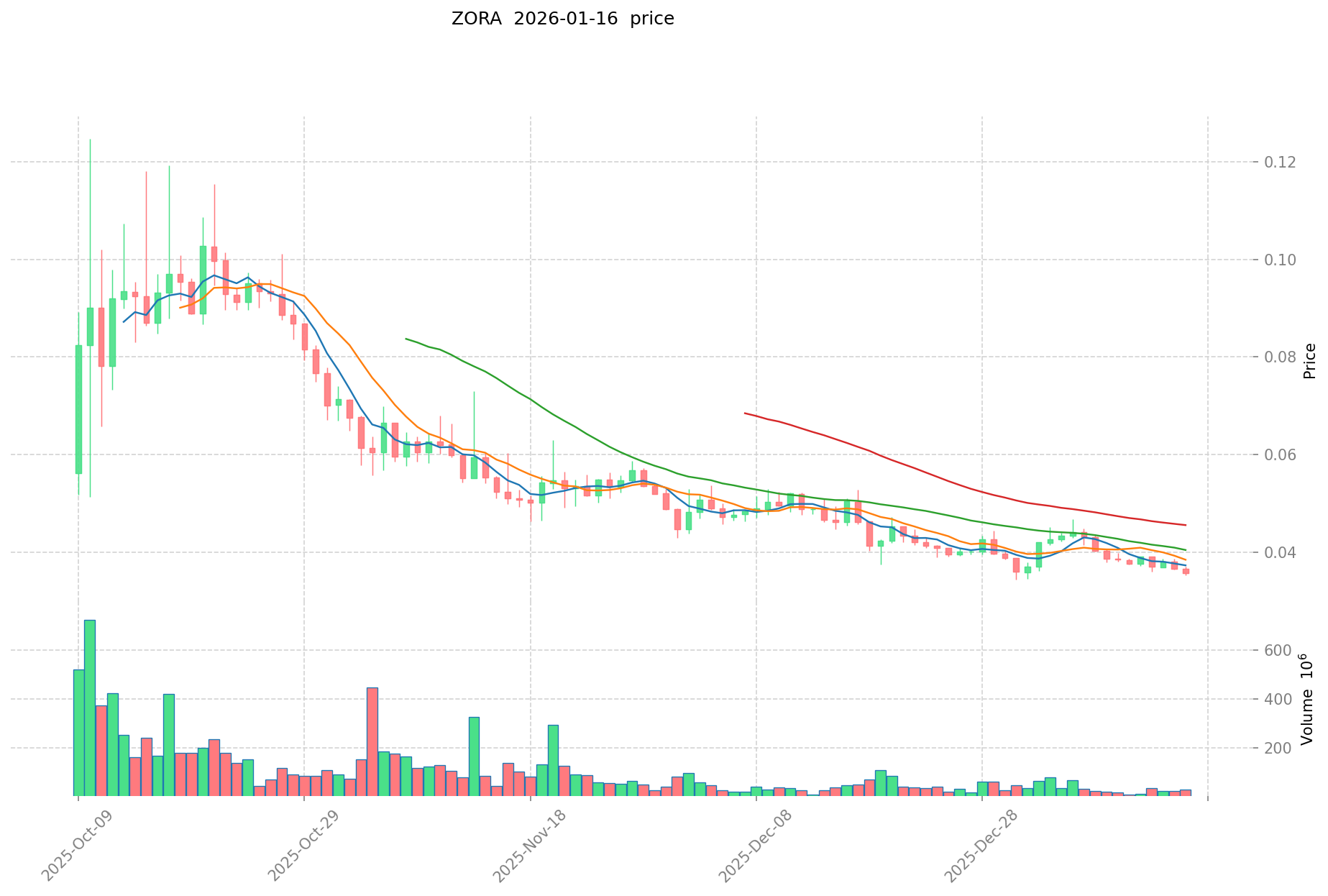
I. Zora (ZORA) Price History Review and Current Investment Value
- 2025: ZORA token reached a notable price level of $0.148437 in August → Early participants experienced significant returns during the initial listing period
- 2025: Price consolidation phase occurred between June and August → ZORA experienced volatility from $0.007755 to $0.148437
- 2026 (January): Market adjustment continues → Current trading range shows price movements between $0.035434 and $0.037233
Current ZORA Investment Market Status (January 2026)
- ZORA current price: $0.035986
- 24-hour trading volume: $1,033,769.81
- Market capitalization: $125,951,000
- Circulating supply: 3.5 billion ZORA (35% of total supply)
- Holder count: 1,073,397 addresses
Click to view real-time ZORA market price
II. Core Factors Influencing Whether ZORA is a Good Investment
Supply Mechanism and Scarcity (ZORA Investment Scarcity)
- Token Supply Structure → ZORA has a maximum supply of 10 billion tokens, with a current circulating supply of 3.5 billion tokens (35% circulation ratio). The total supply framework provides a defined scarcity model that may influence long-term value dynamics.
- Circulation Impact on Price → The current market capitalization stands at approximately $125.95 million, with a fully diluted market cap of $359.86 million. The gradual release of tokens into circulation represents a supply-side factor that market participants may consider when evaluating investment horizons.
- Investment Significance → The defined maximum supply and controlled circulation rate form part of the token's economic model, which some market observers view as relevant to understanding potential supply dynamics over time.
Institutional Investment and Mainstream Adoption (Institutional Investment in ZORA)
- Platform Adoption Metrics → ZORA demonstrates notable user engagement with approximately 1,073,397 holders as of January 2026. The platform's focus on creator economy infrastructure has attracted attention within the content monetization space.
- Exchange Listing Presence → The token is available on 43 exchanges, indicating a degree of market accessibility for participants interested in trading or holding ZORA.
- Creator Economy Positioning → The platform's model enables creators to tokenize content and earn from trading fees, representing an approach to content monetization that aligns with broader trends in digital ownership and creator empowerment.
Macroeconomic Environment's Influence on ZORA Investment
- Market Volatility Context → As with other crypto assets, ZORA's price performance reflects sensitivity to broader market conditions. The token has experienced price fluctuations, with recent 30-day performance showing a decline of 26.3%, indicating responsiveness to market dynamics.
- Risk-Adjusted Considerations → The crypto asset class remains subject to macroeconomic factors including regulatory developments, monetary policy shifts, and investor risk appetite. These external variables influence market participants' allocation decisions across digital assets.
- Market Positioning → With a market dominance of 0.010%, ZORA represents a smaller-cap position within the broader crypto ecosystem, which carries distinct risk-reward characteristics compared to larger-cap assets.
Technology and Ecosystem Development (Technology & Ecosystem for ZORA Investment)
- Layer 2 Infrastructure → ZORA operates as a Layer 2 network built on the OP Stack, focusing on social network functionality and on-chain content monetization. The platform's technical foundation aims to facilitate creator-user interactions through blockchain infrastructure.
- Developer Tools and SDK → The Zora Developer Toolkit (SDK) provides infrastructure for developers to build applications on the protocol, potentially expanding use cases and ecosystem participants over time.
- Content Tokenization Model → The platform's approach enables users to transform content into tradable tokens, with creators earning from trading fees. This model represents an application of blockchain technology to content monetization and social engagement within the digital creator economy.
III. ZORA Future Investment Prediction and Price Outlook (Is Zora(ZORA) worth investing in 2026-2031)
Short-term Investment Prediction (2026, short-term ZORA investment outlook)
- Conservative Forecast: $0.026 - $0.036
- Neutral Forecast: $0.036 - $0.046
- Optimistic Forecast: $0.046 - $0.051
Mid-term Investment Outlook (2027-2029, mid-term Zora(ZORA) investment forecast)
-
Market Stage Expectation: During 2027-2029, ZORA may enter a phase of gradual adoption expansion, with price performance potentially influenced by broader market sentiment, platform user growth, and content creator engagement trends.
-
Investment Return Prediction:
- 2027: $0.038 - $0.060
- 2028: $0.048 - $0.063
- 2029: $0.033 - $0.061
-
Key Catalysts: Potential drivers include increased creator and collector adoption on the platform, expansion of the tokenization ecosystem, broader interest in social tokens, and favorable regulatory developments for decentralized content platforms.
Long-term Investment Outlook (Is ZORA a good long-term investment?)
- Base Scenario: $0.036 - $0.074 (assuming steady growth in platform engagement and moderate market conditions)
- Optimistic Scenario: $0.061 - $0.088 (assuming widespread adoption of tokenized content and strong ecosystem development)
- Risk Scenario: Below $0.026 (in case of prolonged market downturns or significant competitive pressures)
Click to view ZORA long-term investment and price prediction: Price Prediction
2026-01-17 - 2031 Long-term Outlook
- Base Scenario: $0.036 - $0.074 (corresponding to steady progress and gradual mainstream application improvement)
- Optimistic Scenario: $0.061 - $0.088 (corresponding to large-scale adoption and favorable market environment)
- Transformative Scenario: Above $0.088 (if the ecosystem achieves breakthrough progress and mainstream popularity)
- 2031-12-31 Predicted High: $0.088 (based on optimistic development assumptions)
Disclaimer: The above predictions are for reference only and do not constitute investment advice. Cryptocurrency markets are highly volatile, and actual prices may differ significantly from projections due to market conditions, regulatory changes, technological developments, and other unforeseen factors. Investors should conduct thorough research and assess their risk tolerance before making any investment decisions.
| Year |
Predicted High Price |
Predicted Average Price |
Predicted Low Price |
Price Change |
| 2026 |
0.05137276 |
0.036178 |
0.02640994 |
0 |
| 2027 |
0.0595345168 |
0.04377538 |
0.0380845806 |
21 |
| 2028 |
0.062502487564 |
0.0516549484 |
0.048039102012 |
43 |
| 2029 |
0.06107422824074 |
0.057078717982 |
0.03253486924974 |
58 |
| 2030 |
0.088023944935941 |
0.05907647311137 |
0.036036648597935 |
64 |
| 2031 |
0.081640732016257 |
0.073550209023655 |
0.06619518812129 |
104 |
IV. ZORA Investment Strategy and Risk Management (How to invest in ZORA)
Investment Methodology (ZORA investment strategy)
Long-term Holding (HODL ZORA): This approach may be suitable for conservative investors who believe in the long-term value proposition of the Zora protocol and its role in empowering creators through tokenization. Given the project's focus on enabling developers to build and earn on the protocol, investors with this strategy typically focus on the fundamental development of the ecosystem rather than short-term price movements.
Active Trading: This strategy relies on technical analysis and swing trading techniques. Traders may monitor ZORA's price movements, which have shown notable volatility with a 24-hour range between $0.035434 and $0.037233. The token has experienced significant price fluctuations, with a 30-day change of -26.3% and a 7-day change of -6.29%, suggesting opportunities for traders who can navigate short-term market dynamics.
Risk Management (Risk management for ZORA investment)
Asset Allocation Ratio:
- Conservative investors: Consider limiting ZORA exposure to 1-3% of total crypto portfolio
- Moderate investors: May allocate 5-8% depending on risk tolerance and market outlook
- Experienced investors: Could consider 10-15% allocation as part of a diversified Layer 2 and creator economy strategy
Risk Hedging Solutions: Implement a multi-asset portfolio approach that includes established cryptocurrencies alongside emerging projects like ZORA. Consider diversification across different sectors of the crypto ecosystem to mitigate sector-specific risks.
Secure Storage:
- Cold Wallets: Recommended for long-term holdings to minimize exposure to online threats
- Hot Wallets: Suitable for active trading amounts only
- Hardware Wallets: Consider reputable hardware wallet solutions that support BASE network tokens for enhanced security of ZORA holdings
V. ZORA Investment Risks and Challenges (Risks of investing in ZORA)
Market Risks: ZORA has demonstrated significant price volatility. The token reached $0.148437 on August 11, 2025, but also declined to $0.007755 on June 18, 2025. The current price of $0.035986 represents a -26.3% change over the past 30 days, illustrating the potential for substantial short-term price fluctuations. With a 24-hour trading volume of approximately $1.03 million and market capitalization of around $125.95 million, the token's liquidity characteristics may contribute to price volatility.
Regulatory Risks: Different jurisdictions maintain varying approaches to cryptocurrency regulation, particularly regarding tokens that facilitate creator monetization and attention ownership. Policy developments in major markets could impact the project's operations and token value. Investors should monitor regulatory developments that may affect platforms enabling tokenization of creative content.
Technical Risks: As a protocol deployed on the BASE network, ZORA faces potential technical challenges including smart contract vulnerabilities, network congestion, or potential issues with protocol upgrades. The success of the Zora Developer Toolkit (SDK) depends on continued technical development and adoption by the developer community. Any security incidents or technical failures could negatively impact token value and ecosystem growth.
VI. Conclusion: Is ZORA a Good Investment?
Investment Value Summary: ZORA represents a project focused on creator empowerment and protocol development within the BASE ecosystem. With a circulating supply of 3.5 billion tokens (35% of total supply) and approximately 1,073,397 holders, the project has established a community presence. However, the token has experienced notable price volatility, with a -26.3% decline over 30 days, indicating significant short-term price fluctuations.
Investor Recommendations:
✅ Beginners: Consider dollar-cost averaging (DCA) strategy combined with secure wallet storage. Start with minimal allocation to understand the project's dynamics and market behavior.
✅ Experienced Investors: May explore swing trading opportunities based on technical analysis while maintaining a portion in long-term holdings. Consider the project's development milestones and ecosystem growth as key indicators.
✅ Institutional Investors: Could evaluate ZORA as part of a strategic allocation to creator economy and Layer 2 protocols, with emphasis on the project's developer toolkit adoption metrics.
⚠️ Disclaimer: Cryptocurrency investments carry substantial risks. This content is for informational purposes only and does not constitute investment advice. Conduct thorough research and consider your financial situation before making investment decisions.
VII. FAQ
Q1: What is ZORA's current market position and how does it compare to other Layer 2 protocols?
ZORA holds a market ranking of #320 with a market capitalization of approximately $125.95 million as of January 17, 2026. With a circulating supply of 3.5 billion tokens (35% of total 10 billion supply) and a current price around $0.036, ZORA represents a smaller-cap position in the crypto ecosystem with 0.010% market dominance. The project operates as a Layer 2 network built on the OP Stack, distinguishing itself through its focus on creator economy infrastructure and content tokenization. With 1,073,397 holders and listings on 43 exchanges, ZORA has established notable community engagement, though its trading volume of approximately $1.03 million indicates more modest liquidity compared to larger Layer 2 protocols.
Q2: How has ZORA's price performed historically and what factors contributed to its volatility?
ZORA experienced significant price volatility during 2025, reaching a peak of $0.148437 on August 11, 2025, before declining to $0.007755 on June 18, 2025—representing substantial price fluctuations. The token's current price of $0.035986 reflects a -26.3% decline over the past 30 days and -6.29% over seven days. This volatility stems from multiple factors including its relatively smaller market capitalization, limited trading volume, broader crypto market sentiment, and the project's position as an emerging creator economy protocol. The gradual release of tokens into circulation (currently 35% of total supply) and the project's early-stage ecosystem development also contribute to price movements.
Q3: What makes ZORA's tokenization model unique for creators and developers?
ZORA's core value proposition centers on enabling creators to transform their content into tradable tokens while allowing consumers to own attention. The platform operates through its Developer Toolkit (SDK), which provides infrastructure for developers to build applications and monetization mechanisms on the protocol. Creators earn from trading fees generated by their tokenized content, creating a direct revenue stream from user engagement. This model differs from traditional social media monetization by leveraging blockchain technology for transparent ownership and value distribution. The protocol's Layer 2 infrastructure on BASE aims to reduce transaction costs while maintaining the security benefits of blockchain-based content ownership.
Q4: What are the primary investment risks associated with ZORA?
ZORA carries several distinct investment risks. Market risk manifests through significant price volatility—the token declined from $0.148437 to $0.007755 within two months in 2025, demonstrating potential for substantial value fluctuations. Regulatory risk exists as authorities worldwide develop frameworks for tokens facilitating creator monetization and attention ownership. Technical risks include potential smart contract vulnerabilities, network congestion on BASE, and dependency on continued SDK adoption by developers. Additionally, with a relatively small trading volume of $1.03 million daily, liquidity constraints may impact larger transactions. The project's success depends heavily on mainstream adoption of tokenized content models and competition from established social platforms.
Q5: What allocation strategy should different investor types consider for ZORA?
Conservative investors may consider limiting ZORA exposure to 1-3% of their total crypto portfolio, focusing on long-term holding (HODL) aligned with the project's fundamental development. Moderate investors could allocate 5-8% depending on risk tolerance and belief in the creator economy thesis, potentially combining long-term positions with periodic rebalancing. Experienced investors might consider 10-15% allocation as part of a diversified strategy across Layer 2 protocols and creator economy projects, potentially incorporating active trading based on technical analysis of ZORA's price movements. For all investor types, implementing dollar-cost averaging (DCA) can help mitigate timing risk, while maintaining secure storage through hardware wallets or cold storage solutions is recommended for long-term holdings.
Q6: How realistic are ZORA's price predictions for 2026-2031?
ZORA's price predictions range from conservative to optimistic scenarios based on various adoption assumptions. For 2026, forecasts suggest a range between $0.026 (conservative) and $0.051 (optimistic), with neutral expectations around $0.036-$0.046. By 2031, optimistic scenarios project potential highs of $0.088, assuming widespread adoption of tokenized content and favorable market conditions. However, these predictions carry significant uncertainty due to multiple variables including broader crypto market cycles, actual ecosystem development, competition from established platforms, regulatory developments, and mainstream acceptance of creator tokenization models. Historical performance shows ZORA's susceptibility to volatility, with the token experiencing both rapid appreciation and sharp declines. Investors should view these projections as possible scenarios rather than guaranteed outcomes.
Q7: What key milestones should investors monitor to evaluate ZORA's progress?
Investors should track several critical indicators to assess ZORA's development trajectory. Developer adoption metrics for the SDK toolkit provide insight into ecosystem growth potential—increasing numbers of applications built on the protocol suggest expanding utility. User engagement metrics including active creator count, content tokenization volume, and trading fee generation indicate platform traction. Technical milestones such as protocol upgrades, security audits, and network performance improvements on BASE reflect infrastructure stability. Market metrics including exchange listings, trading volume trends, and holder growth patterns reveal liquidity development. Additionally, monitoring the token release schedule (currently 35% circulating) and its impact on price dynamics helps understand supply-side pressures. Regulatory developments affecting creator economy tokens and any strategic partnerships or integrations with established platforms would also significantly influence ZORA's investment outlook.
Q8: How does ZORA's fully diluted valuation compare to its current market cap?
ZORA's current market capitalization stands at approximately $125.95 million with 3.5 billion tokens in circulation, while its fully diluted valuation (FDV) reaches $359.86 million based on the maximum supply of 10 billion tokens. This represents a circulating supply ratio of 35%, meaning approximately 6.5 billion tokens remain to be released into circulation over time. The FDV-to-market cap ratio of roughly 2.86x indicates substantial potential dilution risk as additional tokens enter the market through the project's token release schedule. Investors should consider this supply dynamic when evaluating long-term price potential, as increased circulation typically exerts downward pressure on token price unless offset by corresponding demand growth through ecosystem expansion and user adoption.
* The information is not intended to be and does not constitute financial advice or any other recommendation of any sort offered or endorsed by Gate.