This comprehensive guide compares IZI and LRC, two leading blockchain tokens with distinct market positioning and investment profiles. IZI operates as a liquidity-as-a-service platform launched in 2021, while LRC functions as a decentralized exchange protocol established in 2017. The analysis examines historical price trends, tokenomics mechanisms, technological ecosystems, and price forecasts through 2031 for both assets. Current market data shows IZI at $0.007562 and LRC at $0.04743, with LRC demonstrating slightly higher trading volume. Investment recommendations vary by investor profile: conservative investors may favor LRC's established presence, while experienced investors should evaluate diversification benefits across DeFi infrastructure and DEX protocols. Real-time price data and market insights are available on Gate, supporting informed decision-making in today's fear-dominated market sentiment.
Introduction: Investment Comparison Between IZI and LRC
In the cryptocurrency market, the comparison between IZI vs LRC has consistently been a topic that investors cannot overlook. Both exhibit notable differences in market capitalization ranking, application scenarios, and price performance, representing distinct positioning within the crypto asset landscape.
IZI (izumi): Launched in 2021, it has gained market recognition by positioning itself as a liquidity-as-a-service (LaaS) platform built on Uniswap V3 and multi-chain DEX infrastructure.
LRC (Loopring): Since its inception in 2017, it has been recognized as a decentralized exchange protocol based on ERC20 and smart contracts, becoming one of the widely-adopted protocols in the Ethereum ecosystem.
This article will provide a comprehensive analysis of the investment value comparison between IZI vs LRC, focusing on historical price trends, supply mechanisms, technological ecosystems, and future projections, attempting to address the question that concerns investors most:
"Which is the better buy right now?"
I. Historical Price Comparison and Current Market Status
IZI and LRC Historical Price Trends
- 2021: IZI reached a notable price level of $0.220101 on December 21, 2021, reflecting market activity during that period.
- 2021: LRC experienced significant price movement, reaching $3.75 on November 10, 2021, during a period of heightened market interest.
- Comparative Analysis: During the market cycle from 2021 to 2025, IZI declined from its elevated level of $0.220101 to a lower point of $0.00371135 recorded on May 19, 2025, while LRC experienced a similar downward trajectory from $3.75 to $0.01963893 on December 18, 2019.
Current Market Status (January 28, 2026)
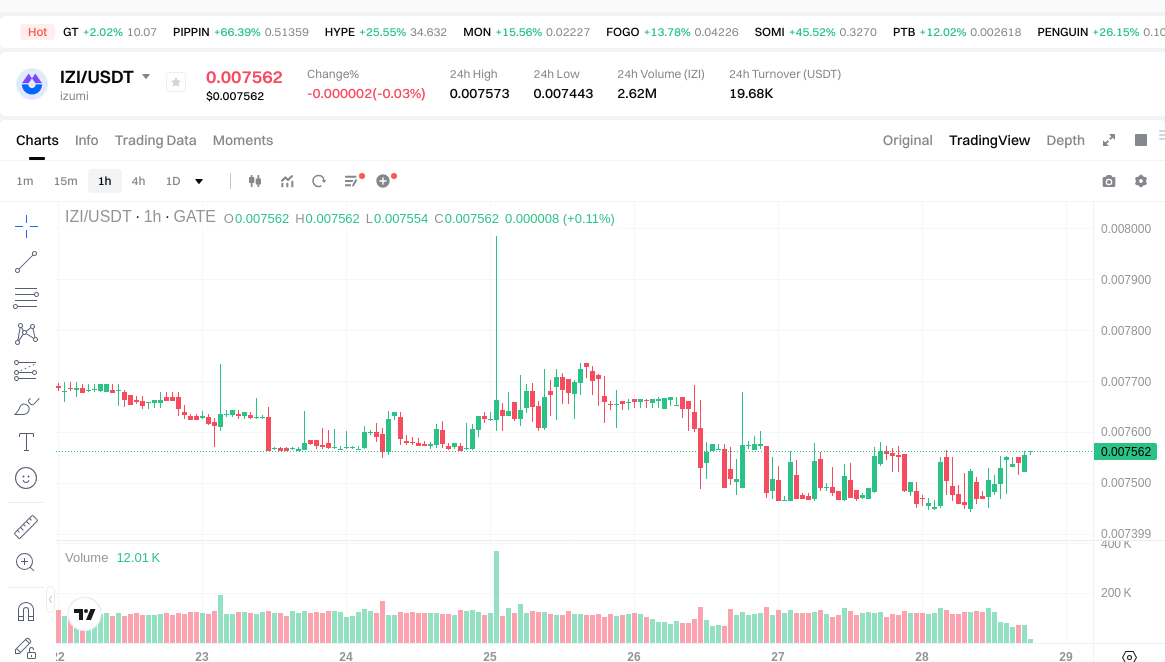
- IZI Current Price: $0.007562
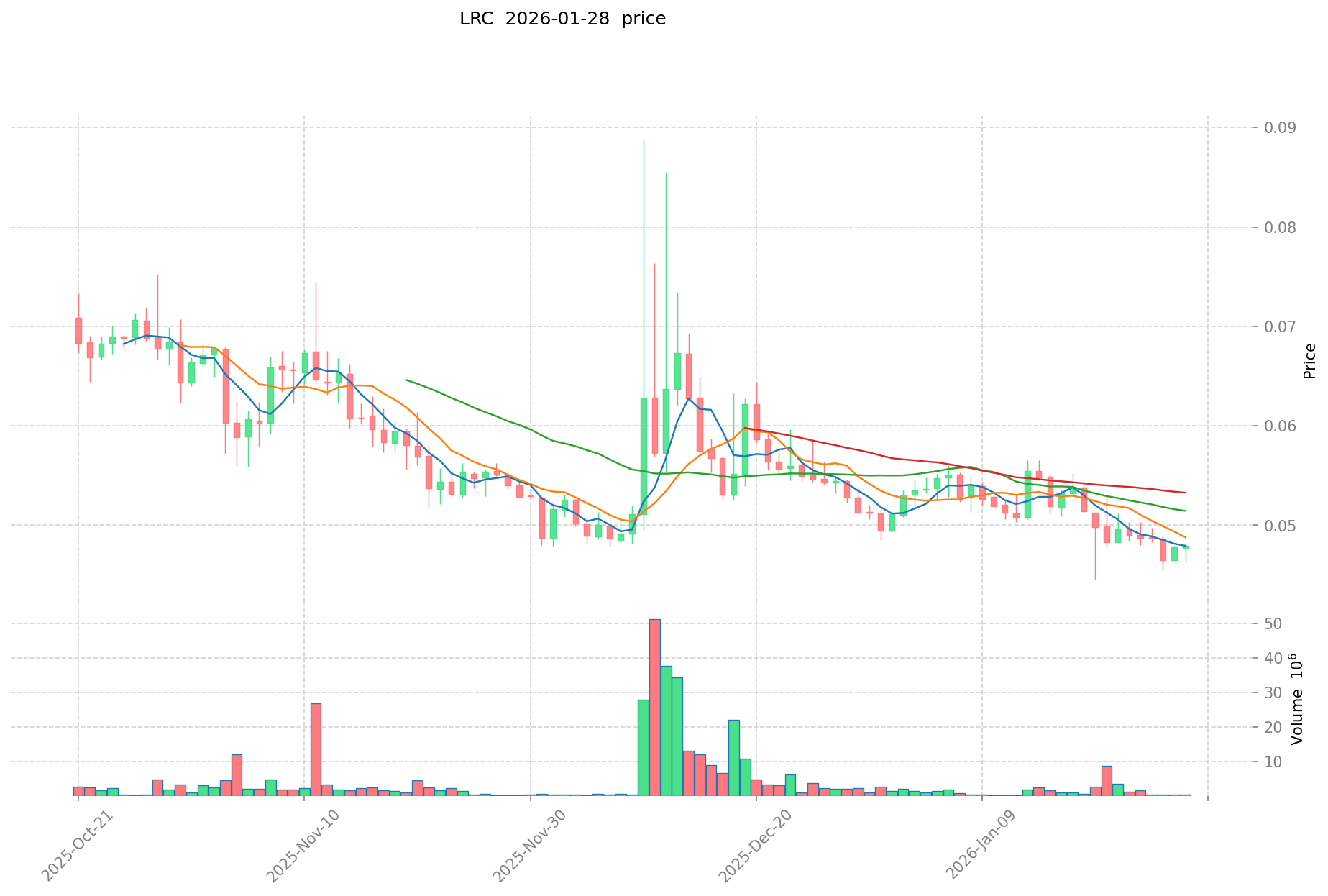
- LRC Current Price: $0.04743
- 24-Hour Trading Volume: IZI recorded $19,756.63 compared to LRC's $21,706.36
- Market Sentiment Index (Fear & Greed Index): 29 (Fear)
View real-time prices:
II. Core Factors Influencing Investment Value of IZI vs LRC
Supply Mechanism Comparison (Tokenomics)
The supply mechanism of crypto assets can influence their long-term price trends and market positioning. Different tokenomics models may lead to varying investment characteristics.
- IZI: Specific supply mechanism details are not available in the provided materials.
- LRC: Specific supply mechanism details are not available in the provided materials.
- 📌 Historical Pattern: Supply mechanisms, such as fixed supply models or deflationary designs, have historically played a role in shaping price cycles. However, their actual impact depends on multiple market factors.
Institutional Adoption and Market Application
Institutional adoption and real-world application scenarios can influence the market demand and long-term value proposition of crypto assets.
- Institutional Holdings: Information regarding institutional preference between IZI and LRC is not available in the provided materials.
- Enterprise Adoption: Details about the application of IZI or LRC in cross-border payments, settlements, or investment portfolios are not available in the provided materials.
- National Policies: Regulatory attitudes toward IZI and LRC in different countries are not available in the provided materials.
Technology Development and Ecosystem Building
Technological upgrades and ecosystem development can affect the competitiveness and adoption rate of crypto projects.
- IZI Technology Upgrades: Specific information about IZI's technology development and potential impact is not available in the provided materials.
- LRC Technology Development: Specific information about LRC's technology development and potential impact is not available in the provided materials.
- Ecosystem Comparison: Details regarding the implementation of DeFi, NFT, payments, and smart contracts for IZI and LRC are not available in the provided materials.
Macroeconomic Factors and Market Cycles
Macroeconomic conditions and market cycles can influence the performance of crypto assets in different economic environments.
- Performance in Inflationary Environments: Information about which asset may exhibit stronger inflation-resistant characteristics is not available in the provided materials.
- Macroeconomic Monetary Policy: Details about how interest rates and the US Dollar Index affect IZI and LRC are not available in the provided materials.
- Geopolitical Factors: Information regarding cross-border transaction demand and international situations affecting IZI and LRC is not available in the provided materials.
III. 2026-2031 Price Forecast: IZI vs LRC
Short-term Forecast (2026)
- IZI: Conservative $0.0053 - $0.0076 | Optimistic $0.0076 - $0.0095
- LRC: Conservative $0.034 - $0.047 | Optimistic $0.047 - $0.065
Mid-term Forecast (2028-2029)
- IZI may enter a gradual accumulation phase, with estimated price range of $0.0076 - $0.013 by 2028, potentially expanding to $0.0089 - $0.014 by 2029
- LRC may enter a consolidation phase, with estimated price range of $0.059 - $0.083 by 2028, potentially reaching $0.048 - $0.108 by 2029
- Key drivers: institutional capital flows, ETF developments, ecosystem expansion
Long-term Forecast (2030-2031)
- IZI: Base scenario $0.010 - $0.015 | Optimistic scenario $0.013 - $0.022
- LRC: Base scenario $0.073 - $0.107 | Optimistic scenario $0.091 - $0.129
View detailed price predictions for IZI and LRC
Disclaimer
IZI:
| Year |
Predicted High Price |
Predicted Average Price |
Predicted Low Price |
Price Change |
| 2026 |
0.0094525 |
0.007562 |
0.0052934 |
0 |
| 2027 |
0.0125056575 |
0.00850725 |
0.0075714525 |
12 |
| 2028 |
0.013238131725 |
0.01050645375 |
0.0075646467 |
38 |
| 2029 |
0.014128028357625 |
0.0118722927375 |
0.008904219553125 |
56 |
| 2030 |
0.01781021995016 |
0.013000160547562 |
0.01157014288733 |
71 |
| 2031 |
0.021875370153383 |
0.015405190248861 |
0.01001337366176 |
103 |
LRC:
| Year |
Predicted High Price |
Predicted Average Price |
Predicted Low Price |
Price Change |
| 2026 |
0.0650202 |
0.04746 |
0.0341712 |
0 |
| 2027 |
0.077048937 |
0.0562401 |
0.052865694 |
18 |
| 2028 |
0.083305648125 |
0.0666445185 |
0.05864717628 |
40 |
| 2029 |
0.10796411997 |
0.0749750833125 |
0.04798405332 |
58 |
| 2030 |
0.121654570182862 |
0.09146960164125 |
0.073175681313 |
92 |
| 2031 |
0.128940123953588 |
0.106562085912056 |
0.098037119039091 |
124 |
IV. Investment Strategy Comparison: IZI vs LRC
Long-term vs Short-term Investment Strategies
- IZI: May suit investors focusing on liquidity infrastructure and multi-chain DeFi ecosystem development, considering its positioning as a liquidity-as-a-service platform
- LRC: May appeal to investors interested in decentralized exchange protocols within the Ethereum ecosystem, given its established presence since 2017
Risk Management and Asset Allocation
- Conservative Investors: IZI 30-40% vs LRC 60-70%
- Aggressive Investors: IZI 50-60% vs LRC 40-50%
- Hedging Tools: Stablecoin allocation, options strategies, cross-asset portfolio diversification
V. Potential Risk Comparison
Market Risk
- IZI: Price volatility reflected in historical price movement from $0.220101 to $0.00371135, current 24-hour trading volume of $19,756.63 indicates moderate liquidity conditions
- LRC: Historical price fluctuation from $3.75 to $0.01963893, current 24-hour trading volume of $21,706.36 suggests similar liquidity patterns
Technical Risk
- IZI: Scalability considerations related to multi-chain infrastructure, network stability dependencies
- LRC: Protocol security considerations, smart contract execution reliability on Ethereum network
Regulatory Risk
- Global regulatory frameworks may impact both assets differently based on their classification as DeFi infrastructure versus exchange protocols, with varying compliance requirements across jurisdictions
VI. Conclusion: Which Is the Better Buy?
📌 Investment Value Summary:
- IZI Advantages: Positioned in liquidity infrastructure sector with multi-chain capabilities, established since 2021 with focus on Uniswap V3 integration
- LRC Advantages: Longer operational history since 2017, established presence in Ethereum ecosystem as decentralized exchange protocol
✅ Investment Recommendations:
- Beginner Investors: Consider starting with LRC due to higher current price point and slightly higher trading volume, allowing for easier entry and exit positions
- Experienced Investors: May evaluate both assets based on portfolio diversification needs, considering IZI for DeFi infrastructure exposure and LRC for DEX protocol positioning
- Institutional Investors: Assessment should incorporate due diligence on liquidity depth, ecosystem partnerships, and alignment with institutional investment mandates
⚠️ Risk Disclaimer: Cryptocurrency markets exhibit substantial volatility. This content does not constitute investment advice. Current market sentiment index at 29 indicates fear conditions. Investors should conduct independent research and consider their risk tolerance before making investment decisions.
VII. FAQ
Q1: What is the main difference between IZI and LRC in terms of their core functionality?
IZI operates as a liquidity-as-a-service (LaaS) platform built on Uniswap V3 and multi-chain DEX infrastructure, while LRC functions as a decentralized exchange protocol based on ERC20 and smart contracts within the Ethereum ecosystem. IZI focuses on providing liquidity infrastructure across multiple blockchain networks, enabling enhanced liquidity management for DeFi applications. LRC, established earlier in 2017, specializes in facilitating decentralized trading through its protocol layer, offering users a non-custodial trading experience on Ethereum.
Q2: Which asset shows better price stability based on historical performance?
Neither asset demonstrates significant price stability, as both have experienced substantial volatility. IZI declined from $0.220101 (December 2021) to $0.00371135 (May 2025), representing a significant downward trajectory, while LRC dropped from $3.75 (November 2021) to $0.01963893 (December 2019), showing similar volatile patterns. Both assets currently trade at lower levels compared to their historical peaks, with IZI at $0.007562 and LRC at $0.04743 as of January 28, 2026, reflecting the broader market cycle dynamics affecting crypto assets.
Q3: How do the current trading volumes compare between IZI and LRC?
LRC exhibits slightly higher 24-hour trading volume at $21,706.36 compared to IZI's $19,756.63. The relatively similar trading volumes suggest comparable liquidity conditions for both assets in the current market environment. However, both volumes remain modest, indicating that investors should consider potential liquidity constraints when planning larger position entries or exits.
Q4: What is the price forecast outlook for both assets by 2031?
According to projections, IZI's base scenario estimates a price range of $0.010 - $0.015 by 2031, with an optimistic scenario reaching $0.013 - $0.022, representing a potential 103% change from 2026 levels. LRC's base scenario forecasts $0.073 - $0.107 by 2031, with an optimistic scenario of $0.091 - $0.129, indicating a potential 124% change from 2026 levels. LRC shows higher absolute price targets and percentage growth potential in long-term forecasts, though both projections depend on multiple market factors including ecosystem development, institutional adoption, and broader market cycles.
Q5: Which asset is more suitable for conservative investors?
Based on the asset allocation recommendations, conservative investors may consider a portfolio weighting of 30-40% IZI versus 60-70% LRC. LRC's longer operational history since 2017, higher current price point, and slightly higher trading volume provide a more established market presence. However, conservative investors should prioritize risk management through diversified holdings, stablecoin allocation, and thorough due diligence rather than concentrating solely on one asset.
Q6: What are the primary risks associated with investing in IZI versus LRC?
IZI faces risks related to multi-chain infrastructure scalability and network stability dependencies across different blockchains. LRC encounters risks associated with protocol security and smart contract execution reliability on the Ethereum network. Both assets experience market risk through significant price volatility and moderate liquidity conditions. Additionally, regulatory risk applies to both, though potentially differently—IZI as DeFi infrastructure and LRC as a DEX protocol may face varying compliance requirements across jurisdictions.
Q7: How does the current market sentiment affect investment decisions for IZI and LRC?
The current market sentiment index stands at 29, indicating fear conditions in the broader cryptocurrency market. This fear sentiment typically suggests cautious investor behavior and potentially suppressed prices. During such periods, both IZI and LRC may experience reduced buying pressure and increased volatility. Investors should exercise heightened caution, avoid over-leveraging, and consider dollar-cost averaging strategies rather than making large lump-sum investments during fear-dominated market conditions.
Q8: What factors should experienced investors prioritize when choosing between IZI and LRC?
Experienced investors should evaluate portfolio diversification needs, considering IZI for exposure to liquidity infrastructure and multi-chain DeFi ecosystem development, and LRC for positioning in decentralized exchange protocols within the Ethereum ecosystem. Key assessment factors include liquidity depth analysis, ecosystem partnership developments, technological roadmap progress, and alignment with overall portfolio strategy. Aggressive investors might consider a 50-60% IZI versus 40-50% LRC allocation to capture potential growth in emerging DeFi infrastructure, while maintaining balance through established DEX protocol exposure.
* The information is not intended to be and does not constitute financial advice or any other recommendation of any sort offered or endorsed by Gate.