This comprehensive guide compares Jupiter (JUP) and Cardano (ADA) across multiple investment dimensions. JUP, launched in 2024, dominates Solana's DeFi infrastructure with over 80% retail liquidity volume and trades at $0.22781 with a $726.81M market cap. ADA, an established blockchain platform since 2017, trades at $0.4238 with a $15.58B market cap. The analysis examines historical price trends, tokenomics, technical ecosystems, and 2026-2031 price forecasts. JUP shows higher volatility and growth potential but carries concentrated ecosystem risk tied to Solana performance. ADA offers greater liquidity depth and broader application scope across multiple sectors. Investment considerations vary by profile: conservative investors favor ADA's established market presence and lower volatility, while growth-oriented investors may balance both assets based on risk tolerance. The guide provides portfolio allocation strategies, comprehensive risk assessment, and detailed FAQ addressing key investment questions.
Introduction: Comparative Investment Analysis of JUP and ADA
In the cryptocurrency market, the comparison between Jupiter (JUP) and Cardano (ADA) represents a noteworthy discussion for investors evaluating different blockchain ecosystems. These two digital assets differ significantly in terms of market capitalization ranking, application scenarios, and price performance, while representing distinct positioning within the crypto asset landscape.
Jupiter (JUP): Launched in 2024, Jupiter has established itself as the leading DeFi application on Solana, functioning as the primary liquidity infrastructure and processing over 80% of retail liquidity volume within the Solana network.
Cardano (ADA): Since its introduction in 2017, Cardano has been recognized as a technology platform designed to support financial applications used by individuals, organizations, and governments worldwide, featuring a layered architecture approach.
This article provides a comprehensive analysis comparing JUP vs ADA across multiple dimensions including historical price trends, supply mechanisms, technological ecosystems, and future outlook, addressing the fundamental question investors often consider:
"Which is the better buy right now?"
As of January 14, 2026, JUP ranks #106 with a market capitalization of approximately $726.81 million and a circulating supply of 3.19 billion tokens, while ADA holds the #11 position with a market capitalization of approximately $15.58 billion and a circulating supply of 36.76 billion tokens. The significant difference in market positioning, project maturity, and ecosystem development offers investors distinct risk-return profiles worth examining.
I. Price History Comparison and Market Status
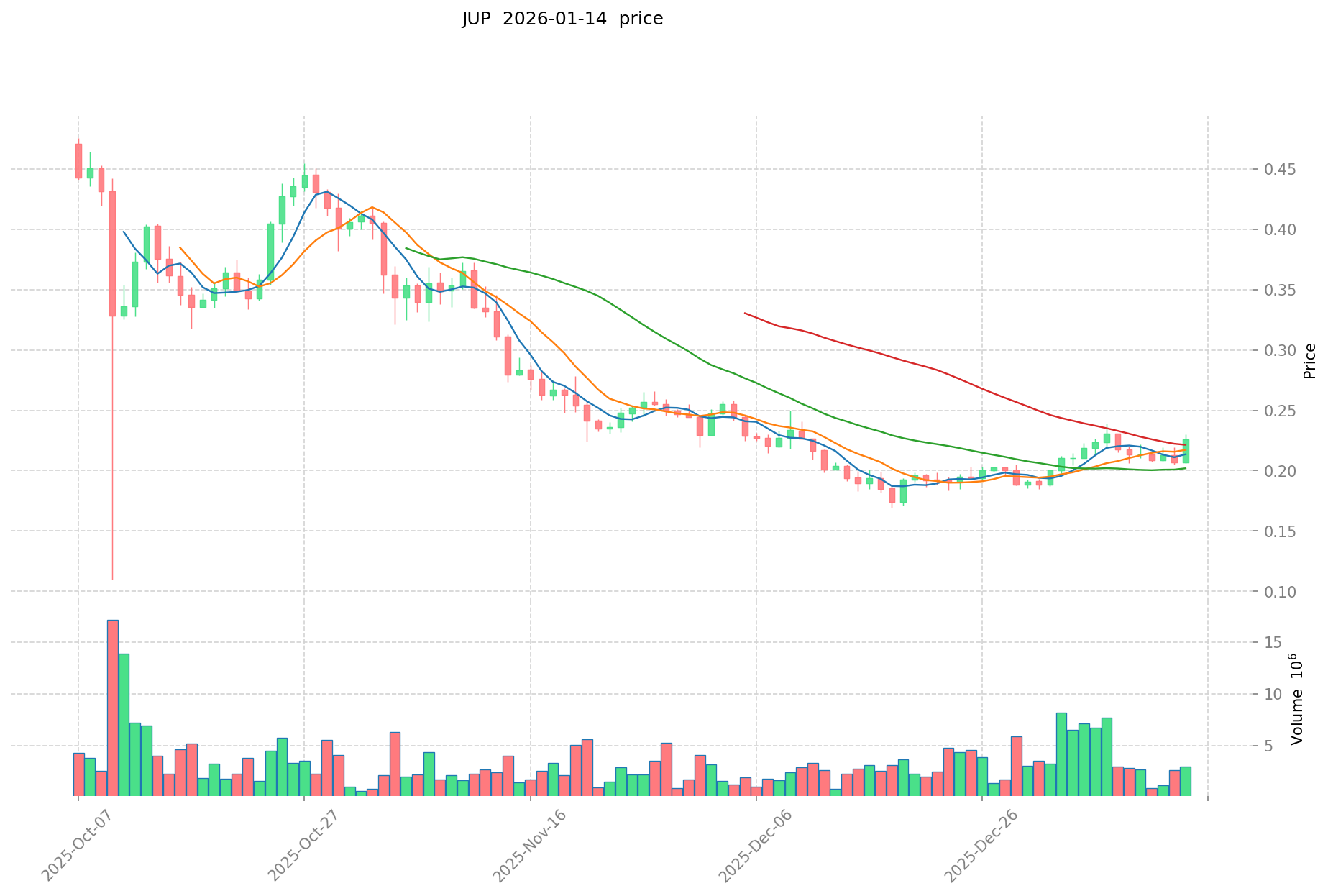
Jupiter (JUP) and Cardano (ADA) Historical Price Trends
-
2024: Jupiter (JUP) launched on January 31, 2024, with its token generation event. The asset experienced significant volatility in its initial months, reaching an all-time high of $2.20 on January 31, 2024, coinciding with its public debut on the Solana network.
-
2021: Cardano (ADA) achieved notable price movement during the broader cryptocurrency market expansion. The asset reached its all-time high of $3.09 on September 2, 2021, driven by the anticipation and launch of smart contract functionality through the Alonzo upgrade.
-
2025: Jupiter (JUP) recorded its all-time low of $0.1097 on October 10, 2025, reflecting broader market corrections and adjustments in DeFi liquidity dynamics on Solana.
-
2020: Cardano (ADA) touched its all-time low of $0.01925275 on March 13, 2020, during the cryptocurrency market downturn associated with global economic uncertainty.
-
Comparative Analysis: During different market cycles, Jupiter (JUP) has experienced a decline from its peak of $2.20 to its current level of $0.22781, representing a substantial correction. Meanwhile, Cardano (ADA) has adjusted from its high of $3.09 to its present price of $0.4238, demonstrating a different volatility pattern across a longer operational history.
Current Market Status (January 14, 2026)
- Jupiter (JUP) current price: $0.22781
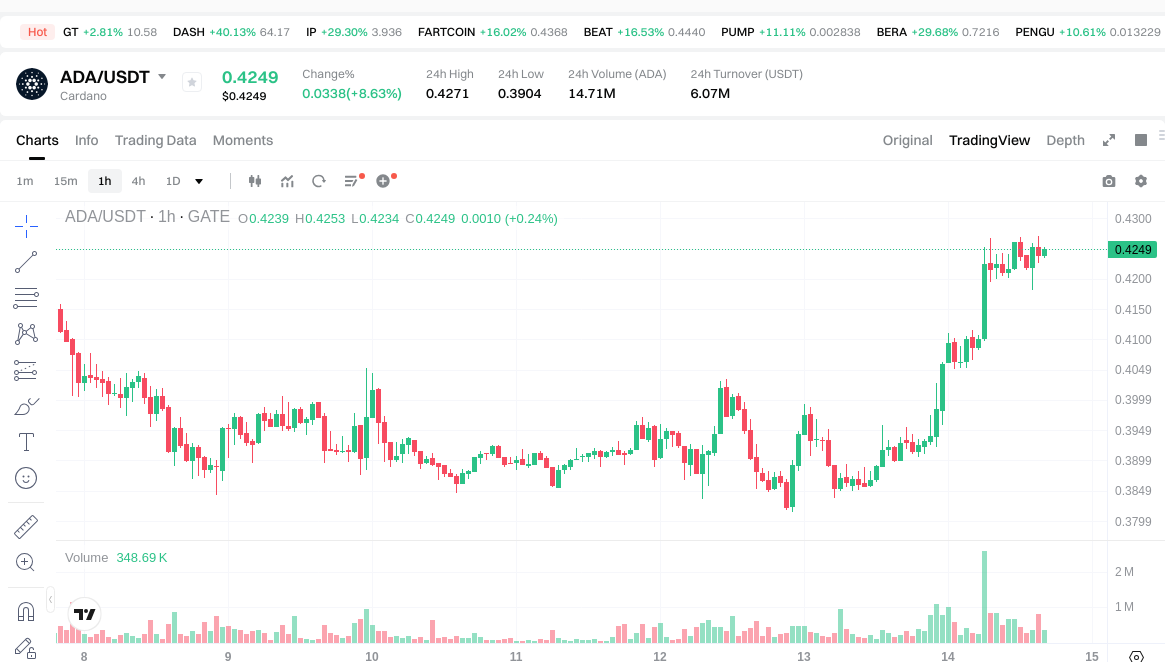
- Cardano (ADA) current price: $0.4238
- 24-hour trading volume: JUP recorded $750,654.60948, while ADA demonstrated higher liquidity with $5,978,879.003027
- Market capitalization: JUP stands at $726,809,368.94, whereas ADA maintains a larger market presence with $15,579,023,572.01
- Circulating supply: JUP has 3,190,419,072.66 tokens in circulation (31.90% of total supply), while ADA shows 36,760,319,896.19 tokens circulating (81.69% of total supply)
- Market sentiment indicator (Fear & Greed Index): 48 (Neutral)
View real-time prices:
- Check JUP current price Market Price
- Check ADA current price Market Price
II. Core Factors Influencing JUP vs ADA Investment Value
Tokenomics Comparison
- JUP: Functions as a governance token within the Jupiter platform, enabling community members to participate in voting on various aspects of platform operations. The token's value proposition is tied to its role in the Solana-based exchange infrastructure.
- ADA: The token distribution and utility model emphasizes practical applications within the blockchain ecosystem, with long-term value dependent on real-world adoption across various use cases.
- 📌 Historical Pattern: Token utility and distribution mechanisms serve as fundamental indicators for assessing long-term cryptocurrency value, with practical ecosystem integration playing a more significant role than market speculation.
Institutional Adoption and Market Applications
- Institutional Interest: Market positioning varies based on each project's infrastructure maturity and ecosystem development stage.
- Enterprise Integration: JUP focuses on building comprehensive exchange infrastructure on Solana for individual users and projects, while ADA emphasizes broader blockchain ecosystem applications.
- Regional Considerations: Both assets operate within evolving regulatory frameworks that vary across jurisdictions.
Technical Development and Ecosystem Building
- JUP Technical Focus: Aims to construct the most comprehensive and reliable exchange infrastructure on Solana, with value closely linked to the success of its exchange platform and community consensus.
- ADA Development Direction: Concentrates on practical blockchain applications with emphasis on ecosystem utility.
- Ecosystem Comparison: JUP's community activity has been identified as a key metric for consensus strength, while both projects seek to establish value through community engagement and practical applications.
Macroeconomic Factors and Market Cycles
- Market Volatility Impact: Both assets are influenced by broader cryptocurrency market cycles, with factors including market volatility, project utility, and community support affecting investment value.
- Portfolio Strategy Considerations: Reference materials suggest diversified allocation strategies, with recommendations to balance established assets, mid-tier projects, and higher-risk opportunities based on risk tolerance.
- Market Dynamics: The 2020-2021 cycle demonstrated how strategic entry during correction periods and disciplined approaches can be more significant than speculation in achieving sustained returns.
III. 2026-2031 Price Forecast: JUP vs ADA
Short-term Forecast (2026)
- JUP: Conservative $0.16-$0.23 | Optimistic $0.23-$0.28
- ADA: Conservative $0.31-$0.42 | Optimistic $0.42-$0.48
Mid-term Forecast (2028-2029)
- JUP may enter a consolidation phase, with estimated price range of $0.21-$0.40
- ADA may enter an expansion phase, with estimated price range of $0.30-$0.84
- Key drivers: institutional capital inflows, ETF developments, ecosystem growth
Long-term Forecast (2031)
- JUP: Baseline scenario $0.25-$0.46 | Optimistic scenario $0.46-$0.55
- ADA: Baseline scenario $0.53-$0.78 | Optimistic scenario $0.78-$1.11
View detailed price predictions for JUP and ADA
Disclaimer: Price predictions are based on historical data analysis and market trends. Cryptocurrency markets are highly volatile and subject to various external factors. This information is for reference purposes only and does not constitute investment advice. Users should conduct their own research and risk assessment before making any investment decisions.
JUP:
| Year |
Predicted High Price |
Predicted Average Price |
Predicted Low Price |
Price Change |
| 2026 |
0.2808459 |
0.22833 |
0.1621143 |
0 |
| 2027 |
0.3589690095 |
0.25458795 |
0.2113079985 |
11 |
| 2028 |
0.398812023675 |
0.30677847975 |
0.20860936623 |
34 |
| 2029 |
0.44452201715775 |
0.3527952517125 |
0.28929210640425 |
54 |
| 2030 |
0.526229397454365 |
0.398658634435125 |
0.35081959830291 |
75 |
| 2031 |
0.545683938814799 |
0.462444015944745 |
0.245095328450714 |
103 |
ADA:
| Year |
Predicted High Price |
Predicted Average Price |
Predicted Low Price |
Price Change |
| 2026 |
0.484272 |
0.4248 |
0.314352 |
0 |
| 2027 |
0.60907824 |
0.454536 |
0.3863556 |
7 |
| 2028 |
0.6222143304 |
0.53180712 |
0.3031300584 |
25 |
| 2029 |
0.83666555154 |
0.5770107252 |
0.334666220616 |
36 |
| 2030 |
0.8552741474277 |
0.70683813837 |
0.5371969851612 |
66 |
| 2031 |
1.109099722916367 |
0.78105614289885 |
0.531118177171218 |
84 |
IV. Investment Strategy Comparison: JUP vs ADA
Long-term vs Short-term Investment Strategies
-
JUP: May appeal to investors focused on DeFi infrastructure growth within the Solana ecosystem, particularly those seeking exposure to decentralized exchange liquidity mechanisms. The asset's shorter operational history and concentrated utility within Solana's trading infrastructure suggest a different risk profile compared to more established blockchain platforms.
-
ADA: May suit investors interested in broader blockchain ecosystem development with emphasis on practical applications across various sectors. The extended operational history since 2017 and larger market capitalization positioning reflect a different maturity stage in blockchain platform evolution.
Risk Management and Asset Allocation
-
Conservative portfolio approach: Considerations may include allocating a smaller percentage to newer DeFi-focused tokens like JUP (15-25%) while maintaining larger exposure to established blockchain platforms like ADA (75-85%), complemented by stable asset holdings.
-
Growth-oriented portfolio approach: Investors with higher risk tolerance might consider balanced exposure between emerging DeFi infrastructure (JUP: 40-50%) and established blockchain ecosystems (ADA: 50-60%), adjusted based on individual risk assessment and market conditions.
-
Risk mitigation tools: Portfolio diversification strategies may incorporate stablecoin allocations for liquidity management, consideration of derivative instruments where available, and cross-asset positioning to balance ecosystem-specific exposures.
V. Potential Risk Comparison
Market Risk
-
JUP: The asset demonstrates significant price volatility with a 24-hour trading volume of $750,654, reflecting its positioning as a newer market participant. Price movements show substantial fluctuation from its launch price, indicating sensitivity to both DeFi sector dynamics and Solana network activity. The lower market capitalization of $726.81 million suggests exposure to liquidity constraints during market stress periods.
-
ADA: With a 24-hour trading volume of $5.98 million and market capitalization of $15.58 billion, the asset exhibits different liquidity characteristics. Historical price patterns demonstrate responsiveness to broader cryptocurrency market cycles, with movements influenced by ecosystem development milestones and overall blockchain sector sentiment.
Technical Risk
-
JUP: Infrastructure dependency on Solana network performance represents a key consideration, as the token's utility is closely tied to exchange functionality and trading activity within the Solana ecosystem. The concentration of liquidity processing (over 80% of retail volume) within a single blockchain environment presents ecosystem-specific technical considerations.
-
ADA: Technical considerations include the ongoing development of the layered architecture approach and the implementation timeline for planned ecosystem features. Network evolution and the progression of technical upgrades represent factors that may influence long-term utility and adoption patterns.
Regulatory Risk
- Global regulatory developments affect both assets differently based on their functional characteristics and geographic operation patterns. JUP's focus on decentralized exchange infrastructure and ADA's broader blockchain platform positioning may encounter distinct regulatory considerations across various jurisdictions. Market participants should monitor evolving compliance frameworks that impact DeFi protocols and blockchain platforms respectively.
VI. Conclusion: Which Is the Better Buy?
📌 Investment Value Summary:
-
JUP characteristics: Represents exposure to Solana-based DeFi infrastructure with focus on exchange liquidity services. The asset's market positioning reflects its role as a newer entrant in the decentralized exchange sector, with value tied to Solana ecosystem growth and trading volume activity. Current market capitalization of $726.81 million and 31.90% circulating supply indicate an earlier development stage.
-
ADA characteristics: Offers exposure to an established blockchain platform with operational history since 2017. The asset's market positioning at rank #11 with $15.58 billion market capitalization reflects broader ecosystem development across multiple application areas. The 81.69% circulating supply and extended price history provide different liquidity and market depth characteristics.
✅ Investment Considerations:
-
Emerging market participants: May consider starting with established blockchain platforms that demonstrate longer operational track records and larger market capitalizations, while gradually exploring exposure to specialized DeFi infrastructure based on risk tolerance and market understanding.
-
Experienced market participants: Might evaluate portfolio allocation based on specific exposure goals, balancing established blockchain platforms with emerging DeFi infrastructure according to individual risk assessment frameworks and market cycle positioning.
-
Institutional participants: Assessment considerations may include liquidity depth, regulatory clarity, ecosystem maturity, and alignment with specific investment mandates regarding blockchain infrastructure exposure.
⚠️ Risk Notice: Cryptocurrency markets demonstrate high volatility characteristics. This content provides informational analysis and does not constitute investment advice. Market participants should conduct independent research and risk evaluation appropriate to their specific circumstances.
VII. FAQ
Q1: What is the primary difference between Jupiter (JUP) and Cardano (ADA) in terms of their core functions?
Jupiter (JUP) is a specialized DeFi protocol focused on decentralized exchange infrastructure within the Solana ecosystem, processing over 80% of retail liquidity volume on Solana. Cardano (ADA), by contrast, is a comprehensive blockchain platform designed to support diverse financial and organizational applications globally through its layered architecture approach.
The fundamental distinction lies in their operational scope: JUP functions as liquidity infrastructure for trading activities, with value directly tied to exchange volume and Solana network adoption. ADA represents a broader blockchain ecosystem platform with applications spanning multiple sectors beyond trading infrastructure. JUP launched in 2024 with a market cap of $726.81 million, while ADA has operated since 2017 with a substantially larger market presence of $15.58 billion, reflecting their different maturity stages and ecosystem breadth.
Q2: Which asset offers better liquidity for trading purposes?
Cardano (ADA) demonstrates significantly higher trading liquidity with a 24-hour trading volume of $5,978,879 compared to Jupiter's $750,654 as of January 14, 2026. ADA's market capitalization of $15.58 billion also substantially exceeds JUP's $726.81 million.
The liquidity difference reflects several factors: ADA's longer operational history (since 2017), broader exchange availability, larger investor base, and higher circulating supply (81.69% vs. JUP's 31.90%). For traders requiring efficient order execution with minimal slippage, ADA's deeper liquidity pools provide more favorable conditions. However, JUP's concentrated liquidity within the Solana ecosystem serves specialized trading needs for participants focused on that specific network, though with inherently different depth characteristics compared to established blockchain platforms.
Q3: What are the key price volatility differences between JUP and ADA?
Jupiter (JUP) exhibits higher volatility, having declined from its all-time high of $2.20 (January 31, 2024) to $0.22781 currently—a decrease of approximately 89.6%. Cardano (ADA) shows relatively lower volatility, declining from $3.09 (September 2, 2021) to $0.4238—a decrease of approximately 86.3%.
The volatility disparity stems from multiple factors: JUP's shorter market history creates less price stability, its smaller market capitalization makes it more susceptible to large orders, and its concentrated utility within Solana exposes it to ecosystem-specific risks. ADA's extended operational period, larger market capitalization, and broader institutional participation contribute to comparatively more stable price movements. Both assets remain highly volatile by traditional financial standards, but JUP's newer market presence and focused application scope result in more pronounced price fluctuations during both expansion and correction cycles.
Q4: How do the tokenomics and supply mechanisms differ between JUP and ADA?
Jupiter (JUP) has a total supply of 10 billion tokens with only 3.19 billion (31.90%) currently circulating, indicating substantial future supply releases that may impact price dynamics. Cardano (ADA) has 45 billion total supply with 36.76 billion (81.69%) circulating, representing a more mature distribution phase.
The tokenomics contrast reflects different project stages: JUP's lower circulating percentage suggests ongoing distribution events that could create selling pressure as tokens unlock. ADA's higher circulation rate indicates completion of major distribution phases, potentially reducing supply-related price pressure. JUP functions primarily as a governance token for platform operations, while ADA's utility extends across the broader Cardano ecosystem for staking, transaction fees, and governance. The supply dynamics significantly affect investment considerations—JUP faces potential dilution from unreleased tokens, whereas ADA's supply structure appears more stabilized for long-term price discovery.
Q5: Which asset is more suitable for conservative investors?
Cardano (ADA) generally aligns better with conservative investment profiles due to its established market presence (#11 ranking), longer operational history (since 2017), higher market capitalization ($15.58 billion), and greater liquidity depth.
Conservative investors typically prioritize capital preservation, lower volatility, and proven track records—characteristics more closely associated with ADA's positioning. The asset's extended price history provides more data for risk assessment, its larger market cap reduces susceptibility to manipulation, and its broader ecosystem adoption indicates established utility. JUP, while potentially offering growth opportunities, presents higher risk factors including: shorter operational history, lower market capitalization, concentrated ecosystem dependency, and significant unreleased token supply. Risk-averse portfolios might allocate 75-85% toward established platforms like ADA while limiting exposure to emerging DeFi infrastructure like JUP to 15-25%, adjusted based on individual risk tolerance and investment objectives.
Q6: How does ecosystem dependency affect the risk profiles of JUP versus ADA?
Jupiter (JUP) exhibits concentrated ecosystem dependency on Solana network performance, with its functionality and value proposition entirely tied to Solana's trading infrastructure. Cardano (ADA) operates as an independent Layer-1 blockchain platform with self-contained ecosystem dynamics.
This dependency difference creates distinct risk considerations: JUP's success directly correlates with Solana network adoption, technical reliability, and trading volume growth within that specific ecosystem. Any technical issues, security concerns, or adoption challenges facing Solana directly impact JUP's utility and value. Conversely, ADA functions as a standalone blockchain platform with its own validator network, governance structure, and application ecosystem, reducing dependency on external infrastructure. However, ADA faces different risks related to its own technical development, upgrade implementation, and competitive positioning among Layer-1 platforms. The concentrated dependency of JUP creates both opportunity (leveraging Solana's growth) and vulnerability (exposure to ecosystem-specific challenges), while ADA's independence distributes risk differently across blockchain platform competition dynamics.
Q7: What are the long-term growth potential differences between JUP and ADA based on current forecasts?
According to 2031 forecasts, Jupiter (JUP) shows potential growth to $0.46-$0.55 in optimistic scenarios (approximately 102-141% increase from current levels), while Cardano (ADA) forecasts indicate $0.78-$1.11 (approximately 84-162% increase from current levels).
The forecast analysis suggests relatively comparable growth potential in percentage terms, though starting from different price bases and market capitalizations. JUP's growth trajectory depends heavily on Solana ecosystem expansion and DeFi sector development, with value creation tied to increasing trading volumes and liquidity provision services. ADA's growth potential relates to broader blockchain adoption across multiple application areas, smart contract ecosystem maturation, and institutional integration. However, percentage gains must be contextualized within risk profiles: JUP's higher volatility and concentrated ecosystem dependency create both amplified upside potential and downside risk, while ADA's established positioning suggests more moderate but potentially more sustainable growth patterns. Investment decisions should weigh absolute return expectations against risk-adjusted return considerations and portfolio diversification objectives.
Q8: How should investors approach portfolio allocation between JUP and ADA?
Portfolio allocation between JUP and ADA should reflect individual risk tolerance, investment timeframe, and exposure objectives rather than following a universal formula.
For conservative approaches, reference materials suggest allocating 75-85% toward established blockchain platforms like ADA while limiting exposure to emerging DeFi infrastructure like JUP to 15-25%. This allocation acknowledges ADA's longer track record, higher liquidity, and broader ecosystem development while maintaining limited exposure to JUP's specialized DeFi growth potential. Growth-oriented portfolios with higher risk tolerance might consider more balanced allocation (40-50% JUP, 50-60% ADA) to capture both established platform stability and emerging infrastructure opportunities. Critical considerations include: maintaining adequate liquidity reserves through stablecoin allocations, implementing rebalancing mechanisms as relative valuations shift, monitoring ecosystem developments affecting each asset's fundamental value proposition, and adjusting exposures based on changing market conditions and personal circumstances. Neither asset should represent total portfolio exposure, and diversification across multiple blockchain ecosystems and asset types remains prudent for managing cryptocurrency market volatility.
* The information is not intended to be and does not constitute financial advice or any other recommendation of any sort offered or endorsed by Gate.