This article provides a comprehensive comparison of Kaspa (KAS) and Zilliqa (ZIL), two distinct Layer-1 blockchain platforms. It analyzes their historical price trends, technical architectures, and market performances to evaluate their investment worth. The core objective is to equip readers with insights on which platform presents a better investment opportunity, addressing needs for informed decision-making amidst current extreme market fear. Structured logically, the comparison covers technology, ecosystem maturity, and risk factors. Keywords like Layer-1, scalability, and investment strategy are optimized for quick reference and easy understanding.
Introduction: KAS vs ZIL Investment Comparison
In the cryptocurrency market, the comparison between Kaspa and Zilliqa has always been a topic that investors cannot avoid. The two projects differ significantly in market capitalization rankings, use cases, and price performance, while representing different positioning in the crypto asset landscape.
Kaspa (KAS): A fast, open-source, decentralized, and fully scalable Layer-1 blockchain that implements the GHOSTDAG protocol, allowing blocks created in parallel to coexist and be sorted in consensus rather than being isolated.
Zilliqa (ZIL): A high-throughput public blockchain platform designed to extend performance to thousands of transactions per second, addressing transaction speed and scalability challenges through sharding technology combined with innovative cryptographic techniques and consensus protocols.
This article will comprehensively analyze the investment value comparison between Kaspa and Zilliqa across multiple dimensions including historical price trends, supply mechanisms, technical ecosystems, and market performance, while attempting to answer the question investors care most about:
"Which is the better investment opportunity at present?"
Comparative Analysis Report: Kaspa (KAS) vs Zilliqa (ZIL)
I. Historical Price Comparison and Current Market Status
Kaspa (KAS) and Zilliqa (ZIL) Historical Price Trajectories
Kaspa (KAS):
- All-Time High (ATH): $0.207411 (August 1, 2024)
- All-Time Low (ATL): $0.00017105 (May 26, 2022)
- Launch Price: $0.000200226
Zilliqa (ZIL):
- All-Time High (ATH): $0.255376 (May 7, 2021)
- All-Time Low (ATL): $0.00239616 (March 13, 2020)
- Launch Price: $0.0081
Comparative Analysis: Kaspa achieved its peak value more recently (August 2024), suggesting a later market cycle entry compared to Zilliqa, whose ATH occurred in May 2021 during the previous bull market cycle. From their respective peaks to the current date, Kaspa has declined approximately 79.6% while Zilliqa has experienced approximately 98.1% depreciation from its ATH.
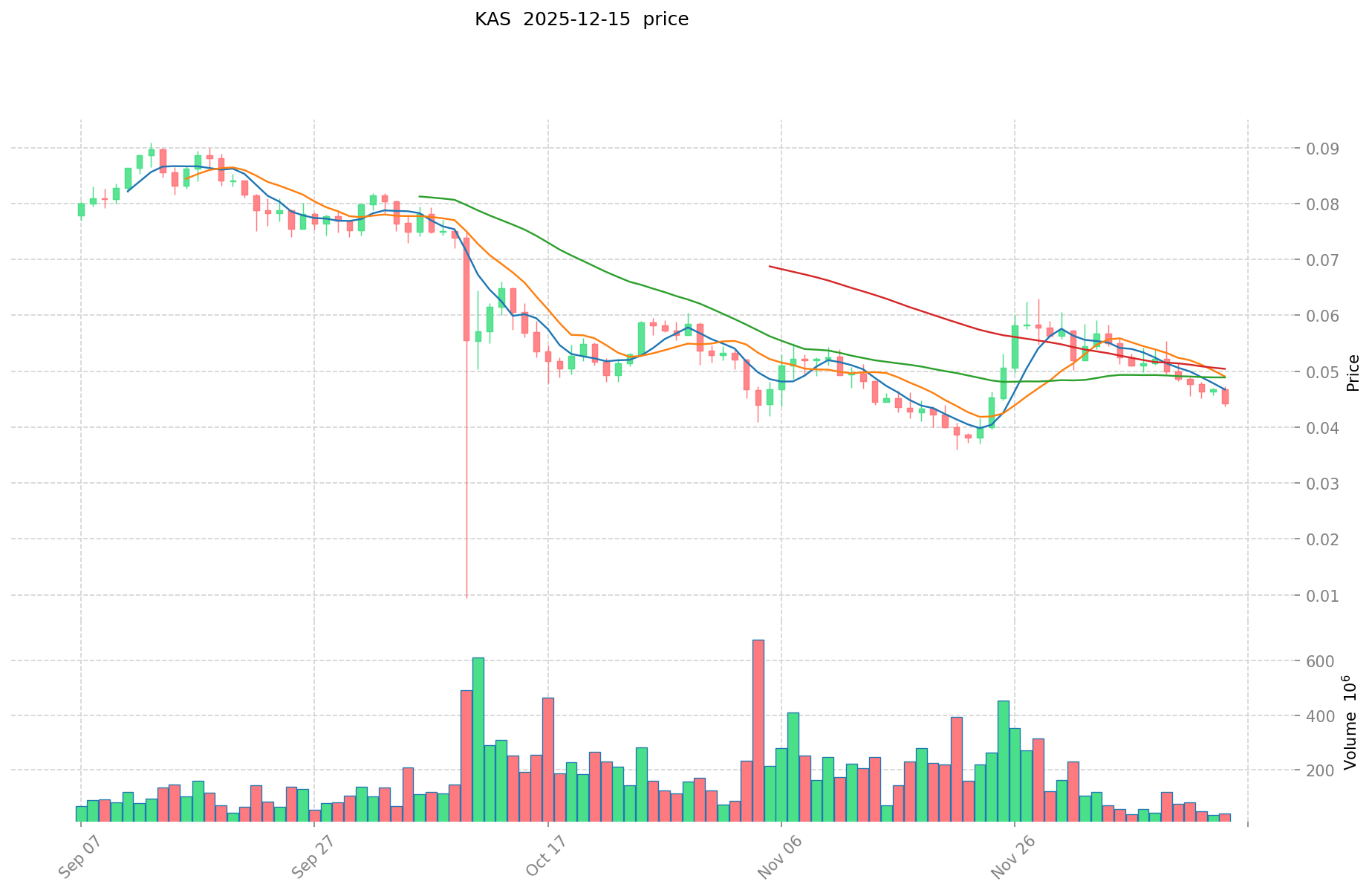
Current Market Status (December 16, 2025)
Kaspa (KAS):
- Current Price: $0.04236
- 24-Hour Price Change: -5.36%
- 7-Day Price Change: -18.8%
- 30-Day Price Change: -5.97%
- 1-Year Price Change: -73.02%
- Market Capitalization: $1,144,535,448.60
- 24-Hour Trading Volume: $4,171,689.96
- Circulating Supply: 26,777,148,610.51 KAS
- Total Supply: 27,019,250,438.98 KAS
- Market Dominance: 0.036%
Zilliqa (ZIL):
- Current Price: $0.004808
- 24-Hour Price Change: -4.96%
- 7-Day Price Change: -9.86%
- 30-Day Price Change: -30.3%
- 1-Year Price Change: -82.05%
- Market Capitalization: $97,590,675.48
- 24-Hour Trading Volume: $322,737.27
- Circulating Supply: 19,616,404,688.79 ZIL
- Total Supply: 20,297,561,455.34 ZIL
- Market Dominance: 0.0031%
Market Sentiment Index: 16 (Extreme Fear)
For real-time price updates:
II. Technology and Protocol Architecture
Kaspa (KAS): GHOSTDAG Protocol
Kaspa is a Layer-1 proof-of-work cryptocurrency implementing the GHOSTDAG protocol. Unlike traditional linear blockchains that orphan blocks created in parallel, GHOSTDAG allows these blocks to coexist and be sorted within the consensus mechanism. This architecture represents a block Directed Acyclic Graph (DAG) structure.
Key Technical Features:
- Current block generation rate: 1 block per second
- Target block generation rate: 10 blocks per second
- Future aspiration: 100 blocks per second
- Confirmation time: Microsecond-level (primarily network-latency limited)
- Security model: Proof of Work maintained at high block generation speeds
Unique Monetary Policy: Kaspa implements a novel block reward mechanism based on the musical 12-tone scale, reducing supply geometrically over time. The "Color Phase" policy launched on May 7, 2022, with an initial block reward of 440 KAS, halving annually through a smooth monthly reduction process.
Zilliqa (ZIL): Sharding-Based Architecture
Zilliqa is a high-throughput public blockchain platform designed to address scalability through sharding technology, extending performance to thousands of transactions per second. The platform combines innovative cryptographic techniques with novel consensus protocols.
Key Technical Features:
- High-throughput capability: Thousands of transactions per second
- Scalability mechanism: Sharding technology
- Transaction speed optimization while maintaining security balance
- Support for on-chain applications requiring high transaction capacity
| Metric |
Kaspa (KAS) |
Zilliqa (ZIL) |
| Current Price |
$0.04236 |
$0.004808 |
| Market Cap |
$1.14B |
$97.59M |
| 24H Volume |
$4.17M |
$0.32M |
| Market Dominance |
0.036% |
0.0031% |
| 24H Change |
-5.36% |
-4.96% |
| 7D Change |
-18.8% |
-9.86% |
| 30D Change |
-5.97% |
-30.3% |
| 1Y Change |
-73.02% |
-82.05% |
| Circulating Supply (%) |
93.29% |
93.41% |
| Price vs ATH |
-79.6% |
-98.1% |
IV. Ecosystem and Project Maturity
Kaspa Ecosystem Development
Kaspa was officially launched on November 23, 2021, by Dr. Yonatan Sompolinsky. The project transitioned from DAGLabs (the research company founded by Sompolinsky) to a decentralized, community-driven model upon mainnet launch. Development is maintained by global contributors through the open-source, permissionless Kaspa protocol.
Project Characteristics:
- Open-source and permissionless infrastructure
- No central governance or commercial business model
- Decentralized contributor network maintaining protocol advancement
- Active research and development community
Zilliqa Ecosystem Development
Zilliqa was launched on January 25, 2018, as a mature blockchain platform. The project originally targeted enterprise-grade applications in advertising, payment processing, sharing economy, and intellectual property management.
Project Characteristics:
- Multi-exchange listing support (44 exchanges)
- Established ecosystem maturity relative to Kaspa
- Longer market presence and historical trading data
V. Risk Assessment and Market Considerations
Extreme Fear Market Condition: The current crypto market sentiment index stands at 16, indicating "Extreme Fear." This suggests heightened market uncertainty and risk aversion among investors, affecting both projects.
Kaspa Considerations:
- Relatively newer market entry compared to established Layer-1 protocols
- Aggressive block generation targets may require sustained technological validation
- Unique monetary policy based on musical intervals—a novel approach requiring market acceptance
Zilliqa Considerations:
- Significant depreciation from 2021 ATH suggests sustained market headwinds
- Lower trading volume relative to market cap indicates liquidity concerns
- Sharding technology adoption faces ongoing competition from other scaling solutions
Shared Risk Factors:
- Extreme market fear conditions affecting all cryptocurrencies
- High year-over-year depreciation for both projects
- Concentration risk in proof-of-work mechanisms during potential energy cost fluctuations
VI. Conclusion
Kaspa maintains substantially higher market capitalization ($1.14B vs $97.59M) and trading volume, reflecting greater market confidence and liquidity. However, both projects operate within a severe market downturn environment, as evidenced by the Extreme Fear sentiment index. Kaspa's innovative GHOSTDAG protocol and aggressive scalability roadmap distinguish it technically from Zilliqa's established sharding approach, though both face challenges in demonstrating sustained technological and market validation during adverse market conditions.

Kaspa (KAS) Investment Value Analysis Report
I. Executive Summary
Kaspa (KAS) is positioned as a Layer 1 proof-of-work (PoW) cryptocurrency network designed for speed, security, and scalability. Based on available reference materials, this report analyzes the core factors influencing KAS investment value, with emphasis on tokenomics, market positioning, and technical architecture.
II. Core Factors Influencing KAS Investment Value
Supply Mechanism and Tokenomics
KAS Supply Structure:
- KAS operates as a proof-of-work network with an economic model centered on token supply, distribution methodology, and ecosystem utility
- As of June 25, 2024, circulating supply was approximately 24 billion KAS tokens
- Current block rewards are established within the protocol design
Tokenomics Impact on Value:
- Token supply and distribution mechanisms directly influence long-term valuation
- Distribution allocations to development teams, investors, and community incentives affect decentralization levels and community trust
- Well-designed tokenomics architecture is fundamental to project sustainability and investor confidence
- Inadequately designed tokenomics can lead to uncontrolled inflation, price manipulation, and project failure
Market Position and Institutional Adoption
Market Standing:
- KAS ranks as the fifth-largest proof-of-work digital asset by market capitalization
- Market capitalization: $3.9 billion (as of June 25, 2024)
- Daily trading volume: approximately $64.8 million
- KAS has achieved listing on major exchanges including Binance, indicating mainstream market recognition
Network Operations:
- Marathon Digital Holdings announced Kaspa mining operations, demonstrating institutional engagement with KAS infrastructure
Community Consensus:
- Strong community support, with KAS described as a potential leader in the PoW sector
- Community recognition positions KAS within emerging cryptocurrency narratives
Technical Architecture and Protocol Innovation
Core Technology:
- KAS implements the GHOSTDAG protocol, which represents a scalable generalization of Bitcoin's consensus mechanism
- The protocol maintains proof-of-work security while enabling enhanced throughput capabilities
- Layer 1 architecture positions KAS as a foundational blockchain network
Technical Positioning:
- Designed to balance speed, security, and decentralization characteristics inherent to PoW systems
- Protocol enables transaction processing at network scale without requiring secondary layers
Key Value Drivers
Primary Investment Value Factors:
I. Technology innovation and protocol efficiency
II. Market demand and real-world utility adoption
III. Community support and ecosystem development
IV. Market performance metrics including trading volume and price stability
III. Market Performance Context
- KAS demonstrated significant growth from historical lows, with approximately 800x appreciation from its minimum price point
- Current market positioning reflects investor confidence in PoW-based alternatives to dominant Layer 1 networks
- Trading liquidity on major exchanges provides market accessibility
IV. Risk Considerations
- Tokenomics design quality directly correlates with long-term sustainability; poor token economics can lead to ecosystem failure
- Market perception and sentiment remain significant price drivers alongside fundamental factors
- Competitive pressure from other PoW and Layer 1 networks influences relative valuation
Report Date: December 16, 2025
Disclaimer: This report is based on publicly available information current as of the reference materials provided. Cryptocurrency markets remain highly volatile and subject to regulatory, technological, and macroeconomic variables.
III. 2025-2030 Price Forecast: KAS vs ZIL
Short-term Forecast (2025)
- KAS: Conservative $0.034-$0.042 | Optimistic $0.048
- ZIL: Conservative $0.003-$0.005 | Optimistic $0.006
Mid-term Forecast (2027-2028)
- KAS may enter a consolidation phase with moderate growth, projected price range $0.028-$0.084
- ZIL showing gradual accumulation pattern, projected price range $0.003-$0.007
- Key drivers: Layer-1 scalability improvements, ecosystem partnerships, market cycle progression
Long-term Forecast (2030)
- KAS: Base scenario $0.057-$0.081 | Optimistic scenario $0.092
- ZIL: Base scenario $0.006-$0.008 | Optimistic scenario $0.012
View detailed KAS and ZIL price forecasts
Disclaimer: This analysis is based on historical data and statistical models. Cryptocurrency markets remain highly volatile and unpredictable. Past performance does not guarantee future results. These forecasts should not be considered investment advice. Conduct your own research and consult with financial professionals before making investment decisions. Market conditions, regulatory changes, and technological developments can significantly impact actual price movements.
KAS:
| 年份 |
预测最高价 |
预测平均价格 |
预测最低价 |
涨跌幅 |
| 2025 |
0.0479911 |
0.04247 |
0.033976 |
0 |
| 2026 |
0.051562827 |
0.04523055 |
0.0384459675 |
6 |
| 2027 |
0.066303463245 |
0.0483966885 |
0.027586112445 |
14 |
| 2028 |
0.08373111077385 |
0.0573500758725 |
0.03785105007585 |
35 |
| 2029 |
0.091702771320127 |
0.070540593323175 |
0.037386514461282 |
66 |
| 2030 |
0.092478717846682 |
0.081121682321651 |
0.056785177625155 |
91 |
ZIL:
| 年份 |
预测最高价 |
预测平均价格 |
预测最低价 |
涨跌幅 |
| 2025 |
0.00635844 |
0.004817 |
0.00260118 |
0 |
| 2026 |
0.0057553516 |
0.00558772 |
0.0035761408 |
16 |
| 2027 |
0.007599857972 |
0.0056715358 |
0.003062629332 |
17 |
| 2028 |
0.00716655263688 |
0.006635696886 |
0.00404777510046 |
38 |
| 2029 |
0.009178495932715 |
0.00690112476144 |
0.005589911056766 |
43 |
| 2030 |
0.011738123106733 |
0.008039810347077 |
0.006431848277662 |
67 |
Investment Strategy Comparison: Kaspa (KAS) vs Zilliqa (ZIL)
IV. Investment Strategy Comparison: KAS vs ZIL
Long-term vs Short-term Investment Strategies
Kaspa (KAS): Better suited for investors focused on Layer-1 protocol innovation and scalability potential. KAS appeals to those seeking exposure to proof-of-work technological advancement and believers in the GHOSTDAG protocol's long-term viability. The aggressive block generation roadmap (targeting 100 blocks per second) represents a multi-year development and validation timeline, making KAS more appropriate for long-term positioning strategies.
Zilliqa (ZIL): Better suited for investors seeking established ecosystem maturity and accumulated market history. ZIL appeals to those examining sharding-based scalability solutions and valuing longer mainnet operational track record (since January 2018). The project's enterprise-targeting history and 44-exchange listing infrastructure provide stability characteristics for moderate-duration investment horizons.
Risk Management and Asset Allocation
Conservative Investors:
- Kaspa (KAS): 35% | Zilliqa (ZIL): 25% | Stablecoin allocation: 40%
- Rationale: Diversification across different PoW and sharding scaling approaches with substantial stablecoin cushion reflecting Extreme Fear market conditions
Aggressive Investors:
- Kaspa (KAS): 55% | Zilliqa (ZIL): 30% | Stablecoin allocation: 15%
- Rationale: Higher concentration in KAS reflecting greater market capitalization and trading volume, with ZIL allocation for technological diversification
Hedging Instruments:
- Stablecoin positioning to capitalize on market volatility during Extreme Fear periods
- Cross-asset diversification between proof-of-work (KAS) and sharding-based (ZIL) architectures reduces single-protocol dependency risk
- Options strategies considering 2025-2030 price forecast volatility ranges
V. Comparative Risk Analysis
Market Risk
Kaspa (KAS): Relatively newer market participant with ATH achieved in August 2024. Market risk includes potential reversion toward earlier price discovery levels if technological milestones delay. Year-over-year depreciation of -73.02% indicates substantial downside realization, though distance from ATL ($0.00017105) provides recovery baseline.
Zilliqa (ZIL): Extended bear market period since 2021 ATH peak, with -98.1% depreciation from all-time high. Extreme vulnerability to further downside movements given proximity to historical lows. Drastically reduced trading volume ($322,737.27) relative to market capitalization creates liquidity risk during adverse market conditions.
Technical Risk
Kaspa (KAS): Protocol execution risk associated with aggressive scalability targets (targeting 10-100 blocks per second). Network stability validation required at elevated block generation rates. Novel monetary policy based on musical 12-tone scale reduction mechanism requires market acceptance and economic modeling validation.
Zilliqa (ZIL): Sharding implementation complexity and potential security vulnerabilities in cross-shard communication mechanisms. Competition from alternative scaling solutions (rollups, other sharding implementations) may diminish ZIL's technological differentiation advantages over extended timeframes.
Regulatory Risk
Global regulatory environment: Both projects operate as decentralized Layer-1 networks without centralized operational entities, reducing direct regulatory targeting vectors. However, proof-of-work networks may face regulatory scrutiny regarding energy consumption in jurisdictions with evolving environmental standards. Sharding-based architectures remain less regulated due to limited legacy regulatory frameworks specific to this technology.
Extreme Fear sentiment (Index: 16): Indicates heightened regulatory uncertainty pervasive across entire cryptocurrency sector, affecting both projects equally.
VI. Conclusion: Which Is the Better Buy?
Investment Value Summary:
Kaspa (KAS) Advantages:
- Superior market capitalization ($1.14B vs $97.59M) providing greater liquidity and institutional adoption pathways
- Recent ATH achievement (August 2024) suggests ongoing market cycle participation
- Innovative GHOSTDAG protocol represents meaningful technological differentiation from incumbent Layer-1 networks
- Higher trading volume enables more efficient position entry and exit
- Institutional recognition through Marathon Digital Holdings mining operations
Zilliqa (ZIL) Advantages:
- Extended market history (since January 2018) with established exchange infrastructure (44 listings)
- Sharding technology represents proven scalability alternative to other approaches
- Lower current price may appeal to accumulation-phase investors with capital constraints
- Historical enterprise-targeting focus demonstrates multi-year product-market focus
Investment Recommendations:
Beginner Investors:
- Allocate primary exposure to Kaspa (KAS) due to superior liquidity, higher trading volume, and greater institutional validation infrastructure
- Maintain substantial stablecoin allocation (40%+) reflecting Extreme Fear market conditions and extreme volatility
- Avoid leveraged or derivative positions given nascent market knowledge base
Experienced Investors:
- Consider KAS primary allocation with ZIL satellite position for technological diversification across different scaling paradigms
- Employ dollar-cost averaging strategies across 2025-2030 forecast period to capture volatility across multiple market cycles
- Monitor Kaspa protocol milestones regarding block generation rate implementations (1 → 10 → 100 blocks per second targets)
- Establish stop-loss parameters reflecting -20% to -30% volatility tolerance ranges
Institutional Investors:
- KAS demonstrates sufficient market depth for institutional position building, supported by Marathon Digital Holdings engagement and multi-exchange listing infrastructure
- Consider KAS as Layer-1 technology exposure within diversified digital asset allocation frameworks
- ZIL allocation better suited for portfolio risk management through sharding technology representation rather than primary return driver
- Evaluate both projects within context of long-term (2027-2030) forecast scenarios showing potential 91% (KAS) and 67% (ZIL) cumulative gains
Disclaimer
⚠️ Risk Warning: Cryptocurrency markets demonstrate extreme volatility and unpredictability. This analysis is based on historical data and publicly available information as of December 16, 2025. Past performance does not guarantee future results. Current market sentiment indicates "Extreme Fear" conditions, signaling heightened uncertainty and risk aversion affecting all digital assets.
This report does not constitute investment advice. All forecasts represent statistical projections subject to invalidation through regulatory changes, technological developments, competitive dynamics, or macroeconomic conditions. Conduct comprehensive independent research and consult qualified financial professionals before making investment decisions. Cryptocurrency investments carry substantial risk of total capital loss and should only constitute allocations appropriate to individual risk tolerance and financial objectives.
None
FAQ: Kaspa (KAS) vs Zilliqa (ZIL) Investment Comparison
I. What are the key technical differences between Kaspa and Zilliqa?
Answer: Kaspa implements the GHOSTDAG protocol, a Layer-1 proof-of-work architecture that allows parallel blocks to coexist and be sorted through consensus, targeting block generation rates from 1 to 100 blocks per second. Zilliqa uses sharding technology combined with innovative cryptographic techniques to achieve thousands of transactions per second. GHOSTDAG represents a Directed Acyclic Graph (DAG) structure, while sharding divides the network into smaller processing groups, representing fundamentally different scalability approaches.
II. Which project has better market liquidity and institutional adoption?
Answer: Kaspa demonstrates significantly superior market metrics. KAS has a market capitalization of $1.14 billion with $4.17 million in 24-hour trading volume, compared to ZIL's $97.59 million market cap and $322,737 trading volume. Kaspa also benefits from institutional recognition through Marathon Digital Holdings' mining operations and multiple major exchange listings. ZIL's substantially lower liquidity creates potential challenges for position entry and exit during volatile market conditions.
III. What do the price forecasts suggest for 2030?
Answer: Kaspa projects a 2030 price range of $0.057-$0.081 in base scenario or $0.092 in optimistic scenario, representing potential 91% gains from current levels. Zilliqa forecasts $0.006-$0.008 in base scenario or $0.012 in optimistic scenario, indicating 67% potential gains. Both forecasts assume positive technological validation and improved market sentiment over the forecast period. However, these remain statistical projections subject to significant invalidation risk through regulatory, competitive, or macroeconomic developments.
IV. How do the risk profiles differ between these two projects?
Answer: Kaspa faces execution risk regarding aggressive scalability targets and requires market acceptance of its novel 12-tone scale monetary policy mechanism. Zilliqa carries vulnerability from its -98.1% depreciation from 2021 all-time high and drastically reduced trading volume relative to market capitalization, creating severe liquidity risk. Both projects operate within "Extreme Fear" market sentiment conditions (Index: 16), heightening systemic cryptocurrency sector risks. KAS presents newer market participation risk while ZIL presents extended bear market vulnerability.
V. What allocation strategy suits different investor profiles?
Answer: Conservative investors should allocate 35% KAS, 25% ZIL, and 40% stablecoins to reflect extreme market fear conditions. Aggressive investors can allocate 55% KAS, 30% ZIL, and 15% stablecoins for higher growth exposure. Beginner investors should prioritize KAS due to superior liquidity and institutional validation, maintaining substantial stablecoin buffers. Experienced investors can employ dollar-cost averaging across 2025-2030 periods. Institutional investors should consider KAS as primary Layer-1 exposure with ZIL as portfolio diversification across different scaling paradigms.
VI. Why is KAS described as the better current investment despite higher volatility?
Answer: Kaspa offers superior market infrastructure with 11.7x greater market capitalization, significantly higher trading volume, and institutional engagement through Marathon Digital Holdings. KAS achieved its all-time high more recently (August 2024) than ZIL (May 2021), suggesting ongoing market cycle participation. The innovative GHOSTDAG protocol represents meaningful technological differentiation. However, "better" remains context-dependent on individual risk tolerance, investment horizon, and portfolio objectives. ZIL appeals to investors prioritizing longer operational history and established ecosystem maturity despite liquidity constraints.
VII. What market conditions would invalidate these investment theses?
Answer: Regulatory crackdowns on proof-of-work mining could negatively impact KAS through energy consumption scrutiny. Technological delays in Kaspa's block generation rate implementations (1 → 10 → 100 blocks per second) would undermine the primary value proposition. For Zilliqa, continued market share loss to superior sharding implementations or alternative scaling solutions would pressure valuation. Macroeconomic recession, sustained "Extreme Fear" sentiment prolongation, or breakthrough competing technologies could invalidate both theses. Additionally, any protocol security vulnerabilities discovered in either network would fundamentally undermine investment cases regardless of market conditions.
VIII. Should investors prioritize accumulation or wait for lower entry points given current market conditions?
Answer: Current market sentiment (Extreme Fear, Index: 16) and year-over-year depreciation (-73.02% for KAS, -82.05% for ZIL) suggest heightened downside vulnerability. Dollar-cost averaging across multiple months or quarters provides rational approach to uncertain entry point timing while reducing downside risk exposure. Conservative investors should maintain elevated stablecoin reserves to capitalize on potential further price declines. However, prices already reflect substantial depreciation from recent highs, potentially providing accumulation opportunities for those with multi-year investment horizons. Individual decisions should reflect personal risk tolerance and capital preservation objectives rather than timing speculation during extreme fear periods.
Disclaimer: These responses provide educational analysis based on available reference materials. This content does not constitute investment advice. Cryptocurrency markets remain highly volatile and unpredictable. Conduct independent research and consult qualified financial professionals before making investment decisions. Past performance does not guarantee future results.
* The information is not intended to be and does not constitute financial advice or any other recommendation of any sort offered or endorsed by Gate.