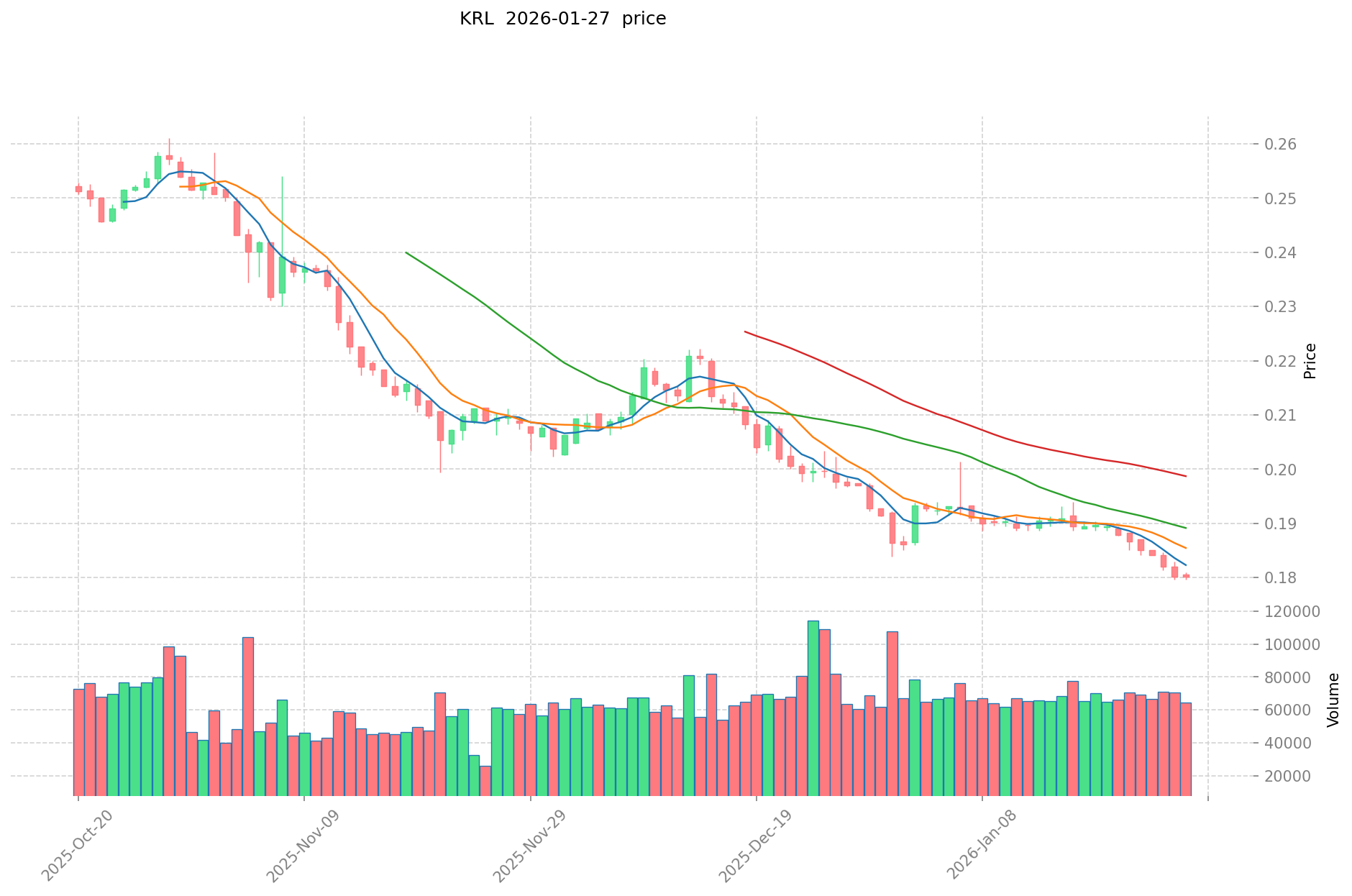
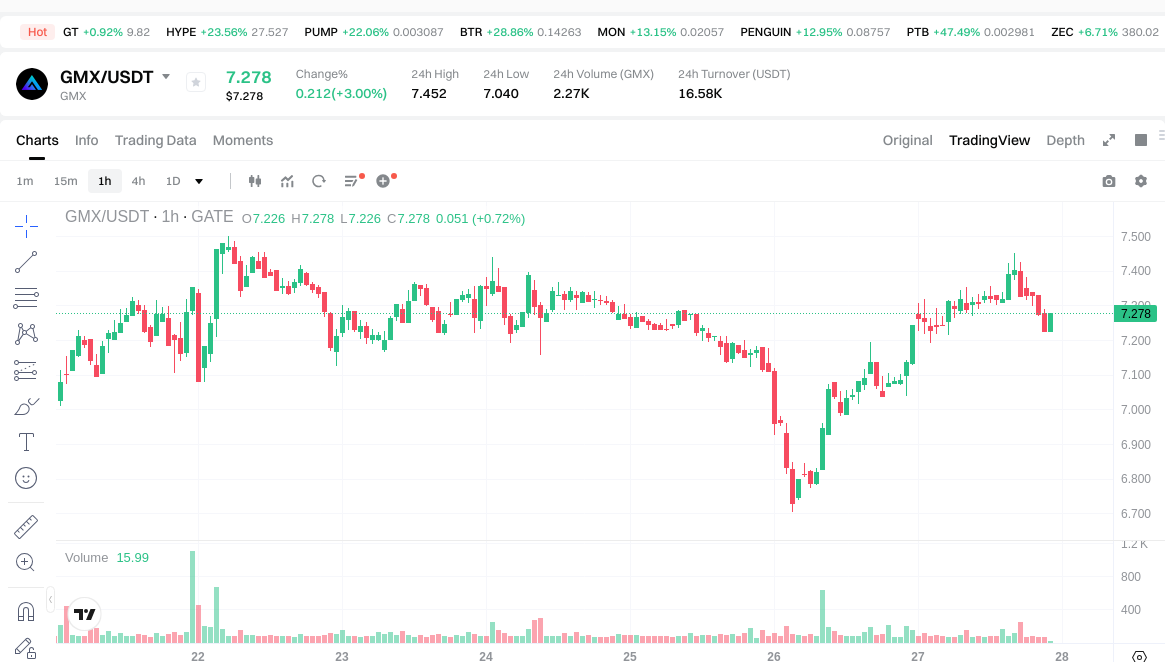
This comprehensive comparison analyzes KRL and GMX, two distinct cryptocurrency assets operating in different sectors. KRL, launched in 2018, functions as an automated trading strategy platform token, while GMX operates as a decentralized perpetual exchange with fee-sharing mechanisms. As of January 2026, KRL trades at $0.1801 with $11,604.98 daily volume, whereas GMX trades at $7.226 with superior $16,573.27 trading volume. Both assets have experienced substantial corrections from all-time highs. The analysis examines historical price trends, supply mechanisms, institutional adoption, technology development, and market risks. Conservative investors should prioritize GMX (85-90% allocation) for established infrastructure and liquidity, while experienced investors may balance GMX (60-70%) with strategic KRL positioning (30-40%) for asymmetric upside. Through 2031, GMX projects stronger growth potential aligned with DeFi infrastructure expansion, though both investments carry elevated cryptocurrency market vola
Introduction: KRL vs GMX Investment Comparison
In the cryptocurrency market, the comparison between KRL vs GMX has consistently been a topic that investors cannot overlook. The two not only demonstrate notable differences in market capitalization ranking, application scenarios, and price performance, but also represent distinct positioning within the crypto asset landscape.
KRL (Kryll): Launched in 2018, it has gained market recognition through its positioning as an intuitive visual platform for automated trading strategies, where KRL serves as the fuel token powering strategy execution on the Kryll.io platform.
GMX (GMX): Positioned as a decentralized perpetual exchange, GMX has established itself as both a utility and governance token, with a mechanism that accrues a portion of platform-generated fees to token holders.
This article will provide a comprehensive analysis of KRL vs GMX investment value comparison through the lens of historical price trends, supply mechanisms, technical ecosystems, and future outlook, attempting to address the question that investors care about most:
"Which is the better buy right now?"
I. Historical Price Comparison and Current Market Status
Historical Price Trends of KRL (Coin A) and GMX (Coin B)
- 2021: KRL reached its all-time high of $4.75 on November 7, driven by increased platform adoption and market momentum.
- 2020: KRL hit its all-time low of $0.00474521 on April 3, reflecting early-stage market conditions and limited liquidity.
- 2023: GMX achieved its all-time high of $91.07 on April 18, supported by growing adoption of decentralized perpetual exchanges.
- 2026: GMX recorded its all-time low of $6.74 on January 26, amid broader market volatility and declining trading activity.
- Comparative Analysis: During the 2021-2026 market cycle, KRL declined from its peak of $4.75 to approximately $0.18, representing a decrease of over 96%. Meanwhile, GMX experienced a decline from $91.07 to around $7.23, reflecting a drop of approximately 92% from its historical high.
Current Market Status (2026-01-27)
- KRL Current Price: $0.1801
- GMX Current Price: $7.226
- 24-Hour Trading Volume: KRL recorded $11,604.98, while GMX registered $16,573.27
- Market Sentiment Index (Fear & Greed Index): 29 (Fear)
View real-time prices:
- Check KRL current price Market Price
- Check GMX current price Market Price
II. Core Factors Influencing KRL vs GMX Investment Value
Supply Mechanism Comparison (Tokenomics)
- KRL: The reference materials do not provide specific information about KRL's supply mechanism or tokenomics structure.
- GMX: The reference materials do not provide specific information about GMX's supply mechanism or tokenomics structure.
- 📌 Historical Pattern: Supply mechanisms can influence price cycles through scarcity dynamics, emission schedules, and deflationary or inflationary models, though specific data for these assets is not available in the provided materials.
Institutional Adoption and Market Application
- Institutional Holdings: The reference materials do not contain information comparing institutional preference between KRL and GMX.
- Enterprise Adoption: Information regarding the application of KRL or GMX in cross-border payments, settlements, or investment portfolios is not available in the provided materials.
- National Policies: The reference materials do not include details about regulatory attitudes toward these assets in different jurisdictions.
Technology Development and Ecosystem Construction
- KRL Technology Upgrades: The reference materials do not provide information about KRL's technical development or potential impacts.
- GMX Technology Development: The reference materials do not provide information about GMX's technical development or potential impacts.
- Ecosystem Comparison: Information regarding DeFi, NFT, payment applications, or smart contract implementation for either asset is not available in the provided materials.
Macroeconomic Conditions and Market Cycles
- Performance in Inflationary Environments: The reference materials do not contain comparative analysis of inflation-hedging characteristics for these assets.
- Macroeconomic Monetary Policy: Information about how interest rates or dollar index movements affect KRL or GMX is not available in the provided materials.
- Geopolitical Factors: The reference materials do not discuss cross-border transaction demand or international situations as they relate to these specific assets.
III. 2026-2031 Price Forecast: KRL vs GMX
Short-term Forecast (2026)
- KRL: Conservative $0.10-$0.18 | Optimistic $0.18-$0.19
- GMX: Conservative $6.37-$7.24 | Optimistic $7.24-$7.89
Mid-term Forecast (2028-2029)
- KRL may enter a gradual growth phase, with estimated price range of $0.15-$0.25
- GMX may enter a consolidation and expansion phase, with estimated price range of $5.08-$10.71
- Key drivers: institutional capital inflows, ETF developments, ecosystem expansion
Long-term Forecast (2030-2031)
- KRL: Baseline scenario $0.17-$0.31 | Optimistic scenario $0.22-$0.34
- GMX: Baseline scenario $7.09-$13.98 | Optimistic scenario $10.05-$14.42
View detailed price predictions for KRL and GMX
Disclaimer
KRL:
| Year |
Predicted High Price |
Predicted Average Price |
Predicted Low Price |
Price Change |
| 2026 |
0.187304 |
0.1801 |
0.102657 |
0 |
| 2027 |
0.22595346 |
0.183702 |
0.09736206 |
2 |
| 2028 |
0.2335036122 |
0.20482773 |
0.1536207975 |
13 |
| 2029 |
0.247657208343 |
0.2191656711 |
0.17533253688 |
21 |
| 2030 |
0.30810310043238 |
0.2334114397215 |
0.221740867735425 |
29 |
| 2031 |
0.335739014895405 |
0.27075727007694 |
0.173284652849241 |
50 |
GMX:
| Year |
Predicted High Price |
Predicted Average Price |
Predicted Low Price |
Price Change |
| 2026 |
7.8916 |
7.24 |
6.3712 |
0 |
| 2027 |
10.59212 |
7.5658 |
5.750008 |
4 |
| 2028 |
9.7144872 |
9.07896 |
5.0842176 |
25 |
| 2029 |
10.712264904 |
9.3967236 |
6.295804812 |
30 |
| 2030 |
13.97574701028 |
10.054494252 |
7.44032574648 |
39 |
| 2031 |
14.418144757368 |
12.01512063114 |
7.0889211723726 |
66 |
IV. Investment Strategy Comparison: KRL vs GMX
Long-term vs Short-term Investment Strategies
- KRL: Suitable for investors focused on automated trading tools and niche platform adoption, with a risk tolerance for smaller-cap assets that may experience higher volatility and limited liquidity.
- GMX: Suitable for investors seeking exposure to decentralized perpetual exchange infrastructure, with interest in fee-sharing mechanisms and utility-driven tokens within the DeFi ecosystem.
Risk Management and Asset Allocation
- Conservative Investors: KRL 10-15% vs GMX 85-90%
- Aggressive Investors: KRL 25-35% vs GMX 65-75%
- Hedging Tools: Stablecoin allocation for portfolio stability, options strategies for downside protection, cross-asset diversification across multiple tokens to mitigate concentration risk.
V. Potential Risk Comparison
Market Risks
- KRL: Exposure to low trading volume ($11,604.98 in 24-hour period) may result in liquidity challenges and increased price slippage during market stress, with higher susceptibility to market sentiment shifts given its smaller market presence.
- GMX: While demonstrating relatively higher trading volume ($16,573.27 in 24-hour period), the asset remains subject to broader market volatility and potential decline in decentralized exchange activity during bear market conditions.
Technical Risks
- KRL: Platform dependency creates concentration risk around the Kryll.io ecosystem, where technical disruptions or adoption challenges could directly impact token utility and value.
- GMX: Protocol security considerations inherent to decentralized perpetual exchange infrastructure, including smart contract vulnerabilities and potential liquidity provision challenges during extreme market conditions.
Regulatory Risks
- Global regulatory frameworks surrounding automated trading platforms and decentralized derivative exchanges remain evolving, with potential divergent impacts on platform-specific utility tokens versus exchange infrastructure tokens depending on jurisdictional interpretations.
VI. Conclusion: Which Is the Better Buy?
📌 Investment Value Summary:
- KRL Advantages: Specialized positioning within automated trading strategy infrastructure, potential upside from platform adoption growth, lower entry price point at $0.1801.
- GMX Advantages: Established presence in decentralized perpetual exchange sector, fee-sharing mechanism providing utility value, relatively higher liquidity compared to KRL.
✅ Investment Recommendations:
- Beginner Investors: Consider GMX as a primary allocation given its relatively established infrastructure and higher liquidity profile, with potential small allocation (5-10%) to KRL for diversification if comfortable with elevated risk.
- Experienced Investors: Evaluate balanced exposure weighted toward GMX (60-70%) while maintaining strategic KRL position (30-40%) to capture potential asymmetric upside from niche platform growth, adjusted based on individual risk tolerance.
- Institutional Investors: Prioritize GMX allocation (80-90%) given its alignment with broader DeFi infrastructure thesis and relatively higher trading volume, with limited tactical exposure to KRL (10-20%) as speculative satellite position.
⚠️ Risk Disclaimer: The cryptocurrency market exhibits extreme volatility characteristics. This analysis does not constitute investment advice. Investors should conduct independent due diligence and only allocate capital they can afford to lose.
VII. FAQ
Q1: What is the current price difference between KRL and GMX, and which offers better entry value?
As of January 27, 2026, KRL trades at $0.1801 while GMX trades at $7.226, representing a nominal price difference of approximately 40x. However, price comparison alone does not indicate investment value. GMX demonstrates relatively higher liquidity with 24-hour trading volume of $16,573.27 compared to KRL's $11,604.98, suggesting better market depth and reduced slippage risk. For investors prioritizing established infrastructure and liquidity, GMX presents a more accessible entry point despite its higher absolute price, while KRL may appeal to those seeking speculative exposure to niche automated trading platforms with tolerance for elevated volatility.
Q2: How have KRL and GMX performed historically from their all-time highs?
Both assets have experienced significant corrections from their respective peaks. KRL declined approximately 96% from its November 2021 all-time high of $4.75 to its current price of $0.1801, while GMX fell approximately 92% from its April 2023 peak of $91.07 to around $7.226. These declines reflect broader cryptocurrency market cycles and sector-specific challenges. KRL's steeper decline suggests greater vulnerability to market sentiment and liquidity constraints inherent to smaller-cap tokens, whereas GMX's relatively milder correction (though still substantial) may indicate marginally stronger market resilience tied to its decentralized exchange infrastructure positioning.
Q3: What is the projected price outlook for KRL and GMX through 2031?
Short-term forecasts for 2026 suggest KRL may trade within $0.10-$0.19 range, while GMX is projected at $6.37-$7.89. By 2030-2031, baseline scenarios estimate KRL reaching $0.17-$0.31 and GMX attaining $7.09-$13.98, with optimistic projections of $0.22-$0.34 for KRL and $10.05-$14.42 for GMX. These forecasts assume gradual ecosystem development, institutional capital inflows, and favorable macroeconomic conditions. However, cryptocurrency price predictions carry substantial uncertainty and should be viewed as probabilistic scenarios rather than definitive outcomes, with actual results potentially varying significantly based on market dynamics, regulatory developments, and technological evolution.
Q4: Which asset is better suited for conservative versus aggressive investors?
Conservative investors should prioritize GMX with an 85-90% allocation due to its relatively established infrastructure, higher liquidity profile, and fee-sharing mechanism providing utility value, complemented by a modest 10-15% KRL position for diversification. Aggressive investors may adopt a more balanced approach with 65-75% GMX allocation while increasing KRL exposure to 25-35% to capture potential asymmetric upside from niche platform adoption. Both strategies should incorporate stablecoin allocations and cross-asset diversification to mitigate concentration risk. Risk management remains critical regardless of investment style, with position sizing calibrated to individual loss tolerance thresholds.
Q5: What are the primary risks associated with investing in KRL versus GMX?
KRL faces liquidity risk stemming from its lower 24-hour trading volume ($11,604.98), platform concentration risk tied to Kryll.io ecosystem dependency, and heightened volatility characteristic of smaller-cap tokens. GMX confronts smart contract security considerations inherent to decentralized perpetual exchange infrastructure, potential liquidity provision challenges during extreme market conditions, and exposure to broader DeFi sector sentiment. Both assets remain subject to evolving regulatory frameworks, with automated trading platforms and decentralized derivatives exchanges facing uncertain jurisdictional treatment. Additionally, the cryptocurrency market's extreme volatility poses systematic risk across both investments, necessitating capital allocation limited to amounts investors can afford to lose entirely.
Q6: How do current market sentiment and trading volumes compare between KRL and GMX?
Current market sentiment reflects a Fear & Greed Index reading of 29 (Fear), indicating cautious market conditions affecting both assets. GMX demonstrates approximately 43% higher 24-hour trading volume ($16,573.27) compared to KRL ($11,604.98), suggesting relatively deeper market participation and improved price discovery mechanisms. However, both volumes remain modest by cryptocurrency market standards, indicating niche positioning rather than mainstream adoption. This liquidity differential implies GMX may offer marginally better execution quality for larger position sizes, while KRL's lower volume creates heightened price impact sensitivity that investors must consider when establishing or unwinding positions, particularly during market stress periods.
Q7: What allocation strategy should institutional investors consider for KRL versus GMX exposure?
Institutional investors should prioritize GMX with an 80-90% allocation weight, reflecting its alignment with broader DeFi infrastructure investment theses, relatively superior liquidity characteristics, and established positioning within decentralized perpetual exchange infrastructure. A tactical 10-20% allocation to KRL may serve as a speculative satellite position, providing asymmetric upside exposure to automated trading platform adoption while maintaining portfolio risk within acceptable parameters. This allocation framework assumes institutional-grade due diligence, robust risk management frameworks, and portfolio construction incorporating hedging instruments such as options strategies and cross-asset diversification. Position sizing should reflect the experimental nature of cryptocurrency investments within broader institutional portfolios, typically representing single-digit percentage allocations of total assets under management.
Q8: Based on the 2026-2031 forecast, which asset offers better long-term growth potential?
Long-term forecasts through 2031 suggest GMX may deliver superior absolute returns, with baseline scenarios projecting potential appreciation to $7.09-$13.98 (representing 0-93% gains from current levels) and optimistic scenarios reaching $10.05-$14.42 (39-99% gains). KRL's projections indicate more modest growth to $0.17-$0.31 baseline (-6% to 72% gains) and $0.22-$0.34 optimistic scenarios (22-89% gains). While percentage-based returns may appear comparable, GMX's higher absolute price and relatively stronger liquidity foundation suggest greater institutional adoption potential and reduced execution risk. However, these projections remain speculative and dependent on numerous variables including ecosystem development, regulatory clarity, macroeconomic conditions, and technological innovation, with actual outcomes potentially differing materially from forecasted scenarios.
* The information is not intended to be and does not constitute financial advice or any other recommendation of any sort offered or endorsed by Gate.