This comprehensive article compares KUB and RUNE, two leading blockchain tokens with distinct market positioning and utility functions. KUB serves as the native currency of Bitkub Chain ecosystem, launched in 2021, while RUNE functions as a multi-chain liquidity protocol token since 2019. The analysis examines historical price trends, current market status, tokenomics, institutional adoption, technological development, and price forecasts through 2031. As of January 2026, KUB trades at $1.32 with $19,923.80 daily volume, while RUNE stands at $0.68 with $393,345.31 volume on Gate. Both tokens declined significantly from 2021 peaks but present distinct investment opportunities: KUB targets ecosystem-specific investors, RUNE appeals to DeFi infrastructure enthusiasts. The article provides detailed risk assessment, investment strategies for different investor profiles, and realistic price projections, helping readers make informed decisions in the cryptocurrency market.
Introduction: Investment Comparison Between KUB and RUNE
In the cryptocurrency market, the comparison between KUB vs RUNE has consistently been a topic of interest for investors. Both demonstrate notable differences in market cap ranking, application scenarios, and price performance, representing distinct positioning within the crypto asset landscape.
KUB Coin (KUB): Launched in 2021, it has gained market recognition through its positioning as the native and utility currency of the Bitkub Chain ecosystem, facilitating transaction fees, exchange fee credits, and ecosystem operations.
RUNE (RUNE): Introduced in 2019, it has been recognized as a multi-chain liquidity protocol token, serving as one of the fundamental assets in decentralized cross-chain trading with notable transaction volume across multiple exchanges.
This article will comprehensively analyze the investment value comparison between KUB vs RUNE, focusing on historical price trends, supply mechanisms, institutional adoption, technological ecosystems, and future projections, attempting to address the question investors care about most:
"Which is the better buy right now?"
I. Historical Price Comparison and Market Status
KUB Coin and RUNE Historical Price Trends
-
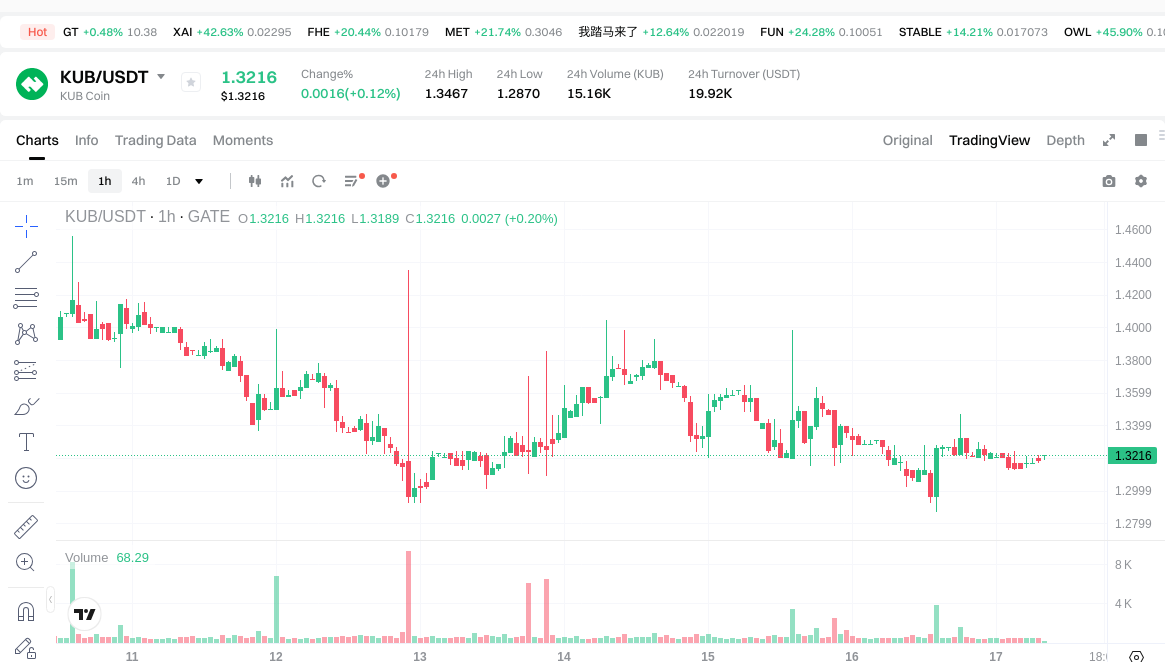
2021: KUB Coin reached its peak price of $17.24 on December 28, 2021, marking a significant milestone since its launch in December 2021. However, the token subsequently experienced a substantial decline of approximately 92.2% from this level.
-
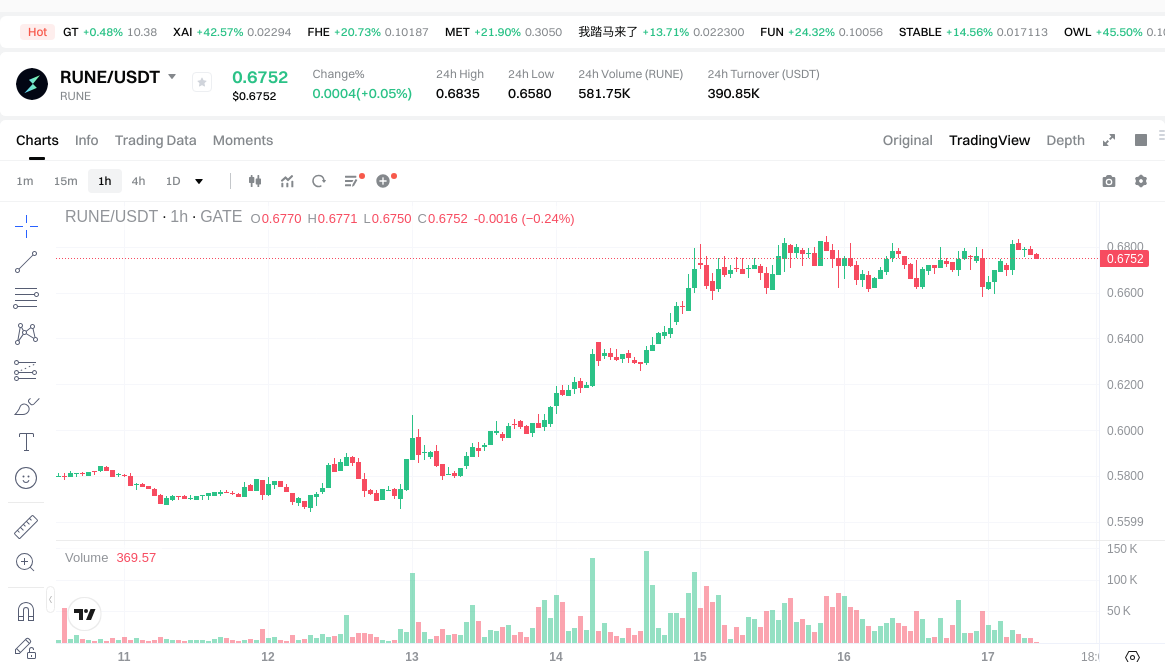
2021: RUNE achieved its all-time high of $20.87 on May 19, 2021, reflecting strong market interest during the DeFi expansion period. Since then, the token has undergone considerable volatility, declining approximately 96.88% from its peak.
-
Comparative Analysis: During the 2021-2026 market cycle, KUB declined from $17.24 to approximately $1.32, while RUNE dropped from $20.87 to around $0.68. Both tokens have experienced similar downward trajectories, with RUNE showing a relatively larger percentage decline from its peak value.
Current Market Status (January 17, 2026)
- KUB Coin Current Price: $1.3203
- RUNE Current Price: $0.6766
- 24-Hour Trading Volume: KUB recorded $19,923.80 compared to RUNE's $393,345.31
- Market Sentiment Index (Fear & Greed Index): 49 (Neutral)
Click to view real-time prices:
- View KUB Current Price Market Price
- View RUNE Current Price Market Price
II. Core Factors Influencing KUB vs RUNE Investment Value
Tokenomics Comparison
- KUB: The supply mechanism details are not extensively documented in available materials, though discussions reference supply-related considerations in decentralized liquidity protocols.
- RUNE: Specific tokenomics information regarding fixed supply or deflationary models requires further investigation beyond current data sources.
- 📌 Historical Pattern: Supply mechanisms have historically influenced price cycles, though specific correlations for these assets require market-specific analysis.
Institutional Adoption and Market Application
- Institutional Holdings: Current data does not provide clear differentiation regarding which asset enjoys stronger institutional preference.
- Enterprise Adoption: Applications in cross-border payments, settlement systems, and investment portfolios for both KUB and RUNE remain under-documented in available sources.
- National Policies: Regulatory attitudes toward these assets vary across jurisdictions, though specific policy frameworks are not detailed in reference materials.
Technological Development and Ecosystem Building
- KUB Technical Progress: As a project within the decentralized liquidity protocol space, technical developments may relate to protocol efficiency and liquidity provision mechanisms.
- RUNE Technical Evolution: Similarly positioned in decentralized finance infrastructure, with potential developments in cross-chain liquidity solutions.
- Ecosystem Comparison: The extent of DeFi integration, NFT applications, payment solutions, and smart contract implementations for both projects requires more comprehensive data for meaningful comparison.
Macroeconomic Environment and Market Cycles
- Performance in Inflationary Environments: The relative inflation-hedging properties of these assets depend on multiple factors including adoption rates and utility expansion.
- Macroeconomic Monetary Policy: Interest rate movements and dollar index fluctuations may impact both assets, though specific sensitivities vary based on market positioning.
- Geopolitical Factors: Cross-border transaction demand and international developments may influence adoption patterns, particularly for decentralized liquidity solutions.
III. 2026-2031 Price Forecast: KUB vs RUNE
Short-term Forecast (2026)
- KUB: Conservative $0.78-$1.32 | Optimistic $1.32-$1.44
- RUNE: Conservative $0.49-$0.68 | Optimistic $0.68-$0.70
Mid-term Forecast (2028-2029)
- KUB may enter a growth phase, with estimated prices ranging from $0.91 to $2.10
- RUNE may enter an expansion phase, with estimated prices ranging from $0.46 to $1.06
- Key drivers: institutional capital inflows, ETF developments, ecosystem expansion
Long-term Forecast (2030-2031)
- KUB: Baseline scenario $1.32-$2.17 | Optimistic scenario $2.17-$2.82
- RUNE: Baseline scenario $0.64-$1.11 | Optimistic scenario $1.11-$1.36
View detailed price predictions for KUB and RUNE
Disclaimer
KUB:
| Year |
Predicted High Price |
Predicted Average Price |
Predicted Low Price |
Price Change |
| 2026 |
1.440544 |
1.3216 |
0.779744 |
0 |
| 2027 |
1.47774704 |
1.381072 |
1.27058624 |
4 |
| 2028 |
1.500879996 |
1.42940952 |
0.9148220928 |
8 |
| 2029 |
2.09515700394 |
1.465144758 |
1.06955567334 |
10 |
| 2030 |
2.5634172685968 |
1.78015088097 |
1.3173116519178 |
34 |
| 2031 |
2.82331929721842 |
2.1717840747834 |
2.019759189548562 |
64 |
RUNE:
| Year |
Predicted High Price |
Predicted Average Price |
Predicted Low Price |
Price Change |
| 2026 |
0.702 |
0.675 |
0.486 |
0 |
| 2027 |
0.79866 |
0.6885 |
0.571455 |
1 |
| 2028 |
0.966654 |
0.74358 |
0.4610196 |
9 |
| 2029 |
1.06034508 |
0.855117 |
0.53872371 |
26 |
| 2030 |
1.2546276624 |
0.95773104 |
0.6416797968 |
41 |
| 2031 |
1.360600601976 |
1.1061793512 |
0.641584023696 |
63 |
IV. Investment Strategy Comparison: KUB vs RUNE
Long-term vs Short-term Investment Strategies
-
KUB: May be suitable for investors interested in decentralized liquidity protocol ecosystems and regional exchange infrastructure development. The token's positioning within the Bitkub Chain ecosystem suggests potential correlation with platform adoption and transaction volume growth.
-
RUNE: May appeal to investors focusing on multi-chain liquidity solutions and decentralized cross-chain trading infrastructure. The token's role in cross-chain liquidity protocols positions it within the broader DeFi infrastructure landscape.
Risk Management and Asset Allocation
-
Conservative Investors: A balanced approach might consider diversified exposure across multiple asset classes, with crypto assets representing a limited portfolio percentage. Conservative allocations typically emphasize established projects with demonstrated utility and liquidity.
-
Aggressive Investors: Those with higher risk tolerance may explore concentrated positions based on specific thesis around ecosystem development, though such strategies require careful monitoring and risk assessment.
-
Hedging Tools: Portfolio risk management may incorporate stablecoin reserves for liquidity management, diversification across multiple protocols, and periodic rebalancing strategies.
V. Potential Risk Comparison
Market Risks
-
KUB: The token has experienced substantial volatility, declining approximately 92.2% from its peak price of $17.24. Current 24-hour trading volume of $19,923.80 suggests relatively limited liquidity compared to major market assets, which may amplify price volatility during market stress periods.
-
RUNE: Historical price data indicates a decline of approximately 96.88% from its peak of $20.87. While 24-hour trading volume of $393,345.31 demonstrates relatively higher liquidity than KUB, both assets remain subject to broader cryptocurrency market cycles and sentiment shifts.
Technical Risks
-
KUB: As an ecosystem token within decentralized liquidity protocols, potential technical considerations include protocol efficiency, smart contract security, and dependency on underlying blockchain infrastructure performance.
-
RUNE: Cross-chain liquidity solutions face technical complexity related to multi-chain integration, bridge security, and protocol synchronization across different blockchain networks. Network stability and scalability remain ongoing considerations.
Regulatory Risks
-
Regulatory frameworks for decentralized liquidity protocols continue to evolve across different jurisdictions. Policy developments regarding decentralized finance, cross-border transactions, and digital asset classifications may affect both projects differently based on their specific implementations and geographic focus.
-
Exchange-related tokens and cross-chain protocols may face varying regulatory scrutiny depending on jurisdiction-specific interpretations of securities laws, financial services regulations, and anti-money laundering requirements.
VI. Conclusion: Which Is the Better Buy?
📌 Investment Value Summary:
-
KUB Characteristics: Positioned within a specific ecosystem as a utility and native currency, with applications in transaction fees and exchange operations. Price forecasts suggest potential recovery scenarios ranging from $0.78 to $2.82 by 2031, though these projections carry inherent uncertainty.
-
RUNE Characteristics: Functions within multi-chain liquidity infrastructure with cross-chain trading applications. Price projections indicate possible ranges from $0.49 to $1.36 by 2031, subject to market conditions and protocol adoption.
✅ Investment Considerations:
-
New Investors: Those new to cryptocurrency markets should prioritize understanding fundamental concepts, risk management principles, and market dynamics before considering positions in either asset. Starting with established, liquid assets while gradually learning about ecosystem-specific tokens may provide a foundation for informed decision-making.
-
Experienced Investors: Those with market experience may evaluate these assets based on specific investment theses, including ecosystem development trajectories, liquidity provision opportunities, and portfolio diversification objectives. Thorough due diligence regarding technical implementations, team backgrounds, and competitive positioning remains essential.
-
Institutional Investors: Professional market participants typically conduct comprehensive analysis including legal framework assessments, custody solutions evaluation, liquidity depth analysis, and regulatory compliance considerations before determining allocation strategies.
⚠️ Risk Disclosure: Cryptocurrency markets demonstrate substantial volatility and inherent risks. Historical performance does not indicate future results. This content provides informational analysis and does not constitute investment advice, financial guidance, or recommendations to buy, sell, or hold any assets. Individuals should conduct independent research and consult qualified financial professionals before making investment decisions.
VII. FAQ
Q1: What are the main differences between KUB and RUNE in terms of their primary use cases?
KUB serves as the native and utility currency of the Bitkub Chain ecosystem, primarily facilitating transaction fees, exchange fee credits, and ecosystem operations within a specific platform infrastructure. RUNE, on the other hand, functions as a multi-chain liquidity protocol token designed for decentralized cross-chain trading, enabling liquidity provision across different blockchain networks. The fundamental distinction lies in KUB's ecosystem-specific utility versus RUNE's broader cross-chain liquidity infrastructure role.
Q2: Which token has shown better historical price resilience since their respective peaks?
KUB has demonstrated relatively better price resilience compared to RUNE. KUB declined approximately 92.2% from its December 2021 peak of $17.24 to current levels around $1.32, while RUNE experienced a larger decline of approximately 96.88% from its May 2021 peak of $20.87 to around $0.68. However, both tokens remain significantly below their all-time highs, reflecting broader cryptocurrency market cycles and sector-specific challenges.
Q3: How do the trading volumes of KUB and RUNE compare, and what does this indicate?
RUNE demonstrates significantly higher trading volume with $393,345.31 in 24-hour volume compared to KUB's $19,923.80 as of January 17, 2026. This substantial difference indicates that RUNE possesses greater market liquidity and trading activity, which typically results in narrower bid-ask spreads, easier entry and exit positions, and potentially lower price slippage during transactions. Higher liquidity generally suggests broader market participation and interest in the asset.
Q4: What are the price forecast ranges for both tokens through 2031?
According to available projections, KUB's price forecasts range from a conservative scenario of $0.78-$1.32 in 2026 to a baseline scenario of $1.32-$2.17 by 2030, with an optimistic scenario reaching $2.17-$2.82 by 2031. RUNE's forecasts indicate a conservative range of $0.49-$0.68 in 2026, expanding to a baseline scenario of $0.64-$1.11 by 2030, with optimistic projections of $1.11-$1.36 by 2031. These forecasts carry inherent uncertainty and should not be considered guarantees of future performance.
Q5: What type of investor profile is most suitable for each token?
KUB may be more suitable for investors interested in ecosystem-specific tokens tied to exchange infrastructure and regional blockchain development, particularly those comfortable with lower liquidity environments and platform-dependent value propositions. RUNE may appeal more to investors focusing on DeFi infrastructure, cross-chain liquidity solutions, and broader decentralized finance ecosystem development. Both require thorough understanding of their respective technical implementations and market dynamics before investment consideration.
Q6: What are the primary technical risks associated with each token?
KUB's technical risks primarily relate to protocol efficiency, smart contract security within the Bitkub Chain ecosystem, and dependency on underlying blockchain infrastructure performance. RUNE faces technical complexity associated with multi-chain integration, including bridge security concerns, protocol synchronization across different blockchain networks, and the inherent challenges of maintaining security and efficiency in cross-chain liquidity provision. Both projects require ongoing technical development and security auditing to maintain operational integrity.
Q7: How might regulatory developments differently impact KUB versus RUNE?
Regulatory impacts may vary significantly between the two tokens based on their different functional positions. KUB, as an exchange-related ecosystem token, may face regulatory scrutiny related to securities classifications, financial services regulations, and jurisdiction-specific exchange licensing requirements. RUNE, as a cross-chain liquidity protocol token, may encounter regulatory considerations related to decentralized finance frameworks, cross-border transaction regulations, and multi-jurisdictional compliance requirements. Both face evolving regulatory landscapes that could substantially affect their operational frameworks and market accessibility.
Q8: Should investors choose one token over the other, or consider both?
The decision between KUB and RUNE depends on individual investment objectives, risk tolerance, and portfolio strategy rather than a binary choice. Investors focused on ecosystem-specific growth tied to regional exchange development might favor KUB, while those interested in cross-chain liquidity infrastructure may prefer RUNE. Diversification-focused investors might consider exposure to both tokens as part of a broader cryptocurrency portfolio strategy, though each position should be sized appropriately based on liquidity considerations, risk assessment, and correlation with existing holdings. Regardless of approach, thorough independent research and consultation with qualified financial professionals remains essential before making investment decisions.
* The information is not intended to be and does not constitute financial advice or any other recommendation of any sort offered or endorsed by Gate.