This comprehensive analysis compares LAZIO and XLM, two distinct digital assets in the cryptocurrency market traded on Gate. LAZIO, launched in 2021, positions itself as a fan engagement token for S.S. Lazio Football Club with voting rights and digital collectibles, while XLM, active since 2014, operates as a cross-border payment infrastructure. The article examines historical price trends, current market status including 24-hour trading volumes ($13,134.32 for LAZIO versus $691,216.98 for XLM), and investment value across short, mid, and long-term horizons through 2031. Key differences include LAZIO's higher volatility profile against XLM's relatively stable price action, distinct use cases spanning fan engagement versus payment systems, and varying liquidity levels. Investment recommendations stratify by investor type: conservative investors favor XLM's established market presence, while aggressive investors may pursue LAZIO's higher growth potential, considering current Extreme Fear market sentiment.
Introduction: LAZIO vs XLM Investment Comparison
In the cryptocurrency market, the comparison between LAZIO vs XLM has been a topic that investors cannot avoid. The two not only show significant differences in market cap ranking, application scenarios, and price performance, but also represent different crypto asset positioning.
LAZIO (LAZIO): Launched in 2021, it has gained market recognition by positioning itself as a fan engagement token that revolutionizes the fan experience for S.S. Lazio Football Club supporters through voting rights, digital collectibles, and gamification features.
XLM (XLM): Since its launch in 2014, it has been recognized as a decentralized gateway for cross-border payments, enabling rapid, stable, and extremely low-cost transfer of digital assets among banks, payment institutions, and individuals.
This article will comprehensively analyze the investment value comparison of LAZIO vs XLM around historical price trends, supply mechanisms, institutional adoption, technical ecosystems, and future predictions, and attempt to answer the question that investors are most concerned about:
"Which is the better buy right now?"
I. Historical Price Comparison and Current Market Status
Historical Price Trends of LAZIO (Coin A) and XLM (Coin B)
- 2018: XLM reached an all-time high of $0.875563 on January 3, reflecting strong market momentum during the previous bull cycle.
- 2021: LAZIO launched on the Binance Smart Chain in October and quickly peaked at $26.75 on October 22, driven by initial fan engagement and launch-period enthusiasm.
- 2025: LAZIO recorded its all-time low of $0.697967 on June 23, indicating significant price correction from peak levels.
- Comparative Analysis: During market cycles, LAZIO declined from its peak of $26.75 to a low of $0.697967, representing substantial volatility. Meanwhile, XLM demonstrated relatively more stable price action, fluctuating between its historical high of $0.875563 and low of $0.00047612 since its 2014 launch.
Current Market Status (January 25, 2026)
- LAZIO current price: $1.0491
- XLM current price: $0.21197
- 24-hour trading volume: LAZIO $13,134.32 vs XLM $691,216.98
- Market sentiment index (Fear & Greed Index): 25 (Extreme Fear)
Check real-time prices:
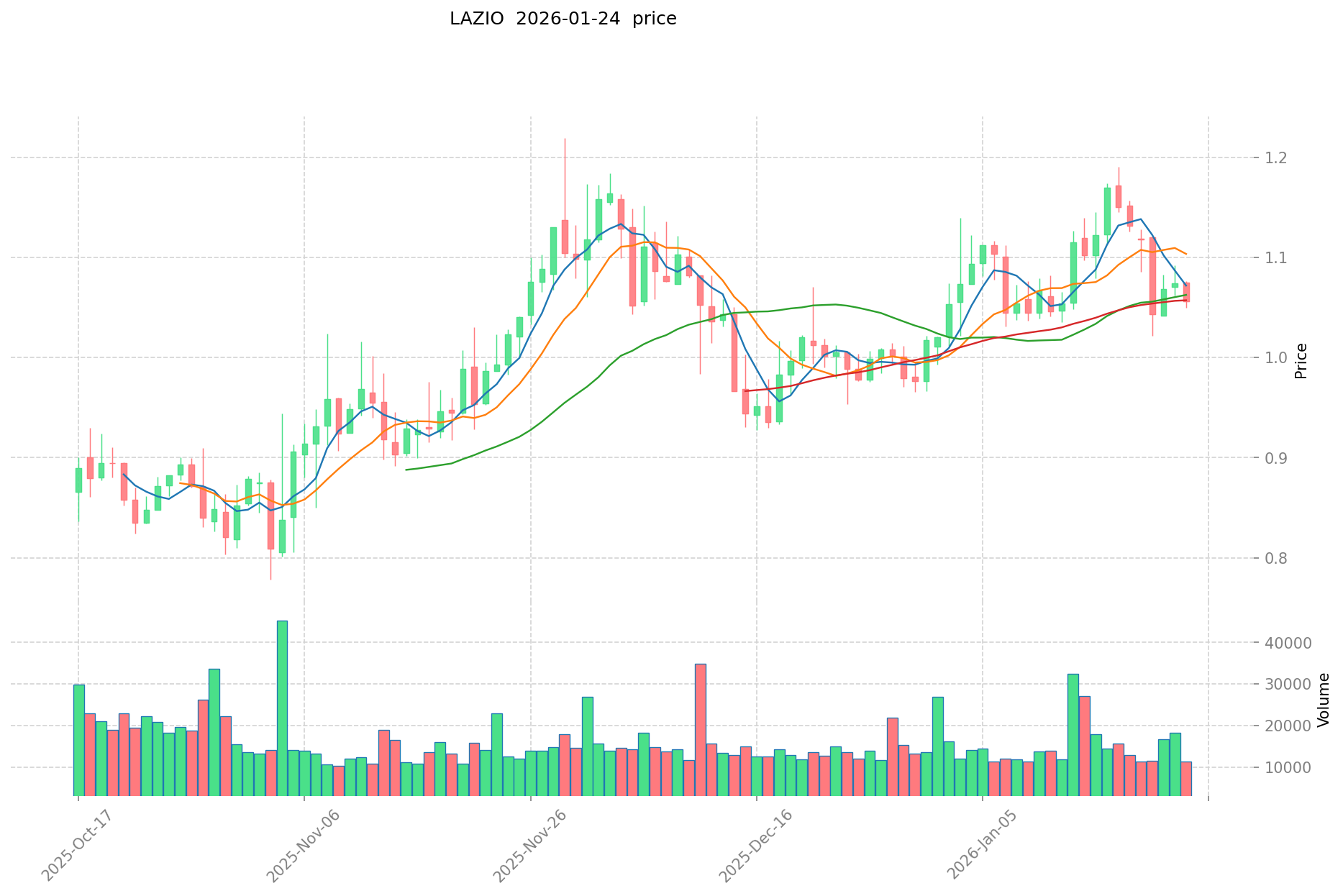
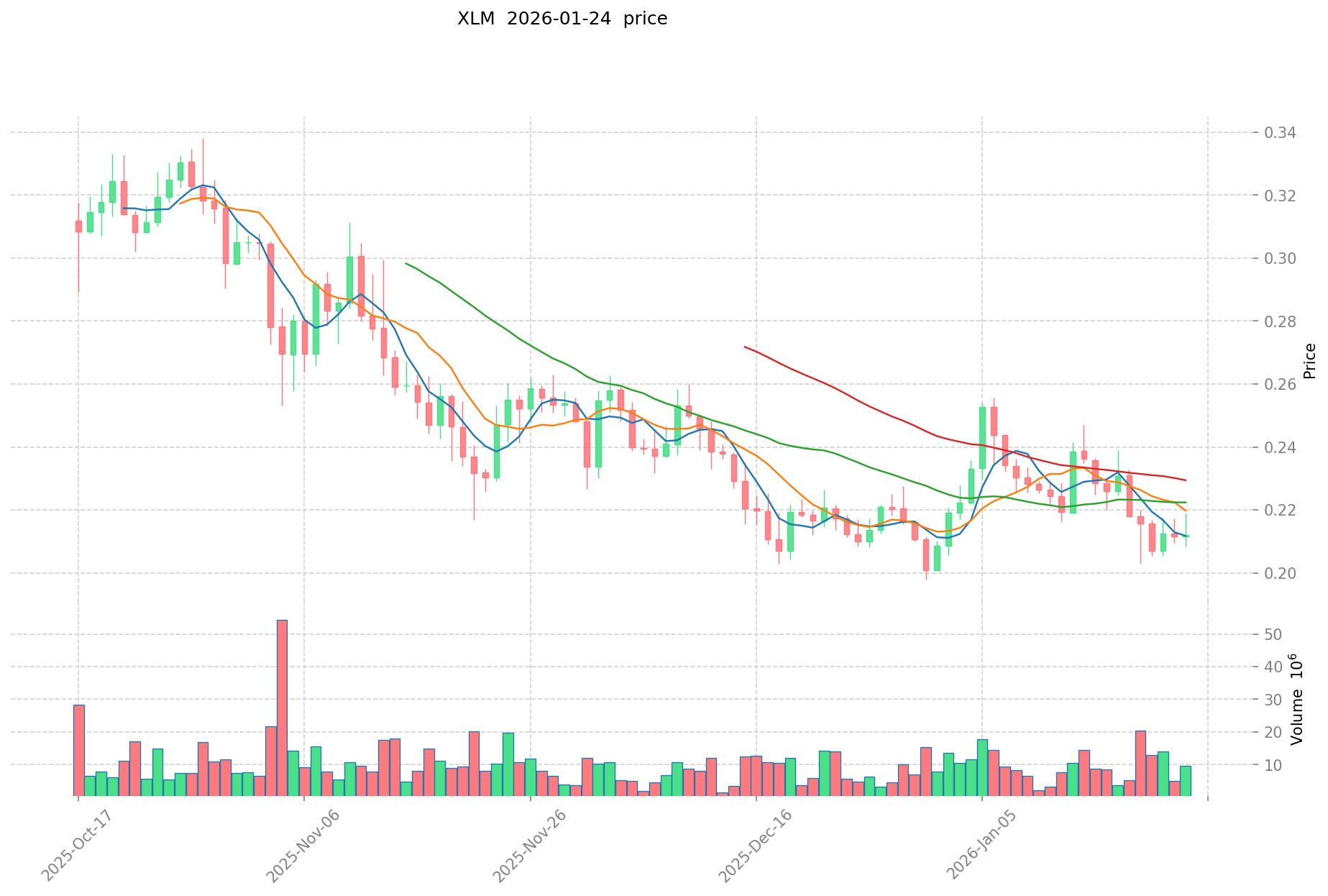
II. Core Factors Affecting LAZIO vs XLM Investment Value
Supply Mechanism Comparison (Tokenomics)
Due to insufficient reference materials and knowledge base limitations regarding the specific supply mechanisms of LAZIO and XLM, this section cannot provide detailed tokenomics analysis at this time.
Institutional Adoption and Market Application
Without available data on institutional holdings, enterprise adoption patterns, or specific regulatory stances across different jurisdictions for LAZIO and XLM, a comprehensive comparison of their institutional acceptance and practical applications cannot be established in this analysis.
Technical Development and Ecosystem Construction
The reference materials do not contain information regarding recent technical upgrades, development roadmaps, or ecosystem activities for either LAZIO or XLM. Consequently, comparative analysis of their technical evolution and ecosystem maturity across DeFi, NFT, payment systems, and smart contract implementations cannot be provided.
Macroeconomic Environment and Market Cycles
Insufficient data exists in the provided materials to evaluate how LAZIO and XLM perform under different macroeconomic conditions, including inflationary environments, monetary policy shifts, interest rate fluctuations, US dollar index movements, or geopolitical factors affecting cross-border transaction demands.
III. 2026-2031 Price Forecast: LAZIO vs XLM
Short-term Forecast (2026)
- LAZIO: Conservative $0.91-$1.05 | Optimistic $1.05-$1.38
- XLM: Conservative $0.20-$0.21 | Optimistic $0.21-$0.24
Mid-term Forecast (2028-2029)
- LAZIO may enter a growth phase, with projected prices ranging from $1.10 to $2.16
- XLM may enter a steady development phase, with projected prices ranging from $0.20 to $0.30
- Key drivers: institutional capital inflows, ETF developments, ecosystem expansion
Long-term Forecast (2030-2031)
- LAZIO: Baseline scenario $1.12-$1.90 | Optimistic scenario $1.96-$2.74
- XLM: Baseline scenario $0.20-$0.32 | Optimistic scenario $0.28-$0.40
View detailed price predictions for LAZIO and XLM
Disclaimer
LAZIO:
| Year |
Predicted High Price |
Predicted Average Price |
Predicted Low Price |
Price Change |
| 2026 |
1.383756 |
1.0483 |
0.912021 |
0 |
| 2027 |
1.43491304 |
1.216028 |
1.10658548 |
15 |
| 2028 |
1.6966022656 |
1.32547052 |
1.1001405316 |
26 |
| 2029 |
2.160782041704 |
1.5110363928 |
1.375043117448 |
44 |
| 2030 |
1.96442286245964 |
1.835909217252 |
1.11990462252372 |
74 |
| 2031 |
2.73623909739238 |
1.90016603985582 |
1.653144454674563 |
81 |
XLM:
| Year |
Predicted High Price |
Predicted Average Price |
Predicted Low Price |
Price Change |
| 2026 |
0.2355531 |
0.21221 |
0.1973553 |
0 |
| 2027 |
0.2395532585 |
0.22388155 |
0.1768664245 |
5 |
| 2028 |
0.2803780591425 |
0.23171740425 |
0.2015941416975 |
9 |
| 2029 |
0.299575846084612 |
0.25604773169625 |
0.1433867297499 |
20 |
| 2030 |
0.36115532555756 |
0.277811788890431 |
0.233361902667962 |
31 |
| 2031 |
0.399354446529995 |
0.319483557223996 |
0.198079805478877 |
50 |
IV. Investment Strategy Comparison: LAZIO vs XLM
Long-term vs Short-term Investment Strategies
- LAZIO: May suit investors seeking fan engagement token exposure with higher risk tolerance, given its significant price volatility from $26.75 peak to $0.697967 low, and current conservative-to-optimistic 2026 projections ranging from $0.91-$1.38.
- XLM: May suit investors prioritizing cross-border payment infrastructure adoption with preference for relatively more stable price action, considering its historical price range between $0.875563 and $0.00047612 since 2014, and 2026 projections ranging from $0.20-$0.24.
Risk Management and Asset Allocation
- Conservative investors: LAZIO 20-30% vs XLM 70-80%, prioritizing XLM's relatively longer market presence and payment-focused use case.
- Aggressive investors: LAZIO 50-60% vs XLM 40-50%, allocating higher proportion to LAZIO's potential upside from fan engagement market growth.
- Hedging instruments: Stablecoin allocation, options strategies, cross-asset portfolio diversification.
V. Potential Risk Comparison
Market Risk
- LAZIO: Demonstrated substantial volatility with decline from $26.75 to $0.697967, reflecting higher price fluctuation risk. Current 24-hour trading volume of $13,134.32 suggests relatively lower liquidity compared to XLM.
- XLM: Shows more moderate price range since 2014 launch, though subject to broader cryptocurrency market cycles. Current 24-hour trading volume of $691,216.98 indicates relatively higher liquidity versus LAZIO.
Technical Risk
- LAZIO: Scalability considerations and network stability factors related to Binance Smart Chain infrastructure.
- XLM: Network performance considerations and potential security vulnerabilities inherent in blockchain systems.
Regulatory Risk
- Global regulatory developments may impact both assets differently, with LAZIO subject to fan token and sports-related digital asset regulations, while XLM faces payment system and cross-border transaction regulatory frameworks across multiple jurisdictions.
VI. Conclusion: Which Is the Better Buy?
📌 Investment Value Summary:
- LAZIO advantages: Positioned in fan engagement sector with potential for growth in sports digitalization trends; 2031 optimistic scenario projects up to $2.74.
- XLM advantages: Established cross-border payment infrastructure positioning since 2014; relatively higher current trading volume of $691,216.98 versus LAZIO's $13,134.32; 2031 optimistic scenario projects up to $0.399.
✅ Investment Recommendations:
- Novice investors: Consider starting with XLM due to its relatively longer market history and payment-focused use case, while maintaining limited exposure to both assets given current Extreme Fear market sentiment (index: 25).
- Experienced investors: May evaluate portfolio allocation based on risk tolerance, considering LAZIO's higher volatility profile versus XLM's relatively more established market presence, while implementing appropriate risk management strategies.
- Institutional investors: Conduct comprehensive due diligence on both assets' regulatory standing, liquidity profiles, and alignment with institutional investment mandates before allocation decisions.
⚠️ Risk Warning: The cryptocurrency market exhibits extreme volatility. This article does not constitute investment advice.
VII. FAQ
Q1: What is the main difference between LAZIO and XLM in terms of use cases?
LAZIO is a fan engagement token for S.S. Lazio Football Club supporters, while XLM serves as a cross-border payment infrastructure. LAZIO focuses on revolutionizing fan experiences through voting rights, digital collectibles, and gamification features within the sports entertainment sector. XLM, launched in 2014, operates as a decentralized gateway enabling rapid, stable, and low-cost transfer of digital assets among banks, payment institutions, and individuals globally, positioning itself in the financial infrastructure space rather than entertainment.
Q2: How does the trading volume compare between LAZIO and XLM?
XLM demonstrates significantly higher trading volume at $691,216.98 compared to LAZIO's $13,134.32 in 24-hour trading volume as of January 25, 2026. This substantial difference indicates XLM possesses relatively higher market liquidity, which typically translates to easier entry and exit positions, tighter bid-ask spreads, and potentially lower price slippage during transactions. The higher liquidity of XLM may be attributed to its longer market presence since 2014 and broader adoption in the cross-border payment sector.
Q3: Which cryptocurrency has experienced greater price volatility historically?
LAZIO has demonstrated substantially greater price volatility. Since its October 2021 launch, LAZIO declined from its peak of $26.75 to an all-time low of $0.697967 in June 2025, representing a dramatic price correction. In contrast, XLM has shown relatively more stable price action since its 2014 launch, fluctuating between its historical high of $0.875563 (January 2018) and low of $0.00047612. This indicates LAZIO carries higher price fluctuation risk, making it potentially more suitable for risk-tolerant investors, while XLM may appeal to those seeking relatively more moderate price movements.
Q4: What are the price predictions for LAZIO and XLM by 2031?
By 2031, LAZIO's optimistic scenario projects a price range of $1.96-$2.74, with predicted average price of $1.90, representing an 81% change from 2026 baseline. XLM's 2031 optimistic scenario projects $0.28-$0.40, with predicted average price of $0.319, representing a 50% change from 2026 baseline. In absolute terms, LAZIO shows higher projected growth percentage, though both projections remain subject to significant market uncertainties including institutional adoption rates, regulatory developments, macroeconomic conditions, and ecosystem expansion success.
Q5: How should different investor types approach LAZIO vs XLM allocation?
Conservative investors may consider allocating 20-30% to LAZIO and 70-80% to XLM, prioritizing XLM's relatively longer market presence since 2014 and payment-focused infrastructure positioning. Aggressive investors might allocate 50-60% to LAZIO and 40-50% to XLM, seeking higher exposure to LAZIO's potential upside from fan engagement market growth despite its greater volatility. Novice investors should consider starting with XLM due to its relatively more established market history and higher liquidity, while maintaining limited overall exposure given the current Extreme Fear market sentiment (index: 25). All allocations should incorporate appropriate risk management strategies including stablecoin hedging and portfolio diversification.
Q6: What regulatory risks affect LAZIO and XLM differently?
LAZIO faces regulatory frameworks specific to fan tokens and sports-related digital assets, which may include consumer protection requirements, licensing obligations for sports-branded cryptocurrencies, and jurisdiction-specific regulations governing fan engagement platforms. XLM encounters payment system regulations and cross-border transaction frameworks across multiple jurisdictions, including compliance with anti-money laundering (AML) requirements, know-your-customer (KYC) protocols, and financial institution partnership regulations. These distinct regulatory landscapes mean each asset faces different compliance challenges and potential regulatory developments that could impact their respective market positions and adoption trajectories.
Q7: Why is the current market sentiment showing Extreme Fear, and how does it affect LAZIO vs XLM investment decisions?
The Fear & Greed Index currently stands at 25, indicating Extreme Fear in the cryptocurrency market as of January 25, 2026. This sentiment typically reflects investor concerns about market conditions, potentially driven by macroeconomic uncertainties, regulatory developments, or recent price corrections. Under Extreme Fear conditions, both LAZIO and XLM may experience selling pressure, though their responses may differ based on their distinct market profiles. XLM's relatively higher liquidity ($691,216.98 trading volume) may provide better price stability during fearful markets compared to LAZIO's lower liquidity ($13,134.32 trading volume). Investors should exercise heightened caution during Extreme Fear periods, consider dollar-cost averaging strategies, and maintain strict risk management protocols regardless of which asset they choose.
Q8: What are the key considerations when comparing investment timelines for LAZIO vs XLM?
Short-term investors (2026 horizon) should note LAZIO's conservative projection of $0.91-$1.05 versus XLM's $0.20-$0.21, with LAZIO showing higher volatility that may create trading opportunities but also increased risk. Mid-term investors (2028-2029) may observe LAZIO's projected range of $1.10-$2.16 compared to XLM's $0.20-$0.30, suggesting LAZIO's potential for higher percentage gains alongside greater uncertainty. Long-term investors (2030-2031) should evaluate LAZIO's baseline scenario of $1.12-$1.90 against XLM's $0.20-$0.32, considering factors beyond price predictions including ecosystem development, institutional adoption progress, and regulatory clarity evolution for both assets' respective sectors over the extended timeframe.
* The information is not intended to be and does not constitute financial advice or any other recommendation of any sort offered or endorsed by Gate.










