This comprehensive analysis compares LDO and STX, two leading blockchain protocols, examining their market performance, tokenomics, and investment potential. LDO operates within Ethereum's liquid staking ecosystem at current price $0.6457, while STX focuses on Bitcoin smart contract functionality at $0.3837. The article evaluates historical price trends, supply mechanisms, institutional adoption, technological developments, and macroeconomic influences on both tokens. Price predictions span 2026-2031, with LDO forecasted at $0.66-$1.46 and STX at $0.35-$0.69. Investment strategy recommendations differ based on investor risk profiles, with conservative allocations at 30-40% and aggressive at 50-60%. Risk assessments address market volatility, technical implementation challenges, and regulatory uncertainties specific to each protocol. Detailed FAQ sections provide actionable insights for investors evaluating these blockchain infrastructure tokens on Gate exchange.
Introduction: Investment Value, Price Prediction, and Risk Analysis of LDO
In the rapidly evolving cryptocurrency market, Lido DAO Token (LDO) has emerged as a notable player in the decentralized finance (DeFi) landscape. As of January 14, 2026, LDO ranks 125th by market capitalization, with a current price of $0.6457 and a circulating supply of approximately 846.57 million tokens.
Lido DAO represents a community-driven approach to liquid staking services for Ethereum, allowing users to earn staking rewards without locking assets or maintaining staking infrastructure. Since its launch in January 2021 at $1.75, LDO has experienced significant market dynamics, reaching a peak of $7.3 in August 2021 before experiencing considerable volatility.
This analysis examines LDO through multiple dimensions:
- Market Performance: Current price trends, historical data analysis, and trading volume patterns
- Supply Economics: Token distribution, circulation ratio (84.66%), and supply mechanisms
- Technical Foundation: The Clarity programming language integration and liquid staking infrastructure
- Risk Assessment: Market volatility, regulatory considerations, and investment risks
The article aims to provide investors with a comprehensive understanding of LDO's investment characteristics by analyzing its market position, technological advantages, and potential challenges. Through examination of historical price movements, supply dynamics, and ecosystem development, readers can gain insights into factors influencing LDO's value proposition in the decentralized staking sector.
I. Historical Price Comparison and Current Market Status
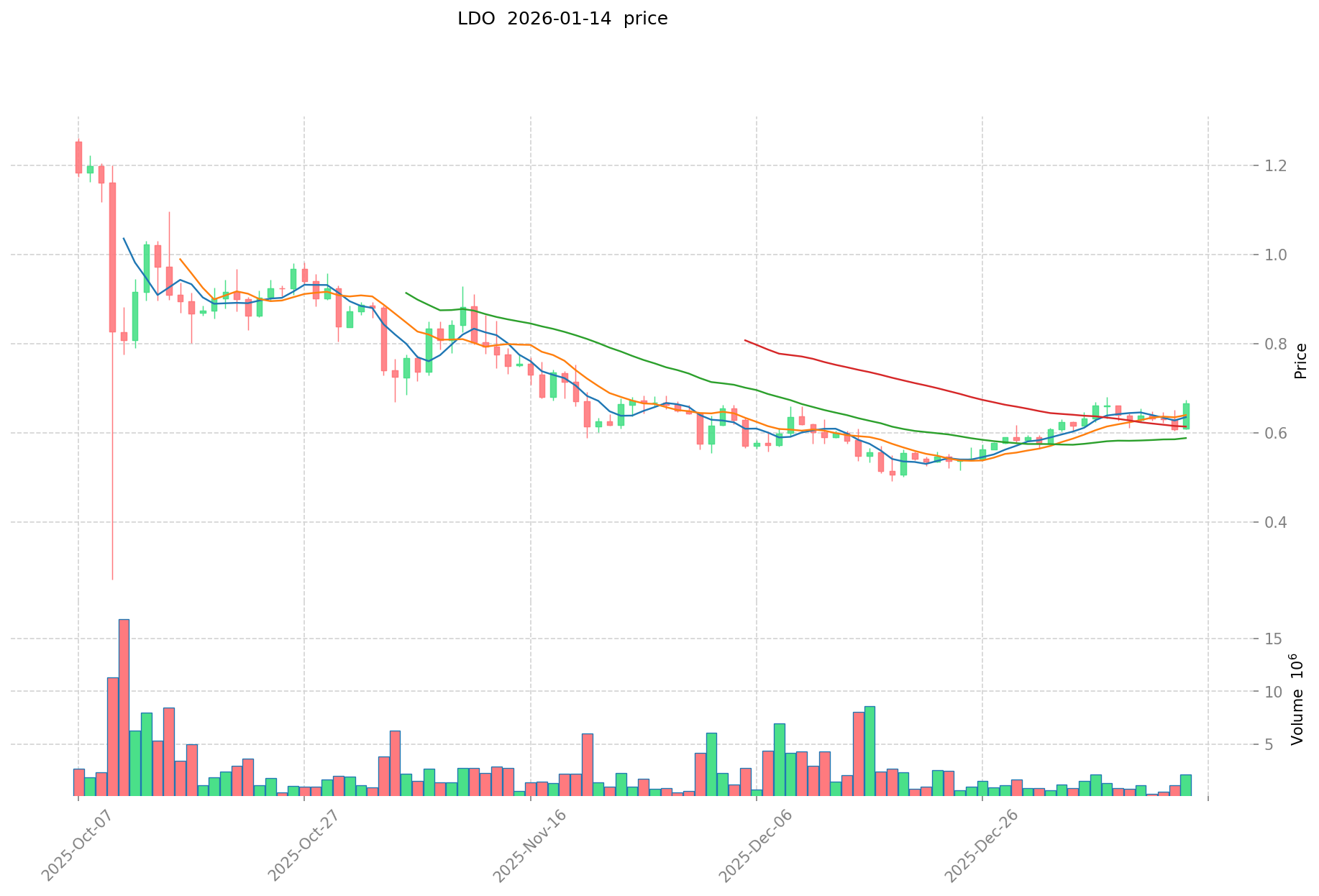
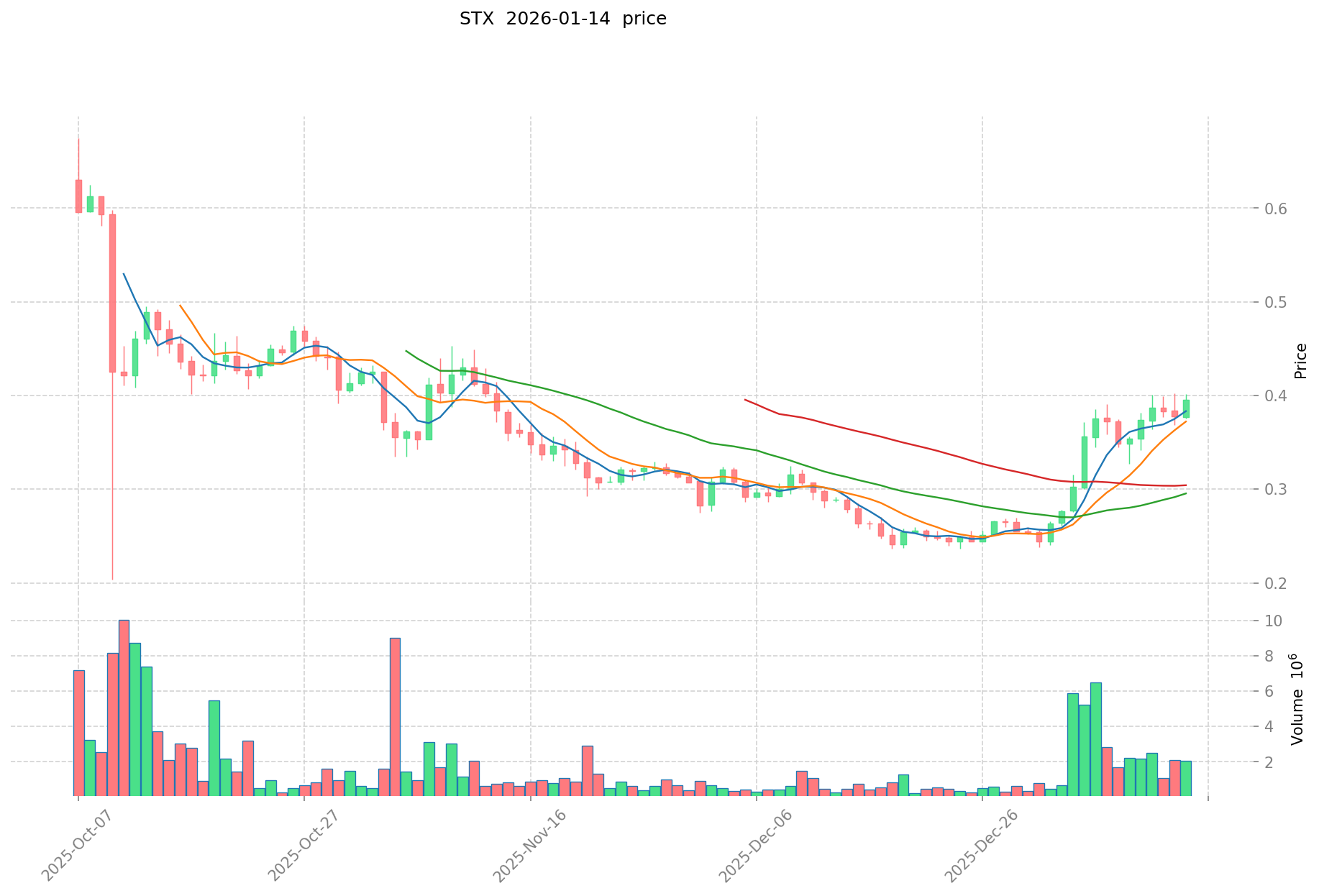
LDO (Coin A) and STX (Coin B) Historical Price Trends
- 2021: LDO reached its all-time high of $7.3 on August 20, 2021, during the broader crypto market bull run, before experiencing significant volatility in subsequent periods.
- 2024: STX achieved its peak price of $3.86 on April 1, 2024, reflecting positive sentiment around Bitcoin Layer-2 solutions and decentralized application development on the Bitcoin network.
- Comparative Analysis: During the 2024-2025 market cycle, LDO declined from its historical high of $7.3 to a low of $0.40615 (recorded on June 19, 2022), representing a substantial correction. In contrast, STX fell from $3.86 to $0.04559639 (recorded on March 13, 2020), demonstrating different volatility patterns and recovery trajectories across market conditions.
Current Market Status (2026-01-14)
- LDO Current Price: $0.6457
- STX Current Price: $0.3837
- 24-Hour Trading Volume: LDO recorded $2,359,679 compared to STX's $1,901,990
- Market Sentiment Index (Fear & Greed Index): 48 (Neutral)
View real-time prices:
II. Core Factors Influencing LDO vs STX Investment Value
Supply Mechanism Comparison (Tokenomics)
-
LDO: Features a fixed maximum supply model with initial circulating supply representing approximately 55% of total tokens at listing. The token distribution includes allocations to team members, investors, and community treasury, with vesting schedules designed to balance liquidity and long-term commitment.
-
STX: Implements a supply structure where approximately 41% of tokens were held by insiders (team and investors) at launch. The token economics follow patterns similar to capital-intensive blockchain projects from previous market cycles.
-
📌 Historical Pattern: Supply mechanisms influence price cycles through unlock schedules and circulation rates. Projects with 10-15% initial circulation have historically demonstrated volatility in early trading periods, with price discovery mechanisms requiring 6-12 months to stabilize.
Institutional Adoption and Market Applications
-
Institutional Holdings: Both tokens have attracted venture capital backing, though specific institutional preference patterns vary based on sector focus. LDO benefits from exposure to Ethereum staking infrastructure, while STX relates to Bitcoin ecosystem expansion.
-
Enterprise Adoption: LDO's utility centers on liquid staking derivatives within DeFi protocols. STX focuses on enabling smart contract functionality on Bitcoin, targeting different segments of blockchain infrastructure needs.
-
Regulatory Landscape: Both projects operate within evolving regulatory frameworks. Token lockup requirements, including standard one-year cliffs for US-regulated investors under Rule 144a, affect liquidity dynamics for both assets.
Technology Development and Ecosystem Construction
-
LDO Technology Progress: Positioned within the staking sector, LDO's value proposition links to Ethereum's proof-of-stake transition and the growth of liquid staking solutions. Development focuses on maintaining protocol security and expanding integration with DeFi platforms.
-
STX Technology Evolution: Operates within the Bitcoin ecosystem category, working to extend Bitcoin's utility beyond store-of-value functions. Technical developments aim to enable smart contract capabilities while maintaining Bitcoin network security properties.
-
Ecosystem Comparison: LDO participates in DeFi infrastructure with emphasis on staking derivatives. STX ecosystem encompasses efforts to build decentralized applications on Bitcoin, including DeFi protocols, NFT platforms, and smart contract implementations. Each faces distinct challenges in user adoption and developer engagement within their respective domains.
Macroeconomic Factors and Market Cycles
-
Performance in Inflation Environments: Crypto assets generally exhibit high volatility during macroeconomic uncertainty. Neither token has established clear anti-inflation characteristics comparable to traditional stores of value. Market behavior tends to correlate with broader crypto market sentiment and risk appetite.
-
Monetary Policy Impact: Interest rate changes and dollar strength influence capital flows into crypto markets. Both tokens have demonstrated sensitivity to overall market conditions, with institutional and retail investment patterns shifting based on risk-on versus risk-off environments.
-
Geopolitical Considerations: Market disruptions, such as the geopolitical tensions observed in April, have historically impacted "high-risk new tokens" category broadly. Both LDO and STX can experience pressure during periods of market risk aversion, with recovery dependent on restoration of investor confidence and broader market stabilization.
Market dynamics reflect multiple interacting factors including supply structures, adoption trajectories, technological progress, and macroeconomic conditions. Historical precedent shows that short-term price movements do not necessarily indicate long-term potential, as demonstrated by previous cycle projects that experienced initial declines before subsequent recoveries.
III. 2026-2031 Price Prediction: LDO vs STX
Short-term Forecast (2026)
- LDO: Conservative $0.38-$0.65 | Optimistic $0.65-$0.94
- STX: Conservative $0.35-$0.39 | Optimistic $0.39-$0.53
Mid-term Forecast (2028-2029)
- LDO may enter a consolidation phase with projected price range of $0.49-$1.29, showing potential upward momentum with average prices rising from $0.89 to $0.92
- STX may experience gradual growth with projected price range of $0.34-$0.64, demonstrating steady development with average prices increasing from $0.48 to $0.50
- Key drivers: institutional capital flows, ETF developments, ecosystem expansion
Long-term Forecast (2030-2031)
- LDO: Base scenario $0.66-$1.18 | Optimistic scenario $1.14-$1.46
- STX: Base scenario $0.35-$0.69 | Optimistic scenario $0.62-$0.69
View detailed price predictions for LDO and STX
Disclaimer: Price predictions are based on historical data analysis and market trends. Cryptocurrency markets are highly volatile and influenced by numerous unpredictable factors. These projections should not be considered as investment advice, and actual prices may vary significantly from predictions.
LDO:
| Year |
Predicted High Price |
Predicted Average Price |
Predicted Low Price |
Price Change |
| 2026 |
0.942065 |
0.6497 |
0.383323 |
0 |
| 2027 |
0.978935475 |
0.7958825 |
0.5730354 |
23 |
| 2028 |
0.949527616625 |
0.8874089875 |
0.488074943125 |
37 |
| 2029 |
1.2858556228875 |
0.9184683020625 |
0.6980359095675 |
42 |
| 2030 |
1.17931329984825 |
1.102161962475 |
1.013989005477 |
70 |
| 2031 |
1.46014416788688 |
1.140737631161625 |
0.661627826073742 |
76 |
STX:
| Year |
Predicted High Price |
Predicted Average Price |
Predicted Low Price |
Price Change |
| 2026 |
0.529916 |
0.3868 |
0.351988 |
0 |
| 2027 |
0.50877738 |
0.458358 |
0.28876554 |
19 |
| 2028 |
0.5174174283 |
0.48356769 |
0.3433330599 |
26 |
| 2029 |
0.6356255501205 |
0.50049255915 |
0.460453154418 |
30 |
| 2030 |
0.6816708655623 |
0.56805905463525 |
0.346516023327502 |
48 |
| 2031 |
0.69360010570964 |
0.624864960098775 |
0.412410873665191 |
62 |
IV. Investment Strategy Comparison: LDO vs STX
Long-term vs Short-term Investment Strategies
-
LDO: Aligns with investors focused on Ethereum staking infrastructure and DeFi ecosystem growth. The token's value proposition connects to liquid staking adoption trends and Ethereum's proof-of-stake consensus mechanism development. Suitable for those seeking exposure to staking derivatives market expansion.
-
STX: Appeals to investors interested in Bitcoin ecosystem expansion and smart contract functionality on Bitcoin infrastructure. Targets those evaluating opportunities in Bitcoin Layer-2 solutions and decentralized applications built on Bitcoin's security model.
Risk Management and Asset Allocation
-
Conservative Investors: LDO 30-40% allocation vs STX 30-40% allocation, with remaining portfolio in established assets or stablecoins to manage volatility exposure
-
Aggressive Investors: LDO 50-60% allocation vs STX 50-60% allocation, accepting higher volatility for potential upside participation in sector-specific growth
-
Hedging Tools: Stablecoin allocation for liquidity management, options strategies where available, cross-token portfolio construction to diversify sector-specific risks
V. Potential Risk Comparison
Market Risk
-
LDO: Price movements correlate with Ethereum staking adoption rates, DeFi sector sentiment, and overall cryptocurrency market conditions. Trading volume of $2,359,679 indicates moderate liquidity levels that may impact position entry and exit dynamics.
-
STX: Value fluctuates based on Bitcoin ecosystem development progress, smart contract platform competition, and broader market risk appetite. Trading volume of $1,901,990 suggests liquidity considerations for larger position sizes.
Technical Risk
-
LDO: Operational considerations include protocol scalability as staking volumes increase, network stability across integrated DeFi platforms, and smart contract security for staking infrastructure
-
STX: Technical aspects encompass Bitcoin network interaction reliability, smart contract implementation security, and developer ecosystem sustainability for applications built on the platform
Regulatory Risk
- Global regulatory frameworks continue evolving for staking services and smart contract platforms. Both tokens face jurisdiction-specific considerations regarding securities classification, staking service regulations, and cross-border operational requirements. Regulatory developments in major markets may influence token utility, exchange availability, and institutional participation differently based on each project's structure and operations.
VI. Conclusion: Which Is the Better Buy?
📌 Investment Value Summary:
-
LDO Considerations: Positioned within Ethereum staking infrastructure sector with current price at $0.6457, representing exposure to liquid staking growth trends. Token benefits from Ethereum's established position while facing competition from other staking solutions.
-
STX Considerations: Operates in Bitcoin ecosystem expansion category with current price at $0.3837, offering access to smart contract development on Bitcoin infrastructure. Project addresses Bitcoin utility extension while navigating technical implementation challenges.
✅ Investment Considerations:
-
New Investors: Should prioritize understanding underlying technology, market volatility patterns, and portfolio risk management principles. Consider starting with smaller allocations while building knowledge of staking mechanisms and Bitcoin ecosystem developments.
-
Experienced Investors: May evaluate sector-specific trends, technological roadmap progress, and competitive positioning within respective categories. Portfolio construction could incorporate both tokens for diversified exposure to different blockchain infrastructure segments.
-
Institutional Investors: Assessment factors include liquidity depth, regulatory compliance frameworks, custody solutions availability, and correlation analysis with broader portfolio holdings. Due diligence on governance structures, token distribution patterns, and vesting schedules remains important.
⚠️ Risk Notice: Cryptocurrency markets exhibit high volatility characteristics. This content does not constitute investment advice. Market conditions, technological developments, and regulatory environments may change significantly. Individuals should conduct independent research and consider personal financial circumstances before making investment decisions.
VII. FAQ
Q1: What is the main difference between LDO and STX in terms of their core value proposition?
LDO focuses on liquid staking infrastructure for Ethereum, while STX targets smart contract functionality on Bitcoin.
LDO (Lido DAO Token) serves the Ethereum staking ecosystem by providing liquid staking services that allow users to earn staking rewards without locking assets or maintaining infrastructure. Its value proposition is directly tied to Ethereum's proof-of-stake consensus mechanism and the growth of DeFi liquid staking derivatives. In contrast, STX (Stacks) operates within the Bitcoin ecosystem, aiming to extend Bitcoin's utility beyond store-of-value functions by enabling smart contract capabilities and decentralized applications while leveraging Bitcoin's security model. These fundamental differences mean investors in LDO are betting on Ethereum staking adoption, while STX investors are positioning for Bitcoin ecosystem expansion.
Q2: How do the supply mechanisms of LDO and STX differ, and what impact does this have on investment strategy?
LDO features a fixed maximum supply with approximately 84.66% currently circulating, while STX had approximately 41% held by insiders at launch.
LDO's tokenomics include a fixed supply model with vesting schedules designed to balance liquidity and long-term commitment, with over half of tokens in circulation at listing. This relatively higher initial circulation ratio can provide better price discovery but may also experience selling pressure during unlock periods. STX's supply structure, with a larger portion initially held by team members and investors, follows patterns similar to capital-intensive blockchain projects, which may result in more gradual token releases and potentially different volatility patterns. For investors, LDO's higher circulation ratio suggests more established liquidity, while STX's insider holdings indicate longer-term alignment considerations and potential future dilution events.
Q3: What are the predicted price ranges for LDO and STX by 2031?
LDO is projected to reach $0.66-$1.46 by 2031, while STX is forecasted at $0.35-$0.69 during the same period.
Based on historical data analysis and market trends, LDO shows potential for higher absolute growth, with base scenario projections of $0.66-$1.18 and optimistic scenarios reaching $1.14-$1.46 by 2031, representing approximately 76% increase from current levels. STX forecasts indicate a range of $0.35-$0.69 under base scenarios and $0.62-$0.69 in optimistic conditions, suggesting approximately 62% growth potential. However, these predictions should be viewed with caution as cryptocurrency markets are highly volatile and influenced by numerous unpredictable factors including technological developments, regulatory changes, institutional adoption rates, and macroeconomic conditions. Mid-term projections (2028-2029) show LDO entering a consolidation phase with average prices around $0.89-$0.92, while STX demonstrates steadier gradual growth with averages of $0.48-$0.50.
Q4: What are the primary risks associated with investing in LDO versus STX?
Both tokens face market volatility, technical implementation risks, and regulatory uncertainty, but with sector-specific differences.
LDO's primary risks include correlation with Ethereum staking adoption rates, competition from other liquid staking solutions, DeFi sector sentiment fluctuations, and protocol scalability challenges as staking volumes increase. With a 24-hour trading volume of $2,359,679, liquidity considerations may impact larger position entries and exits. STX faces risks related to Bitcoin ecosystem development progress, smart contract platform competition, technical challenges in Bitcoin network interaction reliability, and developer ecosystem sustainability. Its lower trading volume of $1,901,990 suggests additional liquidity constraints for substantial positions. Both tokens encounter regulatory risks as global frameworks evolve for staking services and smart contract platforms, with jurisdiction-specific considerations regarding securities classification and operational requirements. Additionally, both demonstrate sensitivity to macroeconomic conditions including interest rate changes, dollar strength, and geopolitical tensions that influence capital flows into crypto markets.
Q5: Which allocation strategy is recommended for different investor types?
Conservative investors should consider 30-40% allocation in either token, while aggressive investors may allocate 50-60%, with remaining portfolio in diversified assets.
Conservative investors seeking exposure to staking infrastructure or Bitcoin ecosystem development should limit allocation to 30-40% of either LDO or STX, maintaining the remainder in established cryptocurrencies or stablecoins to manage volatility exposure. This approach provides sector participation while preserving capital stability. Aggressive investors accepting higher volatility for potential upside participation may allocate 50-60% to their chosen token based on sector preference—LDO for Ethereum staking infrastructure growth or STX for Bitcoin smart contract development. Institutional investors require additional considerations including liquidity depth analysis, custody solution availability, regulatory compliance frameworks, and correlation studies with broader portfolio holdings. All investor types should implement risk management strategies including stablecoin allocation for liquidity management, cross-token portfolio construction for sector diversification, and where available, options strategies for downside protection.
Q6: How do macroeconomic factors affect LDO and STX differently?
Both tokens show sensitivity to broader market conditions, but neither has established clear anti-inflation characteristics.
During periods of macroeconomic uncertainty, both LDO and STX exhibit high volatility correlated with overall cryptocurrency market sentiment rather than functioning as inflation hedges. Interest rate changes and dollar strength influence capital flows into crypto markets, with both tokens demonstrating sensitivity to risk-on versus risk-off environments. Institutional and retail investment patterns shift based on monetary policy developments, affecting both assets similarly as "high-risk" crypto allocations. However, sector-specific factors create differentiation: LDO may benefit during periods when Ethereum's DeFi ecosystem attracts capital flows, while STX could see advantages when Bitcoin ecosystem narratives gain traction. Geopolitical tensions and market disruptions historically impact both tokens as part of the broader crypto market risk-off selling, with recovery dependent on restoration of investor confidence and market stabilization. Neither token has demonstrated consistent outperformance during inflationary periods compared to traditional stores of value.
Q7: What technological developments could significantly impact the future value of LDO and STX?
LDO's value depends on liquid staking adoption and Ethereum scalability, while STX relies on Bitcoin smart contract implementation success and developer ecosystem growth.
For LDO, critical technological factors include Ethereum's continued network upgrades that affect staking parameters, competition from alternative liquid staking protocols, integration depth with major DeFi platforms, and protocol security maintenance as total value locked increases. The success of Ethereum's scalability solutions and broader DeFi adoption directly influences demand for liquid staking services. For STX, key developments involve the technical reliability of smart contract execution on Bitcoin infrastructure, security implementations for applications built on the platform, developer tool maturity that affects ecosystem growth, and competitive positioning against other Bitcoin Layer-2 solutions. Both projects must navigate ongoing technical challenges—LDO faces scalability requirements as staking volumes grow, while STX confronts the complexity of extending Bitcoin's functionality while maintaining security properties. The pace of development, community engagement, and successful deployment of roadmap milestones significantly influence long-term value trajectories for both tokens.
Q8: Should new investors choose LDO or STX for their first cryptocurrency investment beyond Bitcoin and Ethereum?
New investors should prioritize understanding both projects' fundamentals, start with smaller allocations, and consider their risk tolerance before choosing either token.
For newcomers to cryptocurrency beyond major assets, neither LDO nor STX should constitute a first investment without proper education on underlying technologies and market dynamics. New investors considering these tokens should first understand liquid staking mechanisms (for LDO) or Bitcoin smart contract platforms (for STX), recognizing both operate in more specialized segments than Bitcoin or Ethereum. Starting with smaller allocations—significantly below the 30-40% conservative range—allows learning while limiting downside exposure. LDO may appeal to those interested in Ethereum's DeFi ecosystem and passive income through staking, while STX suits investors drawn to Bitcoin ecosystem expansion narratives. However, both require acceptance of high volatility, with LDO currently priced at $0.6457 (down from $7.3 all-time high) and STX at $0.3837 (down from $3.86 recent peak). New investors should prioritize risk management principles, portfolio diversification, and independent research over chasing potential returns, recognizing that cryptocurrency investments carry substantial loss risks regardless of bullish long-term projections.
* The information is not intended to be and does not constitute financial advice or any other recommendation of any sort offered or endorsed by Gate.