This comprehensive analysis compares LINEA and SOL as investment opportunities, examining two distinct blockchain infrastructure positions. LINEA represents an emerging Ethereum Layer 2 scaling solution launched in 2025 with zkEVM technology, featuring institutional backing and rapid ecosystem growth to 7 million wallets and $1.2 billion TVL. SOL operates as an established Layer 1 blockchain protocol since 2020, attracting $3.6 billion in institutional inflows and demonstrating mature market positioning. The article evaluates historical price trends, tokenomics, institutional adoption, technical ecosystems, and long-term forecasts through 2031, providing risk assessments and investment strategies tailored to conservative, aggressive, and institutional participants. Both assets present distinct risk-return profiles within different blockchain scaling categories on Gate exchange.
Introduction: LINEA vs SOL Investment Comparison
In the cryptocurrency market, the comparison between LINEA and SOL has become a topic of interest among investors. Both assets demonstrate distinct differences in market cap ranking, application scenarios, and price performance, representing different positioning within the crypto asset landscape.
LINEA: Launched in 2025, LINEA positions itself as an Ethereum Layer 2 scaling solution with zkEVM-equivalent architecture. It employs a unique dual-burn mechanism and serves as an economic coordination tool rather than a governance or gas token.
SOL (Solana): Introduced in 2020, Solana has established itself as a high-performance blockchain protocol, designed to provide scalability without compromising decentralization or security. Founded by former engineers from Qualcomm, Intel, and Dropbox, it has grown into one of the prominent Layer 1 blockchains.
This article will provide a comprehensive analysis of LINEA vs SOL investment value comparison, examining historical price trends, supply mechanisms, institutional adoption, technical ecosystem, and future outlook. We aim to address the key question that concerns investors:
"Which is the better buy right now?"
I. Historical Price Comparison and Current Market Status
LINEA and SOL Historical Price Trends
-
2025: LINEA experienced significant volatility following its token launch in January 2025, with the price reaching a peak of $0.0484 in September 2025 before declining. The token's price movement reflected early adoption dynamics and market adjustments in the Layer 2 ecosystem.
-
2020-2025: SOL demonstrated substantial growth driven by ecosystem expansion and DeFi adoption. The token reached an all-time high of $293.31 in January 2025, representing significant appreciation from its launch price of $0.22 in March 2020. However, the price has since experienced correction, declining approximately 31.78% over the past year.
-
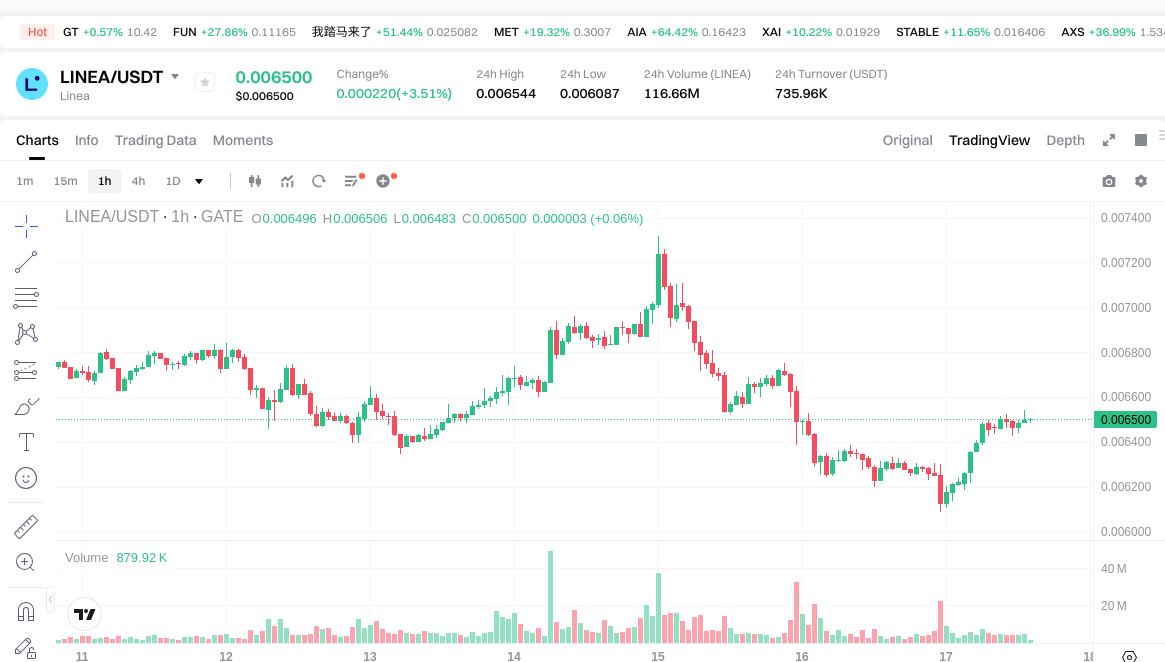
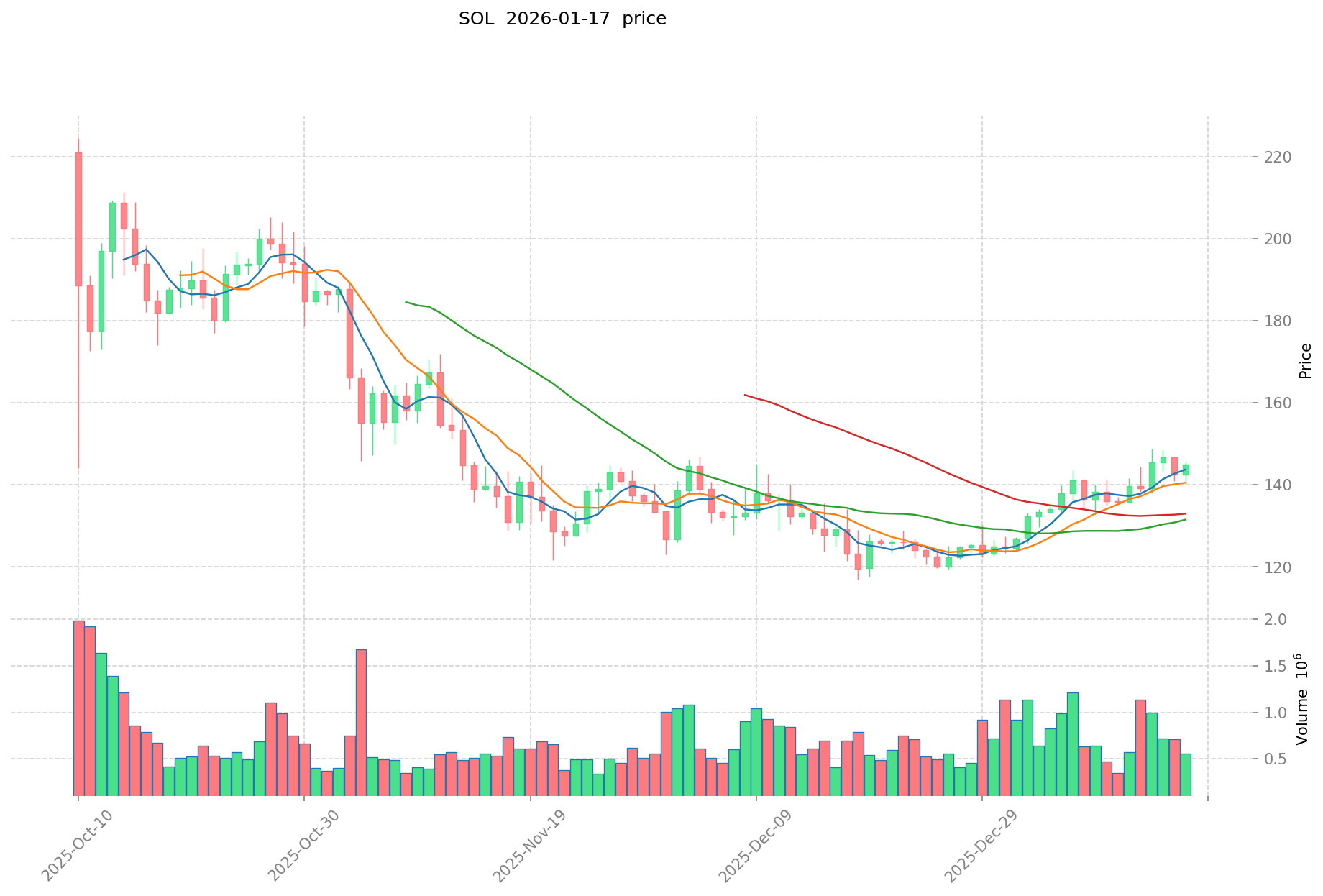
Comparative Analysis: During recent market cycles, LINEA fluctuated from its high of $0.0484 to a low of $0.00575, representing considerable price discovery volatility typical of newly launched tokens. In contrast, SOL exhibited more established trading patterns, moving between $96.59 and $294.33 over a 52-week period, reflecting its maturity as a Layer 1 blockchain platform.
Current Market Status (2026-01-17)
- LINEA Current Price: $0.006497
- SOL Current Price: $144.03
- 24-Hour Trading Volume: LINEA $734,622.74 vs SOL $75,052,578.54
- Market Sentiment Index (Fear & Greed Index): 50 (Neutral)
Click to view real-time prices:
II. Core Factors Influencing LINEA vs SOL Investment Value
Supply Mechanism Comparison (Tokenomics)
-
LINEA: The token generation event (TGE) scheduled for September 10, 2025, introduced a total supply of 72 billion LINEA tokens. The distribution plan balanced ecosystem development and community incentives, with the Linea Ignition program allocating 160 million tokens (increased from the original 150 million), with 80% dedicated to lending pool liquidity providers and 20% for Etherex trading. The airdrop attracted approximately 500,000 eligible addresses, demonstrating strong community engagement.
-
SOL: Reference materials provided limited specific information regarding SOL's supply mechanism during the analyzed period. Available data indicated net inflows of $3.6 billion for SOL, reflecting capital rotation toward certain mainstream alternative assets.
-
📌 Historical Pattern: Supply mechanisms and token distribution strategies may influence short-term price volatility and community participation levels. LINEA's airdrop and incentive programs generated notable market activity during its pre-launch phase.
Institutional Adoption and Market Application
-
Institutional Holdings: Reference materials suggested varying institutional interest patterns. ETH experienced net inflows of $12.7 billion with a year-over-year increase of 138%, while SOL recorded $3.6 billion in net inflows, indicating capital flows among select mainstream assets.
-
Enterprise Adoption: LINEA's integration with international standards and successful SWIFT pilot projects demonstrated potential cross-border infrastructure applications. DeFi protocol SharpLink announced a $170 million strategic cooperation with Layer 2 network Linea, aimed at optimizing cross-chain liquidity and enhancing Ethereum ecosystem interoperability.
-
Regulatory Environment: Ethereum ecosystem project token prices were influenced by two core factors: whether Ethereum spot ETFs could be listed for trading in the near term, and the regulatory stance of the U.S. SEC toward certain projects. Regulatory clarity remained a consideration for market participants.
Technical Development and Ecosystem Building
-
LINEA Technical Progress: As a zkEVM Layer 2 network, Linea provided a fully Ethereum-compatible environment with low fees and high throughput, supporting TVL growth to $1.2 billion. The project received institutional backing from ConsenSys development support, MetaMask integration, and Linea Alliance participation. Through Linea Voyage and Surge activities, the platform attracted 7 million wallets and 2.8 billion transactions.
-
SOL Technical Development: Reference materials contained limited specific information regarding SOL's technical upgrades during the analyzed period. Analysis explored whether Solana had opportunities to advance relative to Ethereum based on data, market sentiment, and various catalysts.
-
Ecosystem Comparison: LINEA's fully diluted valuation (FDV) of approximately $3.6 billion positioned it as a mid-tier Layer 2 project, below Arbitrum ($5 billion) but above Optimism ($3 billion). The Layer 2 ecosystem's development provided long-term value support for ETH through reduced transaction costs and improved scalability. Emerging Layer 2 solution Morph completed $150 million in financing, claiming to reduce transaction costs by 27.6%.
Macroeconomic Environment and Market Cycles
-
Performance Under Inflation: Reference materials did not provide specific comparative data regarding anti-inflation characteristics of LINEA versus SOL.
-
Macroeconomic Monetary Policy: The 2026 Ethereum price outlook considered factors including implementation effects of upgrades, Layer 2 solution adoption rates, institutional investor allocation ratios, global cryptocurrency regulatory policy changes, and macroeconomic conditions particularly interest rate trends. September traditionally represented a down month for crypto markets, potentially creating pressure on initial performance.
-
Geopolitical Factors: LINEA's globalization strategy emphasized localized practices with multicultural ecosystems and cross-border financial infrastructure. Sustainable development considerations featured prominently in regional green initiatives. Cross-border transaction demand and international situations remained relevant considerations for market participants.
III. 2026-2031 Price Forecast: LINEA vs SOL
Short-term Forecast (2026)
- LINEA: Conservative $0.00611 - $0.00650 | Optimistic $0.00650 - $0.00760
- SOL: Conservative $126.68 - $143.95 | Optimistic $143.95 - $151.15
Mid-term Forecast (2028-2029)
- LINEA may enter a consolidation phase, with projected price range of $0.00446 - $0.00819
- SOL may enter an expansion phase, with projected price range of $84.66 - $227.21
- Key drivers: institutional capital flows, ETF developments, ecosystem growth
Long-term Forecast (2031)
- LINEA: Baseline scenario $0.00649 - $0.00927 | Optimistic scenario $0.00927 - $0.01029
- SOL: Baseline scenario $150.83 - $243.27 | Optimistic scenario $243.27 - $270.03
View detailed price predictions for LINEA and SOL
Disclaimer
LINEA:
| Year |
Predicted High Price |
Predicted Average Price |
Predicted Low Price |
Price Change |
| 2026 |
0.00760149 |
0.006497 |
0.00610718 |
0 |
| 2027 |
0.00782466195 |
0.007049245 |
0.0064853054 |
8 |
| 2028 |
0.007734431614 |
0.007436953475 |
0.004462172085 |
14 |
| 2029 |
0.00819254794806 |
0.0075856925445 |
0.005537555557485 |
16 |
| 2030 |
0.010650312332478 |
0.00788912024628 |
0.00536460176747 |
21 |
| 2031 |
0.01028938508121 |
0.009269716289379 |
0.006488801402565 |
42 |
SOL:
| Year |
Predicted High Price |
Predicted Average Price |
Predicted Low Price |
Price Change |
| 2026 |
151.1475 |
143.95 |
126.676 |
0 |
| 2027 |
184.4359375 |
147.54875 |
131.3183875 |
2 |
| 2028 |
225.7495875 |
165.99234375 |
84.6560953125 |
15 |
| 2029 |
227.210320125 |
195.870965625 |
144.9445145625 |
36 |
| 2030 |
275.0028357375 |
211.540642875 |
107.88572786625 |
46 |
| 2031 |
270.0316306299375 |
243.27173930625 |
150.828478369875 |
69 |
IV. Investment Strategy Comparison: LINEA vs SOL
Long-term vs Short-term Investment Strategies
-
LINEA: May appeal to investors interested in emerging Layer 2 infrastructure with focus on Ethereum ecosystem expansion and cross-chain liquidity optimization. The token's recent launch status and ecosystem development initiatives through programs like Linea Voyage and Surge suggest a positioning oriented toward growth-phase investors willing to accept higher volatility in exchange for potential ecosystem development upside.
-
SOL: May appeal to investors seeking exposure to established Layer 1 blockchain infrastructure with demonstrated ecosystem maturity. The platform's track record since 2020, institutional capital inflows, and position as a high-performance blockchain protocol suggest suitability for investors prioritizing more established market positioning with comparatively broader adoption metrics.
Risk Management and Asset Allocation
-
Conservative Investors: A balanced allocation approach might consider diversification across both Layer 1 and Layer 2 assets. Conservative positioning could involve higher allocation toward more established assets with demonstrated track records, while maintaining limited exposure to emerging infrastructure projects for diversification purposes.
-
Aggressive Investors: Growth-oriented strategies might emphasize higher exposure to emerging ecosystem projects alongside established platforms, accepting elevated volatility in pursuit of potential expansion-phase returns. Portfolio construction would consider risk tolerance, investment horizon, and correlation patterns between Layer 1 and Layer 2 assets.
-
Hedging Tools: Risk management considerations include stablecoin allocations for portfolio stability, derivative instruments for directional exposure management, and cross-asset diversification strategies spanning different blockchain infrastructure categories.
V. Potential Risk Comparison
Market Risks
-
LINEA: The token faces price discovery volatility typical of newly launched assets, having experienced fluctuations from $0.0484 to $0.00575 during its initial trading period. Market sentiment toward Layer 2 solutions, broader Ethereum ecosystem performance, and adoption rates of zkEVM technology represent relevant considerations. The project's mid-tier positioning among Layer 2 networks suggests competitive dynamics within the scaling solution landscape.
-
SOL: Price movements have shown correlation with broader market cycles, declining approximately 31.78% over the past year despite reaching all-time highs of $293.31 in January 2025. Market dynamics include competition among Layer 1 protocols, institutional capital allocation patterns, and broader cryptocurrency market sentiment. The 52-week trading range of $96.59 to $294.33 demonstrates substantial price volatility.
Technical Risks
-
LINEA: As a zkEVM Layer 2 solution, technical considerations include network scalability performance, smart contract compatibility maintenance, and infrastructure stability as transaction volumes increase. The platform's integration with existing Ethereum infrastructure through MetaMask and ConsenSys support provides development resources, though execution risks remain inherent to emerging blockchain scaling technologies.
-
SOL: Reference materials contained limited specific technical risk information for SOL during the analyzed period. General considerations for high-performance blockchain protocols include network stability maintenance, validator distribution patterns, and infrastructure resilience under varying transaction load conditions.
Regulatory Risks
- Global Regulatory Environment: Both assets operate within evolving regulatory frameworks. LINEA's positioning within the Ethereum ecosystem faces considerations regarding regulatory treatment of Layer 2 solutions and potential ETF developments. Reference materials indicated that Ethereum ecosystem project valuations may be influenced by regulatory stances and ETF approval processes. SOL's classification as a Layer 1 protocol involves separate regulatory considerations regarding platform classification and securities law applicability across different jurisdictions.
VI. Conclusion: Which Is the Better Buy?
📌 Investment Value Summary:
-
LINEA Characteristics: Represents emerging Layer 2 infrastructure with zkEVM technology implementation, institutional backing through ConsenSys integration, and ecosystem growth initiatives attracting 7 million wallets and 2.8 billion transactions. The project demonstrates mid-tier positioning within the Layer 2 landscape with TVL reaching $1.2 billion. Strategic partnerships including the $170 million SharpLink cooperation indicate ecosystem development momentum.
-
SOL Characteristics: Represents established Layer 1 blockchain infrastructure with demonstrated ecosystem maturity since 2020, institutional capital inflows of $3.6 billion, and positioning as a high-performance blockchain protocol. The platform has achieved significant market capitalization and trading volume metrics, indicating broader market adoption and liquidity depth.
✅ Investment Considerations:
-
Newer Market Participants: May consider starting with more established assets demonstrating longer track records and higher liquidity levels while maintaining modest exposure to emerging infrastructure projects for diversification. Educational focus on understanding both Layer 1 and Layer 2 technology distinctions, tokenomics differences, and risk-return profiles remains advisable.
-
Experienced Market Participants: May evaluate allocation strategies based on individual risk tolerance, investment horizon, and portfolio construction objectives. Consideration of both established Layer 1 infrastructure and emerging Layer 2 solutions could provide exposure across different blockchain scaling approaches and development stages.
-
Institutional Participants: May assess opportunities based on infrastructure maturity, regulatory clarity, liquidity requirements, and strategic positioning within broader digital asset allocation frameworks. Both established Layer 1 protocols and emerging Layer 2 solutions present distinct risk-return characteristics warranting separate evaluation processes.
⚠️ Risk Disclosure: Cryptocurrency markets demonstrate substantial volatility. This analysis does not constitute investment advice. Market participants should conduct independent research, assess individual risk tolerance, and consider consultation with qualified financial professionals before making investment decisions.
VII. FAQ
Q1: What are the main differences between LINEA and SOL as investment assets?
LINEA is an Ethereum Layer 2 scaling solution launched in 2025 with zkEVM technology, while SOL is an established Layer 1 blockchain protocol operating since 2020. LINEA functions as an economic coordination tool within the Ethereum ecosystem, featuring a dual-burn mechanism and focusing on cross-chain liquidity optimization. SOL operates as an independent high-performance blockchain designed for scalability without compromising decentralization. The fundamental difference lies in their infrastructure positioning: LINEA enhances Ethereum's capabilities through Layer 2 scaling, whereas SOL provides a standalone blockchain platform with its own consensus mechanism and validator network.
Q2: How does the price volatility of LINEA compare to SOL?
LINEA demonstrates higher volatility typical of newly launched tokens, with price fluctuations ranging from $0.0484 to $0.00575 during its initial trading period. SOL exhibits more established trading patterns with a 52-week range of $96.59 to $294.33, though it experienced a 31.78% decline over the past year. The 24-hour trading volume disparity is significant, with SOL recording $75,052,578.54 compared to LINEA's $734,622.74, indicating substantially different liquidity depths. This volume differential reflects SOL's maturity as a trading asset with broader market participation, while LINEA continues its price discovery phase as an emerging Layer 2 token.
Q3: What role do institutional investors play in LINEA versus SOL markets?
Institutional participation patterns differ significantly between the two assets. SOL has attracted $3.6 billion in net institutional inflows, demonstrating established institutional interest in Layer 1 blockchain infrastructure. LINEA has secured institutional backing through ConsenSys development support, MetaMask integration, and participation in the Linea Alliance, along with a notable $170 million strategic cooperation with DeFi protocol SharpLink. However, LINEA's institutional engagement primarily focuses on ecosystem development and infrastructure partnerships rather than direct capital allocation at the scale observed with SOL. The institutional involvement in LINEA appears more oriented toward technological integration and platform development during its early growth phase.
Q4: How do regulatory considerations affect LINEA and SOL differently?
Both assets face distinct regulatory considerations based on their infrastructure classifications. LINEA's positioning within the Ethereum ecosystem exposes it to regulatory developments affecting Ethereum-based projects, including potential Ethereum spot ETF approvals and SEC stances toward Layer 2 solutions. The project's classification as an economic coordination tool rather than a governance or gas token presents unique regulatory characteristics. SOL faces regulatory considerations as an independent Layer 1 protocol, with classification questions regarding platform status and securities law applicability across jurisdictions. The evolving global regulatory framework impacts both assets differently based on their technical architecture and market positioning.
Q5: What ecosystem development metrics distinguish LINEA from SOL?
LINEA has achieved specific ecosystem milestones including 7 million wallet connections, 2.8 billion transactions, and $1.2 billion in Total Value Locked (TVL) through initiatives like Linea Voyage and Surge programs. The platform's token generation event allocated 160 million tokens through the Linea Ignition program, attracting approximately 500,000 eligible addresses. Reference materials provided limited specific ecosystem metrics for SOL during the analyzed period, though the platform's established presence since 2020 indicates broader ecosystem maturity with higher transaction volumes and institutional capital flows. LINEA's metrics reflect rapid early-stage growth within the Layer 2 landscape, while SOL's ecosystem demonstrates characteristics of an established Layer 1 protocol with sustained market presence.
Q6: How should investors approach portfolio allocation between LINEA and SOL?
Portfolio allocation considerations depend on individual risk tolerance and investment objectives. Conservative investors might prioritize higher allocation toward established assets like SOL with demonstrated track records and higher liquidity, while maintaining limited exposure to emerging projects like LINEA for diversification. Aggressive investors may emphasize growth-oriented positioning with higher exposure to emerging ecosystem projects alongside established platforms, accepting elevated volatility for potential expansion-phase returns. Risk management strategies include stablecoin allocations for portfolio stability, derivative instruments for directional exposure management, and cross-asset diversification spanning different blockchain infrastructure categories. Both Layer 1 and Layer 2 assets present distinct risk-return profiles warranting separate evaluation within comprehensive portfolio construction frameworks.
Q7: What technical factors should investors monitor for LINEA and SOL?
For LINEA, key technical factors include zkEVM Layer 2 scalability performance, smart contract compatibility maintenance with Ethereum, infrastructure stability under increasing transaction volumes, and successful implementation of the dual-burn mechanism. Integration quality with ConsenSys infrastructure and MetaMask adoption rates provide indicators of technical execution. For SOL, monitoring considerations involve network stability maintenance under varying transaction loads, validator distribution patterns affecting decentralization, and infrastructure resilience during high-demand periods. Both assets require assessment of development activity, upgrade implementation success, and competitive positioning relative to alternative scaling solutions or Layer 1 protocols within their respective categories.
Q8: What are the long-term price outlook differences between LINEA and SOL through 2031?
Long-term projections through 2031 show divergent price trajectories reflecting their different market positions. LINEA forecasts suggest a baseline scenario range of $0.00649 to $0.00927, with an optimistic scenario reaching $0.01029, representing potential growth from current levels as the Layer 2 ecosystem matures. SOL projections indicate a baseline scenario range of $150.83 to $243.27, with an optimistic scenario reaching $270.03, suggesting appreciation potential from its established price base. These projections incorporate considerations including institutional capital flows, ETF developments, ecosystem growth rates, and macroeconomic conditions. The substantial price differential reflects their different market capitalizations and stages of ecosystem development, with LINEA representing emerging infrastructure and SOL representing established blockchain protocol positioning.
* The information is not intended to be and does not constitute financial advice or any other recommendation of any sort offered or endorsed by Gate.