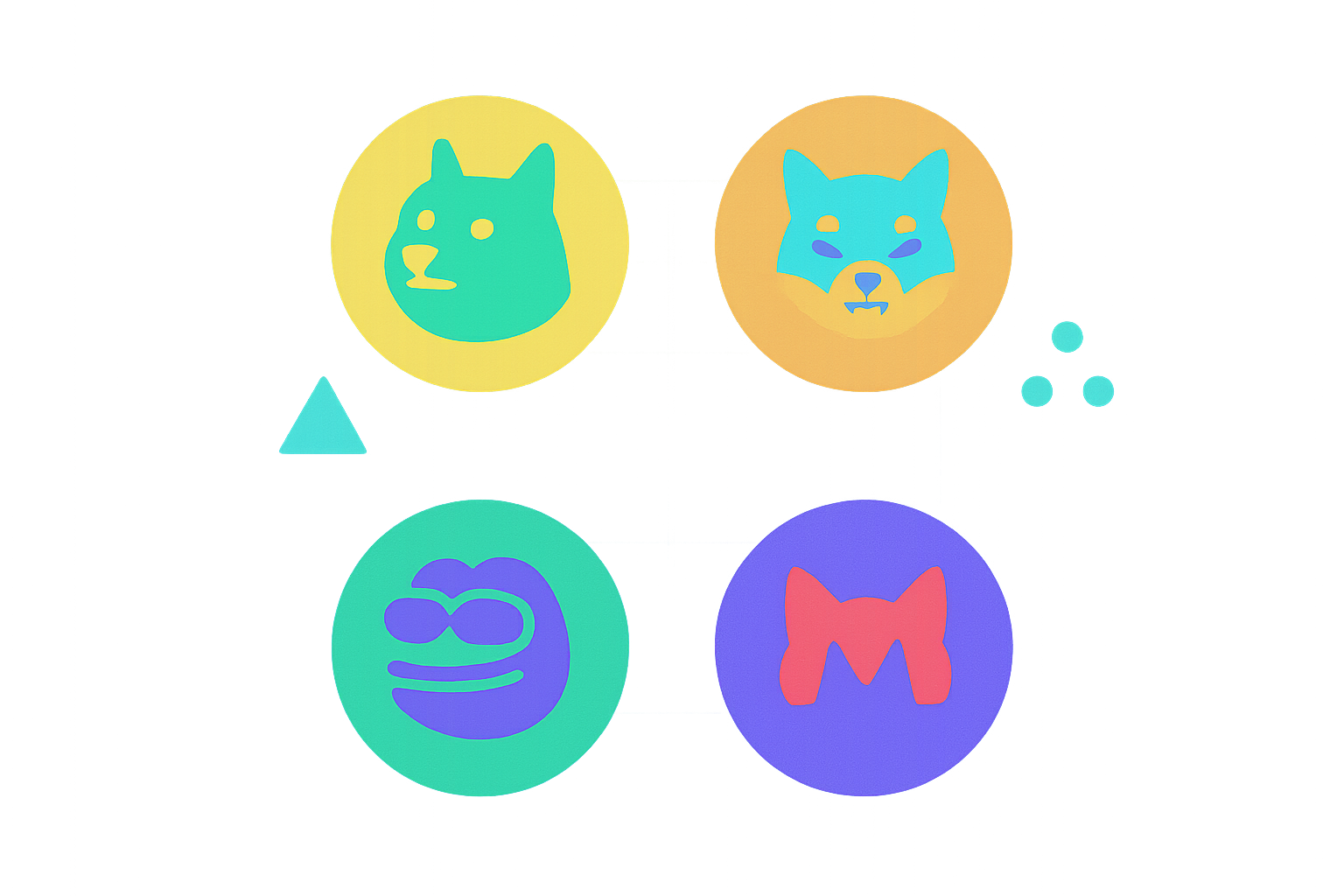
A clear and comprehensive guide to meme coins. Discover the defining features of leading tokens available in Japanese yen—including Dogecoin, Shiba Inu Coin, and Pepe Coin—along with step-by-step instructions for purchasing them on domestic exchanges. This guide also covers beginner-friendly investment strategies and essential risk management practices, providing everything you need to know for safe and informed meme coin investing.
How to Buy Meme Coins with Japanese Yen: Key Methods
Meme coins, rooted in social media and internet culture, hold a distinct presence in the cryptocurrency market. There are two main ways to buy meme coins using Japanese yen: "purchasing directly through domestic exchanges" or "using overseas exchanges and decentralized exchanges (DEXs)."
If a coin is listed on a domestic cryptocurrency exchange registered with the Financial Services Agency, you can buy and sell it directly in Japanese yen. Notable examples include DOGE (Dogecoin), SHIB (Shiba Inu), PEPE (Pepe Coin), and MONA (Monacoin). These coins are traded on platforms that comply with Japanese regulations, providing a secure entry point for beginners.
Many newly launched meme coins, however, are not available on domestic exchanges. To buy these, you'll need to open an account with an overseas exchange or use a decentralized exchange (DEX) for token swaps. For example, Pepe Coin (PEPE), which has recently gained traction, was only accessible on overseas platforms and DEXs before its listing in Japan.
For those new to the market, starting with coins available on domestic exchanges is recommended. This enables smooth yen deposits and withdrawals, and simplifies tax reporting.
Major Meme Coins Directly Purchasable with Japanese Yen
Meme coins listed on domestic exchanges are officially recognized as "cryptocurrencies" by the Financial Services Agency, offering high credibility in terms of legality and safety. Below are the primary meme coins you can buy directly with Japanese yen.
| Coin Name (Symbol) |
Main Domestic Exchanges |
Key Features |
| Dogecoin (DOGE) |
Coincheck, bitbank, GMO Coin, etc. |
The world's first meme coin, inspired by the Shiba Inu "Kabosu" internet meme. No supply cap; inflationary by design. |
| Shiba Inu (SHIB) |
BITPOINT, SBI VC Trade, etc. |
Created as a parody of Dogecoin. ERC-20 token with a total supply exceeding 589 trillion. Community-driven token burns implemented. |
| Pepe Coin (PEPE) |
BITPOINT, bitFlyer, OKCoin Japan, etc. |
Motivated by the "Pepe the Frog" meme. Employs a deflationary model with partial token burns on each transaction. Recently listed on domestic exchanges. |
| Monacoin (MONA) |
Coincheck, bitbank, Bittrex, etc. |
Japan's first meme coin (launched in 2013), inspired by ASCII art "Monā". A PoW coin with its own blockchain derived from Litecoin. |
Each of these coins can be traded on exchanges that adhere to Japanese regulations, allowing for secure transactions. They all feature unique characteristics and communities, which should be considered when making investment decisions.
Dogecoin (DOGE)
Dogecoin is widely recognized as the original meme coin. In December 2013, American engineers Jackson Palmer and Billy Markus created it as an internet joke. The Shiba Inu "Doge" meme became its logo, quickly spreading online due to its playful imagery.
Technically, Dogecoin is a proof-of-work (PoW) coin based on Litecoin, with its own blockchain—an important distinction from Ethereum-based tokens. Its fast block times and low transaction fees have supported tipping and community donations since its early days.
A key feature is its inflationary supply—there is no cap, and about 5 billion DOGE are issued each year. While this limits long-term price appreciation, it supports everyday payments. This approach contrasts sharply with deflationary coins like Bitcoin.
Dogecoin is listed on several major Japanese exchanges, making it accessible for beginners to purchase in small amounts. Its stable popularity and wide availability make it an ideal entry point for meme coin investing.
Main Exchanges: Coincheck, bitbank, GMO Coin
Shiba Inu (SHIB)
Launched in 2020 by the anonymous developer "Ryoshi," Shiba Inu is an ERC-20 token. Dubbed the "Dogecoin Killer," it aims to build a self-governing decentralized ecosystem rather than being a mere imitation.
Its most notable aspect is its massive supply—the initial issuance was 10 quadrillion tokens, and over 589 trillion remain in circulation, resulting in a very low price per token. This allows holders to own large quantities for little cost, fueling a global craze via social media.
As an Ethereum-based token, SHIB offers high compatibility for trading and storage, and integrates easily with DEXs and DeFi protocols. The project is expanding its infrastructure with ShibaSwap (DEX), an NFT marketplace, and its own layer-2 solution "Shibarium."
Regular token burns are conducted to help maintain price and enthusiasm. A notable early event was a large donation of tokens to Ethereum founder Vitalik Buterin.
Main Exchanges: BITPOINT, SBI VC Trade, OKCoin Japan, bitFlyer
Pepe Coin (PEPE)
PEPE is a recent meme token themed around the popular internet character "Pepe the Frog." It was launched by an anonymous team using a fair launch format, with no presale or fees.
Its defining features include a vast supply of 420.69 trillion tokens and a deflationary mechanism that burns tokens with each transaction, gradually reducing circulation and theoretically increasing scarcity.
PEPE quickly became a symbol of the meme coin boom, reaching a market cap of ¥170 billion (around $1.2 billion) at its peak. Listings on major global exchanges drove rapid liquidity growth and attracted wide investor attention.
Early in its development, some team members misappropriated funds, temporarily undermining trust. The remaining team addressed the issue and rebuilt the project, highlighting the ongoing risks of meme coin investments.
Recently, multiple Japanese exchanges have listed PEPE, making direct purchases in yen possible.
Main Exchanges: BITPOINT, bitFlyer, OKCoin Japan
Monacoin (MONA)
Monacoin is Japan’s original meme coin, with a long history. Developed in late 2013 by volunteers from 2channel (now 5channel), it's the world's first domestically produced cryptocurrency, inspired by ASCII art "Monā."
Monacoin operates on a proof-of-work (PoW) blockchain derived from Litecoin, using its own independent chain. Blocks are generated roughly every 1.5 minutes, with a cap of 105.12 million MONA and a halving mechanism similar to Bitcoin.
More than a joke token, Monacoin has seen real-world use in Japan since its early days, such as payments at Akihabara shops and tipping via Twitter bots. It is also accepted at fan events and is closely tied to Japan’s subculture.
Though it has drawn less attention recently, Monacoin maintains a strong community and ongoing development, notably on GitHub. It was formally recognized by the Financial Services Agency in 2017 and is still available for yen purchases on major exchanges.
Main Exchanges: bitFlyer, Coincheck, bitbank
Buying on Domestic Exchanges: The Easiest and Safest Option
The simplest and safest way to buy meme coins with Japanese yen is to purchase coins listed on domestic cryptocurrency exchanges. You can deposit yen and buy your chosen coin directly, making the process straightforward and beginner-friendly.
Basic Steps to Buy
Open an Account at a Domestic Exchange
Open an account with an exchange that lists your desired meme coin (such as Coincheck, bitbank, BITPOINT). Identity verification (KYC) is required, but Japanese-language support is available, making the process accessible even for first-time users.
Deposit Japanese Yen
Once your account is set up, deposit yen via bank transfer, convenience store, or credit card using the exchange's provided methods. Domestic exchanges support instant deposits and withdrawals, with user-friendly interfaces.
Buy Your Chosen Coin
After your deposit is confirmed, select the meme coin you want to buy and purchase it in yen via the marketplace or trading board. For example, you can buy Dogecoin (DOGE) at Coincheck or Shiba Inu (SHIB) at BITPOINT.
Advantages
- High Trustworthiness: Domestic operators registered with the Financial Services Agency provide a regulated, secure trading environment.
- Japanese Language Support: You can receive prompt assistance in Japanese if issues arise.
- Simplified Tax Reporting: Yen-based trading makes tax filing and withdrawals easier.
Disadvantages
- Limited Coin Selection: Only a select number of meme coins can be bought in Japan. New coins require a vetting period before domestic listing, so early access may require using DEXs or overseas exchanges.
For those new to the market, starting with coins available on domestic exchanges is strongly recommended. This enables risk-managed experience with meme coin investing.
Meme Coin Investment: Cautions and Risk Management
Meme coins carry the potential for windfall profits but are also extremely high-risk speculative assets. Before investing, you must understand these key points.
Extreme Price Volatility
Meme coins exhibit exceptional volatility compared to other cryptocurrencies. Social media buzz or celebrity endorsements can drive prices up rapidly, or trigger sudden crashes. Many investors have reported significant losses.
Assume "the risk of total loss" and allocate funds carefully. Diversify small amounts within your surplus capital. Never invest living expenses or borrowed money.
Evaluating Project Reliability
Many meme coin projects started as jokes, with anonymous developers and unclear management. This raises risks of scams or sudden abandonment ("rug pulls").
Before investing, always check:
- Team Transparency: Are the team members' identities and backgrounds public?
- Token Concentration: Are large amounts held in a few addresses (insider risk)?
- Social Media Hype: Is there excessive promotional posting?
- Community Reputation: Review the official site, whitepaper, and social channels.
If you spot warning signs, consider avoiding investment.
Japanese Regulations and Associated Risks
Buying or holding meme coins not listed on domestic exchanges is not illegal. However, these coins are not certified by the Financial Services Agency, so you will not receive official compensation in the event of trouble.
Promoting or selling unregistered crypto assets within Japan may violate laws as unregistered business activity, so proceed with caution.
Meme coins bought via overseas exchanges or DEXs are entirely at your own risk, with no official protection.
Tax treatment is also key. Profits from meme coin trading are subject to miscellaneous income tax. Record transactions thoroughly and file appropriately.
Conclusion: Practice Rigorous Risk Management for Proper Meme Coin Trading
Meme coins' distinctive visuals and viral social media trends lead to dramatic price swings in short timeframes. The growing number of meme coins available for direct purchase in yen has made the market more accessible for beginners.
However, many coins remain available only via overseas or decentralized exchanges. Always conduct thorough project research and understand risk management before investing.
Meme coin investing offers high return potential but comes with equally high risk. Diversify within surplus funds, avoid over-investing, and stay informed on tax and legal obligations.
With accurate knowledge and sound risk management, you can trade meme coins more safely and effectively.
FAQ
Which meme coins are recommended for purchase with Japanese yen?
Dogecoin (DOGE) and Shiba Inu (SHIB) are top recommendations due to their high liquidity and popularity. Pepe Coin (PEPE) is also gaining interest.
How do I buy meme coins on Japanese crypto exchanges?
After depositing yen to your exchange account, connect your wallet and search for the meme coin you want to buy. Each platform has its own procedures, so follow their guides.
What are meme coins, and how are they different from regular cryptocurrencies?
Meme coins are cryptocurrencies based on internet memes, mainly driven by speculation. Traditional cryptocurrencies emphasize utility and technical innovation, while meme coins are more influenced by community hype and market psychology.
What should I watch out for when buying meme coins with yen?
Always research the project's reliability before buying meme coins. The market is highly volatile, so beware of sudden price spikes and drops. Scam risks exist, so start with small investments in trustworthy projects.
What are the characteristics of major meme coins like Dogecoin and Shiba Inu?
Dogecoin and Shiba Inu are cryptocurrencies born from internet memes, featuring strong community support, high social media impact, and liquidity. Their large market caps and broad recognition make them popular choices for beginners.
What should I know before investing in meme coins?
Before investing, thoroughly research the project and assess your risk tolerance. Consider community activity, team credibility, and market liquidity before making investment decisions.
* The information is not intended to be and does not constitute financial advice or any other recommendation of any sort offered or endorsed by Gate.