This comprehensive analysis compares Livepeer (LPT) and NEAR Protocol as blockchain infrastructure investments. LPT specializes in decentralized video transcoding with unique staking rewards tied to actual network usage, currently trading at $3.20 with 78.9% annual decline. NEAR provides broader DeFi and smart contract capabilities with deflationary fee-burning mechanics, priced at $1.7445 with higher trading liquidity. The article examines historical price performance ranging from $0.35-$99.03 (LPT) and $0.53-$20.44 (NEAR), analyzes tokenomics, ecosystem development, and macroeconomic factors. Price projections through 2031 suggest potential appreciation trajectories for both tokens under varying scenarios. Investment strategies differentiate between conservative (30% LPT/70% NEAR) and aggressive allocations, while addressing market, technical, and regulatory risks. The comparison reveals LPT as focused infrastructure play versus NEAR as general-purpose platform, guiding investors toward aligned portfolio po
Introduction: LPT Investment Value, Price Prediction, and Risk Analysis
In the cryptocurrency market, Livepeer (LPT) represents a distinctive category of blockchain infrastructure projects focused on decentralized video streaming services. Since its launch in December 2018, LPT has positioned itself as a protocol token within the Livepeer network, an open-source live video platform built on Ethereum blockchain.
LPT operates with a unique value proposition: token holders can delegate their tokens to transcoders who perform video processing work, earning rewards and newly minted tokens daily. This staking mechanism distinguishes LPT from purely speculative assets by tying its utility directly to network operations and computational resources.
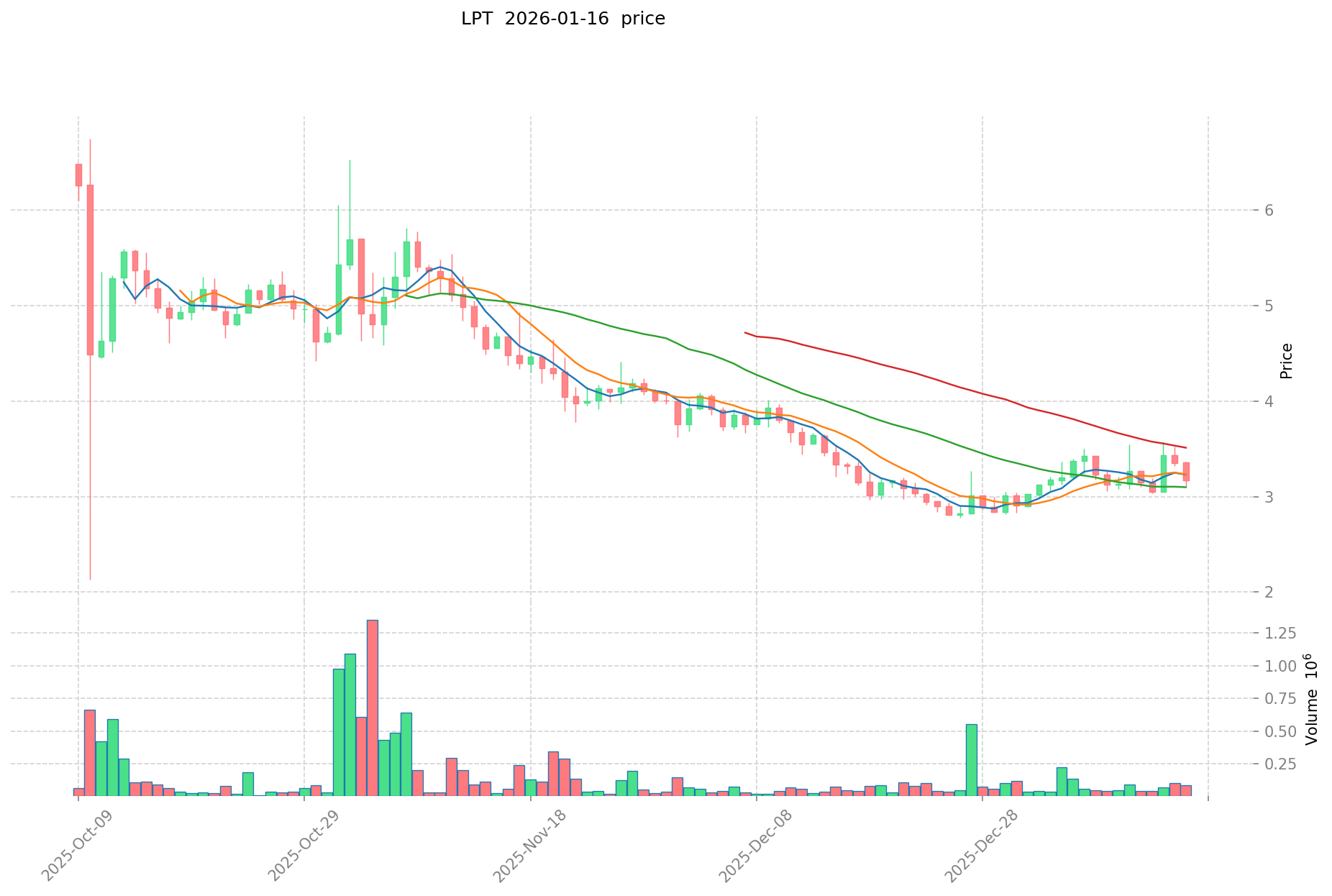
As of January 16, 2026, LPT ranks 279th by market capitalization at approximately $156 million, with a circulating supply of 48.78 million tokens priced at $3.20. The token has experienced significant price volatility since its inception, ranging from a low of $0.35 in October 2019 to a peak of $99.03 in November 2021. Over the past year, LPT has declined by 78.9%, reflecting broader market corrections and sector-specific challenges.
This analysis will examine LPT's investment value through multiple dimensions:
- Historical price performance and volatility patterns
- Token supply mechanisms and circulation dynamics
- Technical ecosystem development and platform utility
- Risk factors and market positioning
- Future price scenarios based on available data
The goal is to provide investors with a comprehensive framework for evaluating LPT's potential within the context of decentralized infrastructure projects, addressing the key question:
"What factors should inform an investment decision regarding LPT?"
I. Historical Price Comparison and Current Market Status
LPT and NEAR Historical Price Trends
- 2021: LPT reached a historical high of $99.03 on November 10, 2021, during the broader cryptocurrency market rally.
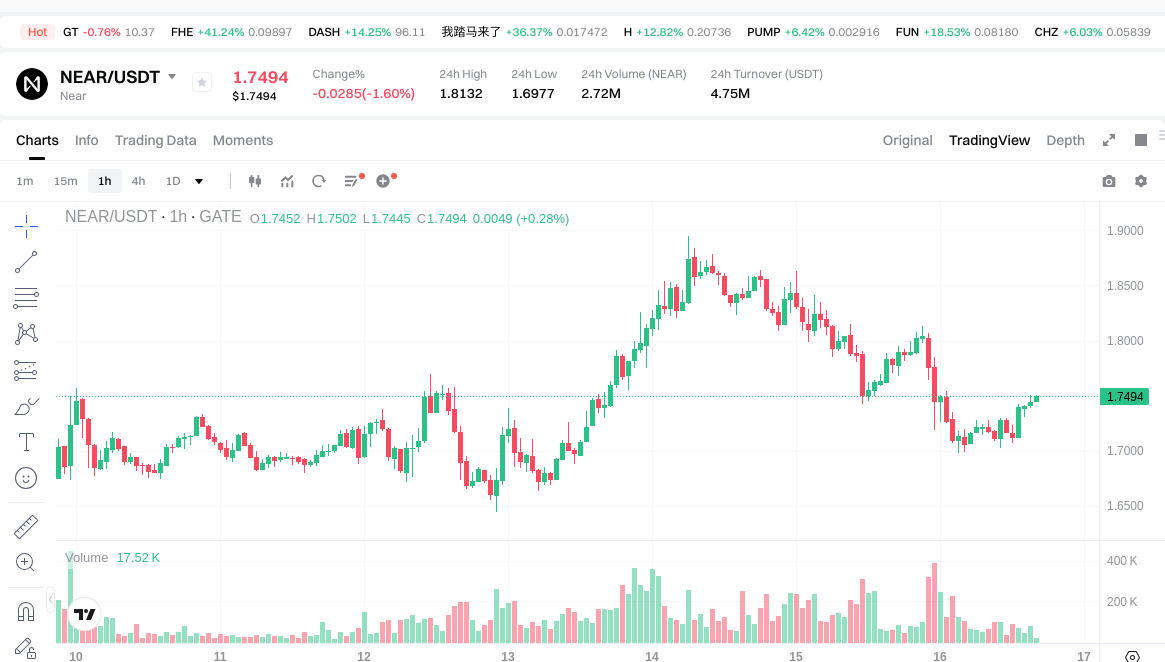
- 2022: NEAR achieved its peak price of $20.44 on January 16, 2022, influenced by growing interest in blockchain scalability solutions.
- Comparative Analysis: During the 2021-2022 market cycle, LPT experienced a decline from $99.03 to $0.354051 at its lowest point, while NEAR fell from $20.44 to $0.526762, showing that both assets underwent significant corrections following their peak valuations.
Current Market Status (2026-01-16)
- LPT Current Price: $3.20
- NEAR Current Price: $1.7445
- 24-Hour Trading Volume: LPT recorded $202,959.21 compared to NEAR's $4,752,375.41
- Market Sentiment Index (Fear & Greed Index): 49 (Neutral)
View real-time prices:
II. Core Factors Influencing Investment Value: LPT vs NEAR
Supply Mechanism Comparison (Tokenomics)
-
LPT: Livepeer employs an inflationary token model where LPT is minted to reward network participants, including orchestrators and delegators who stake their tokens. The inflation rate adjusts based on network participation levels, creating a dynamic supply mechanism that incentivizes active engagement in video transcoding services.
-
NEAR: NEAR Protocol utilizes a fixed maximum supply with an inflationary reward structure for validators and delegators. The protocol implements a fee-burning mechanism where a portion of transaction fees is permanently removed from circulation, creating deflationary pressure that may counterbalance the inflationary rewards over time.
-
📌 Historical Pattern: Supply mechanisms significantly influence price cycles. Inflationary models like LPT's may dilute token value during low-demand periods, while NEAR's burn mechanism could support price stability during network growth phases.
Institutional Adoption and Market Application
-
Institutional Holdings: Neither LPT nor NEAR currently demonstrates dominant institutional preference in available materials. Both projects maintain relatively modest institutional backing compared to major cryptocurrencies.
-
Enterprise Adoption: LPT focuses on decentralized video infrastructure, serving content creators and streaming platforms seeking cost-effective transcoding solutions. NEAR targets broader enterprise applications through its developer-friendly infrastructure, though specific adoption metrics remain limited in reference materials.
-
National Policies: Regulatory approaches toward both projects align with general blockchain infrastructure frameworks. Neither token faces specific regulatory advantages or restrictions beyond standard cryptocurrency oversight in major jurisdictions.
Technology Development and Ecosystem Construction
-
LPT Technical Evolution: Livepeer continues developing its decentralized video transcoding network, with the protocol serving as critical infrastructure for streaming applications. The team aims to expand beyond video processing into broader media infrastructure services, though specific technical upgrade details are not extensively documented in available materials.
-
NEAR Technical Progress: NEAR Protocol focuses on scalability improvements and developer experience enhancement. The platform emphasizes user-friendly features and cross-chain interoperability, though detailed technical roadmap information is limited in reference sources.
-
Ecosystem Comparison: LPT specializes in video infrastructure with narrower but deeper focus in media transcoding. NEAR pursues broader DeFi, NFT, and smart contract applications across multiple sectors. Both ecosystems remain in developmental stages with varying degrees of application deployment.
Macroeconomic Context and Market Cycles
-
Performance in Inflationary Environments: Neither LPT nor NEAR demonstrates established anti-inflation characteristics comparable to traditional store-of-value assets. Both tokens exhibit volatility patterns typical of mid-cap cryptocurrency projects.
-
Macroeconomic Monetary Policy: Interest rate movements and U.S. dollar strength affect both tokens through general cryptocurrency market sentiment rather than direct fundamental linkages. Risk-on/risk-off dynamics in traditional markets tend to influence both projects similarly.
-
Geopolitical Factors: LPT's video infrastructure use case maintains relatively neutral geopolitical positioning. NEAR's broader blockchain infrastructure approach may benefit from increasing demand for decentralized solutions, though specific geopolitical advantages remain theoretical rather than demonstrated in current market conditions.
III. 2026-2031 Price Prediction: LPT vs NEAR
Short-term Prediction (2026)
- LPT: Conservative $2.25-$3.22 | Optimistic $3.22-$4.02
- NEAR: Conservative $1.21-$1.75 | Optimistic $1.75-$2.38
Medium-term Prediction (2028-2029)
- LPT may enter a growth phase, with projected price range of $2.27-$6.72
- NEAR may enter an expansion stage, with projected price range of $1.88-$3.81
- Key drivers: institutional capital inflows, ETF developments, ecosystem growth
Long-term Prediction (2030-2031)
- LPT: Baseline scenario $5.28-$6.81 | Optimistic scenario $5.99-$7.87
- NEAR: Baseline scenario $2.13-$4.66 | Optimistic scenario $3.59-$5.91
View detailed price predictions for LPT and NEAR
Disclaimer
LPT:
| Year |
Predicted High Price |
Predicted Average Price |
Predicted Low Price |
Price Change |
| 2026 |
4.02125 |
3.217 |
2.2519 |
0 |
| 2027 |
3.94484625 |
3.619125 |
2.56957875 |
13 |
| 2028 |
5.48387915625 |
3.781985625 |
2.269191375 |
18 |
| 2029 |
6.71775196640625 |
4.632932390625 |
3.0577353778125 |
44 |
| 2030 |
6.81041061421875 |
5.675342178515625 |
5.278068226019531 |
77 |
| 2031 |
7.866024259422656 |
6.242876396367187 |
5.9931613405125 |
95 |
NEAR:
| Year |
Predicted High Price |
Predicted Average Price |
Predicted Low Price |
Price Change |
| 2026 |
2.378368 |
1.7488 |
1.206672 |
0 |
| 2027 |
2.57948 |
2.063584 |
1.3413296 |
18 |
| 2028 |
3.3662214 |
2.321532 |
2.06616348 |
33 |
| 2029 |
3.810794778 |
2.8438767 |
1.876958622 |
63 |
| 2030 |
4.6582700346 |
3.327335739 |
2.12949487296 |
90 |
| 2031 |
5.909348272464 |
3.9928028868 |
3.59352259812 |
128 |
IV. Investment Strategy Comparison: LPT vs NEAR
Long-term vs Short-term Investment Strategies
-
LPT: Suitable for investors focused on decentralized infrastructure and video streaming applications. The token's staking mechanism provides utility through network participation, making it appropriate for those willing to engage actively with the protocol through delegation to transcoders. Long-term holders may benefit from network growth in decentralized media services, though the specialized use case limits broader appeal.
-
NEAR: Suitable for investors seeking exposure to scalable blockchain infrastructure with broader application potential. The platform's focus on developer-friendly features and cross-chain interoperability positions it for participants interested in DeFi, NFT, and smart contract ecosystems. The fee-burning mechanism may provide some deflationary support during network expansion phases.
Risk Management and Asset Allocation
-
Conservative Investors: LPT 30% vs NEAR 70%. Conservative portfolios may favor NEAR's broader ecosystem potential and deflationary tokenomics over LPT's specialized video infrastructure focus.
-
Aggressive Investors: LPT 45% vs NEAR 55%. Aggressive allocations might increase LPT exposure to capture potential upside from video transcoding market growth, while maintaining NEAR position for broader blockchain infrastructure opportunities.
-
Hedging Tools: Stablecoin allocation (20-40% of crypto portfolio), options strategies for downside protection, cross-asset diversification including tokens from different blockchain infrastructure segments to reduce sector-specific concentration risk.
V. Potential Risk Comparison
Market Risks
-
LPT: Subject to volatility patterns typical of mid-cap infrastructure tokens, with historical price swings from $0.35 to $99.03 demonstrating substantial correction potential. Limited trading volume ($202,959.21 on January 16, 2026) may amplify price movements during market stress. The specialized focus on video transcoding creates dependency on adoption within a specific market segment.
-
NEAR: Experiences volatility characteristic of Layer-1 blockchain protocols, with historical range from $0.53 to $20.44 indicating significant price fluctuation potential. Higher trading volume ($4,752,375.41) provides somewhat better liquidity compared to LPT. Broader application scope across DeFi, NFT, and smart contracts exposes NEAR to multiple sector-specific risks simultaneously.
Technical Risks
-
LPT: Scalability of the video transcoding network depends on sustained orchestrator participation and technological competitiveness against centralized alternatives. Network stability relies on adequate node distribution and transcoding capacity meeting demand. The specialized infrastructure focus creates dependency on continued video streaming market growth.
-
NEAR: Network scalability improvements remain under development, with technical execution risk on roadmap deliverables. Cross-chain interoperability introduces complexity and potential security vulnerabilities. Smart contract platform competition from established networks creates adoption challenges requiring sustained technical differentiation.
Regulatory Risks
- Both LPT and NEAR face general cryptocurrency regulatory uncertainty across jurisdictions. Infrastructure tokens like LPT may encounter fewer regulatory concerns compared to financial application platforms, though decentralized service provision raises questions about liability frameworks. NEAR's broader DeFi and smart contract applications may attract increased regulatory scrutiny as authorities develop frameworks for decentralized financial services. Neither token currently demonstrates specific regulatory advantages or disadvantages compared to the other, with both subject to evolving global cryptocurrency oversight policies.
VI. Conclusion: Which Is the Better Buy?
📌 Investment Value Summary:
-
LPT Advantages: Specialized positioning in decentralized video infrastructure with direct utility through staking and transcoding rewards. Focused use case provides clear value proposition for video streaming applications. Active network participation mechanism creates engagement beyond pure speculation.
-
NEAR Advantages: Broader ecosystem potential across multiple blockchain application categories including DeFi, NFT, and smart contracts. Fee-burning mechanism provides deflationary tokenomics element. Developer-friendly approach and cross-chain interoperability support wider adoption pathways.
✅ Investment Recommendations:
-
Beginner Investors: Consider starting with smaller allocations to both assets as part of diversified cryptocurrency portfolio. NEAR may offer more accessible entry point given broader ecosystem and higher liquidity. Focus on understanding staking mechanisms and network participation before committing significant capital.
-
Experienced Investors: Evaluate portfolio positioning based on infrastructure sector exposure preferences. LPT provides specialized video transcoding infrastructure exposure, while NEAR offers broader Layer-1 blockchain platform positioning. Consider both tokens as complementary holdings representing different infrastructure segments rather than direct alternatives.
-
Institutional Investors: Assess infrastructure investment thesis alignment with specialized (LPT) versus general-purpose (NEAR) blockchain services. Limited institutional adoption data for both projects suggests early-stage positioning. Consider pilot allocations while monitoring ecosystem development metrics and adoption indicators.
⚠️ Risk Warning: Cryptocurrency markets exhibit extreme volatility. This analysis does not constitute investment advice.
VII. FAQ
Q1: What makes LPT's staking mechanism different from typical cryptocurrency staking?
LPT's staking mechanism is uniquely tied to video transcoding services, where token holders delegate their LPT to orchestrators who perform actual computational work processing video streams, rather than simply validating transactions. Unlike traditional proof-of-stake systems where validators secure the network through consensus, LPT delegators earn rewards proportional to the video processing work their chosen orchestrators complete. This creates a direct utility connection between token holdings and real-world infrastructure services, with daily reward distributions based on network usage rather than fixed staking yields.
Q2: How does NEAR's fee-burning mechanism affect long-term token value compared to LPT's inflationary model?
NEAR implements deflationary pressure through its fee-burning mechanism, where a portion of transaction fees is permanently removed from circulation, potentially supporting price stability as network usage grows. In contrast, LPT employs an inflationary model that continuously mints new tokens to reward network participants, with the inflation rate adjusting based on participation levels. During periods of low network demand or adoption, LPT's inflationary supply may create downward price pressure, while NEAR's burn mechanism could provide relative support. However, LPT's inflation incentivizes active network participation in video transcoding, creating utility-driven demand that may offset supply expansion during growth phases.
Q3: What are the primary risk differences between investing in LPT versus NEAR?
LPT carries concentrated sector risk focused specifically on decentralized video streaming adoption, with limited trading volume ($202,959 daily) creating potential liquidity challenges during market stress. NEAR faces broader technical execution risks across multiple application categories (DeFi, NFT, smart contracts), but benefits from higher liquidity ($4,752,375 daily volume) and diversified use case potential. LPT's specialized infrastructure positioning may encounter fewer regulatory concerns compared to NEAR's financial application exposure, though both face general cryptocurrency regulatory uncertainty. The key distinction lies in concentration risk (LPT's video-specific focus) versus execution complexity risk (NEAR's multi-sector development requirements).
Q4: Why have both tokens experienced significant declines from their historical peaks?
Both LPT (down from $99.03 peak to $3.20 current price) and NEAR (down from $20.44 peak to $1.7445 current price) participated in the 2021-2022 cryptocurrency market cycle characterized by excessive speculation followed by broad market correction. LPT's November 2021 peak coincided with general crypto market euphoria rather than fundamental adoption milestones, while NEAR's January 2022 peak reflected Layer-1 blockchain speculation during that period. The subsequent 78.9% annual decline for LPT and similar corrections for NEAR align with broader cryptocurrency market contraction, reduced risk appetite, and the transition from speculation-driven to utility-driven valuations as the market matured.
Q5: How should investors approach allocation between LPT and NEAR based on risk tolerance?
Conservative investors should consider a 30% LPT / 70% NEAR allocation, favoring NEAR's broader ecosystem potential, higher liquidity, and deflationary tokenomics over LPT's specialized video infrastructure focus. Aggressive investors might increase to 45% LPT / 55% NEAR to capture potential upside from video transcoding market growth while maintaining NEAR exposure for general blockchain infrastructure opportunities. Both allocations should represent only a portion of overall cryptocurrency holdings (recommended 20-40% stablecoin reserve for risk management), with total crypto exposure aligned to individual risk tolerance. The allocation strategy recognizes that LPT and NEAR represent complementary infrastructure segments rather than direct substitutes—video-specific versus general-purpose blockchain services.
Q6: What specific adoption metrics should investors monitor for evaluating LPT and NEAR?
For LPT, investors should track orchestrator participation rates, total transcoding volume processed through the network, number of active streaming applications utilizing Livepeer infrastructure, and the effective staking yield after accounting for inflation. For NEAR, key metrics include daily active addresses, smart contract deployment growth, total value locked (TVL) in DeFi applications, transaction fee volume (indicating burn mechanism effectiveness), and developer activity measured by GitHub commits and new project launches. Both tokens require monitoring beyond price action—network utilization metrics directly correlate to fundamental value proposition delivery and provide early indicators of adoption trends that may precede price movements.
Q7: What are realistic expectations for LPT and NEAR price performance through 2026-2031?
Based on available projections, LPT shows conservative 2026 range of $2.25-$3.22 extending to potential $5.99-$7.87 by 2031 under optimistic scenarios, representing gradual appreciation dependent on video infrastructure adoption. NEAR demonstrates conservative 2026 range of $1.21-$1.75 potentially reaching $3.59-$5.91 by 2031, reflecting broader blockchain infrastructure growth assumptions. Both projections assume continued ecosystem development and market recovery from current suppressed valuations. However, investors should recognize that cryptocurrency price predictions carry substantial uncertainty—historical volatility patterns (LPT: $0.35-$99.03 range; NEAR: $0.53-$20.44 range) demonstrate both tokens' capacity for dramatic price movements in either direction based on market sentiment shifts, regulatory developments, and competitive dynamics within blockchain infrastructure sectors.
Q8: Which token is more suitable for investors seeking passive income through network participation?
LPT offers more direct passive income potential through its delegation mechanism, where token holders earn daily rewards by delegating to orchestrators performing video transcoding work, with returns directly tied to network utilization. The process requires minimal active management beyond initial orchestrator selection and periodic performance monitoring. NEAR provides staking rewards through validator delegation, though the income generation is more standardized and less dependent on specific service delivery. For passive income focus, LPT's transcoding reward structure may provide higher yields during network growth periods when video processing demand is strong, while NEAR offers more predictable staking returns less subject to usage variability. However, both require understanding the delegation/staking mechanics and associated risks, including potential slashing penalties and lock-up periods that may limit liquidity during market volatility.
* The information is not intended to be and does not constitute financial advice or any other recommendation of any sort offered or endorsed by Gate.