This comprehensive guide compares LTC and FLOW, two distinct blockchain assets serving different market segments. Litecoin (LTC), launched in 2011, functions as an established peer-to-peer payment cryptocurrency with a fixed 84 million coin supply and halving mechanism. Flow (FLOW), introduced in 2020, operates as a platform for digital applications and NFTs. The comparison examines historical price trends, tokenomics structures, institutional adoption levels, and technical ecosystems across both assets. LTC demonstrates higher liquidity at $8.61 million daily volume versus FLOW's $1.48 million, reflecting market maturity differences. The article analyzes price performance from 2021 peaks, evaluates investment strategies for conservative and aggressive investors, discusses risk factors including market volatility and regulatory considerations, and provides asset allocation frameworks. Detailed price forecasts, FAQ sections, and institutional investment criteria help readers make informed decisions between the
Introduction: Investment Comparison Between LTC and FLOW
In the cryptocurrency market, the comparison between LTC vs FLOW has been a topic that investors cannot avoid. The two not only show significant differences in market cap ranking, application scenarios, and price performance, but also represent different positioning in the crypto asset space.
Litecoin (LTC): Launched in 2011, it has gained market recognition with its positioning as a faster alternative for peer-to-peer transactions.
Flow (FLOW): Since its launch in 2020, it has been positioned as a platform for next-generation games, applications, and digital assets.
This article will provide a comprehensive analysis of the investment value comparison between LTC vs FLOW, focusing on historical price trends, supply mechanisms, institutional adoption, technical ecosystem, and future predictions, attempting to answer the question that investors care about most:
"Which is the better buy right now?"
I. Historical Price Comparison and Current Market Status
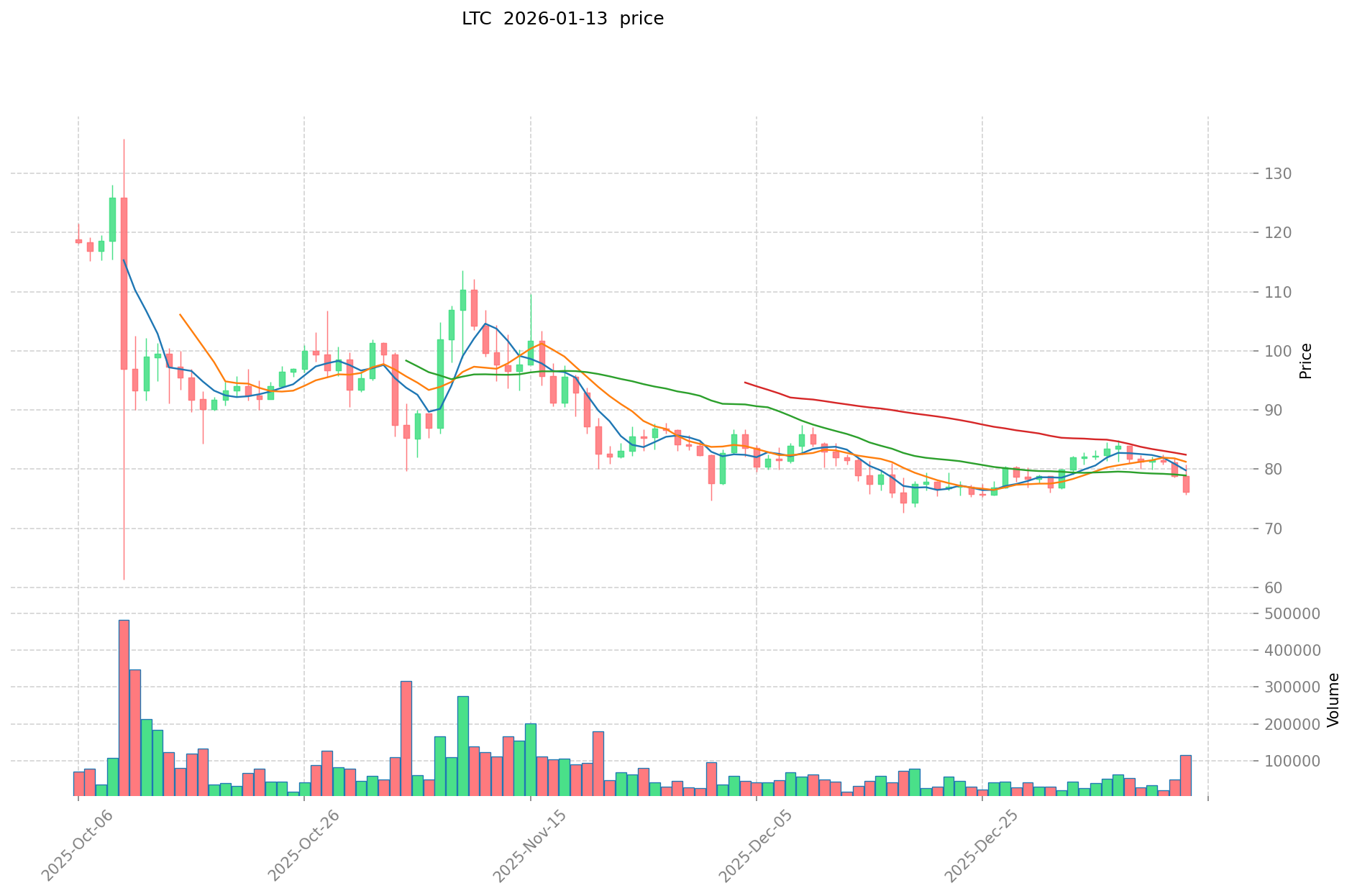
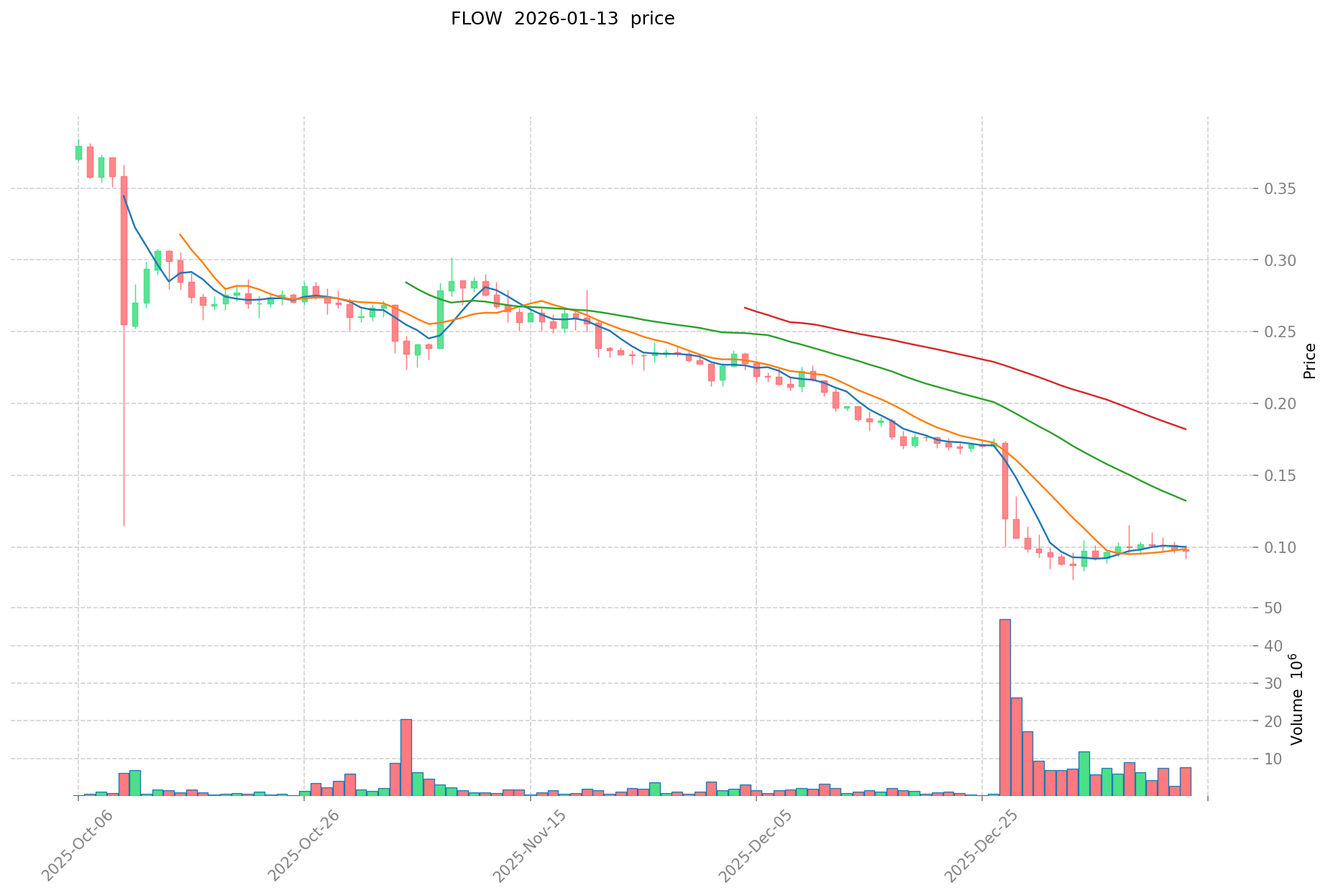
Historical Price Trends of LTC (Coin A) and FLOW (Coin B)
- 2021: LTC experienced notable price movements, reaching an all-time high of $410.26 in May 2021. This peak reflected broader market enthusiasm during the crypto bull cycle.
- 2021: FLOW also reached its historical peak of $42.4 in April 2021, driven by the platform's early traction in the NFT space and gaming applications.
- Comparative Analysis: During the subsequent market correction cycle, LTC declined from its peak of $410.26 to its current level, while FLOW experienced a more pronounced decline from $42.4, recently touching a historical low of $0.07519 on January 2, 2026.
Current Market Status (2026-01-13)
- LTC Current Price: $76.22
- FLOW Current Price: $0.09164
- 24-Hour Trading Volume: LTC recorded $8.61 million in volume, while FLOW registered $1.48 million
- Market Sentiment Index (Fear & Greed Index): 26 (Fear)
View real-time prices:
II. Core Factors Influencing LTC vs FLOW Investment Value
Supply Mechanism Comparison (Tokenomics)
- LTC: Litecoin employs a fixed maximum supply of 84 million coins with a halving mechanism that reduces block rewards approximately every four years, creating deflationary pressure over time.
- FLOW: Flow operates with a different supply structure that focuses on rewarding network validators and ecosystem participants, with token distribution designed to incentivize long-term platform development.
- 📌 Historical Pattern: Supply mechanisms have historically influenced price cycles, with halving events in fixed-supply assets often correlating with periods of increased attention and potential price appreciation.
Institutional Adoption and Market Applications
- Institutional Holdings: The institutional preference between these assets varies based on risk profiles, with established cryptocurrencies potentially attracting different institutional interest compared to newer blockchain platforms.
- Enterprise Application: LTC has been utilized in cross-border payment scenarios and as a portfolio diversification tool, while FLOW has found applications in digital collectibles and decentralized application ecosystems.
- Regulatory Environment: Different jurisdictions maintain varying regulatory stances toward established payment-focused cryptocurrencies versus platform-oriented blockchain projects, affecting their adoption trajectories.
Technological Development and Ecosystem Building
- LTC Technology: Litecoin continues to implement network improvements focused on transaction efficiency and integration with payment systems.
- FLOW Technology: Flow develops capabilities centered on supporting high-throughput applications, particularly in areas requiring complex smart contract functionality.
- Ecosystem Comparison: The two projects occupy different niches, with LTC emphasizing payment utility and FLOW focusing on application platform capabilities, DeFi integration, and digital asset management.
Macroeconomic Environment and Market Cycles
- Performance in Inflationary Periods: Different cryptocurrency assets may exhibit varying responses to inflationary pressures based on their perceived utility, adoption levels, and market positioning.
- Monetary Policy Impact: Interest rate changes and dollar index movements can influence cryptocurrency valuations through their effects on risk appetite and alternative investment attractiveness.
- Geopolitical Considerations: Cross-border transaction demand and international developments may create different opportunities and challenges for payment-oriented versus platform-oriented blockchain projects.
III. 2026-2031 Price Forecast: LTC vs FLOW
Short-term Forecast (2026)
- LTC: Conservative $64.85-$76.29 | Optimistic $76.29-$99.94
- FLOW: Conservative $0.060-$0.093 | Optimistic $0.093-$0.138
Mid-term Forecast (2028-2029)
- LTC may enter a growth phase with projected range of $57.36-$128.95, showing potential upward momentum based on market dynamics
- FLOW may experience gradual appreciation with projected range of $0.091-$0.169, reflecting ecosystem development trajectory
- Key drivers: institutional capital flows, ETF developments, ecosystem expansion
Long-term Forecast (2031)
- LTC: Base scenario $76.92-$139.85 | Optimistic scenario $139.85-$153.83
- FLOW: Base scenario $0.136-$0.181 | Optimistic scenario $0.181-$0.196
View detailed price predictions for LTC and FLOW
Disclaimer
LTC:
| Year |
Predicted High Price |
Predicted Average Price |
Predicted Low Price |
Price Change |
| 2026 |
99.9399 |
76.29 |
64.8465 |
0 |
| 2027 |
96.926445 |
88.11495 |
66.967362 |
15 |
| 2028 |
113.800457925 |
92.5206975 |
57.36283245 |
21 |
| 2029 |
128.950722140625 |
103.1605777125 |
53.6435004105 |
35 |
| 2030 |
163.638466396453125 |
116.0556499265625 |
82.399511447859375 |
52 |
| 2031 |
153.831763977658593 |
139.847058161507812 |
76.915881988829296 |
83 |
FLOW:
| Year |
Predicted High Price |
Predicted Average Price |
Predicted Low Price |
Price Change |
| 2026 |
0.1382422 |
0.09278 |
0.060307 |
1 |
| 2027 |
0.147854208 |
0.1155111 |
0.106270212 |
26 |
| 2028 |
0.16855379712 |
0.131682654 |
0.09086103126 |
43 |
| 2029 |
0.1666312303716 |
0.15011822556 |
0.0945744821028 |
63 |
| 2030 |
0.204303399075882 |
0.1583747279658 |
0.096608584059138 |
72 |
| 2031 |
0.195846188602508 |
0.181339063520841 |
0.13600429764063 |
97 |
IV. Investment Strategy Comparison: LTC vs FLOW
Long-term vs Short-term Investment Strategies
- LTC: May be suitable for investors focused on established payment infrastructure and proven market resilience, with considerations for medium to long-term holding periods aligned with potential halving cycle dynamics
- FLOW: May appeal to investors interested in emerging blockchain application platforms, particularly those tracking developments in digital collectibles and decentralized application ecosystems, with higher risk tolerance for newer market entrants
Risk Management and Asset Allocation
- Conservative Investors: Consideration of allocation frameworks such as LTC: 60-70% vs FLOW: 30-40%, emphasizing established market presence while maintaining measured exposure to emerging platforms
- Aggressive Investors: Potential allocation approaches such as LTC: 40-50% vs FLOW: 50-60%, accepting higher volatility in pursuit of growth-oriented positioning in developing ecosystems
- Hedging Tools: Stablecoin reserves for liquidity management, options strategies for downside protection, cross-asset diversification to manage correlation risks
V. Potential Risk Comparison
Market Risks
- LTC: Exposure to broader cryptocurrency market cycles, competitive pressure from newer payment-focused projects, price sensitivity to Bitcoin market movements given historical correlation patterns
- FLOW: Higher volatility characteristics associated with newer market entrants, liquidity considerations given lower trading volumes ($1.48 million 24-hour volume), sensitivity to adoption rates in target application sectors
Technical Risks
- LTC: Ongoing requirements for network maintenance and upgrades, considerations around transaction processing capacity during peak demand periods
- FLOW: Platform development execution risks, dependencies on successful application ecosystem growth, technical challenges associated with supporting high-throughput decentralized applications
Regulatory Risks
- Differing regulatory treatment possibilities between payment-oriented cryptocurrencies and application platform tokens across various jurisdictions, with potential implications for market access, institutional adoption pathways, and compliance requirements that may affect each asset differently based on their distinct use cases and operational models
VI. Conclusion: Which Is the Better Buy?
📌 Investment Value Summary:
- LTC Characteristics: Established market position since 2011, recognition in payment use cases, fixed supply mechanism with halving dynamics, higher liquidity levels with $8.61 million in 24-hour trading volume
- FLOW Characteristics: Platform orientation toward digital applications and collectibles, positioning in emerging blockchain use cases, ecosystem development focus, potential for growth in nascent market segments
✅ Investment Considerations:
- Newer Investors: May consider starting with more established assets while developing understanding of market dynamics, employing dollar-cost averaging approaches, maintaining appropriate position sizing relative to overall portfolio risk tolerance
- Experienced Investors: Evaluation of portfolio diversification benefits across different cryptocurrency categories, assessment of risk-adjusted return profiles based on individual investment objectives, consideration of correlation patterns with broader digital asset markets
- Institutional Participants: Due diligence requirements encompassing regulatory compliance frameworks, liquidity assessment for entry and exit capabilities, evaluation of custody solutions, analysis of each asset's fit within broader institutional investment mandates
⚠️ Risk Disclosure: Cryptocurrency markets demonstrate substantial volatility characteristics. This analysis does not constitute investment advice. Market participants should conduct independent research, assess personal risk tolerance, and consider consultation with qualified financial professionals before making investment decisions.
VII. FAQ
Q1: What are the main differences between LTC and FLOW in terms of their fundamental use cases?
LTC serves primarily as a peer-to-peer payment cryptocurrency, while FLOW functions as a blockchain platform for applications and digital assets. Litecoin, launched in 2011, has established itself as a faster alternative for transactions with a fixed supply of 84 million coins and a halving mechanism similar to Bitcoin. Flow, introduced in 2020, focuses on supporting next-generation games, NFT applications, and decentralized applications requiring high-throughput smart contract functionality. This fundamental distinction means LTC emphasizes transaction efficiency and payment utility, whereas FLOW prioritizes application platform capabilities and ecosystem development for digital collectibles and complex decentralized applications.
Q2: How do the supply mechanisms of LTC and FLOW differ, and what implications does this have for investors?
LTC employs a deflationary model with a fixed maximum supply of 84 million coins and block reward halvings approximately every four years, while FLOW uses a different supply structure focused on rewarding validators and ecosystem participants. Litecoin's halving mechanism creates predictable supply reduction events that historically correlate with periods of increased market attention and potential price appreciation cycles. Flow's supply model emphasizes long-term platform development incentives rather than predetermined scarcity. For investors, LTC's supply mechanism offers more predictable inflationary dynamics based on historical patterns, while FLOW's approach ties token distribution more directly to platform growth and adoption metrics, presenting different risk-reward profiles depending on ecosystem development success.
Q3: Which asset demonstrates higher liquidity and what does this mean for trading?
LTC shows significantly higher liquidity with $8.61 million in 24-hour trading volume compared to FLOW's $1.48 million as of January 13, 2026. This substantial difference means Litecoin offers easier entry and exit positions with potentially lower slippage and tighter bid-ask spreads, making it more suitable for larger position sizes and more frequent trading strategies. Flow's lower liquidity presents considerations for position sizing, potentially requiring more careful order execution to minimize market impact, and may result in higher price volatility during periods of concentrated buying or selling pressure. For institutional participants or larger retail investors, LTC's superior liquidity provides more flexibility for portfolio rebalancing and risk management operations.
Q4: How have LTC and FLOW performed since their respective all-time highs?
Both assets have experienced significant declines from their 2021 peaks, though with different magnitudes. LTC reached an all-time high of $410.26 in May 2021 and currently trades at $76.22, representing an approximate 81% decline. FLOW peaked at $42.4 in April 2021 and currently trades at $0.09164, having recently touched a historical low of $0.07519 on January 2, 2026, representing a more pronounced decline of approximately 99.8%. These performance patterns reflect both broader cryptocurrency market cycles and asset-specific factors, with FLOW's steeper decline potentially attributable to its shorter market history, lower institutional adoption, reduced liquidity, and the challenges faced by newer blockchain platforms in establishing sustainable ecosystem traction during prolonged bear market conditions.
Q5: What is the price outlook for LTC vs FLOW through 2031?
According to price forecasts, LTC shows a conservative 2026 range of $64.85-$76.29 with an optimistic scenario of $76.29-$99.94, potentially reaching $76.92-$153.83 by 2031. FLOW projects a conservative 2026 range of $0.060-$0.093 with an optimistic scenario of $0.093-$0.138, potentially reaching $0.136-$0.196 by 2031. While both assets show potential for appreciation, LTC's forecasts suggest more modest percentage gains from current levels compared to FLOW's potential for larger proportional increases, reflecting FLOW's position closer to historical lows and higher risk-reward profile. These projections depend heavily on factors including institutional adoption, ecosystem development, broader market cycles, and macroeconomic conditions, with FLOW's forecasts carrying higher uncertainty given its shorter track record and emerging platform status.
Q6: What are the primary risks associated with investing in LTC versus FLOW?
LTC's main risks include exposure to broader cryptocurrency market cycles, competitive pressure from newer payment-focused projects, and price correlation with Bitcoin movements. FLOW faces higher volatility as a newer market entrant, liquidity constraints with lower trading volumes, platform development execution risks, and dependencies on successful application ecosystem growth. Both assets face regulatory uncertainty, though potentially in different forms—LTC as a payment-oriented cryptocurrency may encounter payment and currency-related regulations, while FLOW as an application platform may face scrutiny related to securities classifications depending on jurisdiction. FLOW's technical risks are notably higher given the complexity of supporting high-throughput decentralized applications and the relative novelty of its technology stack compared to LTC's more established and battle-tested protocol.
Q7: How should investors approach portfolio allocation between LTC and FLOW?
Allocation strategies should align with individual risk tolerance and investment objectives. Conservative investors might consider frameworks such as 60-70% LTC and 30-40% FLOW, emphasizing Litecoin's established market presence and proven resilience while maintaining measured exposure to Flow's emerging platform potential. Aggressive investors with higher risk tolerance might explore allocations such as 40-50% LTC and 50-60% FLOW, accepting greater volatility in pursuit of growth-oriented positioning in developing ecosystems. Regardless of allocation approach, investors should employ risk management tools including stablecoin reserves for liquidity, appropriate position sizing relative to overall portfolio, dollar-cost averaging to mitigate timing risk, and regular rebalancing to maintain desired exposure levels as relative valuations shift over time.
Q8: What factors should institutional investors particularly consider when evaluating LTC vs FLOW?
Institutional participants must conduct comprehensive due diligence encompassing multiple dimensions. Regulatory compliance frameworks differ between payment-oriented cryptocurrencies like LTC and application platform tokens like FLOW, affecting permissible investment structures and reporting requirements across jurisdictions. Liquidity assessment becomes critical, with LTC's higher trading volumes ($8.61 million vs $1.48 million for FLOW) providing superior entry and exit capabilities for larger position sizes. Custody solutions availability and security standards vary, with more established assets like LTC typically supported by a broader range of qualified custodians. Additionally, institutions must evaluate how each asset fits within broader investment mandates, considering factors such as track record length, market capitalization, correlation with traditional portfolios, and alignment with investment policy statements regarding emerging versus established digital assets.
* The information is not intended to be and does not constitute financial advice or any other recommendation of any sort offered or endorsed by Gate.